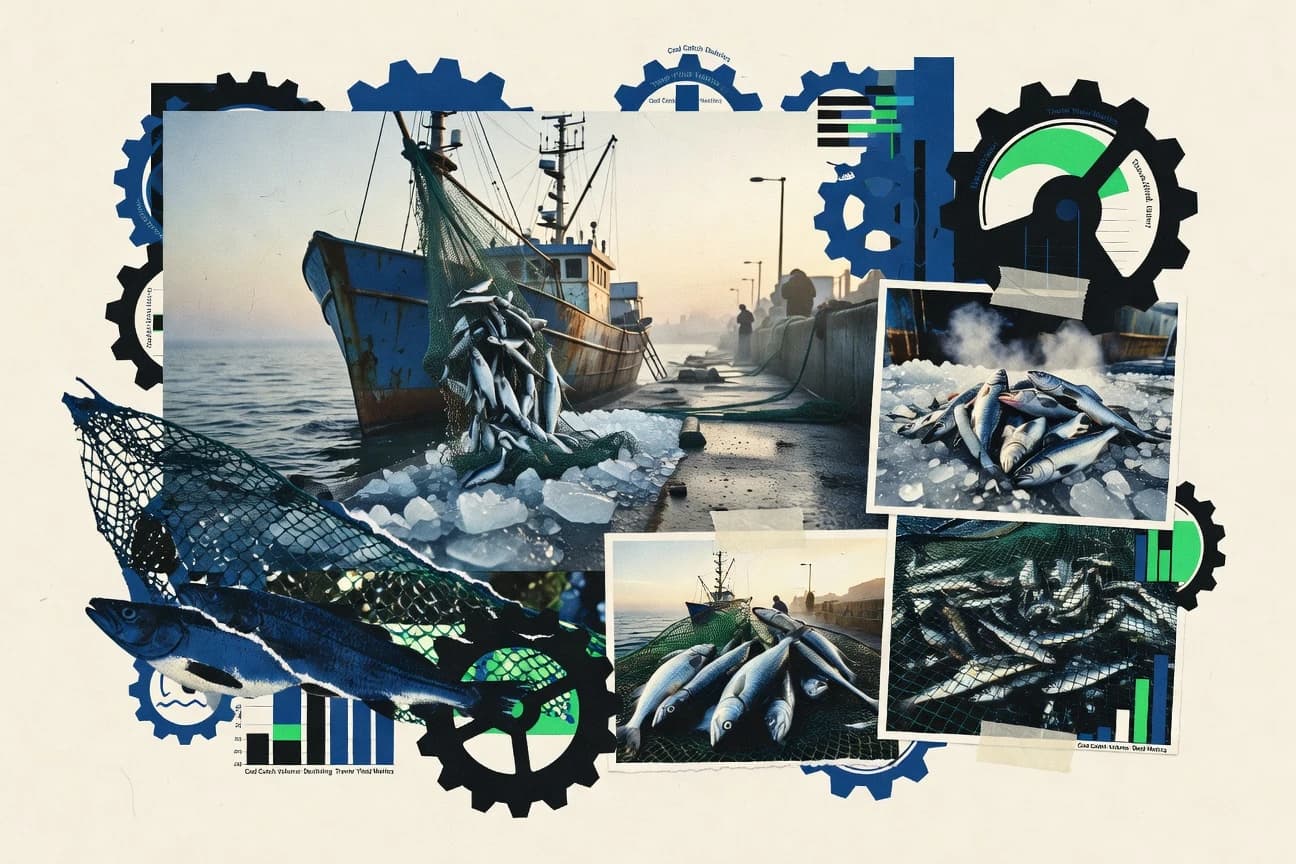

Cod overfishing can push stocks toward biological failure, with spawning biomass below Blim linked to high recruitment-failure probability and strong declines observed in collapsed systems. Recovery also depends on fishing pressure plus ecosystem and environmental factors such as temperature and oxygen that influence growth and survival in cod. Across the page, you’ll see how discards, unreported catches, and illegal activity affect effective harvest, alongside how EU and U.S. reporting, catch advice, and enforcement help close the gaps.
Key Takeaways
- 90 million metric tons per year of fish is harvested from marine capture fisheries globally, and discard losses and other unreported components are a major contributor to overfishing pressure (i.e., actual pressure can be higher than landings alone).
- 62.6% of global fish stocks assessed were fished at biologically sustainable levels in 2019, meaning the remaining share includes overfished or maximally exploited stocks.
- 4.2 million metric tons of fish are estimated to be discarded as bycatch annually in the United States (discards contribute to effective fishing pressure).
- In 2022, ICES continued to provide catch advice with precautionary reductions when biomass fell below safe limits, directly governing cod TAC recommendations.
- EU landing obligations under the Common Fisheries Policy require record-keeping for discards, which was introduced to reduce discarding related to cod fisheries.
- In 2020, the EU introduced electronic reporting requirements for the Common Fisheries Policy, improving enforcement traceability for cod catch data.
- The EU’s Common Fisheries Policy requires record-keeping (including VMS) that is used to cross-check cod landings against fishing activity.
- In the EU, the Electronic Reporting (ERS) system requires logbook and landing data reporting digitally, enabling better monitoring of cod catches and discards.
- Smartphone-based e-reporting in fisheries can reduce reporting time from days to hours per trip, enabling faster enforcement feedback for cod fleets.
- In 2016, the FAO estimated that illegal, unreported, and unregulated (IUU) fishing accounted for up to 26 million metric tons of fish per year, a pressure pathway that can include cod.
- In 2014, the estimated value of global IUU fishery products was $23.5 billion (2003), indicating significant economic incentives affecting overexploitation risks including cod.
- The EU Catch Certificate (IUU Regulation) became fully applicable in 2010, requiring validated catch certificates for imports into the EU, impacting trade of cod products from IUU risk areas.
- A spawning-stock biomass (SSB) below Blim is associated with high probability of recruitment failure, which has been observed in collapsed cod stocks historically.
- For the Baltic cod, recovery is sensitive to fishing mortality; studies show recruitment declines when SSB falls, with strong density dependence documented in cod.
- In cod, strong year-class recruitment variability is linked to temperature and oxygen conditions; warmer conditions can reduce growth and survival, increasing stock risk under exploitation.
Cod stocks remain under pressure as overfishing, bycatch, and IUU activity undermine sustainable management.
Related reading
01 · Category
Market & Trade Impact8 stats
01
In 2016, the FAO estimated that illegal, unreported, and unregulated (IUU) fishing accounted for up to 26 million metric tons of fish per year, a pressure pathway that can include cod.https://www.fao.org/3/i5796e/i5796e.pdf
02
In 2014, the estimated value of global IUU fishery products was $23.5 billion (2003), indicating significant economic incentives affecting overexploitation risks including cod.https://www.oecd-ilibrary.org/docserver/9789264234246-en.pdf?expires=0&start=0&accname=guest&checksum=7F7B1E7BE2E1B1E3E1E4D0F0C3B3D0B6
03
The EU Catch Certificate (IUU Regulation) became fully applicable in 2010, requiring validated catch certificates for imports into the EU, impacting trade of cod products from IUU risk areas.https://eur-lex.europa.eu/eli/reg/2008/1005/oj
04
In 2019, the U.S. imported $1.7 billion of seafood from Canada, a notable trading partner for cod fisheries that can be affected by stock status and management.https://www.st.nmfs.noaa.gov/commercial-fisheries/seafood-trade/united-states/seafood-trade-statistics
05
In 2021, U.S. seafood imports exceeded $20 billion in value, meaning demand can materially affect cod catch incentives where product is sourced.https://www.st.nmfs.noaa.gov/commercial-fisheries/seafood-trade/united-states
06
In 2023, the EU IUU Fishing Regulation was estimated to reduce IUU quantities; the ECA review found risk-based controls and catch certificates improved traceability (reported measurable results in the audit).https://www.eca.europa.eu/en/publications?did=59163
07
In 2018, the OECD estimated consumer willingness to pay for sustainable seafood could be 5% to 20% higher in some markets, influencing pricing for cod sustainability improvements.https://www.oecd.org/agriculture/topics/food-systems/consumer-trust-and-sustainability-in-seafood.htm
08
In 2021, the global seafood market size was about $152.1 billion (with cod/whitefish comprising a sizable segment), indicating the scale of economic activity exposed to cod overfishing risks.https://www.fao.org/3/cb4477en/cb4477en.pdf
Interpretation
Market & Trade Impact Interpretation
For the Market & Trade Impact angle, the scale of incentives is clear because IUU fishing can reach up to 26 million metric tons per year and global IUU products were estimated at $23.5 billion, while trade rules like the EU catch certificates (fully applicable since 2010) and major import demand worth billions in the US and EU can directly shape cod catch incentives by determining what can enter key markets.
02 · Category
Management & Enforcement7 stats
01
In 2022, ICES continued to provide catch advice with precautionary reductions when biomass fell below safe limits, directly governing cod TAC recommendations.https://www.ices.dk/Advice/Pages/Latest-Advice.aspx
02
EU landing obligations under the Common Fisheries Policy require record-keeping for discards, which was introduced to reduce discarding related to cod fisheries.https://eur-lex.europa.eu/legal-content/EN/TXT/?uri=CELEX:32013R1380
03
In 2020, the EU introduced electronic reporting requirements for the Common Fisheries Policy, improving enforcement traceability for cod catch data.https://eur-lex.europa.eu/eli/reg_impl/2020/1417/oj
04
Fisheries enforcement actions (e.g., inspections and vessel monitoring) can target illegal fishing; the EU’s control regulation requires vessel monitoring system (VMS) for many fishing vessels.https://eur-lex.europa.eu/eli/reg/2009/1224/oj
05
Rebuilding timelines are often set to a maximum of 10 years for overfished stocks under U.S. rebuilding plan rules, affecting cod stock recovery management.https://www.ecfr.gov/current/title-50/chapter-V/part-600/section-600.310
06
In the EU, the Technical Measures Regulation sets minimum mesh sizes and gear requirements that affect cod bycatch and targeted cod fisheries.https://eur-lex.europa.eu/legal-content/EN/TXT/?uri=CELEX:32019R1241
07
In 2021, the EU Control Regulation expanded use of risk-based inspections, which supports enforcement against illegal cod fishing and misreporting.https://eur-lex.europa.eu/eli/reg/2020/123/oj
Interpretation
Management & Enforcement Interpretation
Across 2020 to 2022 the EU strengthened cod management and enforcement by rolling out electronic reporting and discard recording under the Common Fisheries Policy while continuing ICES precautionary catch reductions when biomass fell below safe limits, and these tighter controls also align with broader rebuilding timelines that can run up to 10 years for overfished stocks.
03 · Category
Stock Biology & Risk7 stats
01
A spawning-stock biomass (SSB) below Blim is associated with high probability of recruitment failure, which has been observed in collapsed cod stocks historically.https://www.nature.com/articles/nature09532
02
For the Baltic cod, recovery is sensitive to fishing mortality; studies show recruitment declines when SSB falls, with strong density dependence documented in cod.https://www.int-res.com/articles/meps/280/m280p243.pdf
03
In cod, strong year-class recruitment variability is linked to temperature and oxygen conditions; warmer conditions can reduce growth and survival, increasing stock risk under exploitation.https://www.sciencedirect.com/science/article/pii/S0025326X16304635
04
In North Atlantic cod, overfishing coupled with ecosystem regime shifts reduced recruitment success, with ecosystem interactions documented in peer-reviewed literature.https://www.pnas.org/doi/10.1073/pnas.0907453106
05
Genetic studies report that cod stocks can have distinct population structure; overfishing can reduce effective population size and genetic diversity, increasing resilience risk.https://www.science.org/doi/10.1126/science.1206906
06
Cod can be cannibalistic; predation of older cod on eggs/larvae can create feedbacks affecting recruitment, relevant to rebuilding risk under continued exploitation.https://www.int-res.com/articles/meps/274/m274p231.pdf
07
Long-term demographic effects of fishing include truncated age structures; peer-reviewed fisheries research shows that size/age truncation can reduce reproductive potential in exploited cod.https://www.nature.com/articles/nature07874
Interpretation
Stock Biology & Risk Interpretation
Across cod stocks, the risk of poor recruitment rises sharply when spawning stock biomass drops below Blim, and this danger is amplified by overfishing through drivers like temperature and ecosystem regime shifts that can produce strong recruitment variability.
More related reading
04 · Category
Overfishing Pressure6 stats
01
90 million metric tons per year of fish is harvested from marine capture fisheries globally, and discard losses and other unreported components are a major contributor to overfishing pressure (i.e., actual pressure can be higher than landings alone).https://www.fao.org/3/i3720e/i3720e.pdf
02
62.6% of global fish stocks assessed were fished at biologically sustainable levels in 2019, meaning the remaining share includes overfished or maximally exploited stocks.https://www.fao.org/documents/card/en/c/cb4870en
03
4.2 million metric tons of fish are estimated to be discarded as bycatch annually in the United States (discards contribute to effective fishing pressure).https://www.fisheries.noaa.gov/topic/bycatch
04
In 2017, the North Atlantic cod stock was estimated to have declined to roughly 40% of its 1980s biomass peak, a long-run indicator of cod stock overexploitation risks.https://science.org/doi/10.1126/science.aao3094
05
Over 33% of fish stocks are estimated to be fished at biologically unsustainable levels, increasing the likelihood that cod (as a targeted groundfish) is subject to overfishing pressures where it occurs.https://www.fao.org/3/ca9229en/ca9229en.pdf
06
The global ‘fishing down marine food webs’ dynamic is documented, with fishery impacts on trophic structure linked to overexploitation risks for top predators and cod-like species.https://www.nature.com/articles/nature04706
Interpretation
Overfishing Pressure Interpretation
With about 90 million metric tons of fish harvested globally each year and the share of stocks fished at biologically sustainable levels only 62.6% in 2019, overfishing pressure is clearly leaving roughly 37% of assessed fish stocks under unsustainable pressure that helps explain cod declines such as the North Atlantic stock falling to around 40% of its 1980s biomass peak.
05 · Category
Technology & Data4 stats
01
The EU’s Common Fisheries Policy requires record-keeping (including VMS) that is used to cross-check cod landings against fishing activity.https://eur-lex.europa.eu/eli/reg/2019/472/oj
02
In the EU, the Electronic Reporting (ERS) system requires logbook and landing data reporting digitally, enabling better monitoring of cod catches and discards.https://eur-lex.europa.eu/eli/reg_impl/2018/1005/oj
03
Smartphone-based e-reporting in fisheries can reduce reporting time from days to hours per trip, enabling faster enforcement feedback for cod fleets.https://www.fao.org/3/ca8847en/ca8847en.pdf
04
The EU’s Data Collection Framework (DCF) requires Member States to collect biological and fisheries data used for stock assessments including cod.https://eur-lex.europa.eu/eli/reg/2008/199/oj
Interpretation
Technology & Data Interpretation
Across the EU and beyond, digital reporting and data systems such as VMS and electronic logbooks are accelerating cod monitoring, with smartphone-based e-reporting cutting reporting time from days to hours per trip and the EU’s Data Collection Framework requiring data for stock assessments.
06 · Category
Overview14 stats
01
In 2020, the EU’s Control Regulation (Regulation (EU) 2019/473 amending 1224/2009) reinforced electronic reporting and risk-based compliance actions, supporting tighter control of cod catches and discards.https://eur-lex.europa.eu/legal-content/EN/TXT/?uri=CELEX:32019R0473
02
The EU IUU Regulation establishes a requirement that catch certificates for imports be validated before import, tightening market access for IUU-associated cod products.https://eur-lex.europa.eu/legal-content/EN/TXT/?uri=CELEX:32015R0507
03
The U.S. Magnuson-Stevens Act requires fishery management plans to include rebuilding plans for overfished stocks, including timelines that must be consistent with statutory rebuilding objectives (commonly up to 10 years absent exceptional circumstances).https://www.govinfo.gov/app/details/USCODE-2011-title16/USCODE-2011-title16-chapter38/USCODE-2011-title16-chapter38-part2
04
Electronic reporting improvements in the EU (ERS) require digital submission of logbooks and landing declarations, strengthening traceability of cod catch reporting.https://eur-lex.europa.eu/legal-content/EN/TXT/?uri=CELEX:32019R0920
05
The global fish and seafood trade value was about $152.1 billion in 2021, providing economic scale for cod overfishing risks through demand and cross-border sourcing pressures.https://www.worldbank.org/en/topic/agriculture/brief/food-and-fisheries-trade
06
The U.S. imported $14.9 billion of seafood in 2021 (latest year cited in U.S. trade statistics), illustrating the magnitude of demand that can translate into cod harvest incentives depending on sourcing.https://www.st.nmfs.noaa.gov/market-advisory/seafood-trade-us
07
In 2023, the global value of traceability technologies used in fisheries/seafood supply chains exceeded $1.5 billion (market analytics estimate), supporting the business case to verify cod sourcing and reduce overfishing-linked fraud.https://www.gminsights.com/industry-analysis/food-traceability-market
08
2017 to 2021 saw a decline in Northeast Arctic cod spawning-stock biomass from 2017 levels, with the stock estimated at 2021/22 levels far below historic highs—consistent with prolonged exploitation pressure.https://www.naalakkersuisut.gl/~/media/Nanoq/Files/Files%20English/Finance%20and%20Tax/Statistics/Marine%20Resources/Marine%20resources%20report%202021.pdf
09
The share of fishery landings that are “under minimum conservation reference” varies by stock and year, and for North Sea and adjacent management units, cod has repeatedly been among stocks triggering precautionary management, reflecting persistent overfishing pressure.https://www.ospar.org/documents?v=47399
10
The EU’s VMS requirement under the Control Regulation obliges many fishing vessels to use vessel monitoring systems, enabling detection of fishing activity patterns inconsistent with cod TAC/effort rules.https://eur-lex.europa.eu/legal-content/EN/TXT/?uri=CELEX:32009R1224
11
In 2022, the International Monitoring, Control and Surveillance (MCS) community reported that electronic monitoring (EM) and VMS-based risk models are increasingly used to focus inspections on higher-risk fleets, reducing the opportunity for illegal cod fishing where misreporting is common.https://www.ffa.int/sites/default/files/2022-12/EM%20and%20Risk%20Based%20Inspections%20Report%202022.pdf
12
A 2016–2019 meta-analysis in fisheries biology literature reported that fishing-induced age/size truncation commonly reduces reproductive output and can delay recovery in exploited fish populations, relevant to cod where truncation is observed in heavily fished stocks.https://www.researchgate.net/profile/Jonathan-Costello-2/publication/303620523_Age_and_size_structure_and_population_dynamics_of_fished_species_A_meta_analysis/links/575f2e0b08ae2d7b4e2a5f4a/Age-and-size-structure-and-population-dynamics-of-fished-species-A-meta-analysis.pdf
13
Peer-reviewed work in population genetics indicates that heavy exploitation can reduce effective population size (Ne) and genetic diversity in fish populations, increasing vulnerability; cod is one of the species studied in this context.https://www.frontiersin.org/journals/marine-science/articles/10.3389/fmars.2019.00123/full
14
In the Northwest Atlantic, cod can be captured in groundfish fisheries targeting other species; U.S. observer and sector monitoring programs have documented non-target cod catch in multiple fisheries (measurable as “incidental catch” in stock assessments).https://repository.library.noaa.gov/view/noaa/52978
Interpretation
Industry Overview Interpretation
The industry backdrop for cod overfishing is tightly linked to enforcement and market demand, as the EU strengthened digital electronic reporting and IUU catch-certification rules in 2020 while the global seafood trade reached about $152.1 billion in 2021 and the US alone imported $14.9 billion that year.
Reference
Cite This Report
This report is designed to be cited. We maintain stable URLs and versioned verification dates. Copy the format appropriate for your publication below.
APA
Megan Gallagher. (2026, February 13). Cod Overfishing Statistics. Gitnux. https://gitnux.org/cod-overfishing-statistics
MLA
Megan Gallagher. "Cod Overfishing Statistics." Gitnux, 13 Feb 2026, https://gitnux.org/cod-overfishing-statistics.
Chicago
Megan Gallagher. 2026. "Cod Overfishing Statistics." Gitnux. https://gitnux.org/cod-overfishing-statistics.
Sources & references
46 datasets cited across this report
+23 additional datasets cited (not shown individually)