
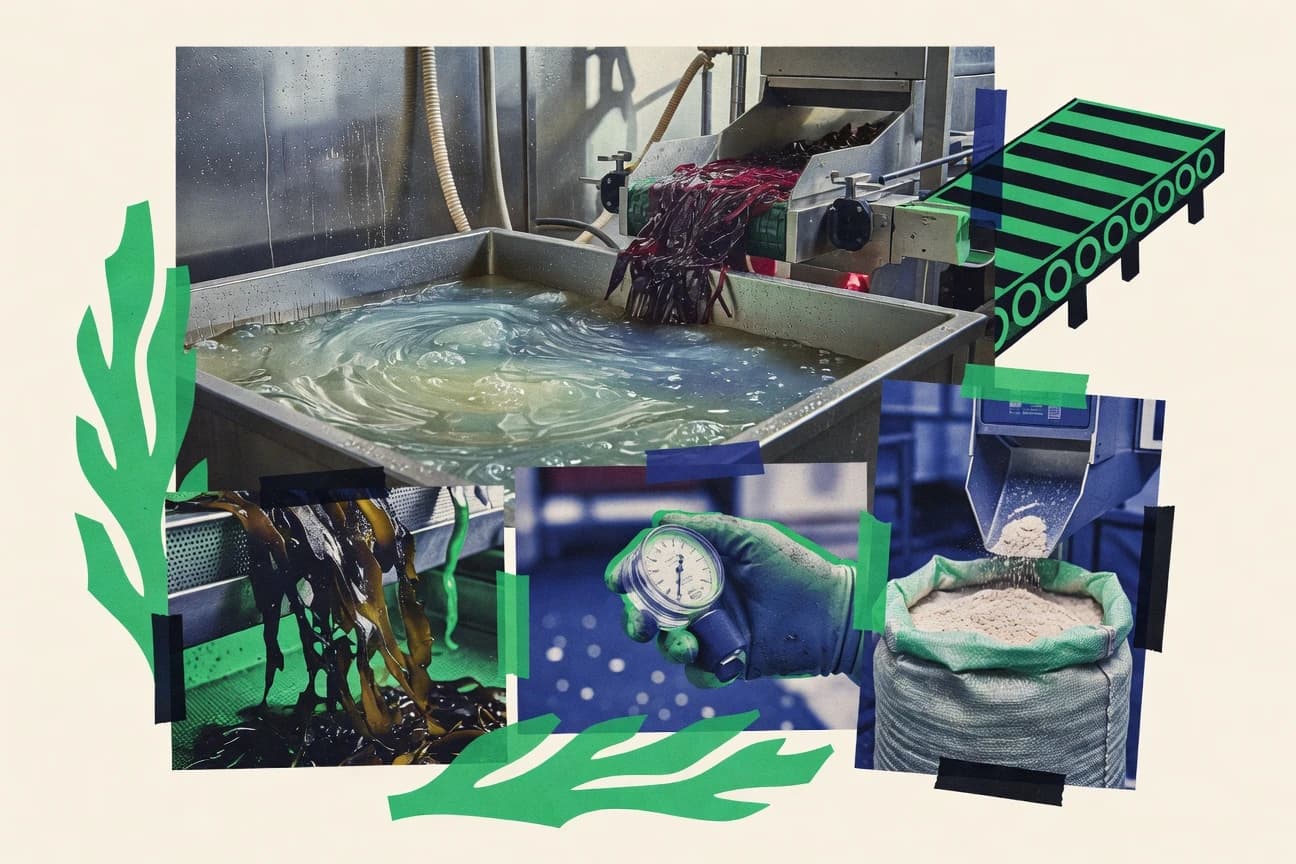

The global carrageenan market, valued at over $1 billion, consumes more than 21,000 tons annually just in desserts. Dairy applications alone used 28,000 tons in a recent year.
Key Takeaways
- Global carrageenan consumption in dairy products was 28,000 tons in 2022
- Global carrageenan market size was valued at USD 1.02 billion in 2022 and is projected to reach USD 1.48 billion by 2030, growing at a CAGR of 4.8% from 2023 to 2030
- Global carrageenan production capacity stood at 85,000 metric tons in 2022
- 75% of commercial ice creams contain carrageenan as stabilizer at 0.1-0.3% levels
- Global carrageenan exports totaled 62,000 metric tons in 2021, valued at USD 520 million
Carrageenan demand is steadily growing, highlighting its increasing importance across food, pharma, and other industries.
Related reading
01 · Category
Consumption and Applications20 stats
01
Global carrageenan consumption in dairy products was 28,000 tons in 2022
02
Meat and poultry products used 15% of total carrageenan supply in 2021, approximately 12,750 tons globally
03
Pharmaceutical grade carrageenan consumption grew to 5,200 tons in 2022, up 7% from prior year
04
Beverages segment consumed 9,500 tons of carrageenan in 2022 for stabilization
05
Pet food applications for carrageenan reached 3,800 tons globally in 2021
06
Cosmetics and personal care used 2,100 tons of carrageenan in 2022, primarily as thickeners
07
U.S. food industry carrageenan usage was 18,000 tons in 2021, 60% in desserts
08
Europe dessert market carrageenan demand projected at 10,500 tons by 2025
09
Air fresheners incorporated 850 tons of carrageenan in 2022 worldwide
10
Vegan food products saw 22% increase in carrageenan use, reaching 4,200 tons in 2022
11
Dessert segment consumed 25% of carrageenan, 21,000 tons in 2022
12
Bakery products used 8,500 tons carrageenan globally 2021 for texture
13
Oral care products incorporated 1,200 tons in 2022
14
Plant-based milk stabilizers: carrageenan at 11,000 tons demand 2023
15
Confectionery usage 4,500 tons in 2022
16
Household products like gels used 1,800 tons carrageenan 2021
17
Asia dairy consumption of carrageenan 16,200 tons in 2022
18
Infant formula carrageenan use restricted, <0.3% max, 500 tons global 2022
19
Medical applications like wound dressings 900 tons in 2022
20
Sauces and dressings 7,200 tons carrageenan 2022
Interpretation
Consumption and Applications Interpretation
From our dairy desserts to our pet food and even our air fresheners, humanity now seems to be held together, stabilized, and thickened by the humble carrageenan, one versatile seaweed extract at a time.
02 · Category
Market Statistics18 stats
01
Global carrageenan market size was valued at USD 1.02 billion in 2022 and is projected to reach USD 1.48 billion by 2030, growing at a CAGR of 4.8% from 2023 to 2030
02
The food and beverage segment accounted for 68% of the global carrageenan market revenue in 2022, driven by demand for stabilizers in dairy products
03
Asia Pacific held 42% share of the global carrageenan market in 2022, due to abundant seaweed resources in Indonesia and Philippines
04
Refined carrageenan segment dominated with 55% market share in 2022, preferred for its clarity in applications like beverages
05
Demand for lambda carrageenan grew by 5.2% annually from 2018-2022 in pharmaceutical applications
06
U.S. carrageenan imports reached 12,500 metric tons in 2021, primarily from Philippines
07
Europe carrageenan market is expected to grow at 5.1% CAGR through 2028, fueled by clean-label trends
08
Processed Eucheuma Seaweed (PES) carrageenan market valued at USD 450 million in 2023
09
Organic carrageenan segment projected to grow fastest at 6.3% CAGR from 2023-2030
10
Carrageenan price averaged USD 8.5 per kg in 2022 for food-grade refined type
11
Global carrageenan market projected to hit USD 1.12 billion by 2027 at 5.4% CAGR
12
Latin America carrageenan market share was 12% in 2022, led by Brazil production
13
Semi-refined carrageenan grew at 4.9% CAGR 2017-2022 due to cost advantages
14
Middle East & Africa market for carrageenan expected USD 95 million by 2028
15
Kappa carrageenan segment revenue USD 560 million in 2022
16
Iota carrageenan market size USD 280 million in 2023, growing for gel applications
17
Carrageenan spot price in Europe reached EUR 7.2/kg in Q4 2022
18
North America carrageenan demand 22,000 tons in 2022
Interpretation
Market Statistics Interpretation
The global carrageenan market is steadily thickening, with Asia Pacific holding the seaweed reigns and the dairy aisle driving the bulk of its billion-dollar growth, proving that consumers and industries alike are firmly gelled to this versatile extract.
03 · Category
Production Statistics20 stats
01
Global carrageenan production capacity stood at 85,000 metric tons in 2022
02
Philippines produced 45,000 metric tons of semi-refined carrageenan in 2021, representing 52% of global output
03
Indonesia's carrageenan seaweed farming area expanded to 250,000 hectares in 2022, yielding 1.2 million tons wet weight
04
Kappaphycus alvarezii accounted for 78% of carrageenan-producing seaweed farmed globally in 2021
05
China's carrageenan production reached 8,200 metric tons in 2020 from wild and cultured sources
06
Annual yield per hectare for Eucheuma cottonii seaweed is 2.5-3.5 tons dry weight, basis for carrageenan extraction
07
Vietnam exported 15,000 tons of carrageenan raw material in 2022, with production up 12% YoY
08
Tanzania's carrageenan production from cottonii seaweed hit 4,500 tons dry in 2021
09
Processing yield from dry seaweed to carrageenan is typically 30-40% for kappa types
10
Madagascar increased carrageenan seaweed production by 18% to 25,000 tons wet in 2022
11
Global seaweed for carrageenan production 1.8 million tons dry in 2022
12
Philippines Kappaphycus production 850,000 tons wet weight in 2021
13
Indonesia exported 450,000 tons dry seaweed for carrageenan in 2022
14
Eucheuma spinosum yield 2.8 tons/ha dry, used for iota carrageenan
15
Malaysia carrageenan production capacity 12,000 tons/year in 2022
16
Extraction efficiency for carrageenan from seaweed averages 35%
17
Kiribati produced 3,200 tons dry carrageenan seaweed in 2021
18
Solomon Islands expanded carrageenan farms to 1,500 ha, output 4,000 tons dry 2022
19
Biotechnology improved carrageenan yield by 15% in lab trials 2021
20
Global dry seaweed processing for carrageenan 120,000 tons in 2022
Interpretation
Production Statistics Interpretation
While the Philippines remains the undisputed champion of carrageenan, producing over half the world's supply from its seaweed farms, the industry's future is being written across a sprawling global map, from Indonesia's vast new hectares to Vietnam's rising exports and even Madagascar's growth, all racing to refine more gel from every ton of seaweed.
More related reading
04 · Category
Regulatory and Health20 stats
01
75% of commercial ice creams contain carrageenan as stabilizer at 0.1-0.3% levels
02
FDA GRAS status reaffirmed for carrageenan in 2018 with no ADI limit specified
03
EU Regulation 231/2012 sets purity criteria for E407 carrageenan, max 2% acid-insoluble ash
04
JECFA established ADI "not specified" for carrageenan in 2003
05
California Prop 65 lists degraded carrageenan (poligeenan) but not native form
06
Over 90% of carrageenan safety studies (n=185) show no toxicity up to 5% dietary levels
07
EFSA re-evaluated carrageenan E407 in 2018, concluding safe at mean intake 75 mg/kg bw/day
08
WHO intake estimate for carrageenan is 20-40 mg/kg bw/day in high consumers
09
Brazil ANVISA approved carrageenan quantum satis in foods except infants under 12 months
10
2016 NCCAM review found no evidence linking carrageenan to IBD in humans
11
Canada banned carrageenan in infant formula in 2020 per Health Canada
12
Over 50 human studies show no gastrointestinal effects from carrageenan at food levels
13
NOAEL for carrageenan 5000 mg/kg bw/day in 2-year rodent study
14
Australia FSANZ permits carrageenan GMP in most foods
15
Degraded carrageenan not permitted in food, purity test required >80% sulfate ester
16
Japan allows carrageenan up to 2% in noodles
17
Meta-analysis 2017: no association carrageenan and colorectal cancer in humans
18
Codex Stan 192-1995 lists carrageenan as additive 407, quantum satis
19
South Korea MFDS reaffirmed safety 2021, intake <200 mg/kg bw/day safe
20
New Zealand MPI approves carrageenan for 150+ food categories
Interpretation
Regulatory and Health Interpretation
Despite the internet’s culinary courtroom drama, carrageenan stands as the world’s most judiciously scrutinized dessert deputy, legally cleared for duty everywhere from ice cream tubs to international tables.
05 · Category
Trade and Export17 stats
01
Global carrageenan exports totaled 62,000 metric tons in 2021, valued at USD 520 million
02
Philippines exported 32,500 tons of carrageenan in 2022, 85% to USA and Europe
03
China imported 18,200 tons of carrageenan raw materials in 2021, mainly from Indonesia
04
Denmark re-exported 9,800 tons of refined carrageenan in 2022, leading EU hub
05
U.S. imported USD 120 million worth of carrageenan in 2021 from top suppliers Philippines (45%)
06
India’s carrageenan imports rose 15% to 5,600 tons in 2022 for food processing
07
South Korea exported 2,100 tons of carrageenan products in 2021, valued at USD 18 million
08
World carrageenan trade volume grew 4.2% YoY in 2022 to 65,400 tons
09
France imported 4,200 tons for cosmetics industry in 2021
10
Indonesia exported USD 250 million carrageenan in 2022
11
Thailand carrageenan trade volume 3,500 tons export 2021
12
Germany imported 6,100 tons carrageenan 2022 for processing
13
Spain carrageenan exports 2,800 tons 2021
14
Mexico imported 2,400 tons from Philippines 2022
15
Singapore re-export hub handled 4,500 tons carrageenan 2022
16
Russia carrageenan imports 1,900 tons 2021 despite sanctions
17
Top 10 exporters control 92% of carrageenan trade volume 2022
Interpretation
Trade and Export Interpretation
While the Philippines reigns as the king of carrageenan production, supplying nearly half of America's ice cream and toothpaste needs, the global trade of this humble seaweed extract reveals a complex web where China buys the raw materials, Denmark refines its image, and a small club of ten nations controls the entire, gelatinous supply chain.
Reference
Cite This Report
This report is designed to be cited. We maintain stable URLs and versioned verification dates. Copy the format appropriate for your publication below.
APA
Margot Villeneuve. (2026, February 13). Carrageenan Industry Statistics. Gitnux. https://gitnux.org/carrageenan-industry-statistics
MLA
Margot Villeneuve. "Carrageenan Industry Statistics." Gitnux, 13 Feb 2026, https://gitnux.org/carrageenan-industry-statistics.
Chicago
Margot Villeneuve. 2026. "Carrageenan Industry Statistics." Gitnux. https://gitnux.org/carrageenan-industry-statistics.
Sources & references
82 datasets cited across this report