
GITNUXSOFTWARE ADVICE
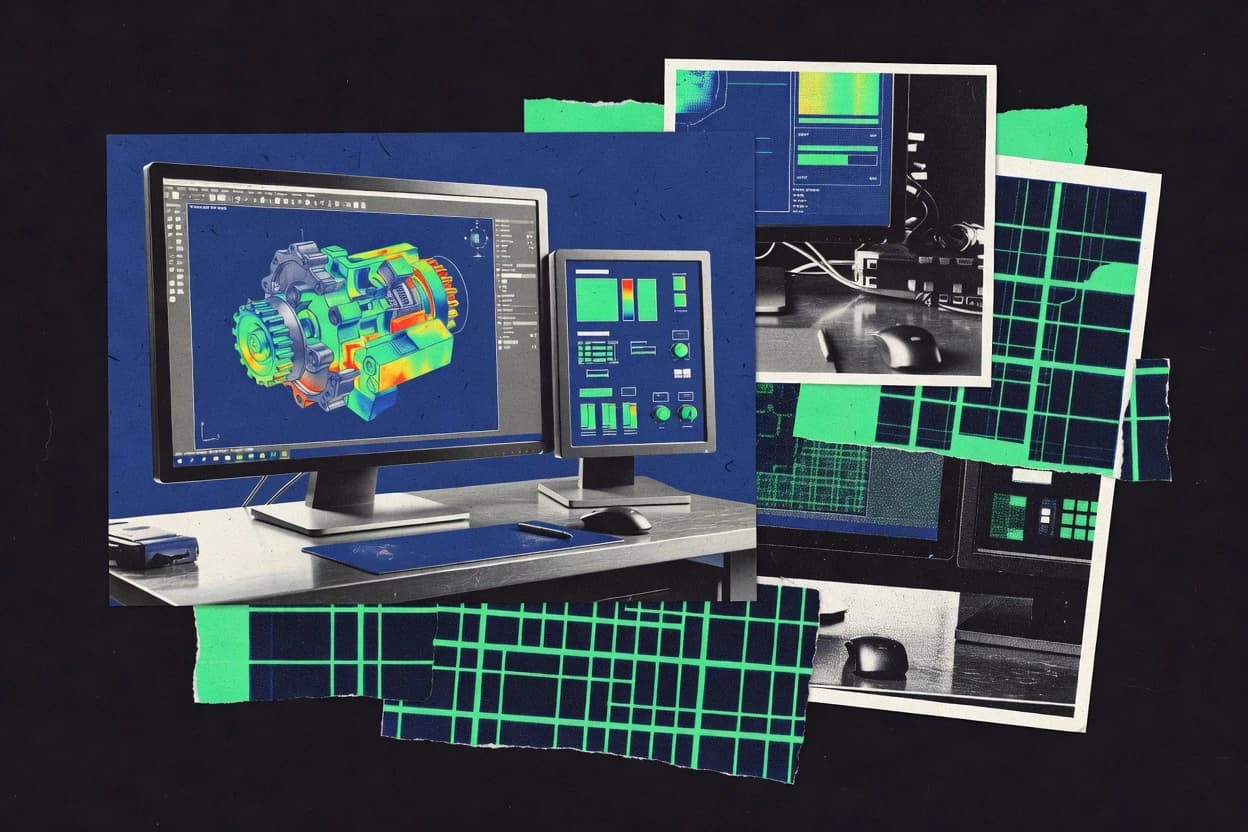
Manufacturing EngineeringTop 10 Best Simulation Cad Software of 2026
Ranking the top simulation cad software for engineering teams, comparing Siemens Simcenter 3D, SIMULIA, Altair Inspire, plus Autodesk Fusion 360.

How we ranked these tools
Core product claims cross-referenced against official documentation, changelogs, and independent technical reviews.
Analyzed video reviews and hundreds of written evaluations to capture real-world user experiences with each tool.
AI persona simulations modeled how different user types would experience each tool across common use cases and workflows.
Final rankings reviewed and approved by our editorial team with authority to override AI-generated scores based on domain expertise.
Score: Features 40% · Ease 30% · Value 30%
Gitnux may earn a commission through links on this page — this does not influence rankings. Editorial policy
Autodesk Fusion 360 is the best pick for engineers iterating CAD changes who want quick, associative mechanical FEA-style runs in one place, whereas Siemens Simcenter fits teams needing repeatable, portfolio-level CAD to CAE updates across assembly variants.
Editor’s top 3 picks
Three quick recommendations before you dive into the full comparison below — each one leads on a different dimension.
Autodesk Fusion 360
Study regeneration tied to parametric design history keeps results aligned with dimension changes.
Built for fits when engineers iterate CAD changes and need quick, associative mechanical FEA runs..
Siemens Simcenter
Editor pickSimcenter 3D maintains associativity so analysis definitions follow CAD changes without full rebuild.
Built for fits when engineering teams need repeatable CAD-CAE updates across assembly variants..
COMSOL Multiphysics
Editor pickLive parameterization and study control for coupled multiphysics workflows driven through the COMSOL API.
Built for fits when engineering teams need repeatable multiphysics studies with API-driven automation and CAD import..
Comparison Table
Autodesk Fusion 360
SMBCloud-based CAD, CAM, and CAE platform with integrated simulation for stress, thermal, and fluid studies.
Study regeneration tied to parametric design history keeps results aligned with dimension changes.
Fusion 360 integrates CAD and simulation in a single modeling session, which reduces handoffs when assembly mating constraints and contact definitions must track geometry edits. The environment includes meshing tools for shell and solid discretizations and provides boundary condition and load templates that can be reused across similar parts. The setup process supports model parameters so the same study can be regenerated as dimensions change in the parametric CAD model.
A key tradeoff is that Fusion 360’s simulation breadth and advanced solver control lag behind dedicated simulation platforms, especially for highly specialized nonlinear contact modeling and complex coupled multiphysics workflows. Fusion 360 fits teams that run frequent iteration loops on mechanical parts and subassemblies, where turnaround time and associative rework matter more than deep solver feature coverage.
Fusion 360 is also a reasonable selection for mixed documentation needs because it keeps the geometry, study inputs, and results tied to the same design history, which helps when reviewing changes across revisions.
- +Associative simulation setup regenerates after parametric geometry edits
- +Modal, buckling, and linear static studies cover common mechanical checks
- +In-editor meshing and boundary condition assignment reduce model handoffs
- +Reusable study parameters support repeatable analysis across design variants
- –Advanced solver controls are limited versus dedicated FEA suites
- –Highly complex nonlinear contact and coupled problems can require workaround modeling
- –Assembly-scale studies may hit performance limits on dense meshes
Mechanical design engineers
Validate bracket stiffness after design tweaks
Fewer rework cycles
Product design teams
Compare buckling sensitivity across variants
Faster variant screening
Show 1 more scenario
Prototype and test support
Investigate failure modes using nonlinear studies
Tighter correlation to tests
Update loads and restraints against the latest CAD to test modeling hypotheses quickly.
Best for: Fits when engineers iterate CAD changes and need quick, associative mechanical FEA runs.
Siemens Simcenter
enterprisePortfolio of CAE tools for structural, acoustic, thermal, and fluids simulation integrated with Siemens PLM.
Simcenter 3D maintains associativity so analysis definitions follow CAD changes without full rebuild.
Simcenter supports simulation-driven CAD changes through Simcenter 3D, with assemblies kept consistent for analysis reuse instead of manual rework. Engineering teams can manage study configurations across variants, then propagate geometry and boundary condition updates through the model build sequence. The suite also targets multiphysics workflows where coupled setup, shared regions, and consistent meshing choices reduce the risk of mismatched physical assumptions.
A tradeoff appears in the learning curve around simulation-ready model conventions and the way model updates propagate through the workflow. Simcenter fits best when engineering teams already standardize on CAD assembly structure and want high-throughput iteration across design options using repeatable study templates.
- +Strong bidirectional CAD to CAE workflow via Simcenter 3D associativity
- +Study management supports repeatable parametric iterations across assemblies
- +Good coverage for contact-heavy assembly analysis workflows
- +Integrated multiphysics setup reduces cross-tool setup drift
- –Simulation model conventions require training for reliable update propagation
- –Workflow performance can degrade on very large assemblies without tuning
- –CFD workflows depend on consistent mesh strategy to avoid remeshing churn
- –Advanced setup often requires disciplined templates and clear modeling standards
Mechanical design engineering teams
Iterate assembly FEA during redesign
Faster study reruns with fewer errors
Multiphysics simulation groups
Coupled thermal and structural studies
More consistent coupled results
Show 2 more scenarios
Product engineering programs
Variant management across configurations
Higher throughput design evaluation
Study templates standardize meshing choices and boundary condition logic across variants.
Validation and stress teams
Contact-heavy durability checks
More credible stress predictions
Contact workflows support complex interaction modeling for realistic load paths.
Best for: Fits when engineering teams need repeatable CAD-CAE updates across assembly variants.
COMSOL Multiphysics
vertical specialistPhysics-based simulation platform for coupled multiphysics modeling with CAD import support.
Live parameterization and study control for coupled multiphysics workflows driven through the COMSOL API.
COMSOL Multiphysics pairs geometry import and parametric edits with physics interfaces that share meshes across coupled physics. It handles common engineering study types such as transient analysis, modal frequency extraction, and buckling load factor estimation with nonlinear material behavior. Automation is supported through a parameter-driven model tree and an API for programmatic model setup, solve runs, and result extraction. This combination fits teams that need bidirectional CAD-CAE coordination without moving between separate authoring and scripting tools.
A practical tradeoff is that COMSOL models can become heavy when workflows mix detailed CAD, fine tetrahedral or hexahedral meshing, and multiple coupled solvers. A common usage situation is generating variants from one parameterized geometry, then reusing the same physics definitions while tuning remeshing and solver convergence criteria per revision.
- +Multiphysics couplings use shared meshes across physics interfaces
- +API enables parameterized study generation and batch solving
- +Nonlinear transient workflows with configurable solver controls
- +STEP and IGES geometry import feeds parametric remeshing
- –Large coupled models can slow meshing and nonlinear solves
- –Some advanced CAD-assembly workflows need more manual alignment work
R&D engineering teams
Coupled transient thermal-fluid simulations
Stable convergence across variants
Product reliability analysts
Buckling and modal characterization
Actionable stiffness risk signals
Show 1 more scenario
Simulation platform engineers
Batch study orchestration via API
Reduced manual rerun time
Generate and solve parameter sets programmatically while extracting results for pipelines.
Best for: Fits when engineering teams need repeatable multiphysics studies with API-driven automation and CAD import.
PTC Creo
enterpriseParametric 3D CAD software with built-in structural, thermal, and vibration simulation extensions.
Creo’s design-to-simulation associativity preserves simulation definitions through parametric model updates.
PTC Creo’s simulation workflow keeps analysis artifacts linked to the parametric assembly structure, so model edits can propagate into the next run with less redefinition.
The integrated authoring experience favors structural study patterns such as modal frequency and buckling load factor, where loads and constraints map cleanly onto CAD features.
- +Associative design-to-simulation links keep loads tied to geometry changes
- +Assembly-aware setup reduces rework when mating constraints and subcomponents shift
- +Integrated simulation workflow minimizes STEP and IGES round trips for geometry edits
- +Works well for typical structural studies like modal and buckling on assembly models
- –Contact setup and nonlinear study authoring often needs careful meshing discipline
- –CFD workflows can require external solver coupling and stronger remeshing control than CAD-first teams expect
- –Advanced multiphysics setups tend to depend on additional engines or add-ons
- –Large assemblies can slow remesh and regeneration when simulation-ready geometry is not simplified
Best for: Fits when Creo-centric teams need associative structural analysis from assemblies with fewer translation steps.
Onshape
SMBCloud-native CAD platform with integrated structural simulation for parts and assemblies.
Real-time collaboration on the same parametric model reduces version mismatch when iterating assembly geometry for external FEA handoff.
Onshape turns parametric CAD authoring into a shared workflow where geometry and study setup can stay coupled across teams. For simulation CAD work, it supports round-trip style handoff by exporting STEP and other common CAD formats from linked assemblies built with assembly mating constraints and feature history.
Its collaboration model reduces version drift by keeping edits and references inside one model workspace before exporting to an external FEA solver. Simulation readiness depends on clean export geometry and disciplined setup of loads and contacts once the model leaves the CAD environment.
- +Parametric feature history keeps FEA-ready geometry updates linked to design intent
- +Browser-first collaboration reduces merge conflicts on assembly edits
- +Assembly mating constraints help preserve mates during iterative revisions
- +Exports CAD geometry consistently for external FEA and CFD pipelines
- –FEA tooling is not a native solver workflow inside Onshape
- –Mesh generation and boundary-condition definition happen outside the CAD model
- –STEP import clean-up can require manual repair for complex feature trees
- –Contact-ready geometry often needs extra simplification before export
Best for: Fits when engineering teams need collaborative parametric CAD and controlled iteration into external FEA or CFD tools.
FreeCAD
open-sourceOpen-source parametric 3D CAD modeler with a built-in FEM workbench powered by CalculiX.
Parametric assemblies keep geometry changes consistent across analysis study iterations through a feature-driven model tree.
FreeCAD is a parametric CAD tool that can serve as a simulation CAD entry point when teams want an open, model-first workflow. Its core value comes from a parametric feature tree, assembly modeling with constraints, and STEP import to bring CAD geometry into analysis-oriented preparation.
Simulation usage is mostly driven by built-in analysis add-ons and the ability to export meshes and geometry in formats commonly used in downstream solvers. For engineering teams, FreeCAD works best when simulation steps prioritize repeatable geometry edits and controlled model variations rather than a full end-to-end FEA or CFD stack.
- +Parametric feature tree supports repeatable geometry edits for study variations
- +Assembly modeling with mating constraints helps maintain consistent component relationships
- +STEP import helps keep simulation-ready solids aligned with engineering source geometry
- +Extensible module system supports adding analysis workflows through add-ons
- –Simulation depth depends heavily on add-on coverage and feature maturity
- –FEA preparation and solver automation are not as integrated as simulation-focused suites
- –Mesh workflow can require manual tuning to achieve stable results
- –Large assemblies can slow down when recomputing parametric changes
Best for: Fits when engineering teams need editable parametric geometry feeding downstream FEA or CFD, not a full solver suite.
OpenFOAM
open-sourceOpen-source CFD toolbox for solving complex fluid dynamics and heat transfer problems.
Runtime-selectable solvers and models driven by OpenFOAM case dictionaries for configurable numerics per case.
OpenFOAM differentiates from CAD-centric simulation CAD tools by delivering a full open-source CFD and multiphysics solver framework driven by case dictionaries and text-based configuration. The core workflow covers geometry import for meshing, boundary condition specification, iterative solution controls, and post-processing hooks for field data analysis.
Integration typically happens through file-based interchange and standard mesh formats rather than a parametric CAD feature history. For engineering teams needing control over numerics, customization, and extensibility, OpenFOAM supports solver extensions and runtime selection patterns.
- +Text-based case dictionaries give deterministic control over solver settings and runtime options
- +Solver extension and custom model compilation support deep numerics and physics customization
- +Standard mesh-driven workflows align with tetrahedral and hexahedral meshing pipelines
- +Extensible boundary condition mechanisms support specialized contact, turbulence, and source terms
- –Case setup and debugging demand strong understanding of discretization, stability, and convergence
- –CAD-to-analysis associations are limited compared with parametric CAx bidirectional workflows
- –Large runs often need manual performance tuning for decomposition and IO patterns
- –Automation and API surface depend heavily on external scripts and ecosystem tooling
Best for: Fits when teams need customizable CFD or multiphysics control and accept script-driven case management.
Cadence Design Systems
vertical specialistElectronic design automation with SPICE, electromagnetic, and thermal simulation engines.
Associative engineering data exchange between CAD and analysis setup helps propagate design changes into simulation definitions with less manual rebuild.
Cadence Design Systems brings simulation CAD-CAE integration through a portfolio that connects geometry, meshing workflows, and solver-grade setup under one governance model. The company’s strength is automation around associative engineering data exchange, with configuration and batch execution options that fit multi-team engineering groups.
Cadence also supports multidisciplinary workflows that span structural, acoustic, and fluid domains by routing boundary conditions and interface definitions across tools. For engineering teams using parametric CAD sources and assembly-level constraints, Cadence emphasizes repeatability from model build to simulation run orchestration.
- +Automation and batch execution support scale repeated simulation runs
- +Associative engineering data exchange reduces manual rework after CAD updates
- +Multidomain workflow routing helps coordinate coupled analysis inputs
- +Governance tooling supports controlled configuration across teams
- –Workflow depth can require more setup time than single-tool mesh-and-solve stacks
- –Some solver workflows depend on licensed add-on components for full coverage
- –End-to-end assembly constraints need careful interface definition to avoid setup errors
- –Model repair and format translation can add friction for irregular imported geometry
Best for: Fits when engineering teams need controlled, automated CAD-CAE handoff and multidisciplinary workflow orchestration across groups.
Synopsys
vertical specialistSilicon design and verification platform with TCAD, optical, and thermal simulation capabilities.
Tightly integrated study orchestration for automated parameter runs with traceable inputs and outputs.
Synopsys covers geometry-to-results simulation workflows with preprocessing tools, solver execution, and analysis tooling within a single CAE flow. The core focus is repeatable engineering runs through automation features for parameter studies and job management. This emphasis affects how teams manage iterations, since model changes can be re-run with the same study structure.
The software supports nonlinear configuration work where contact definitions, material behaviors, and boundary conditions must stay consistent across iterations. It also provides multiphysics-capable configuration paths for coupled analyses where shared geometry and interfaces matter. For teams integrating CAD-CAE links, the emphasis is on maintaining attribute continuity through the workflow.
Usability is strongest when simulation setups follow a consistent pattern that can be automated. New users often spend time mapping workflow concepts to solver requirements, especially when assembling complex contact and nonlinear material definitions.
- +Automation supports parameter sweeps and repeatable solver job orchestration
- +Contact and nonlinear setup tools help reduce manual rework across runs
- +Scripting and extensibility support customized preprocessing and studies
- +Multiphysics workflow support fits coupled analyses with shared models
- –UI complexity increases for teams that only need basic linear static runs
- –Large-model performance depends on disciplined mesh and contact configuration
Best for: Fits when engineering teams run repeated nonlinear and coupled studies that need controlled automation.
nTop
mid-marketImplicit modeling and simulation platform for advanced manufacturing and generative design.
Topology optimization that generates solver-ready design geometry with constraint-driven material layouts.
nTop is a simulation CAD workflow tool focused on topology optimization and lattice-ready design iteration, which makes it different from general-purpose CAD-only authoring. It supports an optimization-to-geometry loop that outputs manufacturing-aware geometry rather than just scalar analysis results.
Core capabilities include parametric control over design domains, constraints, and objectives, plus post-processing for stresses and modes where nTop is used as an upstream design engine. For teams that need tight iteration between design changes and analysis-ready shape output, nTop fits better than tools that separate optimization and CAD rework.
- +Optimization-to-geometry workflow reduces redraw time after each design iteration
- +Topology optimization controls let teams vary material layouts with explicit constraints
- +Geometry output is designed for downstream meshing and solver workflows
- +Lattice-aware generation supports lightweighting studies without manual remodeling
- –Associative CAD links to external assemblies are limited compared with CAD-first ecosystems
- –Complex import and cleanup for legacy STEP and mesh-heavy geometries can require manual repair
- –Automation via API and headless runs is thinner than in engineering ecosystems built around CAE pipelines
- –Advanced multiphysics setup depends on exporting shapes into separate solvers
Best for: Fits when engineering teams run iterative topology optimization and need analysis-ready geometry handoff.
Conclusion
After evaluating 10 manufacturing engineering, Autodesk Fusion 360 stands out as our overall top pick — it scored highest across our combined criteria of features, ease of use, and value, which is why it sits at #1 in the rankings above.
Use the comparison table and detailed reviews above to validate the fit against your own requirements before committing to a tool.
How to Choose the Right simulation cad software
Simulation CAD software connects engineering geometry edits to repeatable analysis setup, so changes in a parametric model propagate into study definitions without manual rebuild work. This guide covers Autodesk Fusion 360, Siemens Simcenter 3D, SIMULIA, and Altair Inspire alongside COMSOL Multiphysics, PTC Creo, Onshape, FreeCAD, OpenFOAM, Cadence Design Systems, Synopsys, and nTop.
The evaluation emphasizes how each platform handles associativity between CAD and CAE, how automation and API surface support parameterized runs, and how governance controls like audit trails and provisioning shape multi-user workflows. Those themes show up in Fusion 360’s study regeneration tied to design history and in Simcenter 3D’s associativity that maintains analysis definitions across assembly variants.
Simulation CAD software for CAD-CAE associativity, study automation, and analysis-ready iteration
Simulation CAD software packages CAD modeling and simulation orchestration so engineering teams can define loads, contacts, and study cases while preserving links to evolving geometry. Autodesk Fusion 360 pairs parametric design history with associative simulation setup so modal, buckling, and linear static studies regenerate after dimension edits.
Siemens Simcenter 3D focuses on repeatable CAD-CAE updates for assembly variants by maintaining associativity through Simcenter 3D, so analysis definitions follow CAD changes without full rebuild. COMSOL Multiphysics complements this with API-driven automation for parameterized multiphysics study generation and batch solving, using shared meshes across physics couplings when workflows support it.
CAD to CAE associativity and automation controls that drive rework-free iterations
Associativity decides whether simulation setup stays linked to geometry edits, which determines whether teams can regenerate study definitions after parametric changes instead of rebuilding loads, contacts, and boundary conditions. Autodesk Fusion 360’s study regeneration tied to parametric design history keeps modal, buckling, and linear static studies aligned when dimensions change.
Automation and API surface decide whether engineering teams can generate and run parameterized studies at scale instead of clicking the same study setup across variants. COMSOL Multiphysics uses the COMSOL API for coupled multiphysics study generation and batch solving, while Synopsys focuses on study orchestration for automated parameter runs with traceable inputs and outputs.
Associative study regeneration across parametric geometry edits
Autodesk Fusion 360 regenerates simulation setup after parametric geometry edits so study definitions stay aligned with dimension changes. Siemens Simcenter 3D maintains associativity through Simcenter 3D so analysis definitions follow CAD changes across assembly variants.
Assembly-aware workflow for repeatable CAD-CAE updates
Siemens Simcenter 3D’s study management supports repeatable parametric iterations across assemblies. PTC Creo preserves design-to-simulation associativity so load and contact definitions remain tied to geometry changes when assembly components shift.
API-driven parameterization for batch multiphysics runs
COMSOL Multiphysics exposes the COMSOL API to drive live parameterization and study control for coupled multiphysics workflows. OpenFOAM uses runtime-selectable solvers and models driven by text-based case dictionaries, which makes many numerics changes deterministic per case.
Deterministic study orchestration with traceable inputs and outputs
Synopsys provides tightly integrated study orchestration for automated parameter runs with controlled job execution. Cadence Design Systems supports associative engineering data exchange so CAD-CAE handoff propagates design changes into analysis setup with less manual rebuild.
Collaboration-grade parametric modeling feeding analysis handoff
Onshape provides real-time collaboration on the same parametric model, which reduces version mismatch during assembly geometry iteration for external FEA or CFD handoff. FreeCAD’s parametric assemblies keep geometry changes consistent across study iterations through a feature-driven model tree, which helps when analysis preparation depends on editable geometry.
Choose based on how CAD changes must propagate into analysis runs, not by solver coverage alone
The main decision axis is whether the workflow is driven from inside the CAD-CAE package or from external solvers, because that determines how much associativity and automation teams can rely on for repeated iterations. Fusion 360 and Simcenter 3D emphasize associativity that follows CAD edits, while OpenFOAM pushes numerics control into case dictionaries and scripting-style case management.
A second axis is whether the team needs API and batch control for parameter sweeps or needs interactive orchestration for repeatable nonlinear and coupled studies. COMSOL Multiphysics pairs API-driven parameterized study generation with shared mesh usage across coupled physics, while Synopsys focuses on automated parameter runs with traceable inputs and outputs.
Start from CAD-change frequency and require regeneration without rebuild work
If the engineering team frequently changes dimensions and expects study definitions to regenerate automatically, Autodesk Fusion 360 ties simulation setup to parametric design history regeneration. If the CAD-CAE updates must remain consistent across assembly variants and repeated parametric iterations, Siemens Simcenter 3D maintains associativity so analysis definitions follow CAD changes.
If the work is multiphysics and parameterized, pick the platform with the most automation hooks
COMSOL Multiphysics fits teams that need API-driven parameterized study generation and batch solving for coupled multiphysics workflows. Synopsys fits teams running repeated nonlinear and coupled studies that need automated parameter sweeps with traceable inputs and outputs rather than manual run-by-run control.
Choose CAD-first versus case-dictionary control based on who owns solver numerics
Select PTC Creo or Creo-centric workflows when associative design-to-simulation links must preserve loads through assembly mating constraint shifts and subcomponent changes. Select OpenFOAM when solver configuration is expected to be driven per case through text dictionaries with runtime-selectable solvers and model options.
Decide whether the CAD system is the collaboration hub or a handoff bridge
Choose Onshape when real-time collaboration on a single parametric model is the mechanism to reduce version mismatch before external analysis. Choose Cadence Design Systems when CAD-CAE data exchange and analysis setup propagation between groups must be controlled through associative engineering data exchange.
Use the topology optimization tool only when design geometry must be generated for downstream analysis
Choose nTop when topology optimization generates solver-ready design geometry with explicit constraint-driven material layouts that feed analysis-ready handoff. Choose specialized CAD-CAE associativity tools like Simcenter 3D or Fusion 360 when the core requirement is keeping simulation definitions aligned with CAD edits rather than generating new geometry layouts.
Who should buy simulation CAD software based on workflow ownership and iteration style
Simulation CAD software fits teams that want simulation setup to stay linked to evolving geometry so repeated study runs do not require rebuilding model definitions. It also fits teams that need automation for parameter sweeps, either through an API or through integrated study orchestration.
Different platforms align with different workflow ownership styles, where Fusion 360 and Simcenter 3D focus on associative update propagation, COMSOL Multiphysics focuses on API-driven coupled multiphysics control, and OpenFOAM focuses on case dictionaries that control solver numerics per run.
Mechanical teams iterating parametric designs inside a single workflow
Autodesk Fusion 360 supports associative simulation setup regeneration tied to parametric design history for modal, buckling, and linear static studies. This matches workflows where geometry edits happen frequently and study definitions must track those edits.
Engineering teams managing many assembly variants with repeatable CAD-CAE updates
Siemens Simcenter 3D maintains associativity through Simcenter 3D so analysis definitions follow CAD changes without a full rebuild. It also includes study management that supports repeatable parametric iterations across assemblies.
Multiphysics teams building automated, parameterized study pipelines
COMSOL Multiphysics uses the COMSOL API to generate parameterized studies and run batch solves for coupled physics. This matches teams that script or automate multiphysics configuration rather than repeating manual setup.
CFD teams that expect solver configuration to be managed per case
OpenFOAM provides runtime-selectable solvers and models driven by case dictionaries, which supports deterministic solver numerics per case. This matches organizations comfortable with script-driven case management and solver configuration debugging.
Teams running repeated nonlinear and coupled studies that need orchestration and traceability
Synopsys provides integrated study orchestration for automated parameter runs with traceable inputs and outputs. This fits teams that prioritize controlled automation of complex run sequences over single-study interactive setup.
Common pitfalls in CAD-CAE workflows that cause rework, drift, or slow iterations
A frequent failure mode is assuming simulation setup updates automatically, then discovering that update propagation depends on workflow conventions and model structure discipline. Siemens Simcenter 3D requires training on simulation model conventions for reliable update propagation, and failing that discipline leads to analysis definitions that do not match the latest CAD.
Another common failure mode is underestimating configuration complexity for advanced problems and multiphysics coupling, which can slow meshing and nonlinear solves. COMSOL Multiphysics can slow meshing and nonlinear solves for large coupled models, while Fusion 360 can require workaround modeling for highly complex nonlinear contact and coupled problems.
Buying for associativity but skipping team training on update propagation conventions
Siemens Simcenter 3D’s update propagation depends on simulation model conventions, so teams should plan training before relying on repeatable CAD-CAE updates. This is the difference between analysis definitions that follow edits versus studies that drift after geometry changes.
Attempting advanced nonlinear or coupled contact workflows without a plan for configuration complexity
Autodesk Fusion 360’s advanced solver controls are limited versus dedicated FEA suites, so highly complex nonlinear contact and coupled problems can require workaround modeling. Planning solver workflow depth and contact setup discipline prevents late-stage rework.
Selecting API-driven automation for multiphysics but underestimating meshing and nonlinear solve throughput
COMSOL Multiphysics can slow meshing and nonlinear solves for large coupled models, which makes batch pipelines slower than expected. Throughput targets should include worst-case coupled scenarios, not only small test cases.
Assuming a CAD collaboration tool includes solver-native workflows
Onshape supports real-time collaboration on parametric models, but FEA tooling is not a native solver workflow inside Onshape. Mesh generation and boundary-condition definition happen outside the CAD model, so teams must plan the external workflow boundaries up front.
Trying to use CAD-first associativity for deep topology optimization handoff without geometry cleanup time
nTop has limited associative CAD links to external assemblies compared with CAD-first ecosystems, so material layout outputs can require additional import and cleanup. Legacy STEP and mesh-heavy geometries can need manual repair, so time should be budgeted for geometry cleanup.
How We Selected and Ranked These Tools
We evaluated each simulation cad software on CAD-CAE associativity quality, where Autodesk Fusion 360 leads with study regeneration tied to parametric design history and keeps modal, buckling, and linear static studies aligned after dimension edits. Features accounted for 40% of the score and emphasized study setup coverage like associative regeneration, assembly update propagation, and multiphysics coupling workflows.
Ease and value each accounted for 30% of the score and reflected how quickly teams can generate repeatable parameterized studies using exposed automation, such as COMSOL Multiphysics COMSOL API-driven batch solving and Synopsys integrated study orchestration with traceable inputs and outputs. Autodesk Fusion 360 stood out because associative simulation setup updates after parametric geometry edits reduce rebuild work compared with tools that focus more on external handoff or workflow-specific update conventions.
Frequently Asked Questions About simulation cad software
How does CAD-CAE associativity affect simulation setup reuse during design iterations in Simcenter 3D and Fusion 360?
Which tool is better for API-driven automation of parametric multiphysics studies, COMSOL Multiphysics or Simcenter?
When do STEP and IGES import workflows matter most for OpenFOAM versus Onshape export into external solvers?
What breaks if a model uses inconsistent contact definitions or contact pairs during assembly changes in Creo and Simcenter 3D?
How should teams plan data migration from an existing CAD-CAE setup into Cadence Design Systems for controlled batch execution?
Which approach provides stronger admin control for multi-team simulation cad workflows: Cadence Design Systems governance or COMSOL project configuration?
Where does SSO and security most often show up in day-to-day simulation workflows for enterprise teams using Synopsys and Siemens Simcenter?
What tradeoff appears when teams use FreeCAD as a simulation CAD entry point instead of an end-to-end CAE environment like Synopsys?
When is topology optimization better handled by nTop than by standard FEA or CFD workflows in OpenFOAM?
How do remeshing workflows and mesh convergence checks differ between COMSOL Multiphysics and OpenFOAM case dictionary control?
Tools reviewed
Primary sources checked during evaluation.
Referenced in the comparison table and product reviews above.
- Manufacturing EngineeringTop 10 Best Cad Simulation Software of 2026
- Manufacturing EngineeringTop 10 Best Cad Cam Simulation Software of 2026
- Manufacturing EngineeringTop 10 Best Computer Aided Design Cad Software of 2026
- Manufacturing EngineeringTop 10 Best Cad Engineering Services of 2026
- Science ResearchTop 10 Best Simulation Services of 2026
Keep exploring
Comparing two specific tools?
Software Alternatives
See head-to-head software comparisons with feature breakdowns, pricing, and our recommendation for each use case.
Explore software alternatives→In this category
Manufacturing Engineering alternatives
See side-by-side comparisons of manufacturing engineering tools and pick the right one for your stack.
Compare manufacturing engineering tools→