
GITNUXSOFTWARE ADVICE
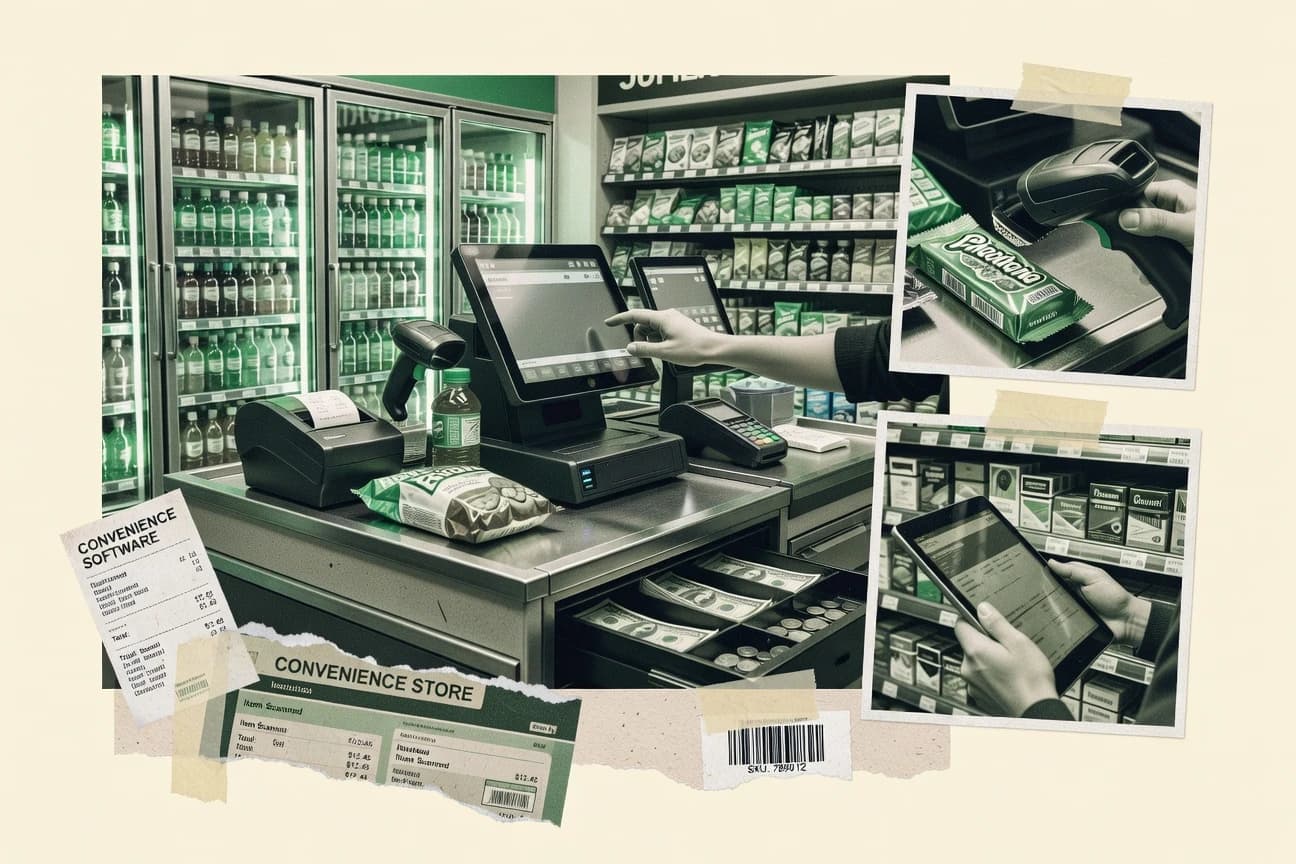
Consumer RetailTop 10 Best Convenience Store Software of 2026
Ranking roundup of the top 10 convenience store software tools, with POS Nation, Verifone Ruby, and COMBASE, plus comparison notes for buyers.

How we ranked these tools
Core product claims cross-referenced against official documentation, changelogs, and independent technical reviews.
Analyzed video reviews and hundreds of written evaluations to capture real-world user experiences with each tool.
AI persona simulations modeled how different user types would experience each tool across common use cases and workflows.
Final rankings reviewed and approved by our editorial team with authority to override AI-generated scores based on domain expertise.
Score: Features 40% · Ease 30% · Value 30%
Gitnux may earn a commission through links on this page — this does not influence rankings. Editorial policy
POS Nation is the best fit for convenience store chains that need purchase order receiving synced to perpetual inventory and age-restricted POS flows, whereas LS Central is a strong alternative for multi-store teams on Microsoft Dynamics, and CStorePro suits independent shops that want disciplined daily close and fast barcode entry.
Editor’s top 3 picks
Three quick recommendations before you dive into the full comparison below — each one leads on a different dimension.
POS Nation
Purchase order to receiving workflow that updates inventory and aligns daily replenishment with register sales movement.
Built for fits when convenience store chains need purchase order receiving synced to perpetual inventory and age-restricted POS flows..
Verifone Ruby
Editor pickBuilt for lane-ready POS with deep payment terminal coupling that keeps transaction flow consistent across registers.
Built for fits when convenience chains need POS-grade checkout consistency tied to integrated terminals..
COMBASE
Editor pickWorkflow-first receiving and purchasing that reuses the same item definitions used at POS.
Built for fits when a convenience chain needs consistent item and ordering workflows across multiple stores..
Comparison Table
POS Nation
vertical specialistRetail POS software for convenience stores with inventory, employee, vendor, and reporting tools.
Purchase order to receiving workflow that updates inventory and aligns daily replenishment with register sales movement.
POS Nation is built around day-to-day retail execution, including barcode scanning for item selection, inventory updates from sales, and purchase order driven receiving. It is suitable when convenience store staff need consistent checkout screens, repeatable end-of-day close steps, and traceability across daily cash movements. Multi-store operations benefit from centralized setup that reduces per-store drift in item lists and operational rules.
A practical tradeoff is that deeper automation depends on correct operational configuration before ramping volume transactions. POS Nation fits when a chain needs purchase order and receiving to stay synchronized with perpetual inventory behavior while staff handle age checks at the point of sale.
- +Purchase order receiving ties stock changes to daily replenishment
- +Barcode scanning and item lookup speed up high-throughput checkouts
- +Age-restricted sales workflows support ID checks at the register
- +End-of-day reconciliation coverage supports daily close discipline
- –Per-store setup errors can cause inventory and pricing drift
- –Complex vendor catalog workflows require consistent item mapping
- –Some advanced integrations may depend on add-on configuration
Store operations managers
Standardize daily close steps
Fewer close-day discrepancies
Inventory and procurement teams
Control replenishment via purchase orders
Better stock availability
Show 2 more scenarios
Frontline cashier teams
Speed up item lookup under rush
Faster throughput at checkout
Use barcode scanning and item lookup to reduce manual entry during peak periods.
Compliance-focused retailers
Handle age-restricted purchases
More consistent compliance handling
Capture ID checks in the sales flow for age-restricted items at the point of sale.
Best for: Fits when convenience store chains need purchase order receiving synced to perpetual inventory and age-restricted POS flows.
Verifone Ruby
vertical specialistSite controller and POS system integrating fuel pumps, payment processing, and store operations.
Built for lane-ready POS with deep payment terminal coupling that keeps transaction flow consistent across registers.
Verifone Ruby is built for operators that run busy checkouts and need consistent register behavior across stores. It emphasizes terminal integration for payment capture and lane operations, while keeping POS transaction flow centered on item scanning and cashier workflows. Administration focuses on enabling the right functions per role and keeping auditability around transaction actions. This fit is strongest when store teams want repeatable configuration across registers and locations.
A key tradeoff is that Ruby’s strongest advantage comes when the hardware and payments stack matches its expected integration path. Standalone software-only deployments or highly custom retail workflows usually require additional integration work or partner components. It works best when store operations already follow standard POS processes for scanning, receipt printing, and end-of-day reconciliation.
- +Terminal-first transaction flow reduces checkout friction
- +Role-based permissions help limit cashier access to sensitive actions
- +End-of-day workflows support consistent closeout across registers
- +Config-driven rollout supports multi-store operational consistency
- –Advanced tailoring of retail workflows needs integration assistance
- –Hardware and payments dependencies narrow deployment flexibility
- –Some governance tasks can become heavy for large chains
- –Offline mode expectations must be validated per installation
Multi-store operations teams
Standardize register behavior across locations
Fewer configuration drift incidents
Store managers
Control cashier actions during shifts
Lower risk from incorrect overrides
Show 2 more scenarios
Accounting and reconciliation staff
Run consistent closeout processes
Cleaner daily reconciliation cycles
End-of-day processes help align register totals with daily accounting routines.
Retail operations leads
Deploy POS terminals with payment integration
Lower checkout latency
Terminal integration keeps the checkout path stable under high throughput.
Best for: Fits when convenience chains need POS-grade checkout consistency tied to integrated terminals.
COMBASE
vertical specialistRetail POS and merchandise management software used across convenience and specialty retail.
Workflow-first receiving and purchasing that reuses the same item definitions used at POS.
COMBASE is most compelling when store operations depend on tight coordination between POS activity and inventory-related workflows like item catalogs, stock receiving, and purchase planning. Inventory behavior is designed for ongoing item movement, including routine end-of-day handling patterns and audit trails around transactions. The system’s value grows as store networks standardize item definitions and operational rules across locations.
A tradeoff appears in integration depth because COMBASE tends to require deliberate partner work for payment processors, peripherals, and site-specific back-office connectivity. It fits best when a chain can commit to configuration discipline for item data and vendor catalog mappings, then run consistent processes across stores.
- +Strong linkage between item catalog setup and store transaction workflows
- +Clear receiving and purchase order workflows that mirror store operations
- +Multi-store standardization supports repeated processes across locations
- +Audit trail coverage across POS and inventory-affecting activities
- –Peripheral and third-party payment integration can require project work
- –Role permissions and governance require deliberate configuration discipline
- –Merchandising controls feel less granular than workflow-first competitors
Store operations managers
Standardize item handling across locations
Fewer item mismatches during counts
Back-office procurement teams
Run purchase order cycles from store demand
More predictable replenishment timing
Show 1 more scenario
Regional retail administrators
Control chain-wide operational configuration
More consistent store execution
Administrators roll out shared store rules and item data patterns to multiple sites.
Best for: Fits when a convenience chain needs consistent item and ordering workflows across multiple stores.
LS Central
enterpriseRetail management software for convenience stores built on Microsoft Dynamics technology.
Receiving and purchase order workflow integration that drives perpetual inventory updates into POS stock availability.
LS Central fits convenience store operations by pairing retail inventory management with point-of-sale workflows tied to receiving and ordering processes. The system supports barcode scanning, PLU lookup, and day-to-day stock control aimed at keeping perpetual inventory counts aligned with sales activity.
Store operations also benefit from end-of-day reconciliation tools and audit trail visibility for cash drawer and transaction completion steps. LS Central’s admin surface focuses on multi-store operational control and configuration of items, prices, and store-specific rules for consistent POS execution.
- +Perpetual inventory flows connect receiving, selling, and stock movement
- +Barcode scanning and PLU lookup support fast item selection at the POS
- +End-of-day reconciliation provides structured closeout for daily operation
- +Multi-store configuration helps standardize items and rules across locations
- –Setup and catalog configuration require careful governance for clean item data
- –Offline mode depth for all POS workflows can be limiting at the edge
- –Extensibility and API coverage depend on integration choices and add-ons
- –Complex workflows can slow new operator training on exception handling
Best for: Fits when multi-store convenience chains need connected inventory control and consistent POS transactions across sites.
PAR Brink POS
enterpriseCloud point-of-sale software for foodservice and convenience retail locations.
Integrated regulated-item sale controls combined with receiving and purchase order execution in one store workflow.
PAR Brink POS records sales at point-of-sale terminals with PLU lookup, barcode entry, and fast item lookup workflows for convenience-store basket rings. It handles day-to-day retail inventory actions such as stock receiving and purchase order flows, with receipt details tied back to store operations.
The system supports common compliance and regulated retail behaviors including age-restricted item handling and tobacco sales controls. PAR Brink POS also coordinates multi-store workflows through centralized administration that keeps pricing and product availability consistent across locations.
- +Point-of-sale workflow supports barcode and PLU item lookup for quick rings
- +Stock receiving and purchase order flows tie back to store inventory execution
- +Age-restricted sales and tobacco controls support regulated item handling
- +Centralized multi-store administration helps keep pricing and catalog changes consistent
- –Offline operation behavior needs explicit planning for reconciliation and queueing
- –Forecourt and fuel integration depends on site-specific hardware and middleware
- –Lottery workflows can require careful screen mapping per store setup
Best for: Fits when convenience operators need regulated-item POS control tied to receiving and multi-store catalog governance.

Shopify POS
SMBRetail point-of-sale software connecting in-store transactions with online product and customer data.
Webhook and app-driven integration between Shopify admin data and POS sales events for automation and reporting.
Shopify POS fits convenience stores that already run on Shopify for catalog, pricing, and online-to-instore consistency. It delivers fast point-of-sale workflows with barcode and PLU style lookup, and it syncs sales back into Shopify for consolidated retail reporting.
Store operations can use offline mode for continued checkout, while the same product data powers receipt itemization and inventory updates. Core automation comes from Shopify’s broader ecosystem integrations and webhook-based data flows into and out of the POS.
- +Inventory and product catalog updates stay aligned with Shopify storefront data
- +Offline mode supports continued checkout when connectivity drops
- +Automation via Shopify apps extends POS to loyalty, gift cards, and reporting
- +Role-based staff permissions can be configured inside the Shopify admin
- –Advanced convenience-store workflows need app add-ons rather than native modules
- –Multi-location governance relies on Shopify admin setup discipline for consistent controls
- –Tight forecourt or tank integrations require specialized third-party solutions
- –Age-restricted and ID verification workflows depend on configuration and compatible apps
Best for: Fits when Shopify-managed item data and offline checkout matter more than specialized forecourt integrations.
CStorePro
SMBCloud-based POS and management software for independent convenience stores.
Receiving-to-inventory workflow that ties delivery intake to on-hand updates with end-of-day close confirmation.
CStorePro focuses on convenience-store workflows with a point-of-sale setup that supports barcode-driven item lookups and fast menu keying. It includes retail inventory management features geared toward stock receiving and ongoing inventory counts, plus end-of-day reconciliation outputs for daily close.
Store administrators can configure core operational rules around products, pricing, and transaction handling so teams can run consistent shifts across registers. Automation options center on repeatable back-office processes tied to receiving, counts, and daily close rather than bespoke integration projects.
- +Barcode-based PLU lookup speeds item entry at the point-of-sale terminal
- +Receiving workflow supports turning deliveries into updated on-hand quantities
- +End-of-day reconciliation produces a clear closeout record for daily operations
- +Configuration covers common product, pricing, and transaction handling rules
- –Multi-store administration depth is limited compared with enterprises
- –Automation surface is mostly workflow-based and not integration-first
- –Offline mode coverage for sustained outages is less clear than top competitors
- –Tobacco and age-restricted compliance controls appear basic without deeper policy tooling
Best for: Fits when convenience stores need disciplined daily close, receiving-to-inventory accuracy, and barcode-speed POS entry.
Petrosoft
vertical specialistPOS and back-office software for gas stations, convenience stores, and tobacco shops.
Store-level purchase order management ties directly into receiving and inventory adjustments for tighter stock reconciliation.
Petrosoft is a convenience-store software option aimed at operators that need POS-linked store operations beyond basic sales. It supports core retail workflows like inventory movement, stock receiving, and purchase order management to keep purchase and on-shelf counts aligned.
The system also targets compliance-heavy retail by covering identity-gated and age-restricted sales workflows alongside tobacco and lottery operations. Integration and automation depth matter in Petrosoft’s fit because day-to-day performance depends on how store terminals, scanners, and external payment and reporting systems connect.
- +Inventory and ordering workflows connect to reduce receive-to-stock mismatches.
- +Age-restricted and tobacco workflows are designed for compliance-heavy sales lanes.
- +Lottery sales management supports regulated retail operations in the same environment.
- +Multi-store management supports centralized control across store locations.
- –Fuel and forecourt integrations require tighter terminal and device alignment.
- –Lot-level compliance edge cases can demand careful configuration discipline.
- –Self-checkout readiness depends on specific hardware support and mappings.
- –End-of-day reconciliation visibility can lag when integrations delay posting.
Best for: Fits when operators need POS-linked inventory receiving and regulated sales workflows across multiple stores.
Lightspeed Retail
SMBCloud retail POS software with inventory, purchasing, reporting, and customer management features.
Multi-store inventory control that ties perpetual inventory adjustments to receipt and sale events across locations.
Lightspeed Retail handles point-of-sale workflows for multi-store convenience retail, including barcode-first item lookup and end-of-day settlement. It supports retail inventory management with perpetual inventory updates tied to sales and stock receiving.
Admin controls focus on store-level operations, while integration and extensibility extend beyond a basic terminal setup. For convenience operators, the practical fit is strongest when the store needs fast POS execution plus repeatable inventory and operational routines.
- +Strong POS terminal speed for item scanning and PLU lookup at checkout
- +Perpetual inventory movements update from sales and stock receiving
- +Multi-store management supports consistent operations across locations
- +Integration-focused design with an API surface for connected retail systems
- –Wet-stock workflows require add-on configuration to match reconciliation needs
- –Advanced compliance like tobacco and ID verification depends on proper setup
- –Offline mode behavior needs careful testing around inventory accuracy
- –Role configuration can be tedious for complex approval chains
Best for: Fits when convenience teams need fast POS throughput plus perpetual inventory consistency across multiple stores.
Square for Retail
SMBRetail POS software with payments, inventory, employee management, and reporting tools.
Square API access to POS transaction and inventory events for building custom receiving, reporting, and store-to-store automation.
Square for Retail is designed for convenience stores that want a card-first POS workflow backed by Square Payments and hardware options. It supports retail inventory management with barcode scanning, receiving workflows, and end-of-day reconciliation tied to sales and payments.
Square for Retail also handles multi-location operations with centralized product and team access settings. For automation, it offers API access and data sync patterns that connect POS activity to external tools and reporting.
- +Fast POS flow for counter service with integrated payment handling
- +Barcode scanning and product lookup reduce time-to-sale for common SKUs
- +Multi-location configuration supports shared products across stores
- +API access enables external reporting, integrations, and custom workflows
- –Limited convenience-specific controls for age-restricted sales compared with specialty POS
- –Offline mode coverage depends on hardware and network conditions
- –Per-store exceptions for complex pricing rules require operational discipline
- –Fuel and forecourt integration support is narrower than dedicated fuel POS
Best for: Fits when convenience stores want quick POS checkout with practical inventory and integration via API.
Conclusion
After evaluating 10 consumer retail, POS Nation stands out as our overall top pick — it scored highest across our combined criteria of features, ease of use, and value, which is why it sits at #1 in the rankings above.
Use the comparison table and detailed reviews above to validate the fit against your own requirements before committing to a tool.
How to Choose the Right convenience store software
Convenience store software typically combines point-of-sale checkout with inventory movement tracking, purchase order and receiving workflows, and regulated-item lane controls. This buyer’s guide covers POS Nation, Verifone Ruby, COMBASE, LS Central, PAR Brink POS, Shopify POS, CStorePro, Petrosoft, Lightspeed Retail, and Square for Retail.
Each tool card frames how store operations flow from ordering to receiving to perpetual inventory updates and back into POS stock availability. The differences show up in how tightly purchase order receiving syncs to inventory, how regulated sales controls attach to lane flows, and how much integration automation exists through connectors, webhooks, or API access.
Convenience store software for regulated retail checkout, inventory receiving, and perpetual stock control
Convenience store software manages POS transactions while also driving inventory receiving into perpetual inventory so on-hand quantities match what cashiers sell. It usually includes barcode scanning and fast item lookup at the point-of-sale terminal so PLU and item resolution stays consistent across stores.
Tools such as POS Nation and LS Central connect purchase order execution and receiving to inventory updates that flow back into POS stock availability. COMBASE follows the same workflow-first approach by reusing the same item definitions in receiving and purchase order execution as those used in store transactions.
Convenience store workflow coverage that ties receiving, regulated lanes, and perpetual inventory
Convenience store software lives or dies on transaction-to-stock accuracy, so receiving workflows must update the same perpetual inventory that POS terminals use for item availability. The category standard is barcode scanning plus PLU and item lookup at checkout so lane resolution matches what stores order and receive.
Feature differences show up in how purchase order receiving links to inventory movement and how regulated-item controls attach to lane flows. Some tools keep that linkage native inside one store workflow, while others require connectors, app modules, or device-specific setup to keep operations consistent across locations.
Purchase order to receiving to perpetual inventory sync
POS Nation and LS Central both connect receiving and purchase orders to perpetual inventory updates that feed back into POS stock availability. COMBASE and Petrosoft both emphasize receiving-to-inventory alignment, but POS Nation’s receiving workflow is positioned as the daily replenishment bridge aligned with register sales movement.
Regulated-item lane controls with POS execution
PAR Brink POS includes integrated regulated-item sale controls inside the same store workflow that also executes receiving and purchase orders. Petrosoft also designs age-restricted and tobacco workflows for compliance-heavy sales lanes, while POS Nation focuses more on purchase order receiving and item mapping.
Governed multi-store item catalog and mapping consistency
COMBASE is workflow-first and reuses item definitions across receiving and purchase order execution that mirror store transaction workflows. POS Nation supports fast item selection at checkout using barcode scanning and item lookup, but its cons warn that per-store setup errors can create inventory and pricing drift when item mapping is inconsistent.
Throughput at the point of sale with barcode and PLU lookup
Lightspeed Retail provides strong POS terminal speed for item scanning and PLU lookup, with perpetual inventory movements updating from both sales and stock receiving. CStorePro also centers barcode-based PLU lookup speed and a receiving workflow that turns deliveries into updated on-hand quantities.
Offline mode depth for store operations
LS Central supports offline mode for POS workflows, but its offline coverage can be limiting at the edge when every workflow needs to continue without connectivity. Square for Retail offers offline mode coverage that depends on hardware and network conditions, which can affect store execution during outages.
Integration automation surface for external workflows
Shopify POS emphasizes webhook and app-driven integration that syncs Shopify admin data and POS sales events for automation and reporting. Square for Retail provides Square API access to POS transaction and inventory events for building custom receiving and store-to-store automation.
Decision framework for selecting convenience store software by workflow attachment and control depth
The fastest path to a good fit is to map the store’s daily workflow to where the software attaches each step, especially the handoff from purchase order receiving to perpetual inventory and then into POS stock availability. The strongest systems keep item definitions consistent from catalog setup through receiving and then into lane execution for regulated sales.
The next fork is where automation comes from, because some platforms keep operations native inside one workflow stack while others rely on apps, webhooks, or API access to extend convenience store workflows. The final fork is governance and resilience, since multi-store control and offline behavior determine whether edge cases become reconciliation work at end-of-day.
Pick the receiving model that matches how replenishment is actually executed
Choose POS Nation when purchase order receiving must update inventory while aligning daily replenishment with register sales movement. Choose LS Central when perpetual inventory flows must connect receiving, selling, and stock movement across sites with POS stock availability that reflects those updates.
Match regulated-item controls to lane execution needs
Choose PAR Brink POS when regulated-item controls must be integrated into the point-of-sale workflow that also runs receiving and purchase order execution. Choose Petrosoft when compliance-heavy age-restricted and tobacco workflows must be designed for sales lanes tied to POS-linked inventory receiving.
Decide whether item definitions are reused across store workflows or rebuilt per integration
Choose COMBASE when item catalog setup must link directly to store transaction workflows because receiving and purchase order execution reuse the same item definitions used at POS. Choose POS Nation when barcode-driven item lookup speed is prioritized, but plan governance to prevent per-store setup errors that can create inventory and pricing drift.
Choose the integration shape that fits the operation’s automation plan
Choose Shopify POS when Shopify admin data alignment and app-driven or webhook automation are the primary integration strategy, including offline checkout when connectivity drops. Choose Square for Retail when a custom receiving and reporting workflow is planned using Square API access to POS transaction and inventory events.
Validate offline and edge-case reconciliation workflow ownership
Choose LS Central when offline mode depth for POS workflows must cover more than a basic cash register operation, but confirm whether all required workflows can run at the edge. Choose Square for Retail when offline mode coverage can be handled through hardware and network conditions because offline behavior depends on those inputs.
Ensure multi-store governance matches operational scale
Choose COMBASE when role permissions and governance need deliberate configuration to maintain consistent item and workflow behavior across multiple stores. Choose Lightspeed Retail when multi-store inventory control must pair with fast POS scanning and PLU lookup, but note that wet-stock workflows may require add-on configuration for reconciliation needs.
Which convenience store operators should shortlist each tool
Convenience store teams with strict replenishment cycles need tools where purchase order receiving updates the same perpetual inventory that drives POS stock availability. Operators with regulated lanes need lane controls that attach to POS execution rather than requiring manual override steps during checkout.
Multi-store operators need governance that keeps item mapping consistent across locations, while teams focused on integrations often prefer webhook and app automation or API event access to connect POS behavior to external workflows.
Convenience store chains running purchase order receiving as the primary replenishment trigger
POS Nation fits stores that require purchase order receiving to tie stock changes to daily replenishment and then reflect that in perpetual inventory for POS stock availability. LS Central also fits when receiving and purchase order workflow integration must drive perpetual inventory updates into POS stock availability across multiple sites.
Operators that treat age-restricted or tobacco sales as regulated lane workflows
PAR Brink POS fits operators that need integrated regulated-item sale controls in the POS workflow that also runs receiving and purchase orders. Petrosoft fits compliance-heavy lane operations where age-restricted and tobacco workflows are designed for regulated sales lanes tied to inventory receiving.
Multi-store teams managing one shared item catalog definition across ordering and POS transactions
COMBASE fits teams that need receiving and purchase order execution to reuse the same item definitions used at POS. POS Nation can fit throughput-focused stores using barcode scanning and item lookup, but per-store setup must be governed to avoid inventory and pricing drift.
Operators prioritizing fast checkout throughput with scanning and PLU lookup
Lightspeed Retail fits when fast POS terminal scanning and PLU lookup are required with perpetual inventory movements updating from both sales and stock receiving. CStorePro fits when barcode-based PLU lookup speed and receiving-to-on-hand updates must support disciplined daily close.
Stores that plan automation through webhooks, apps, or custom API workflows
Shopify POS fits teams running Shopify-admin-managed item data that must stay aligned with POS sales events through webhook and app-driven integration. Square for Retail fits teams that plan custom receiving, reporting, and store-to-store automation using Square API access to POS transaction and inventory events.
Common convenience store software pitfalls during implementation and rollout
Implementation fails most often when the store’s daily receiving workflow does not map cleanly to the software’s inventory movement rules that drive POS availability. Another frequent failure is treating regulated-item controls as configuration-only rather than verifying lane execution under real checkout conditions.
Multi-store rollouts also fail when item mapping differs per location, because that breaks the linkage between receiving, replenishment, and the item resolution used at POS terminals.
Assuming purchase order receiving and perpetual inventory updates behave the same without validating end-to-end stock movement
POS Nation and LS Central both emphasize receiving-to-inventory linkage into POS stock availability, so the receiving workflow must be tested against daily replenishment and register sales movement. CStorePro also ties receiving to on-hand updates with end-of-day close confirmation, so its close workflow should be tested with the same SKU set used in live receiving.
Underestimating the impact of per-store item catalog configuration differences on accuracy
POS Nation warns that per-store setup errors can cause inventory and pricing drift, so item mapping and catalog governance must be enforced during rollout. COMBASE requires deliberate role permissions and governance configuration, so permission templates and item mapping processes must be defined before the first store goes live.
Treating offline mode as a generic setting rather than a workflow-specific constraint
LS Central notes that offline mode depth for all POS workflows can be limiting at the edge, so every required lane action and receiving dependency should be validated under connectivity loss. Square for Retail states that offline mode coverage depends on hardware and network conditions, so store hardware and network assumptions must be tested before relying on offline execution.
Delaying regulated-item control validation until after store operations start
PAR Brink POS includes regulated-item sale controls integrated with receiving and purchase orders, so lane control behavior must be verified alongside stock movement scenarios. Petrosoft also designs age-restricted and tobacco workflows for compliance-heavy sales lanes, so lane verification should run with the real ID verification inputs used by cashiers.
How We Selected and Ranked These Tools
We evaluated each convenience store tool on feature coverage that connects checkout outcomes to inventory updates, and feature depth counted for 40% of the score. Ease of use and value each counted for 30% based on how directly the workflow supports barcode and PLU lookup speed and receiving-to-inventory execution without extra project work.
POS Nation earned the top rank because purchase order to receiving updates inventory in a way that aligns daily replenishment with register sales movement, and that receiving sync is paired with barcode scanning and item lookup designed for high-throughput checkouts. POS Nation also scored strongly on usability because per-lane execution stays centered on the same workflow stack rather than pushing key operations into external integration modules.
Frequently Asked Questions About convenience store software
How do POS Nation and LS Central handle purchase order receiving into perpetual inventory?
Which tools provide API or integration hooks for transaction and inventory automation?
How do Verifone Ruby and PAR Brink POS keep lane operations consistent across multiple registers?
What breaks if store teams migrate item catalogs without a shared data model between POS and back office?
When does offline mode matter, and which tool supports it for convenience store checkout?
How do age-restricted sales and tobacco compliance controls work in PAR Brink POS and Petrosoft?
What administrative controls are typically required for multi-store operations in LS Central and Lightspeed Retail?
How does each tool support end-of-day reconciliation and audit visibility for cash drawer close?
Which setup is a better fit for stores that already use Shopify for product, price, and reporting?
Tools reviewed
Primary sources checked during evaluation.
shopify.comReferenced in the comparison table and product reviews above.
- Consumer RetailTop 10 Best Convenience Store Pos Software of 2026
- Consumer RetailTop 10 Best Convenience Store Back Office Software of 2026
- Consumer RetailTop 10 Best Convenience Store Inventory Management Software of 2026
- Furniture And Home DecorTop 10 Best Retail Furniture Store Software of 2026
- Consumer RetailTop 10 Best Consignment Store Software of 2026
Keep exploring
Comparing two specific tools?
Software Alternatives
See head-to-head software comparisons with feature breakdowns, pricing, and our recommendation for each use case.
Explore software alternatives→In this category
Consumer Retail alternatives
See side-by-side comparisons of consumer retail tools and pick the right one for your stack.
Compare consumer retail tools→