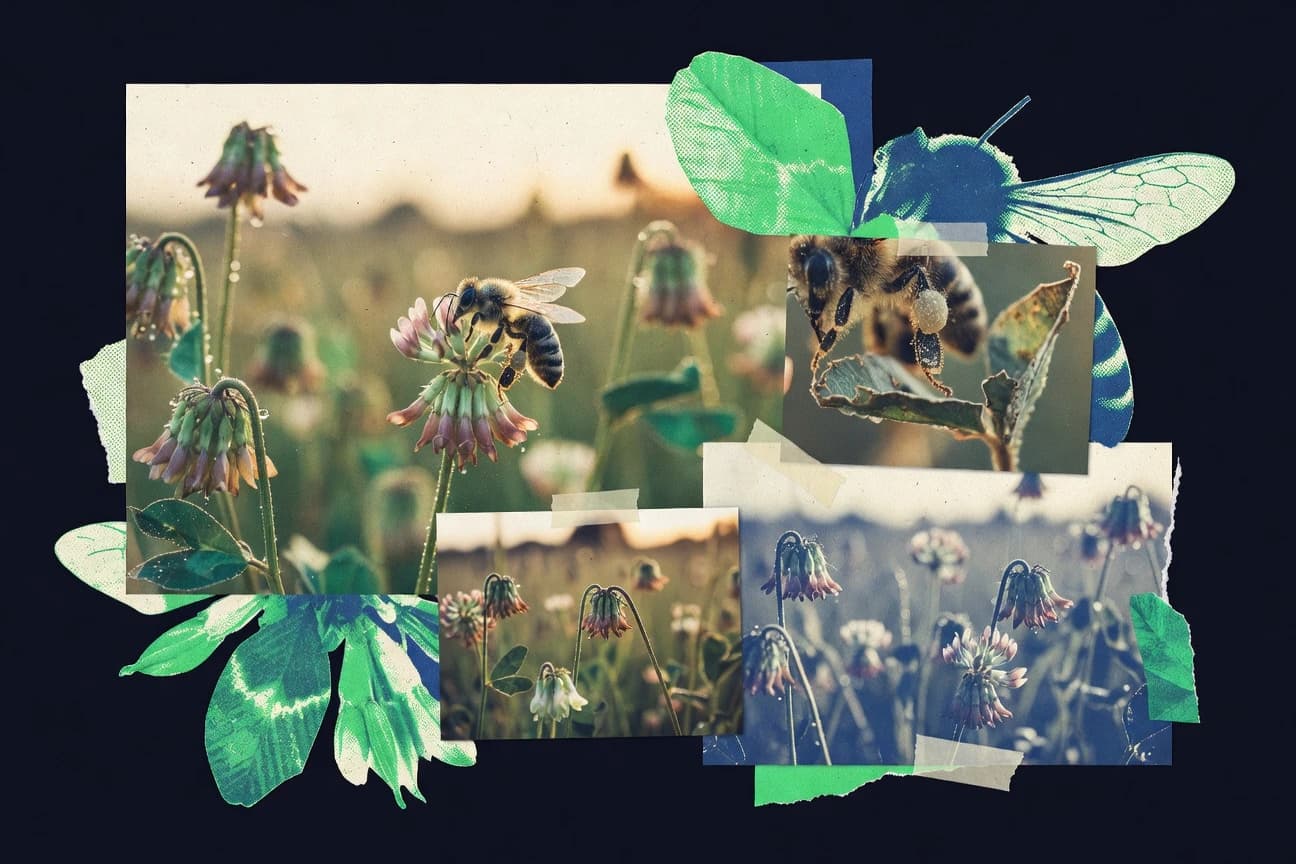

Bee decline affects both wild pollinators and managed honey bees, with pressures felt across crops, ecosystems, and livelihoods. Key drivers include habitat loss from urbanization, parasites such as Varroa mites, and climate-driven shifts in foraging timing that can reduce pollen availability. On this page, you’ll see where declines are most severe and which actions—like restoring prairie habitat or restricting high-risk pesticides—have shown measurable recovery.
Key Takeaways
- Neonicotinoid insecticides applied to crops were found in 75% of pollen and 45% of nectar samples from beehives, contributing to 20-30% higher mortality rates.
- Varroa destructor mite infestations cause up to 50% colony loss in untreated hives annually in North America.
- Climate change has shifted bee foraging seasons by 2-3 weeks earlier in Europe, desynchronizing with bloom times and reducing pollen availability by 20%.
- Restoration of 1,000 km² of U.S. prairie habitat increased bee abundance by 50% within 3 years.
- EU bans on neonicotinoids led to 20% recovery in wild bee populations in treated fields by 2020.
- Wildflower strips on 10% of farmland boosted bumble bee colonies by 40% in UK trials.
- Honey bees pollinate 35% of global food crops, with U.S. almond crops alone requiring 80% of commercial hives annually.
- Bee declines threaten $15 billion in annual U.S. crop value from pollination services.
- In Europe, pollination services from bees contribute €15 billion yearly to agriculture, with 84% of crops at risk.
- From 2007 to 2016, U.S. honey bee colonies experienced an average annual loss rate of 30.6%, with total losses amounting to over 2.7 million colonies per year.
- The rusty patched bumble bee (Bombus affinis) saw a 91% decline in relative abundance from 2000 to 2014 across its historical range in the U.S.
- Between 1990 and 2014, 28% of monitored wild bee species in the Netherlands showed significant declines, while only 12% increased.
- In North America, 9 of 57 bumble bee species declined by >50% since 2000, worst in the Southwest with 80% losses.
- Europe saw 37% of bee species threatened, with 9% regionally extinct, per 2019 IPBES report.
- In Brazil's Atlantic Forest, 50% of orchid bee species declined due to deforestation since 1990.
Bees face mounting stress from pesticides, mites, climate shifts, and habitat loss, driving major colony declines.
Related reading
01 · Category
Causes20 stats
01
Neonicotinoid insecticides applied to crops were found in 75% of pollen and 45% of nectar samples from beehives, contributing to 20-30% higher mortality rates.
02
Varroa destructor mite infestations cause up to 50% colony loss in untreated hives annually in North America.
03
Climate change has shifted bee foraging seasons by 2-3 weeks earlier in Europe, desynchronizing with bloom times and reducing pollen availability by 20%.
04
Habitat loss from urbanization reduced wild bee diversity by 50% in urban vs. rural sites in the U.S. Midwest.
05
Glyphosate exposure reduced larval bee survival by 47% and adult lifespan by 20% in lab studies.
06
Nosema ceranae infection prevalence reached 80% in U.S. hives by 2010, correlating with 25% higher winter mortality.
07
Monoculture farming practices decreased floral resources by 70% in agricultural landscapes, starving 60% of wild bee species.
08
Air pollution from diesel exhaust degrades floral scents by 90%, reducing bee foraging efficiency by 30%.
09
Imidacloprid at field-realistic doses (10 ppb) impaired bumble bee reproduction by 85% and foraging by 50%.
10
Deformed wing virus prevalence in Varroa-infested hives was 100%, leading to 90% worker bee mortality within 10 days.
11
Fungicides synergize with neonicotinoids to increase bee mortality by 50%.
12
Parasitic phorid flies reduced bumble bee colony success by 30% in field studies.
13
Drought reduced bee reproductive success by 40% in California studies.
14
Agricultural intensification decreased hedgerows by 60%, correlating with 30% bee decline.
15
Clothianidin exposure caused 50% homing failure in honey bees at 4 ppb.
16
American foulbrood disease infected 15% of U.S. hives annually, causing 20% loss.
17
Invasive Argentine ants displaced native bees from 70% of floral resources.
18
Electromagnetic fields from power lines reduced bee orientation by 25%.
19
Overgrazing by livestock reduced bee forage by 45% in rangelands.
20
Chronic exposure to thiamethoxam impaired bee learning by 30%.
Interpretation
Causes Interpretation
Across the listed causes, the strongest signal is that multiple human driven pressures are already hitting bee populations at large scale, such as neonicotinoids appearing in 75% of pollen samples and Varroa driving up to 50% annual colony loss in untreated hives.
02 · Category
Conservation And Recovery19 stats
01
Restoration of 1,000 km² of U.S. prairie habitat increased bee abundance by 50% within 3 years.
02
EU bans on neonicotinoids led to 20% recovery in wild bee populations in treated fields by 2020.
03
Wildflower strips on 10% of farmland boosted bumble bee colonies by 40% in UK trials.
04
U.S. feral honey bee populations rebounded 15% after Varroa mite-resistant breeding programs.
05
Organic farms had 50% higher bee diversity than conventional ones in meta-analysis of 30 studies.
06
Hedgerow planting in Germany increased wild bee visitation by 70% and fruit set by 25%.
07
Citizen science monitoring via Bumble Bee Watch documented 25% range recovery for 3 declining species.
08
Neonic-free zones in Ontario, Canada, saw honey bee survival improve by 30% over 5 years.
09
Cover cropping on 20% of fields increased soil moisture and bee nesting by 35% in Midwest U.S.
10
Agroforestry systems increased bee diversity 60% in Costa Rica trials.
11
U.S. monarch waystations boosted milkweed and bee co-visitation by 40%.
12
Neonic bans in France recovered 30% wild bee density by 2018.
13
Bee hotels in urban Switzerland raised solitary bee populations 25%.
14
Reduced mowing in road verges increased bees 45% in Sweden.
15
Selective breeding for mite resistance cut U.S. losses 20%.
16
1 million acres of pollinator habitat restored by U.S. NRCS by 2020.
17
Flowering lawns in UK cities boosted bees 70% over turf grass.
18
Probiotic treatments reduced Nosema by 50% in hive trials.
19
Community gardens in U.S. cities supported 2x bee diversity.
Interpretation
Conservation And Recovery Interpretation
Conservation and recovery efforts are clearly working, with measures such as habitat restoration and pesticide reduction boosting bee populations by 40% or more in several studies, including a 50% increase in bee abundance after 1,000 km² of prairie restoration and a 20% recovery of wild bees in EU fields after neonicotinoid bans.
03 · Category
Impacts On Pollination/agriculture20 stats
01
Honey bees pollinate 35% of global food crops, with U.S. almond crops alone requiring 80% of commercial hives annually.
02
Bee declines threaten $15 billion in annual U.S. crop value from pollination services.
03
In Europe, pollination services from bees contribute €15 billion yearly to agriculture, with 84% of crops at risk.
04
California's almond industry, valued at $5.6 billion, relies on 1.6 million beehives transported annually, facing 30% colony loss post-pollination.
05
Wild bees contribute 39% of pollination service value in the U.S., estimated at $3 billion annually.
06
Squash bees declining by 30% have reduced pumpkin yields by 40% in U.S. Northeast farms without supplemental pollination.
07
Global coffee production, dependent on bees for 20% yield, faces $1.5 billion loss from pollinator decline.
08
Apple orchards in Washington state lost 20% fruit set due to 50% bumble bee decline since 2000.
09
Vanishing bees could reduce global fruit and vegetable production by 3-8%, affecting nutrition for 1.7 billion people.
10
In the UK, 4 bumble bee species declined >70% since 1980, correlating with 25% drop in wildflower pollination success.
11
Pollination deficit causes $235 million annual loss in U.S. blueberry production.
12
75% of leading global food crops depend on animal pollination, bees providing 80%.
13
Watermelon yields drop 60% without bee pollination in U.S. trials.
14
European rapeseed yields declined 10% from bee shortages since 2000.
15
Bees pollinate 95% of U.S. tomatoes grown for processing.
16
Chocolate production risks from declining cacao pollinators, 90% hand-pollinated now.
17
Sunflower seed set reduced 50% without bees in Argentina.
18
Global pollination market valued at $577 billion, 10% decline from bees projected.
19
Clover seed yields fell 30% in New Zealand from bumble bee decline.
20
In India, mustard crop yields dropped 20% due to 40% honey bee decline.
Interpretation
Impacts On Pollination/agriculture Interpretation
As bee declines intensify, pollination dependence is becoming more fragile, with honey bees covering 35% of global food crops while U.S. almond growers rely on 80% of commercial hives and face major colony loss, placing roughly $15 billion in annual U.S. crop value at risk from pollination services.
04 · Category
Population Declines18 stats
01
From 2007 to 2016, U.S. honey bee colonies experienced an average annual loss rate of 30.6%, with total losses amounting to over 2.7 million colonies per year.
02
The rusty patched bumble bee (Bombus affinis) saw a 91% decline in relative abundance from 2000 to 2014 across its historical range in the U.S.
03
Between 1990 and 2014, 28% of monitored wild bee species in the Netherlands showed significant declines, while only 12% increased.
04
U.S. commercial honey bee colonies numbered 2.7 million in 1947 but dropped to about 2.5 million by 2017 despite increased agricultural demand.
05
From 2006 to 2015, managed honey bee colony losses in the U.S. averaged 29.7% annually, totaling 33% in winter 2016-2017.
06
European dark bee (Apis mellifera mellifera) populations declined by 25-50% in central Europe between 1960 and 1990 due to replacement by other subspecies.
07
In the UK, 13 of 27 bumblebee species declined by more than 80% in abundance between 1980 and 1999.
08
U.S. honey bee overwintering mortality reached 40.7% in 2018-2019, the second highest on record.
09
California's managed honey bee colonies declined from 550,000 in 1990 to 450,000 by 2010, despite almond industry growth.
10
From 2007 to 2016, U.S. honey bee colonies lost averaged 40% overwintering mortality, peaking at 44% in 2015-2016.
11
Western bumble bee (Bombus occidentalis) declined 93% in the Pacific Northwest since 1990.
12
17% of Europe's 2,000 wild bee species face extinction risk per IUCN Red List.
13
U.S. managed honey bee colonies fell from 5 million in 1947 to 2.8 million in 2019.
14
Annual U.S. honey bee losses were 43.7% in 2010-2011, the highest recorded.
15
UK bumblebee populations declined by 59% on average since the 1980s.
16
40% of U.S. bumble bee species show significant declines since 2000.
17
Global wild bee abundance declined 25% from 1990-2017 per meta-analysis.
18
Hawaii's native Hylaeus bees declined 50% since 1900 due to invasive species.
Interpretation
Population Declines Interpretation
Across these population declines, the clearest signal is that major bee groups are shrinking fast, with U.S. managed honey bee colonies losing about 30.6% per year from 2007 to 2016 and the rusty patched bumble bee dropping 91% in relative abundance from 2000 to 2014.
05 · Category
Regional Variations20 stats
01
In North America, 9 of 57 bumble bee species declined by >50% since 2000, worst in the Southwest with 80% losses.
02
Europe saw 37% of bee species threatened, with 9% regionally extinct, per 2019 IPBES report.
03
In Brazil's Atlantic Forest, 50% of orchid bee species declined due to deforestation since 1990.
04
Australian native bee diversity dropped 23% in urban areas vs. natural habitats.
05
In China, Apis cerana populations fell 40% from 2000-2015 due to intensive agriculture.
06
Midwest U.S. prairie remnants lost 60% bee species richness since 1900 from habitat fragmentation.
07
In the Mediterranean Basin, 27% of wild bees are threatened, highest in coastal areas with 40% urbanization impact.
08
Sub-Saharan Africa saw 20% decline in stingless bee colonies from 1990-2020 due to drought and fire.
09
New Zealand's introduced honey bees displaced 15 native bee species by 30% in forage competition.
10
Southeast Asia's wild honey bees declined 35% in oil palm plantations vs. forests.
11
Central Valley, CA, lost 25% native bee species since 1990s urbanization.
12
In Mexico, 30% of stingless bee species declined in coffee regions.
13
Japan's honey bee colonies dropped 25% from 2007-2017 Varroa impact.
14
South Africa's Cape Floristic Region saw 40% bee decline from fire regime changes.
15
Prairie provinces of Canada lost 35% bumble bee abundance since 1990.
16
Iberian Peninsula wild bees declined 20% from 1990-2010 aridification.
17
Amazonia's orchid bees fell 45% in deforested areas.
18
Urban bees in Beijing declined 28% in species richness vs. rural.
19
Tasmania's native bees dropped 15% from eucalyptus plantation expansion.
20
Midwest U.S. lost 50% bee biomass from corn-soy conversion.
Interpretation
Regional Variations Interpretation
Across regions, bee decline is uneven but unmistakable, with losses ranging from 23% fewer native bee species in Australian urban areas to 80% declines in the Southwest of North America and 60% prairie richness losses in the US Midwest since 1900.
report visual · Key figures
Bee Decline Signals Across Drivers
Multiple stressors—from pesticides and parasites to habitat loss and climate shifts—are linked to large, often accelerating declines in bee health and abundance.
70%
In the UK, 4 bumble bee species declined >70% since 1980, correlating with 25% drop in wildflower pollination success.
10%
European rapeseed yields declined 10% from bee shortages since 2000.
70%
Flowering lawns in UK cities boosted bees 70% over turf grass.
91%
The rusty patched bumble bee (Bombus affinis) saw a 91% decline in relative abundance from 2000 to 2014 across its histo
25%
Global wild bee abundance declined 25% from 1990-2017 per meta-analysis.
50%
Hawaii's native Hylaeus bees declined 50% since 1900 due to invasive species.
Reference
Cite This Report
This report is designed to be cited. We maintain stable URLs and versioned verification dates. Copy the format appropriate for your publication below.
APA
Leah Kessler. (2026, February 13). Bee Decline Statistics. Gitnux. https://gitnux.org/bee-decline-statistics
MLA
Leah Kessler. "Bee Decline Statistics." Gitnux, 13 Feb 2026, https://gitnux.org/bee-decline-statistics.
Chicago
Leah Kessler. 2026. "Bee Decline Statistics." Gitnux. https://gitnux.org/bee-decline-statistics.
Sources & references
39 datasets cited across this report