
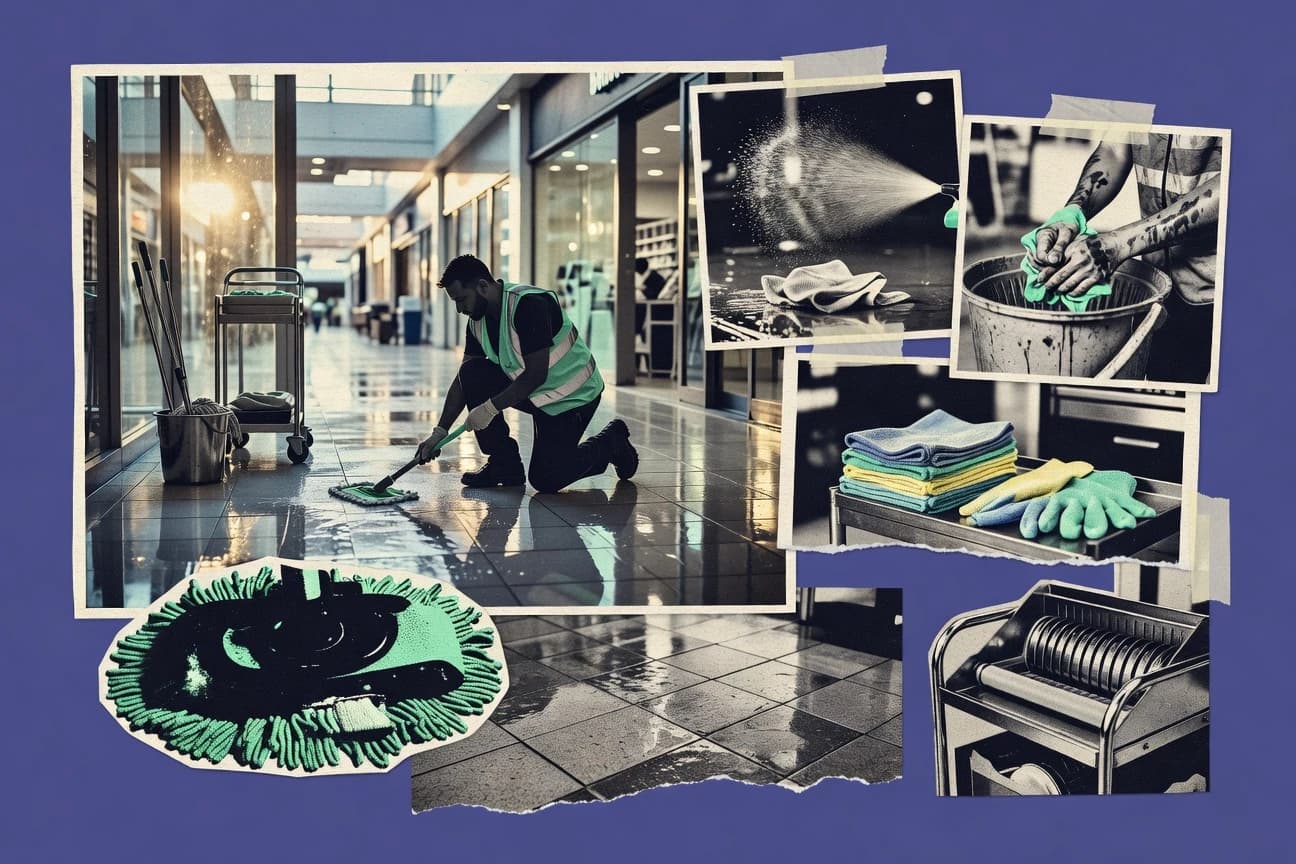

Australia’s cleaning industry spans homes and workplaces across every state and territory, affecting residents, facility operators, workers, and customers. The guide maps market size by service type—commercial offices, healthcare sites, retail, and industrial plants—then connects those segments to compliance and safety pressures. You’ll also see how infection-control requirements, workplace guidance, and environmental rules shape how firms operate. Finally, the page covers employment and working arrangements.
Key Takeaways
- In 2023, the Australian cleaning services industry generated total revenue of $14.2 billion, marking a 4.5% increase from 2022 driven by post-pandemic hygiene demands
- Commercial cleaning accounted for 62% of total industry revenue in Australia during FY2023, equating to approximately $8.8 billion
- The average annual revenue per cleaning business in Australia was $1.27 million in 2023, with over 11,000 enterprises operating nationwide
- Commercial office cleaning represented 45% of all cleaning services contracts in Australia in 2023
- Healthcare facility cleaning services grew to 22% market share, handling 1.2 million square meters daily in 2023
- Industrial cleaning, including manufacturing plants, accounted for 18% of industry activity, servicing 4,500 sites in 2023
- 75% of Australian cleaning firms complied with AS 4146 standards for infection control in 2023 audits
- WorkSafe Victoria issued 2,450 fines totaling $4.2 million for cleaning safety breaches in 2023
- National Cleaning Standards under the Cleaning Industry Code of Conduct covered 92% of businesses by 2023
- Robotic vacuum adoption in Australian cleaning rose to 28% of commercial sites in 2023
- UV-C disinfection devices were used in 35% of healthcare cleaning contracts by 2023
- Electrostatic sprayers deployment increased 52% to 4,200 units in offices in 2023
- In 2023, 92% of cleaning firms anticipated continued revenue growth through 2028 at 4.1% CAGR
- Sustainability trends saw 67% of businesses shifting to eco-friendly chemicals by 2025 projections
- Gig economy platforms expected to capture 25% of domestic cleaning market by 2027
In 2023, Australia’s cleaning industry grew to $14.2 billion, led by commercial cleaning and rising automation.
Related reading
01 · Category
Financial Performance20 stats
01
In 2023, the Australian cleaning services industry generated total revenue of $14.2 billion, marking a 4.5% increase from 2022 driven by post-pandemic hygiene demands
02
Commercial cleaning accounted for 62% of total industry revenue in Australia during FY2023, equating to approximately $8.8 billion
03
The average annual revenue per cleaning business in Australia was $1.27 million in 2023, with over 11,000 enterprises operating nationwide
04
Domestic cleaning services contributed $2.9 billion to the Australian market in 2023, growing at a CAGR of 3.8% over the past five years
05
Industry profit margins in Australian cleaning services averaged 6.2% in FY2023, influenced by rising labor costs and supply chain issues
06
Total industry expenses for Australian cleaning firms reached $13.3 billion in 2023, with wages comprising 45% of costs
07
Carpet cleaning segment revenue in Australia hit $1.1 billion in 2023, up 5.2% year-on-year due to increased commercial contracts
08
The cleaning industry in Australia saw a 7.1% revenue growth in NSW alone, totaling $4.2 billion in 2023
09
Victoria's cleaning services market was valued at $3.8 billion in FY2023, representing 27% of national revenue
10
Queensland cleaning industry revenue grew to $2.9 billion in 2023, boosted by tourism recovery
11
Over 85% of Australian cleaning businesses reported revenue increases exceeding 5% in 2023 surveys
12
The industry exported cleaning services worth $450 million in 2023, primarily to New Zealand and Pacific islands
13
EBITDA for top 10 Australian cleaning firms averaged 12.4% in 2023
14
Small cleaning businesses (under 10 employees) generated 28% of total revenue, or $4.0 billion in 2023
15
Industry cost of goods sold rose 8.3% to $2.1 billion in 2023 due to chemical price hikes
16
Rental and leasing income from cleaning equipment contributed $320 million to industry revenue in 2023
17
Government contracts accounted for 15% of cleaning revenue, totaling $2.1 billion in FY2023
18
Online booking platforms drove 12% revenue growth for digital-savvy cleaning firms in 2023
19
Post-COVID hygiene premium services added $1.5 billion to industry revenue in 2023
20
Average profit per employee in Australian cleaning industry was $28,500in 2023
Interpretation
Financial Performance Interpretation
In 2023, Australia’s cleaning services industry revenue rose to $14.2 billion, but profit margins averaged just 6.2% as costs totaled $13.3 billion with wages taking 45%, showing that financial gains are being pressured for businesses in this sector.
02 · Category
Operational Segments19 stats
01
Commercial office cleaning represented 45% of all cleaning services contracts in Australia in 2023
02
Healthcare facility cleaning services grew to 22% market share, handling 1.2 million square meters daily in 2023
03
Industrial cleaning, including manufacturing plants, accounted for 18% of industry activity, servicing 4,500 sites in 2023
04
Retail space cleaning covered 28 million square meters monthly across Australia in 2023
05
Educational institution cleaning contracts numbered 12,400, serving 9.5 million students in 2023
06
Hospitality cleaning for hotels and restaurants processed 2.8 million rooms annually in 2023
07
Window cleaning services reached 1.5 million jobs yearly, focusing on high-rise buildings in urban areas in 2023
08
Floor care and polishing services were demanded in 65% of commercial contracts in 2023
09
Biohazard cleaning incidents responded to totaled 8,200 nationwide in 2023
10
Aged care facility cleaning standards applied to 2,300 facilities, covering 450,000 beds in 2023
11
Construction site cleaning post-build services grew 9%, handling 15,000 sites in 2023
12
Public transport cleaning (trains, buses) serviced 1.2 billion passenger touches annually in 2023
13
Gym and fitness center cleaning contracts increased 14% to 5,600 facilities in 2023
14
Data center cleaning for tech firms required 99.99% dust-free standards in 420 sites in 2023
15
Event venue cleaning post-event handled 45,000 events yearly in 2023
16
Parking lot and outdoor area cleaning covered 2,500 km of surfaces monthly in 2023
17
Laboratory and cleanroom cleaning adhered to ISO 5 standards in 1,800 facilities in 2023
18
Childcare center cleaning protocols served 4,200 centers with daily deep cleans in 2023
19
Waste management facility cleaning processed 1.1 million tons of waste contact areas in 2023
Interpretation
Operational Segments Interpretation
Operational segments in Australia’s cleaning market are highly concentrated, with commercial office cleaning leading at 45% of contracts in 2023 while healthcare cleaning climbed to a 22% share and handled 1.2 million square meters daily.
03 · Category
Regulatory Compliance20 stats
01
75% of Australian cleaning firms complied with AS 4146 standards for infection control in 2023 audits
02
WorkSafe Victoria issued 2,450 fines totaling $4.2 million for cleaning safety breaches in 2023
03
National Cleaning Standards under the Cleaning Industry Code of Conduct covered 92% of businesses by 2023
04
EPA Australia enforced 1,200 wastewater disposal regulations for cleaning chemicals in 2023
05
Fair Work Ombudsman resolved 5,600 underpayment claims in cleaning, recovering $12.5 million in 2023
06
88% of commercial cleaners used approved PPE as per Safe Work Australia guidelines in 2023
07
Building Code of Australia mandated green cleaning products in 65% of new builds by 2023
08
Queensland Health audits found 94% compliance in hospital cleaning protocols in 2023
09
Chemical labeling under GHS standards was 97% compliant across 11,000 firms in 2023
10
Disability Discrimination Act accommodations in cleaning jobs met 82% compliance in 2023
11
Noise pollution regulations limited 24/7 cleaning to 1,200 sites with exemptions in 2023
12
Food safety cleaning under FSANZ standards applied to 7,800 venues with 100% audit pass in critical areas 2023
13
Workers' compensation claims in cleaning dropped 11% to 18,500 incidents in 2023 due to training
14
Privacy laws for data center cleaning ensured 99.5% compliance with no breaches reported in 2023
15
Anti-dumping duties on imported cleaning chemicals affected 15% of supplies in 2023
16
42% of firms achieved Green Star certification for sustainable cleaning practices in 2023
17
Biosecurity cleaning for agriculture complied in 2,100 farms under DAFF rules in 2023
18
Electrical safety certifications for cleaning equipment reached 96% in inspections 2023
19
Tobacco smoke residue cleaning regulations enforced in 1,200 rental properties in 2023
20
Radiation safety in medical cleaning met ARPANSA standards in 850 facilities 2023
Interpretation
Regulatory Compliance Interpretation
In Australia’s cleaning industry, regulatory compliance is improving but still under pressure, with 92% of businesses covered by the Cleaning Industry Code of Conduct in 2023 while WorkSafe Victoria issued 2,450 fines totaling $4.2 million for safety breaches and Fair Work Ombudsman recovered $12.5 million from 5,600 underpayment claims.
More related reading
04 · Category
Technological Advancements20 stats
01
Robotic vacuum adoption in Australian cleaning rose to 28% of commercial sites in 2023
02
UV-C disinfection devices were used in 35% of healthcare cleaning contracts by 2023
03
Electrostatic sprayers deployment increased 52% to 4,200 units in offices in 2023
04
IoT-enabled cleaning sensors monitored 1.5 million sqm in smart buildings 2023
05
Autonomous floor scrubbers cleaned 12 million sqm annually across 2,800 sites in 2023
06
HEPA filter vacuums standard in 82% of allergy-sensitive environments by 2023
07
AI scheduling software adopted by 47% of cleaning firms, reducing labor by 18% in 2023
08
Nano-coating antimicrobial surfaces applied in 1,200 hospitals in 2023
09
Drone-assisted high-rise window cleaning tested in 150 buildings in Sydney 2023
10
Blockchain for cleaning supply chain traceability in 12% of large firms 2023
11
Ozone generators for odor control used in 2,900 commercial spaces 2023
12
5G-connected cleaning carts piloted in 450 warehouses for real-time tracking 2023
13
Hypochlorous acid foggers deployed post-COVID in 3,200 schools 2023
14
VR training modules for cleaning staff reached 25,000 users in 2023
15
Steam vapor cleaning systems eco-adopted in 38% of green-certified buildings 2023
16
Predictive maintenance AI for equipment reduced downtime 24% in 1,100 fleets 2023
17
Biometric check-in for cleaning teams in secure sites numbered 780 facilities 2023
18
Hydrogen peroxide vapor systems for cleanrooms in 950 labs 2023
19
Augmented reality apps for quality checks used by 19% of supervisors 2023
20
Solar-powered cleaning robots trialed in 320 outdoor areas 2023
Interpretation
Technological Advancements Interpretation
In Australia’s cleaning industry, technological advancements are accelerating quickly with robotic vacuums reaching 28% of commercial sites in 2023 and autonomous floor scrubbers cleaning 12 million square meters annually across 2,800 sites, alongside broader uptake of innovations like UV-C disinfection and electrostatic sprayers.
05 · Category
Trends & Future Outlook10 stats
01
In 2023, 92% of cleaning firms anticipated continued revenue growth through 2028 at 4.1% CAGR
02
Sustainability trends saw 67% of businesses shifting to eco-friendly chemicals by 2025 projections
03
Gig economy platforms expected to capture 25% of domestic cleaning market by 2027
04
Post-2025, automation projected to displace 15% of manual cleaning jobs, affecting 36,000 roles
05
Hygiene-as-a-service models forecasted to grow 12% annually to $2.5 billion by 2028
06
Regional cleaning demand to rise 6.2% due to mining boom through 2027
07
Elderly care cleaning projected to need 20,000 more workers by 2030 amid aging population
08
Net-zero cleaning operations targeted by 55% of large firms by 2030
09
E-commerce warehouse cleaning to surge 18% with online retail growth to 2028
10
Antimicrobial tech integration expected in 60% of contracts by 2026
Interpretation
Trends & Future Outlook Interpretation
Looking ahead in Australia’s cleaning industry, strong momentum is expected as 92% of firms forecast revenue growth through 2028 at a 4.1% CAGR alongside major shifts toward sustainability, with 67% moving to eco friendly chemicals by 2025 and hygiene as a service projected to reach $2.5 billion by 2028.
06 · Category
Workforce Dynamics18 stats
01
The employment in Australia's cleaning industry stood at 245,000 full-time equivalent workers in 2023, with a 2.8% annual growth rate
02
Women comprised 68% of the cleaning workforce in Australia in 2023, totaling approximately 166,600 female employees
03
Average weekly earnings for cleaning supervisors in Australia reached $1,450in FY2023, up 4.2% from prior year
04
42% of cleaning workers in Australia were casual employees in 2023, affecting 102,900 individuals
05
Training completion rates for cleaning certifications reached 78% among 150,000 workers in 2023
06
Labour turnover in the cleaning industry averaged 22% annually in Australia during 2023
07
Migrant workers made up 35% of the cleaning workforce, or 85,750 people, in major cities like Sydney and Melbourne in 2023
08
Part-time cleaning jobs accounted for 28% of total employment, equating to 68,600 positions nationwide in 2023
09
Union membership in the cleaning industry was 19% of workers, or 46,550 members, as of 2023
10
Average age of cleaning workers in Australia was 41.2 years in 2023, with 25% under 30
11
Overtime hours worked by cleaning staff totaled 12.5 million hours annually in 2023
12
Disability employment in cleaning reached 8.2%, or 20,100 workers, supported by inclusive hiring in 2023
13
Night shift workers comprised 31% of the workforce, totaling 75,950 employees in commercial cleaning in 2023
14
Apprenticeships in cleaning numbered 4,200 in 2023, representing 1.7% of total employment
15
Remote area cleaning jobs grew 15%, adding 3,675 positions in regional Australia in 2023
16
Gender pay gap in cleaning was 18.5%, with females earning $920 weekly vs $1,130 for males in 2023
17
56% of cleaning businesses reported skill shortages for specialized roles in 2023 surveys
18
Indigenous employment in cleaning increased to 2.4%, or 5,880 workers, in 2023 initiatives
Interpretation
Workforce Dynamics Interpretation
In Australia’s cleaning industry, workforce dynamics are being shaped by rapid growth and high churn, with employment at 245,000 full time equivalent workers in 2023 growing 2.8% annually while labour turnover averages 22% and 42% of workers are casual.
Reference
Cite This Report
This report is designed to be cited. We maintain stable URLs and versioned verification dates. Copy the format appropriate for your publication below.
APA
Felix Zimmermann. (2026, February 13). Australia Cleaning Industry Statistics. Gitnux. https://gitnux.org/australia-cleaning-industry-statistics
MLA
Felix Zimmermann. "Australia Cleaning Industry Statistics." Gitnux, 13 Feb 2026, https://gitnux.org/australia-cleaning-industry-statistics.
Chicago
Felix Zimmermann. 2026. "Australia Cleaning Industry Statistics." Gitnux. https://gitnux.org/australia-cleaning-industry-statistics.
Sources & references
70 datasets cited across this report · attribution is report-level