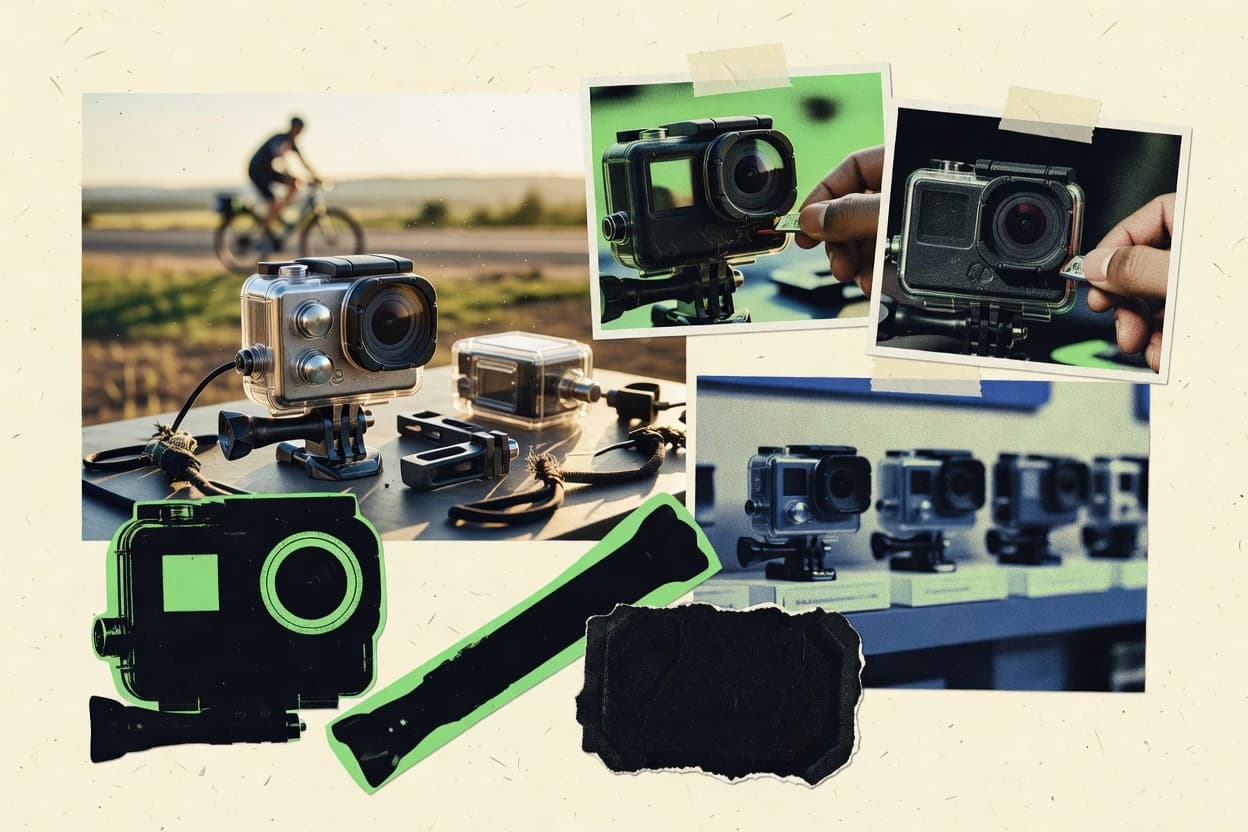

01 Industry overview
The action camera industry at a glance
The global action camera market was estimated at $8.13 billion in 2026, with growth driven by AI-enabled imaging, stabilization, 360-degree capture and creator-focused features despite intense competition and long replacement cycles.
- $8.13B[15]
- Global market size, 2026
- 12.1%[15]
- Forecast CAGR, 2026–2033
- 1.83M[11]
- GoPro camera units shipped, 2025
- 34.1%[15]
- North America share, 2025
- Market size
- Grand View Research estimated the global action camera market at $7.272 billion in 2025 and forecast it at $8.132 billion in 2026. GoPro, a major branded participant, reported $651.5 million in total 2025 revenue, including $545.3 million from hardware.[15][11]
- Forecast & CAGR
- The global market is forecast to grow at a 12.1% compound annual growth rate from 2026 to 2033, reaching $18.044 billion by 2033. Forecast growth is supported by AI-powered features, smart stabilization, connected camera ecosystems and real-time image processing.[15][44]
- Market share & regions
- North America accounted for 34.1% of global action camera revenue in 2025, making it the largest regional market in Grand View Research’s outlook. The United States held the largest country-level revenue share within the industry during 2025.[15]
- Segmentation
- The market is segmented by product type, including box-style, cube-style, bullet-style and 360-degree cameras; by resolution, including HD and Full HD, Ultra HD, and 4K and above; and by application, distribution channel and region. HD and Full HD cameras represented 50.12% of North American revenue in 2025.[15]
- Key players & concentration
- Key competitors include GoPro, DJI, Insta360, Garmin, Ricoh and YI Technology. GoPro reported 1.826 million camera units shipped in 2025, down 24.9% from 2024, and identified Insta360 and SZ DJI Technology as major competitors in its annual filing; no reliable public source located for a consolidated industry concentration ratio.[11]
- Pricing
- GoPro’s reported average selling price rose 8.2% to $357 in 2025, while 75% of its camera revenue came from products with a manufacturer suggested retail price of at least $400. Current flagship action-camera pricing generally clusters around the $400 level, although older models and entry-level products are sold at substantial discounts.[11][45]
- Trends, drivers & challenges
- Growth is being supported by AI-enabled processors, improved low-light performance, electronic stabilization, 360-degree video and creator-oriented editing tools. The principal challenges are softer consumer spending, long replacement cycles, lower-priced Chinese competitors, tariffs and competition from smartphones and video-enabled glasses; GoPro cited these factors in reporting its 2025 decline.[44][11]
- Consumer behavior & competition
- Consumers increasingly compare rugged cameras on stabilization, low-light quality, battery life, waterproofing, 360-degree capture and app-based editing rather than resolution alone. GoPro reported 53.4 million social-media followers and 4.9 billion YouTube channel views as of December 31, 2025, while its overall subscription attach rate reached 43% in the fourth quarter of 2025, up from 34% a year earlier.[11]
- M&A
- GoPro entered into a definitive agreement in September 2026 to merge with Starman Optical, an optical-photonics company. The transaction provides for $285 million in aggregate cash consideration, approximately 10% continuing ownership for GoPro shareholders and an expected closing by the end of 2026, subject to approvals; it would broaden GoPro beyond consumer cameras into optical transceivers, AI infrastructure, government, defense and aerospace.[23]
- Latest news
- The most significant recent corporate development was GoPro’s September 1, 2026 merger agreement with Starman Optical, followed by a preliminary proxy filing on October 19, 2026. GoPro also launched its MISSION 1 PRO ILS compact cinema camera in September 2026 and presented its GP3 processor as the basis for its next generation of cameras.[23]
02 Ranking
Top 7 Companies in the Action Camera Industry
The leading companies in the action camera industry, ranked on market impact, performance, momentum, innovation and brand popularity.
Updated November 11, 2026 · Next review December 11, 2026
Arashi Vision stands out for the Insta360 Ace Pro 2 8K action camera because it sells the Insta360 Ace Pro 2 8K action camera, while SZ DJI Technology leads in Osmo Action cameras since it currently sells multiple Osmo Action cameras including the Osmo Action 6.
Ranked by Overall score · How we score ↓
Editor's top 3 picks
Where to start, by need.
#1 Overall · Leader in action & 360 cameras
Arashi Vision
CN
Ranked #1 · 9.6 · Action & 360 cameras
Why we picked it: Arashi Vision sells the Insta360 Ace Pro 2 8K action camera and reported an operating margin of 9.26%.
Leader in outdoor rugged cameras
Garmin
Ranked #3 · 9.3 · Outdoor rugged cameras
Why we picked it: Garmin produces the VIRB series of action cameras and posted an operating margin of 25.9%.
Leader in waterproof action cameras
Ricoh
JP
Ranked #5 · 8.2 · Waterproof action cameras
Why we picked it: Ricoh produces the WG-series rugged waterproof cameras and reported an operating margin of 2.5%.
Pick 1 is the #1 company overall. Picks 2 and 3 are the highest-ranked companies in the top 5 that add a new segment.
Full ranking
| # | Company | Overall ↓ | Impact | Performance | Momentum | Innovation | Company snapshot |
|---|---|---|---|---|---|---|---|
| 1 | Arashi Vision Action & 360 cameras · CN | 9.6 | 9.9 | 9.6 | 9.9 | 9.6 | |
Company snapshot · Arashi Vision · Data as of November 11, 2026 Arashi Vision sells the Insta360 Ace Pro 2 8K action camera.[16]
| |||||||
| 2 | SZ DJI Technology Action & 360 cameras · CN | 9.5 | 9.9 | 9.9 | 9.1 | 9.9 | |
Company snapshot · SZ DJI Technology · Data as of November 11, 2026 DJI currently sells multiple Osmo Action cameras, including the Osmo Action 6.[46]
| |||||||
| 3 | Garmin Outdoor rugged cameras | 9.3 | 8.4 | 9.8 | 9.6 | 9.6 | |
Company snapshot · Garmin · Data as of November 11, 2026 Produces the VIRB series of action cameras.
| |||||||
| 4 | Olympus Outdoor rugged cameras · JP | 8.3 | 7.0 | 8.9 | 9.1 | 9.0 | |
Company snapshot · Olympus · Data as of November 11, 2026 Manufactures TG-series rugged cameras used in outdoor sports.
| |||||||
| 5 | Ricoh Waterproof action cameras · JP | 8.2 | 7.0 | 8.2 | 8.8 | 7.9 | |
Company snapshot · Ricoh · Data as of November 11, 2026 Produces the WG-series rugged waterproof cameras.
| |||||||
| 6 | GoPro Rugged action and 360 cameras, global · US | 8.0 | 8.6 | 7.0 | 7.0 | 8.7 | |
Company snapshot · GoPro · Data as of November 11, 2026 GoPro shipped 1.8 million cameras globally in 2025.[11]
| |||||||
| 7 | Shenzhen SJCAM Technology Action cameras and accessories, global · CN | 7.6 | 7.0 | 8.1 | 8.0 | 7.0 | |
Company snapshot · Shenzhen SJCAM Technology · Data as of November 11, 2026 SJCAM develops action cameras for cycling, fishing, skiing and other outdoor uses.[47]
| |||||||
How we score
- Impact (30%): scale and weight in the market (revenue, market share, employees, market position).
- Performance (20%): recent revenue growth and operating margin; an analyst assessment where a company does not publish them.
- Momentum (20%): growth trajectory and future potential.
- Innovation (15%): R&D intensity and how technologically advanced the company is.
Popularity (brand search demand, 15%) counts toward Overall but is not published as a column. Overall leaves out what is not known.
Scale Scores are shown on a 7–10 scale with one decimal; bars start at 7.0.
Cadence Recalculated when new figures are published; next review December 11, 2026.
Independence. Rankings are editorially independent. Scores, ranks, picks and the verdict follow the method above; no company can pay to change them.
Cite this ranking
APA
Samuel Norberg. (2026, November 11). Top 7 companies in the action camera industry. In Action Camera Industry Statistics. Gitnux. https://gitnux.org/action-camera-industry-statistics/#top-companies
Global action camera market revenue, professional end use
Global action camera market revenue, professional end use grew from $1.6B in 2022 to $2.1B in 2025.
03 Trends & forecasts
Top 10 Action Camera Industry Trends & Forecasts 2027
What is changing in the action camera industry, with the evidence behind each trend and a forecast for 2027.
Forecasts were generated by an AI model from the cited evidence. They are estimates, not guarantees.
01Market growth accelerates through 2027
High confidenceGrand View Research estimates the global action camera market at $7.272 billion in 2025 and $8.132 billion in 2026, with a forecast CAGR of 12.1% from 2026 to 2033. The market is projected to reach $18.044 billion by 2033.[15]
Forecast 2027: Applying the published growth trajectory implies a global market of approximately $9.1 billion in 2027. Growth will remain strongest in premium, connected and 360-degree products rather than basic cameras.
02Unit demand remains weaker than value growth
High confidenceGoPro shipped approximately 1.8 million camera units in 2025, down 24.9% year over year, while total revenue fell to $651.5 million from $801.5 million in 2024. The company attributed pressure to softer consumer demand, competition and product-launch timing.[11]
Forecast 2027: In 2027, industry unit growth is likely to trail revenue growth because consumers are replacing cameras less frequently and upgrading selectively. A modest recovery in units is plausible, but a return to earlier shipment peaks appears unlikely without lower prices or major new use cases.
03Premium pricing holds near $400
High confidenceGoPro’s average selling price rose 8.2% to $357 in 2025, and cameras with a manufacturer suggested retail price of at least $400 represented 75% of camera revenue. The figures indicate that premium models are carrying a disproportionate share of category value.[11]
Forecast 2027: Premium action cameras will probably remain concentrated around the $350–$550 range in 2027, with higher prices justified by larger sensors, AI processing, 8K or 360-degree capture and bundled software. Discounts on prior-generation models will continue to serve price-sensitive buyers.
04360-degree cameras gain share
High confidenceGrand View Research includes 360-degree cameras as a distinct product segment, while DJI launched the Osmo 360 II in September 2026 with 8K/60fps capture, a 1-inch sensor, AI SuperNight 2.0 and replaceable lenses. Insta360 also markets X5 and X6 models around 360 capture, AI editing and reframing.[15][46][48]
Forecast 2027: 360-degree cameras will be one of the fastest-growing action-camera subsegments in 2027 as users increasingly capture first and choose the viewpoint later. Competition among DJI, Insta360 and GoPro should expand availability while gradually reducing the premium for older 360 models.
05AI editing becomes a purchase driver
High confidenceInsta360’s X6 combines 360 capture with an AI Director that automatically creates highlight edits, while GoPro describes AI-enabled image stabilization, mobile editing, auto-upload and voice recognition in more than 11 languages as product investments. These features shift competition from hardware specifications toward finished-content workflows.[48][11]
Forecast 2027: By 2027, automatic highlight selection, subject tracking, reframing and caption-ready exports will be standard in mid-range and premium cameras. Vendors with stronger mobile and cloud software will be better positioned to defend hardware prices and recurring revenue.
06Stabilization and low-light quality converge
High confidenceDJI’s Osmo 360 II combines AI SuperNight 2.0 with stabilization technology derived from its Ronin and Osmo product lines. Insta360’s X5 emphasizes AI-powered low-light shooting and FlowState stabilization, showing that stabilization and night performance are becoming core differentiators.[46][16]
Forecast 2027: In 2027, buyers will increasingly compare cameras on usable footage in motion and low light rather than resolution alone. Software-based stabilization, larger sensors and computational noise reduction will improve performance, although battery consumption and heat will remain constraints.
07Subscriptions offset hardware cyclicality
High confidenceGoPro reported $106.3 million in subscription and services revenue in 2025, broadly flat year over year, while GoPro.com revenue reached $169.6 million, or 26.0% of total revenue. Its fourth-quarter 2025 subscriber attach rate was 43%, up from 34% a year earlier.[11][17]
Forecast 2027: Cloud backup, editing, device insurance and premium AI tools will become more important revenue sources in 2027. Subscription growth should continue even if camera-unit sales remain subdued, but consumers may resist plans that restrict basic camera functionality.
08North America remains the largest region
High confidenceGrand View Research estimates North America held about 34.0% of global action-camera revenue in 2025. The United States also held the largest country-level revenue share in the same outlook.[15]
Forecast 2027: North America will likely remain the largest regional market in 2027 because of high purchasing power, established creator ecosystems and strong outdoor-recreation demand. Its share may edge down as Asia-Pacific grows faster from a smaller base.
09Asia-Pacific expands fastest
Medium confidenceGrand View Research identifies Asia-Pacific as the fastest-growing regional market for 2026–2033, while listing China, Japan, India, Southeast Asia and other Asian markets in the regional scope. The report also identifies several Asian-based competitors, including Insta360, DJI and YI Technology.[15]
Forecast 2027: Asia-Pacific is likely to deliver the strongest percentage growth in 2027, supported by expanding creator economies, e-commerce distribution and local brands. Competitive pricing will be particularly important because consumers in many markets remain more price-sensitive than North American buyers.
10Chinese competitors intensify price pressure
High confidenceGoPro identifies Insta360 and SZ DJI Technology as major competitors and says it faces lower-priced competitors largely based in China. Its filing also notes that competitors benefit from broader product portfolios, larger resources and the ability to maintain or lower selling prices despite tariff pressure.[11]
Forecast 2027: Competition will intensify in 2027 as DJI and Insta360 combine rapid product cycles with broader imaging ecosystems. GoPro and other incumbents will need clearer differentiation through software, durability, accessories, brand communities and professional workflows.
04 Statistics
Technology & Innovation
Technology coverage focuses on digitization adoption and analytics integration gaps, alongside survey results on AI investment and automation in consumer products.
Digital Transformation in the consumer goods sector (sector benchmark)
- Across consumer markets, 35% of respondents said their companies had integrated digital capabilities end to end in 2026.[1]
- Across consumer products, 94% of surveyed supply-chain executives said they were transforming the supply-chain function in 2026.[2]
- Across consumer products, 72% of respondents identified enterprise access to real-time supply-chain analytics as an economic-value area for digitization in 2024.[3]
- Across consumer products, 67% of surveyed executives said digital transformation was necessary to compete in 2025, while 68% were investing in smart technology and automation.[4]
Technology Adoption in the consumer goods sector (sector benchmark)
- Across consumer products, 73% of chief executives said planned AI investment for 2026 had increased compared with 2025.[2]
- Across consumer goods, 90% of leaders expected their companies to increase investment in AI agents, and 89% believed AI agents would be essential to compete within two years; 2025 industry survey.[5]
- Across consumer products, 66% of leaders said their organizations would increase or strongly increase artificial-intelligence investment over the next three years; survey of 505 leaders in 23 countries.[6]
- Across consumer goods, 82% of surveyed companies were already using or planning to deploy generative AI in social-media marketing and analytics in 2024.[7]
- Across consumer goods, 81% of surveyed companies were already using or planning to deploy generative AI in sales, marketing and consumer experiences in 2024.[7]
- Across consumer products, about 40% of executives said their companies were applying AI technologies to the business in 2025; survey of consumer-products executives.[3]
Cloud Computing in the consumer goods sector (sector benchmark)
- Across EU enterprises, 52.74% used paid cloud-computing services in 2025.[8]
- Across EU enterprises, 85.2% of those using paid cloud services used them for email in 2025.[8]
- Across EU enterprises, 71.5% of those using paid cloud services used them for file storage in 2025.[8]
- Across EU enterprises, 71.7% of those using paid cloud services used them for office software in 2025.[8]
- Across EU enterprises, 30.1% of those using paid cloud services used them for enterprise-resource-planning software in 2025.[8]
Big Data in the consumer goods sector (sector benchmark)
- Across consumer goods, 51% identified inability to integrate data from multiple sources as their primary analytics challenge in 2025.[9]
- Across EU enterprises, 17.62% performed analytics on customer data in 2025.[8]
- Across EU enterprises, 26.20% performed analytics on transaction records such as sales or payment data in 2025.[8]
- Across EU enterprises, 33.02% performed data analytics using their own employees in 2025.[8]
- Across EU enterprises, 40% performed data analytics internally or through another organization in 2025.[8]
IoT in the consumer goods sector (sector benchmark)
- Across EU enterprises, 29% used IoT devices or systems in 2021, including 48% of large enterprises and 26% of small enterprises.[8]
- Across consumer manufacturing, IoT devices delivered an average 20.9% return on investment in the surveyed benchmark.[10]
- Across consumer manufacturing, 89% identified better supply-chain management as a leading IoT use or benefit in the surveyed benchmark.[10]
- Across consumer manufacturing, 80% identified reduced energy and resource consumption as a leading IoT use or benefit in the surveyed benchmark.[10]
- Across consumer manufacturing, IoT devices accounted for 10.3% of IT and operational-technology budgets in the surveyed benchmark.[10]
Innovation in the action camera industry
- More than 2,500 U.S. patents were held by GoPro after 24 years of developing imaging solutions, according to a 2026 company filing.[11]
- $113.1 million was GoPro’s research-and-development expense in 2025, down 26% from 2024, globally.[11]
- $153.3 million was GoPro’s research-and-development expense in 2024, up 5% from 2023, globally.[11]
05 Statistics
Data & Analytics
Data coverage highlights data governance needs and trust in data quality, alongside GoPro figures such as $169.6 million GoPro.com revenue in 2025.
Data Quality in the consumer goods sector (sector benchmark)
- Across consumer packaged goods, 60% planned to increase investment in data and analytics during the following 12 months in 2024.[3]
- Across supply-management organizations, 49% rated their data quality as good or excellent in 2024.[12]
- Across consumer packaged goods, 22% reported that businesses lacked trust in data quality and validity in 2024.[3]
- Across retail and consumer goods, 26% of leaders said their data quality was poor compared with competitors in 2024.[13]
Data Governance in the consumer goods sector (sector benchmark)
- Across retail and CPG companies, 35% reported receiving inconsistent or incorrect answers to data questions in 2025.[14]
- Across retail and CPG companies, 31% cited the lack of a corporate data strategy and semantic layer as a key challenge in 2025.[14]
- Across supply-management organizations, 61% had a dedicated data-governance function in 2024.[12]
- Across retail and CPG companies, 42% identified inconsistent data quality, absent semantic layers and fragmented reporting as critical governance challenges in 2025.[14]
- Across consumer packaged goods companies, 43% said they struggled with establishing the right level of data governance in 2024.[3]
KPIs in the action camera industry
- 25.0% of GoPro’s 2024 revenue came from GoPro.com, including subscription and service revenue.[11]
- 23.2% of GoPro’s 2024 revenue was represented by total research-and-development expense.[11]
- $801 million was GoPro’s 2024 revenue, while camera-unit sales reached 2.4 million globally.[11]
- 12.1% was the projected compound annual growth rate for the global action-camera market from 2026 to 2033 in Grand View Research’s forecast.[15]
06 Statistics
Strategy & Growth
Strategy and growth notes connect market drivers like 360-degree field of view and connected ecosystems to company actions, including GoPro’s 2026 merger agreement.
Growth in the action camera industry
Differentiation in the action camera industry
- 360 degrees was the field of view enabled by Insta360’s interchangeable dual-lens setup described for the ONE R action-camera system.[16]
- 1 inch was the sensor size of the premium wide-angle module co-engineered by Leica and Insta360 for the ONE R 1-Inch Edition.[16]
- 5.3K was the resolution of the Leica and Insta360 ONE R 1-Inch Edition’s wide-angle module launched as a premium action-camera product.[16]
- 75% of GoPro’s 2025 camera revenue came from cameras with a manufacturer’s suggested retail price of at least $400.[11]
Strategic partnerships in the action camera industry
- 2 camera configurations were supported by the Leica and Insta360 ONE R system: a wide-angle module and a dual-lens 360-degree setup.[16]
- 1 official action-camera partnership made Insta360 the official camera partner of Swatch Nines 2025.[16]
- 1 strategic partnership between Leica Camera AG and Insta360 was announced to develop action-camera and 360-degree-camera innovations.[16]
07 Statistics
People & Workforce
Workforce reporting centers on GoPro’s restructuring footprint and retention context, including 145 scheduled layoffs during 2026 and more than 950 employees as of March 31, 2024.
Hiring in the action camera industry
- More than 950 employees worked across GoPro’s global organization as of March 31, 2024.[17]
- 145 GoPro workers were scheduled for layoffs during 2026, representing nearly one-quarter of the company’s workforce, in the United States.[18]
- 135 GoPro jobs were cut in a 2024 round of layoffs, according to reporting on the company’s restructuring.[18]
Remote Work in the consumer goods sector (sector benchmark)
- Across retail and consumer goods organizations, 23% support international hybrid remote-working assignments, according to a 2024 survey.[19]
- Across retail and consumer goods organizations, 8% support permanent remote working arrangements, according to a 2024 international mobility survey.[19]
- Across retail and consumer goods organizations, 54% support workcations, compared with 65% across all surveyed sectors in 2024.[19]
- Across consumer goods companies, 69% offer some form of work-location flexibility, according to the Flex Index industry benchmark.[20]
- Among U.S. remote-capable employees, 26% worked exclusively remotely in May 2026, while 52% worked in a hybrid arrangement.[21]
Hybrid Work in the consumer goods sector (sector benchmark)
- Among U.S. remote-capable employees, 34% of hybrid workers were engaged in May 2026, compared with 37% of exclusively remote workers.[21]
- Among U.S. remote-capable employees, 52% worked hybrid in May 2026, compared with 26% exclusively remote and 22% on-site.[21]
- Among U.S. remote-capable employees, 54% of hybrid workers were thriving in May 2026, compared with 52% of exclusively remote workers.[21]
- Only 11% of U.S. employees benefited from a hybrid policy set jointly by their work team in May 2025.[21]
- Among U.S. remote-capable employees, 61% preferred hybrid work in November 2025, compared with 33% preferring exclusively remote work and 6% on-site work.[21]
Employee Engagement in the consumer goods sector (sector benchmark)
- Globally, 20% of employees were engaged in 2025, according to Gallup’s World Poll benchmark.[21]
- Across consumer goods and services organizations, the median employee net promoter score was 23 in data collected from July 2025 through June 2026.[22]
- Across consumer goods and services organizations, 72% of employees were engaged in data collected from July 2025 through June 2026.[22]
- Across consumer goods and services organizations, 18% of employees were thinking of or actively seeking jobs elsewhere in data collected from July 2025 through June 2026.[22]
- Across consumer goods and services organizations, 9% of employees expected to leave within two years in data collected from July 2025 through June 2026.[22]
DEI in the action camera industry
- 7.3% of GoPro’s U.S. workforce was Hispanic or Latino as of March 31, 2024.[17]
- 3.0% of GoPro’s U.S. workforce was Black or African American as of March 31, 2024.[17]
- 29.4% of GoPro’s U.S. workforce was Asian as of March 31, 2024.[17]
- 29.4% of GoPro’s U.S. workforce was female as of March 31, 2024.[17]
- 27.8% of GoPro employees at director level and above in the United States were female as of March 31, 2024.[17]
Change Management in the consumer goods sector (sector benchmark)
- Across consumer products leaders in 23 countries, 51% cited cost as a top challenge and 34% cited time to implement technology in 2025.[6]
- Across 300 senior executives at global consumer products companies, 79% expected power to shift further toward retailers over the next two to three years.[4]
- Across consumer products leaders in 23 countries, 48% reported productivity benefits from digital transformation in 2025.[6]
- Across consumer products leaders in 23 countries, 78% at digitally mature companies felt prepared for change, compared with 46% at less digitally mature organizations.[6]
- Across 300 senior executives at global consumer products companies, 74% said their organizations were simplifying organizational structures in 2026.[4]
08 Statistics
Customer & Sales
Customer and sales figures track unit shipping pressure and subscription attach rates, including 1.8 million cameras shipped in 2025 and a 43% subscription attach rate in Q4 2025.
Customer experience in the action camera industry
- $107 million was GoPro’s subscription-and-service revenue in 2024, up 10% year over year, globally.[11]
- 2.52 million GoPro subscribers were recorded at the end of the fourth quarter of 2024, up 1% year over year.[11]
- $169.6 million was GoPro.com revenue, including subscription and service revenue, in 2025, representing 26.0% of total revenue globally.[11]
- $106.3 million was GoPro’s subscription-and-services revenue in 2025, globally.[11]
Customer acquisition in the action camera industry
Customer loyalty in the action camera industry
09 Statistics
Marketing & Brand
Marketing and brand metrics show spend changes and subscription pull-through, including a $33.6 million decrease in advertising and marketing expenses in 2025.
Marketing in the action camera industry
- $33.6 million was the decrease in GoPro’s advertising and marketing expenses in 2025 compared with 2024.[11]
- $100.8 million was GoPro’s total sales and marketing expense in 2025, equal to 15.5% of revenue globally.[11]
- 37.3% was the year-over-year decrease in GoPro’s sales and marketing expense in 2025, primarily driven by lower online campaigns, activation events and sponsorships.[11]
- $160.6 million was GoPro’s total sales and marketing expense in 2024, equal to 20.0% of revenue globally.[11]
Digital marketing in the action camera industry
- $33.6 million was the decrease in GoPro’s advertising and marketing expenses in 2025, primarily attributable to online campaigns, globally.[11]
- 43% was GoPro’s fourth-quarter 2025 subscription attach rate from GoPro.com and retail camera purchases globally.[11]
- 26.0% of GoPro’s 2025 revenue came through GoPro.com, which includes subscription and service revenue, globally.[11]
Branding in the action camera industry
Influencer Marketing in the consumer goods sector (sector benchmark)
- 22.2% brand lift was recorded for CPG influencer campaigns in 2025.[24]
- 8.8% consideration lift was recorded for CPG influencer campaigns in 2025.[24]
- 15.7% ad-recall lift was recorded for CPG influencer campaigns in 2025.[24]
- 46% of FMCG/CPG marketers had dedicated and growing creator or influencer budgets in 2026.[25]
- 96.39% positive campaign sentiment was recorded for CPG influencer campaigns in 2025.[24]
10 Statistics
Operations & Execution
Operations coverage ties cost discipline and inventory changes to delivery and R&D shifts, including a 24.9% decrease in camera units shipped in 2025 to 1.8 million.
Process optimization in the action camera industry
- 25% was the reduction in GoPro’s global workforce compared with its second-quarter 2024 headcount under restructuring actions.[11]
- 31.8% was the year-over-year decrease in GoPro’s total research and development expense in 2025.[11]
- 5.8% was the year-over-year decrease in GoPro’s general and administrative expense in 2025.[11]
- 90% was the year-over-year decrease in GoPro’s restructuring costs within research and development in 2025.[11]
Operational efficiency in the action camera industry
- 33.6% was GoPro’s full-year 2025 gross margin globally, down from 33.8% in 2024.[11]
- $42.3 million was GoPro’s decrease in inventory during 2025, contributing to working-capital improvement globally.[11]
- 24.9% was the year-over-year decrease in GoPro camera units shipped in 2025, to 1.8 million units globally.[11]
Supply chain in the action camera industry
Outsourcing / Offshoring in the consumer goods sector (sector benchmark)
- 25% of surveyed consumer packaged goods brands outsource none of their operations, while most others outsource between 1% and 49%, in 2026.[26]
- 63% of surveyed brand owners contract out between 10% and 49% of their business to contract packaging or manufacturing providers, in 2024.[27]
- 30% of output is outsourced on average by brands surveyed across CPG, industrial manufacturing and pharmaceuticals in 2025.[28]
- 67% of brand owners plan to maintain or increase their use of contract packaging or manufacturing services in the coming years, based on a 2024 survey.[27]
- About 40% of surveyed manufacturing professionals outsource more than half their production, spanning CPG, industrial manufacturing and pharmaceuticals, in 2025.[28]
11 Statistics
Finance & Pricing
Finance and pricing reporting anchors on GoPro’s average selling price of $357 in 2025, up 8.2% year over year, and a 33.6% gross margin in 2025.
Pricing strategy in the action camera industry
Cost reduction in the action camera industry
- $59.9 million was GoPro’s year-over-year reduction in total sales and marketing expense in 2025 globally.[11]
- $18.7 million was GoPro’s total restructuring charge under its 2024 workforce-reduction plan.[11]
- $3.4 million was GoPro’s year-over-year reduction in general and administrative expense in 2025 globally.[11]
- $59.1 million was GoPro’s year-over-year reduction in research and development expense in 2025 globally.[11]
Profitability in the action camera industry
Financial planning in the action camera industry
- $49.7 million was GoPro’s cash, cash equivalents and marketable securities at December 31, 2025, equal to 12% of total assets globally.[11]
- $94.3 million was GoPro’s cash repayment of the remaining aggregate principal of its 2025 Notes in November 2025.[11]
- $20.7 million was GoPro’s cash used in operating activities during 2025 globally.[11]
- $35.0 million was the borrowing limit under GoPro’s 2021 credit facility before the borrowing-base conversion date in 2025–2026.[11]
12 Statistics
Product & Service
Product and service section links R&D spend and new launches, including GoPro’s 2024 HERO13 Black and 2024 entry-level 4K HERO introductions.
Product development in the action camera industry
- $11.6 million of GoPro’s 2024 year-over-year research-and-development increase was attributed primarily to consulting and professional services for next-generation system-on-chip development.[11]
- 2 new cameras were introduced by GoPro in 2024: the HERO13 Black and the entry-level 4K HERO.[11]
- $126.8 million was GoPro’s research-and-development expense in 2025, compared with $185.9 million in 2024.[11]
- $185.9 million was GoPro’s total research-and-development expense in 2024, equal to 23.2% of revenue globally.[11]
Product lifecycle in the action camera industry
- GoPro planned a significant number of new products for 2026 after focusing on a renewed 360-camera launch in 2025.[11]
- 3 million GoPro camera units were delivered in 2023, according to the company’s sustainability reporting.[29]
- 2.4 million GoPro camera units were sold in 2024, a 19% decrease from 2023.[11]
- More than 50 million GoPro cameras had been sold worldwide by 2024 since the company’s first modern action camera launch.[30]
After-sales in the action camera industry
- 70 basis points of GoPro’s 2024 gross-margin improvement were attributed to lower operational costs related to warranty, tariff and freight savings.[11]
- $200.6 million in GoPro.com revenue, including subscription and service revenue, represented 25.0% of total company revenue in 2024.[11]
- More than 2.5 million GoPro subscribers were reported in 2024, an increase of 1% from 2023.[11]
- $107.0 million in GoPro subscription and service revenue was generated in 2024, up 10% year over year.[11]
Value proposition in the action camera industry
- $801.5 million was GoPro’s total revenue in 2024, down from $1.01 billion in 2023.[11]
- 84% of GoPro’s camera revenue in the fourth quarter of 2024 came from cameras priced at $400 or more at manufacturer’s suggested retail price.[11]
- 34.0% was North America’s share of global action-camera-market revenue in 2025, the largest regional share reported by Grand View Research.[15]
- 33.8% was GoPro’s gross margin in 2024, compared with 32.2% in 2023.[11]
13 Statistics
Sustainability & Ethics
Sustainability coverage includes packaging and emissions tracking, including 100% plastic-free customer order pack-outs from the second half of 2022.
Sustainability in the action camera industry
- Approximately 99% of orders at GoPro’s European direct-to-consumer facility used automatic box-closure machines in 2020.[31]
- 100% of GoPro’s global direct-to-consumer fulfillment centers had eliminated plastic from customer order pack-outs from the second half of 2022.[31]
- 30% was GoPro’s reduction in global market-based greenhouse-gas emissions in 2023 compared with 2022.[32]
- Less than 2% of plastic was used in GoPro HERO11 camera packaging and logistics, compared with 39% for HERO8 cameras.[31]
ESG in the action camera industry
- 155 metric tons of CO2e were GoPro’s Scope 1 emissions in 2023, down 29% from 2022.[17]
- 233 metric tons of market-based CO2e were GoPro’s Scope 2 emissions in 2023, down 31% from 2022.[17]
- 388 metric tons of carbon-dioxide equivalent represented GoPro’s 2023 global market-based greenhouse-gas footprint.[32]
- 3,450 mmBtu of renewable Scope 2 energy consumption was reported by GoPro for 2023.[17]
CSR in the action camera industry
- 3 million GoPro camera units were delivered in 2023 while the company reported support for climate-action and conservation organizations through GoPro for a Cause.[29]
- 100% of GoPro’s global direct-to-consumer fulfillment centers were plastic-free in customer order pack-outs from the second half of 2022.[31]
- 30% was GoPro’s reported reduction in global market-based greenhouse-gas emissions in 2023, a central environmental objective in its corporate-responsibility program.[31]
Carbon footprint in the action camera industry
- 219 metric tons of CO2e were GoPro’s Scope 1 emissions in 2022, compared with 155 metric tons in 2023.[17]
- 388 metric tons of CO2e was GoPro’s total market-based greenhouse-gas footprint in 2023, down from 555 metric tons in 2022.[17]
- 336 metric tons of market-based CO2e were GoPro’s Scope 2 emissions in 2022, compared with 233 metric tons in 2023.[17]
- 29% was the decrease in GoPro’s Scope 1 market-based greenhouse-gas emissions between 2022 and 2023.[32]
14 Statistics
Risk, Compliance & Legal
Risk and compliance data includes memory cost volatility in March 2026, outstanding letters of credit of $9.2 million at December 31, 2025, and cybersecurity budget shares for 2026.
Compliance in the action camera industry
- 80% to 115% were the unexpected increases in memory costs reported by GoPro during the last week of March 2026, affecting product forecasts and supply commitments.[11]
- $9.2 million in outstanding letters of credit supported certain duty-related requirements at GoPro on December 31, 2025.[11]
- $24.5 million was GoPro’s non-cancelable, non-refundable purchase commitment for materials affected by memory-supply reductions in 2026.[11]
- 1.25x was the required asset-coverage ratio under GoPro’s 2025 Credit Agreement at December 31, 2025, when the company was not in compliance before amending the covenant in February 2026.[11]
Risk Management in the consumer goods sector (sector benchmark)
- Across consumer goods, 21% of 39 surveyed companies selected cyber incidents as a top risk in 2025.[33]
- Across consumer goods, 28% of 39 surveyed companies selected market developments, including competition, mergers and acquisitions, and market stagnation, as a top risk in 2025.[33]
- Across consumer goods, 41% of 39 surveyed companies selected business interruption, including supply-chain disruption, as a top risk in 2025.[33]
- Consumer products and services companies reported a 2024 risk-management investment expectation of 5.84 on the survey scale, with the largest year-over-year decline among industry groups.[34]
Cybersecurity in the consumer goods sector (sector benchmark)
- Across consumer products companies, 13% allocated 16%–20% of IT budgets to cybersecurity in 2026, up from 4% the previous year.[35]
- Across consumer products companies, 81% of surveyed executives expected cybersecurity budgets to increase over the following year in 2026.[35]
- Across consumer packaged goods and retail companies, 46% were enhancing cybersecurity programs with artificial intelligence, 43% with blockchain, and 33% with behavioral analytics in the survey year.[36]
- Across consumer products companies, 4% allocated more than 20% of IT budgets to cybersecurity in 2026, up from 2% the previous year.[35]
- Consumer goods and services accounted for 640 ransomware victims, or 12.39% of the global total, in CYFIRMA’s 2024 industry analysis.[37]
Data Privacy in the consumer goods sector (sector benchmark)
- Across global consumers, trusted companies were on average 8 percentage points more likely to receive comfort with using each surveyed personal-data type for personalization in 2024.[38]
- Globally, 81% of consumers aware of privacy laws felt confident their data was protected in 2024, compared with 44% of consumers unaware of privacy laws.[39]
- Globally, 53% of consumers were aware of their national privacy laws in 2024, based on Cisco’s survey of more than 2,600 consumers across 12 countries.[39]
- Globally, 84% of generative-AI users were concerned in 2024 that data entered into generative-AI tools could become public, while 30% still entered personal or confidential information.[40]
- Globally, 75% of consumers said in 2024 that they would not purchase from organizations they do not trust with their data.[41]
Crisis Management in the consumer goods sector (sector benchmark)
- Among commerce and consumer-goods companies in Switzerland, 71% had established a crisis-management organization in 2020.[42]
- Among food and beverage companies, 78% reviewed and refreshed business-continuity plans every six months or quarterly in 2024.[43]
- Among commerce and consumer-goods companies in Switzerland, 24% had carried out exercises with their crisis-management team in 2020.[42]
- Among commerce and consumer-goods companies in Switzerland, 59% had formulated a business-continuity-management strategy in 2020.[42]
- Among commerce and consumer-goods companies in Switzerland, 44% had drawn up pandemic planning in 2020.[42]
Governance in the action camera industry
- 75% was the minimum attendance threshold met by every GoPro director for applicable Board and committee meetings during 2025.[11]
- 9 times did GoPro’s Board of Directors meet during 2025.[11]
- 6 of GoPro’s directors and nominees were identified as independent directors under SEC and Nasdaq standards in 2025.[11]
- 6 meetings each were held by GoPro’s Audit Committee and Compensation Committee during 2025.[11]
15 Statistics
Globalization & Expansion
Globalization reporting includes regional revenue mix, including $481.9 million retail revenue in 2025 and $77.3 million revenue from Asia and Pacific in 2025.
Globalization in the action camera industry
Supplier management in the action camera industry
- 65 strategic distributors approximately resold GoPro hardware products in international and domestic markets in 2025.[11]
- 3 countries—China, Thailand and Vietnam—hosted the majority of GoPro’s outsourced manufacturing in 2025.[11]
- 4 countries—the United States, France, China and Romania—were locations where GoPro designed and developed its hardware products in 2025.[11]
- $24.5 million in materials were subject to GoPro’s non-cancelable, non-refundable purchase commitment after memory-supplier production reductions in 2026.[11]
Stakeholder management in the action camera industry
Distribution channels in the action camera industry
Key questions about the action camera industry
What was the global action camera market size in 2026?
What does the forecast imply for market growth from 2026 to 2033?
Which companies lead the action camera industry?
Which technology shifts are driving demand in the action camera market?
How concentrated is the action camera market among major brands?
How does subscription behavior relate to hardware cyclicality?
Cite This Report
This report is designed to be cited. We maintain stable URLs and versioned verification dates. Copy the format appropriate for your publication below.
Samuel Norberg. (2026, November 11). Action Camera Industry Statistics. Gitnux. https://gitnux.org/action-camera-industry-statistics
Samuel Norberg. "Action Camera Industry Statistics." Gitnux, 11 Nov 2026, https://gitnux.org/action-camera-industry-statistics.
Samuel Norberg. 2026. "Action Camera Industry Statistics." Gitnux. https://gitnux.org/action-camera-industry-statistics.
Sources & references
48 sources cited across this report
pwc.com
ey.com
kpmg.com
deloitte.com
salesforce.com
boards.autodesk.com
view.ceros.com
ec.europa.eu
info.retailvelocity.com
axis.com
sec.gov
utah.ismworld.org
cdpinstitute.org
assets.contentstack.io
grandviewresearch.com
insta360.com
s21.q4cdn.com
sfgate.com
- feex.org
cresa.com
gallup.com
cultureamp.com
investor.gopro.com
- connect.rhythminfluence.com
- brand-news.it
packworld.com
pmmi-fonteva.s3.us-east-1.amazonaws.com
nulogy.com
- financialfilings.com
t3.com
commercial.allianz.com
erm.ncsu.edu
rsmus.com
infosys.com
cyfirma.com
qualtrics.com
newsroom.cisco.com
- 2bridge.partners
- andaf.it
thebusinessresearchcompany.com
- tomsguide.com
dji.com
- sjcamx.com
prnewswire.com