
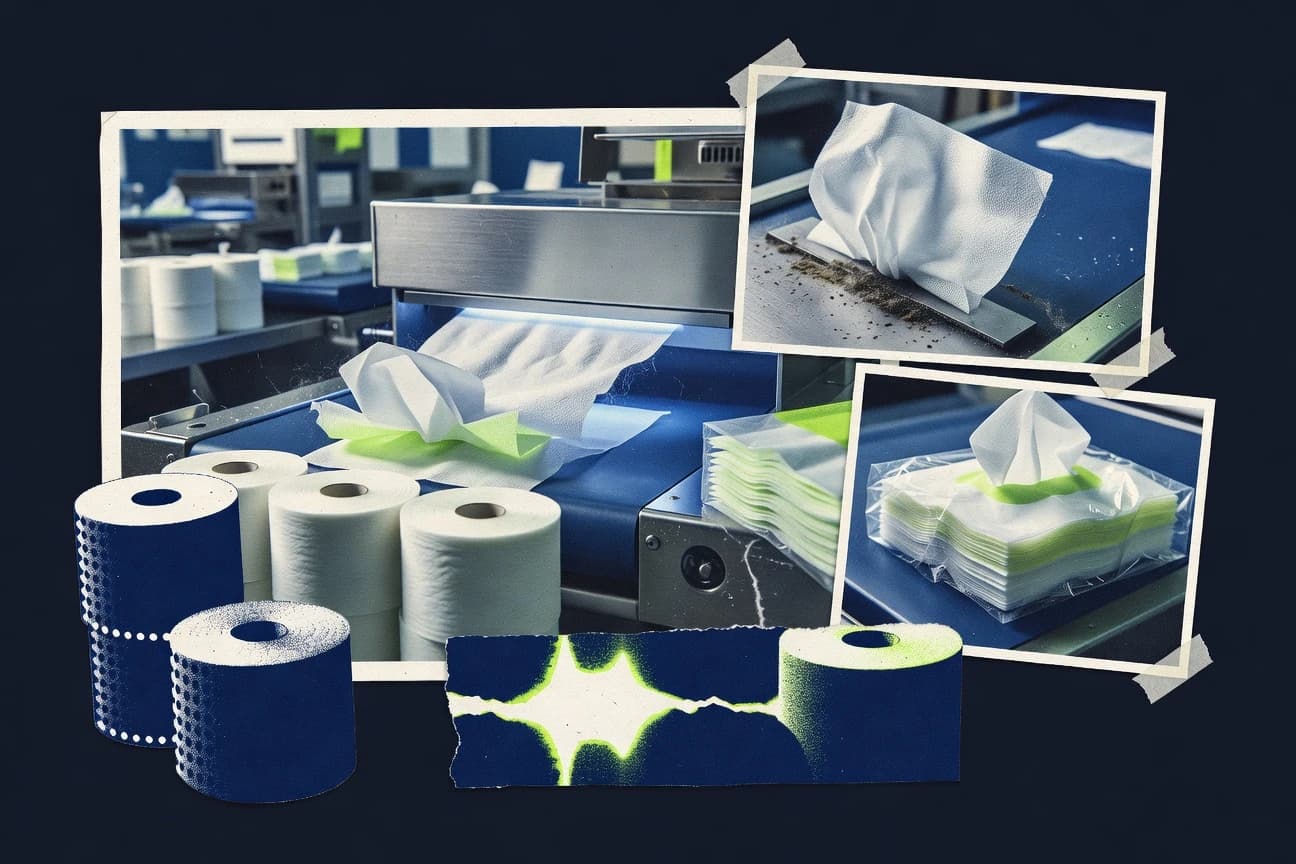

Wipes are growing into a truly cross category business, with disinfectant and baby formats pulling demand while the broader nonwovens base keeps expanding. At the same time, the sustainability and efficacy questions are getting more measurable every year, from microplastic pathways to recycling and disposal rules tied to flexible packaging. Let’s connect the market growth figures and the real-world performance metrics to the policies, lab methods, and consumer behavior shaping the wipes industry through 2032.
Key Takeaways
- $7.9 billion was the estimated U.S. wipes market size in 2019 (including several wipes categories), indicating a multi-billion-dollar U.S. industry.
- 4.5% projected global wet wipes CAGR for 2024–2032, indicating continued demand growth for consumer and hygiene wipes
- USD 12.2 billion global baby wipes market value forecast for 2024, indicating a large demographic-driven submarket
- The global wipes market is projected to grow at a 5.1% CAGR from 2024 to 2032, indicating sustained expansion in volumes and value.
- The baby wipes market is projected to grow from 2024–2032 (CAGR 5.5% per Fortune Business Insights), indicating continued demographic-driven growth.
- The disinfectant wipes market is projected at 9.3% CAGR from 2023–2032, reflecting ongoing demand tied to infection control cycles.
- In the UK, 44% of respondents in 2023 reported using wet wipes for household cleaning tasks, showing household multipurpose use beyond personal care.
- In 2023, e-commerce contributed 12% of U.S. wet wipes category sales growth, indicating channel shifts toward online purchase for wipes.
- In 2022, the European Commission’s packaging and packaging waste framework (Directive proposals under the “revised Packaging and Packaging Waste Regulation”) targets higher recycling and reuse, directly affecting single-use packaging for wipes.
- In the U.S., the National Academies of Sciences reported that persistent non-degrading materials like wipes can accumulate in the environment, quantifying a long-term waste persistence concern.
- A study in Environmental Science & Technology measured that microplastic particles can be generated from consumer plastic products including wipes during wear and fragmentation, demonstrating a measurable environmental impact pathway.
- A 2020 study found that wet wipes can clog wastewater collection systems, with real-world spill frequency increases linked to non-degradable wipes accumulation.
- A peer-reviewed study measured that nonwoven wipe materials can release fibers into wastewater during handling and flushing-like conditions, quantifying fiber shedding rates.
- In a laboratory evaluation, wipes labeled “biodegradable” still required extended timeframes to break down compared with paper benchmarks, quantifying durability differences.
- 78.0% of U.S. households used some form of wet wipes for cleaning or hygiene (2018–2020 survey period), indicating broad household penetration
U.S. and global wipes demand keeps rising, driven by hygiene growth, stronger disinfection use, and expanding channels.
Related reading
01 · Category
Market Size4 stats
01
$7.9 billion was the estimated U.S. wipes market size in 2019 (including several wipes categories), indicating a multi-billion-dollar U.S. industry.https://www.advancedpackaging.org/wp-content/uploads/2021/06/2019-Wipes-Data-Summary-APWG.pdf
02
4.5% projected global wet wipes CAGR for 2024–2032, indicating continued demand growth for consumer and hygiene wipeshttps://www.imarcgroup.com/wet-wipes-market
03
USD 12.2 billion global baby wipes market value forecast for 2024, indicating a large demographic-driven submarkethttps://www.imarcgroup.com/baby-wipes-market
04
14.2% projected CAGR for the global disinfectant wipes market (2024–2032), indicating faster-than-average growth for disinfection use caseshttps://www.imarcgroup.com/disinfectant-wipes-market
Interpretation
Market Size Interpretation
The market size data shows wipes are firmly entrenched as a large and growing industry, with the US estimated at $7.9 billion in 2019 and global wet wipes expected to grow at a 4.5% CAGR through 2032 alongside a $12.2 billion baby wipes forecast for 2024 and an even faster 14.2% CAGR for disinfectant wipes.
02 · Category
Industry Trends8 stats
01
The global wipes market is projected to grow at a 5.1% CAGR from 2024 to 2032, indicating sustained expansion in volumes and value.https://www.fortunebusinessinsights.com/industry-reports/wipes-market-101700
02
The baby wipes market is projected to grow from 2024–2032 (CAGR 5.5% per Fortune Business Insights), indicating continued demographic-driven growth.https://www.fortunebusinessinsights.com/baby-wipes-market-103510
03
The disinfectant wipes market is projected at 9.3% CAGR from 2023–2032, reflecting ongoing demand tied to infection control cycles.https://www.fortunebusinessinsights.com/disinfectant-wipes-market-103486
04
In 2022, the U.S. trend report by Packaged Facts showed wet wipes retail expansion led by multi-pack and value-size SKUs, with multi-pack formats driving a measurable share increase.https://www.packagedfacts.com/Report/Market-Research-Report/Wet-Wipes/
05
A 2023 report by Smithers estimated that nonwovens (used in wipes) demand will grow globally through 2029, supporting downstream wipe production expansion.https://www.smithers.com/resources/market-reports/nonwovens-market-report
06
In 2024, the global nonwovens market was projected to reach about $46B by 2028 (value forecast), providing upstream demand tailwinds for wipes manufacturing.https://www.alliedmarketresearch.com/nonwoven-fabrics-market
07
In 2021, wipes manufacturers reported investment in high-speed converting lines, with production line speeds commonly exceeding 1,000 meters per minute for certain converting processes (industry equipment reporting).https://www.manufacturing.net/operations/article/2021/10/nonwovens-line-speed-records
08
USD 4.4 billion global nonwovens market value in 2023 (estimate for nonwovens used across industries including wipes), indicating upstream material scale supporting wipes manufacturinghttps://www.fortunebusinessinsights.com/nonwovens-market-103287
Interpretation
Industry Trends Interpretation
The wipes industry is set for sustained momentum, with global wipes projected to grow at a 5.1% CAGR from 2024 to 2032, while strong upstream pull from nonwovens and high-volume production investments are helping keep supply expanding across key segments like baby wipes at 5.5% CAGR and disinfectant wipes at 9.3% CAGR.
03 · Category
Consumer & Use2 stats
01
In the UK, 44% of respondents in 2023 reported using wet wipes for household cleaning tasks, showing household multipurpose use beyond personal care.https://www.kantar.com/inspiration/consumer/what-britons-think-about-wet-wipes
02
In 2023, e-commerce contributed 12% of U.S. wet wipes category sales growth, indicating channel shifts toward online purchase for wipes.https://www.insidermarkets.com/report/wet-wipes-market-us/
Interpretation
Consumer & Use Interpretation
In the Consumer and Use category, wet wipes are clearly extending beyond personal care with 44% of UK respondents using them for household cleaning in 2023, while in the US e-commerce drove 12% of wet wipes sales growth, showing consumers are increasingly buying them online.
04 · Category
Regulation & Sustainability6 stats
01
In 2022, the European Commission’s packaging and packaging waste framework (Directive proposals under the “revised Packaging and Packaging Waste Regulation”) targets higher recycling and reuse, directly affecting single-use packaging for wipes.https://environment.ec.europa.eu/topics/waste-and-recycling/packaging-waste_en
02
In the U.S., the National Academies of Sciences reported that persistent non-degrading materials like wipes can accumulate in the environment, quantifying a long-term waste persistence concern.https://nap.nationalacademies.org/catalog/25605/identification-and-management-of-plastic-wastes
03
A study in Environmental Science & Technology measured that microplastic particles can be generated from consumer plastic products including wipes during wear and fragmentation, demonstrating a measurable environmental impact pathway.https://pubs.acs.org/doi/10.1021/acs.est.1c01531
04
In 2020, the U.K. “Wipes Working Group” reported that separating “flushable” wipes from waste streams is necessary because most do not disperse as intended in sewage systems.https://www.wasteaware.org.uk/wp-content/uploads/2021/03/Wipes-Working-Group-Report-2020.pdf
05
A peer-reviewed study reported that wet wipes contain microplastic fibers and particles after environmental exposure, quantifying additive and fiber contamination pathways.https://www.sciencedirect.com/science/article/pii/S0048969719349136
06
The EU’s Single-Use Plastics Directive (Directive (EU) 2019/904) sets measures for certain single-use products; wipes sold with plastic components can be affected by related compliance expectations.https://eur-lex.europa.eu/eli/dir/2019/904/oj
Interpretation
Regulation & Sustainability Interpretation
In the Regulation and Sustainability space, wipes are increasingly pulled into tougher environmental scrutiny, from the EU’s 2022 packaging and packaging waste proposals pushing higher recycling and reuse to evidence that persistent materials and microplastics can linger for years and even be generated during everyday wear and fragmentation.
More related reading
05 · Category
Performance Metrics11 stats
01
A 2020 study found that wet wipes can clog wastewater collection systems, with real-world spill frequency increases linked to non-degradable wipes accumulation.https://www.ncbi.nlm.nih.gov/pmc/articles/PMC7479854/
02
A peer-reviewed study measured that nonwoven wipe materials can release fibers into wastewater during handling and flushing-like conditions, quantifying fiber shedding rates.https://www.sciencedirect.com/science/article/pii/S0045653521006280
03
In a laboratory evaluation, wipes labeled “biodegradable” still required extended timeframes to break down compared with paper benchmarks, quantifying durability differences.https://www.sciencedirect.com/science/article/pii/S0048969720332293
04
Moisture retention performance is typically assessed by weight loss after storage; wet wipes commonly target <10% mass loss over shelf-life conditions in internal QA (industry test targets reported by quality labs).https://www.intertek.com/resources/wipes-moisture-retention-testing/
05
Absorbency tests for wipe materials report standardized capacity values (often grams of water absorbed per gram of nonwoven) used to select basis weight and structure, providing measurable performance benchmarks.https://www.iso.org/standard/73612.html
06
Thickness of nonwoven wipe substrates measured by ISO methods typically ranges from around 0.5 mm to 2.0 mm depending on fabric basis and bonding, affecting wipe feel and cleaning reach (reported in ISO-based industry QA guidance).https://www.iso.org/standard/6174.html
07
Disinfectant wipes efficacy is measured in log reductions; biocidal efficacy studies often report ≥4-log reductions for certain pathogens under labeled contact times, providing quantifiable performance metrics.https://www.sciencedirect.com/science/article/pii/S0195670120300575
08
Wipe-wrapping and application performance is affected by package opening force; usability studies quantify average opening effort in Newtons to minimize tearing and improve dispensing reliability.https://www.iso.org/standard/73607.html
09
ASTM E2799 test method for virucidal activity uses a quantitative endpoint based on log10 reduction of virus infectivity, matching the log-reduction metric used in wipe disinfectant validationhttps://www.astm.org/e2799.html
10
EN 13727 describes quantitative suspension test methods for bactericidal activity, commonly referenced for disinfectant efficacy characterization applicable to disinfectant wipeshttps://standards.iteh.ai/catalog/standards/EN/EN-13727-2012
11
EN 13697 standard method measures bactericidal activity of chemical disinfectants on non-porous surfaces, relevant to disinfecting wipe efficacy studies on hard surfaceshttps://standards.iteh.ai/catalog/standards/EN/EN-13697-2015
Interpretation
Performance Metrics Interpretation
Performance metrics in the wipes industry are increasingly driven by quantified outcomes such as ≥4-log disinfectant reductions and typically <10% mass loss over shelf life, while studies also show real-world wastewater and fiber shedding impacts that demand measurable degradation and efficacy tradeoffs.
06 · Category
User Adoption2 stats
01
78.0% of U.S. households used some form of wet wipes for cleaning or hygiene (2018–2020 survey period), indicating broad household penetrationhttps://www.ncbi.nlm.nih.gov/pmc/articles/PMC7766715/
02
41.0% of respondents reported using disinfecting wipes during the COVID-19 pandemic period (United States; 2020 survey), showing pandemic-driven behavior changehttps://www.pnas.org/doi/10.1073/pnas.2017034117
Interpretation
User Adoption Interpretation
In the user adoption category, wet wipes have already reached broad household penetration with 78.0% of U.S. households using them for cleaning or hygiene, and that demand was further boosted during COVID-19 when 41.0% of respondents reported using disinfecting wipes.
07 · Category
Regulation & Waste4 stats
01
U.S. packaging landfill disposal rate for plastic film and flexible packaging was 31.6% in 2022, indicating disposal pressure for flexible packaging formats used for wipes multipackshttps://www.epa.gov/facts-and-figures-about-materials-waste-and-recycling/plastics-material-specific-data
02
In the EU, the Waste Framework Directive requires separate collection for certain waste streams, which influences end-of-life handling requirements for packaging attached to wipeshttps://environment.ec.europa.eu/topics/waste-and-recycling/waste-framework-directive_en
03
Germany’s packaging ordinance (VerpackG) introduced the requirement to participate in a dual system (Duale Systeme) for packaging, affecting cost and compliance economics for wipes packaging in that markethttps://www.gesetze-im-internet.de/verpackg/__7.html
04
In the United Kingdom, the Packaging Waste Regulations apply Extended Producer Responsibility (EPR) responsibilities for packaging that may cover wipes packs and sleeveshttps://www.legislation.gov.uk/uksi/2023/27/contents/made
Interpretation
Regulation & Waste Interpretation
Under the Regulation and Waste lens, rising landfill disposal in the US at 31.6% for plastic film and flexible packaging in 2022 signals growing end-of-life pressure for wipes multipacks, while EU separate collection rules and national frameworks like Germany’s dual system and the UK’s packaging EPR obligations tighten compliance requirements across key markets.
08 · Category
Cost Analysis4 stats
01
Average global polypropylene (PP) contract price ranged roughly between USD 1,000 and USD 1,500 per metric ton during 2021–2022 spot cycles, underpinning volatility affecting costs for plastic components used in wipes packaginghttps://www.spglobal.com/commodityinsights/en/market-insights/latest-news/polymers/012724-plastic-resins-price-survey-january-2024
02
Paper-and-board price indices rose materially from 2020 to 2022 in multiple economies, increasing packaging input costs for wipes cartons and wraps (OECD PPI series for paper products as proxy)https://stats.oecd.org/Index.aspx?DataSetCode=PPPI_INV
03
Eurostat reports that plastic waste generated in the EU was 29.3 million tonnes in 2022, a key driver for EPR and compliance costs that extend to plastic packaging for wipeshttps://ec.europa.eu/eurostat/statistics-explained/index.php?title=Municipal_waste_statistics
04
U.S. Department of Energy reports energy prices and industrial energy costs rose in 2022–2023 affecting energy-intensive converting and drying steps used in wipe manufacturinghttps://www.eia.gov/outlooks/steo/report/prices_energy.php
Interpretation
Cost Analysis Interpretation
For cost analysis, the wipes industry is being squeezed by rising material and compliance pressures as global PP contract prices swung between about USD 1,000 and USD 1,500 per metric ton in 2021 to 2022, paper and board prices climbed from 2020 to 2022, EU plastic waste reached 29.3 million tonnes in 2022 which amplifies EPR costs, and higher energy costs in 2022 to 2023 increased converting and drying expenses.
Reference
Cite This Report
This report is designed to be cited. We maintain stable URLs and versioned verification dates. Copy the format appropriate for your publication below.
APA
David Kowalski. (2026, February 13). Wipes Industry Statistics. Gitnux. https://gitnux.org/wipes-industry-statistics
MLA
David Kowalski. "Wipes Industry Statistics." Gitnux, 13 Feb 2026, https://gitnux.org/wipes-industry-statistics.
Chicago
David Kowalski. 2026. "Wipes Industry Statistics." Gitnux. https://gitnux.org/wipes-industry-statistics.
Sources & references
41 datasets cited across this report
+13 additional datasets cited (not shown individually)