
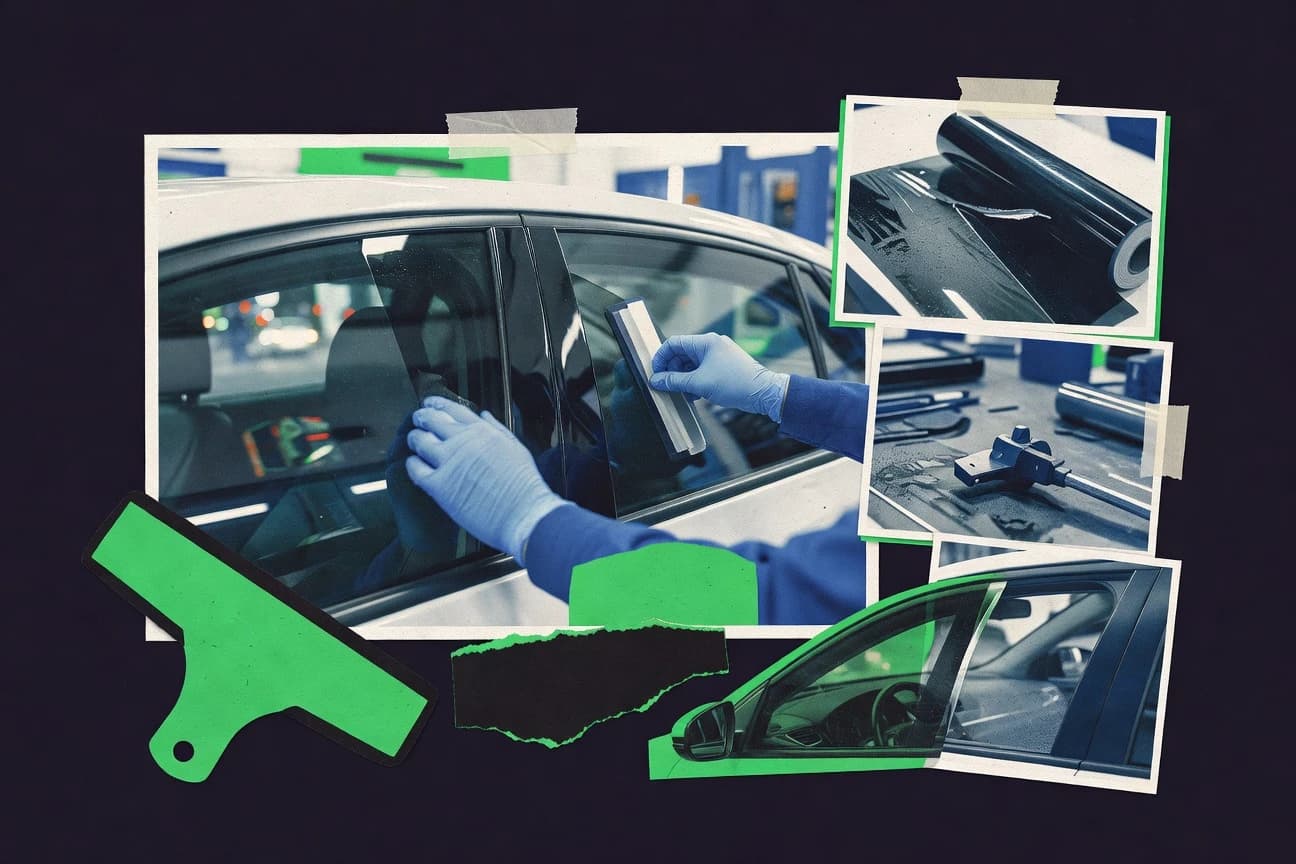

Window tinting demand is shaped by daily drivers and homeowners across the U.S., North America, Europe, and Australia. In 2023, U.S. tinting shops generated $2.8 billion in revenue, up 5.2% from 2022, supported by rising automotive aftermarket demand. Service capacity and profitability depend on labor-heavy operations and peak-season throughput, while VLT rules and safety standards determine what can be installed and where.
Key Takeaways
- Average U.S. tint shop handles 150 vehicles per month, with peak season May-September at 65% capacity utilization.
- Labor costs account for 42% of total expenses in U.S. window tinting businesses in 2023.
- 78% of tint shops in North America use CRM software for customer scheduling, improving efficiency by 25%.
- 62% of U.S. window tinting customers are aged 25-44, primarily urban millennials seeking vehicle customization.
- 45% of residential window tint buyers in the U.S. are homeowners aged 35-54 with household incomes over $100,000.
- In Europe, 38% of window tint purchasers are women, up from 28% in 2018, favoring privacy films.
- The U.S. window tinting industry generated $2.8 billion in revenue in 2023, marking a 5.2% increase from 2022 due to rising automotive aftermarket demand.
- Global window film market size reached $4.1 billion in 2022 and is expected to grow to $6.7 billion by 2030 at a CAGR of 6.3%, fueled by energy-efficient building applications.
- Automotive window tinting segment accounted for 52% of the total window tint market share in North America in 2023.
- 43 U.S. states mandate VLT limits for front side windows at 35% or higher in 2023.
- California limits windshield tint to 70% VLT, with medical exemptions granted to 12% applicants.
- EU ECE R43 standard requires rear windows >6% VLT for safety glass, tint extras restricted.
- Ceramic films comprise 58% of product sales in premium tint shops.
- Nano-carbon window tints block 99.9% IR rays while allowing 70% VLT, per 2023 lab tests.
- Smart PDLC film switches opacity in 0.1 seconds via 24V app control for architectural use.
U.S. window tinting revenue grew to $2.8 billion in 2023 as profit and demand increased.
Related reading
01 · Category
Business Operations19 stats
01
Average U.S. tint shop handles 150 vehicles per month, with peak season May-September at 65% capacity utilization.
02
Labor costs account for 42% of total expenses in U.S. window tinting businesses in 2023.
03
78% of tint shops in North America use CRM software for customer scheduling, improving efficiency by 25%.
04
Average profit margin for independent U.S. tint shops is 18-22% post-2023 overheads.
05
Franchise window tint outlets report 15% higher customer retention via loyalty programs.
06
Equipment costs for a standard tint installation bay average $45,000-$60,000 in 2023.
07
62% of U.S. tint businesses expanded mobile services in 2023, boosting revenue by 12%.
08
Inventory turnover rate for window films in tint shops is 4.2 times per year on average.
09
Marketing spend averages 8% of revenue for top-performing tint shops, ROI 4:1 on digital ads.
10
Employee turnover in window tinting industry stands at 22% annually, highest for installers.
11
Average tint job ticket value: $350for autos, $1,200 for residential in U.S. 2023.
12
55% of tint shops offer warranties averaging 5-7 years on ceramic films.
13
Utility costs represent 7% of operating expenses, reduced 15% via LED shop lighting.
14
Online booking adopted by 68% of U.S. tint businesses, cutting no-show rates by 30%.
15
Insurance premiums for tint shops averaged $12,000/year in 2023 for liability coverage.
16
Peak daily installs per technician: 8-10 vehicles in high-volume shops.
17
Rent/lease costs: 10-12% of revenue for urban tint locations.
18
45% of businesses use POS systems integrated with inventory, reducing errors by 40%.
19
Average shop size: 2,500 sq ft, with 3-5 bays for mid-tier operations.
Interpretation
Business Operations Interpretation
Business operations in U.S. window tinting are being shaped by capacity and staffing realities, since an average shop handles 150 vehicles per month with May through September running at 65% utilization while labor drives 42% of total expenses, making CRM adoption and retention tactics increasingly important to protect the 18 to 22% post overhead profit margins.
02 · Category
Consumer Demographics18 stats
01
62% of U.S. window tinting customers are aged 25-44, primarily urban millennials seeking vehicle customization.
02
45% of residential window tint buyers in the U.S. are homeowners aged 35-54 with household incomes over $100,000.
03
In Europe, 38% of window tint purchasers are women, up from 28% in 2018, favoring privacy films.
04
71% of automotive tint customers in Australia are male drivers under 40, per 2023 surveys.
05
U.S. Gen Z (18-24) represents 22% of new window tint service inquiries, driven by social media trends.
06
55% of commercial window tint clients in North America are small business owners aged 40-60.
07
In China, 65% of luxury car owners (income > RMB 500k) opt for premium window tints.
08
UK window tint market sees 48% female uptake in residential sector, focused on child safety films.
09
59% of U.S. tint shop repeat customers are families with children under 12, citing UV protection.
10
Brazilian window tint buyers average age 32, with 70% urban residents in top 10 cities.
11
67% of smart window tint adopters in the U.S. have college degrees and tech professions.
12
Canada tint customers: 52% aged 30-49, 60% in provinces with high sunlight hours like BC and ON.
13
Middle East: 75% of window tint users are expatriates aged 25-45 in GCC countries.
14
41% of EU residential tint buyers are renters seeking energy savings, avg age 28-37.
15
U.S. marine tint segment: 80% male boat owners 45+, income $150k+.
16
India: 55% of two-wheeler tint buyers are youth 18-30 in metro areas.
17
49% of franchise tint customers in U.S. are Hispanic or Asian demographics.
18
Global: 36% women in automotive tint market, highest in privacy-focused segments.
Interpretation
Consumer Demographics Interpretation
Across the consumer demographic data, the biggest takeaway is that window tint demand is being driven by prime working age buyers, with 62% of U.S. automotive tint customers aged 25 to 44 and 45% of U.S. residential buyers aged 35 to 54 with incomes over $100,000, showing strong alignment with millennials and affluent homeowners seeking privacy and customization.
03 · Category
Market Size & Growth23 stats
01
The U.S. window tinting industry generated $2.8 billion in revenue in 2023, marking a 5.2% increase from 2022 due to rising automotive aftermarket demand.
02
Global window film market size reached $4.1 billion in 2022 and is expected to grow to $6.7 billion by 2030 at a CAGR of 6.3%, fueled by energy-efficient building applications.
03
Automotive window tinting segment accounted for 52% of the total window tint market share in North America in 2023.
04
The residential window tinting market in Europe expanded by 7.8% YoY in 2023, reaching €1.2 billion.
05
U.S. commercial window tinting services revenue hit $850 million in 2023, with a projected CAGR of 4.9% through 2028.
06
Asia-Pacific window tinting market grew at 8.1% CAGR from 2018-2023, driven by rapid urbanization in China and India.
07
Window tinting industry employment in the U.S. increased to 25,400 jobs in 2023, up 3.5% from prior year.
08
Global smart window tint market valued at $1.2 billion in 2023, forecasted to reach $4.5 billion by 2032 at 15.9% CAGR.
09
U.S. automotive tinting aftermarket saw $1.65 billion in sales in 2023.
10
Window film market in Latin America projected to grow from $320 million in 2023 to $520 million by 2030.
11
Canadian window tinting industry revenue reached CAD 450 million in 2023, with 6% growth.
12
Middle East window tinting market expanded 9.2% in 2023 due to luxury vehicle imports.
13
U.S. window tint franchises contributed $1.1 billion to industry revenue in 2023.
14
Global ceramic window film segment grew 11.4% YoY in 2023 to $1.8 billion.
15
Australian window tinting market valued at AUD 350 million in 2023, up 4.7%.
16
U.S. residential solar control window films sales increased 6.8% to $420 million in 2023.
17
Global nano-ceramic tint market reached $950 million in 2023, CAGR 12.1% projected.
18
U.S. marine window tinting segment generated $180 million in 2023.
19
India window tinting market grew 10.5% to INR 15 billion in 2023.
20
$19.0 billion was the global window tinting market size in 2022 (industry revenue)
21
$31.9 billion is forecast global window tinting market size in 2030 (industry revenue)
22
$2.9 billion was the U.S. window tinting market size in 2022 (industry revenue)
23
$3.1 billion is forecast U.S. window tinting market size in 2023 (industry revenue)
Interpretation
Market Size & Growth Interpretation
The window tinting market is clearly in an expansion phase, with the global market rising from $4.1 billion in 2022 to a projected $6.7 billion by 2030 at a 6.3% CAGR, while the U.S. industry alone reached $2.8 billion in 2023 with a 5.2% year over year gain, reinforcing steady Market Size and Growth momentum across regions and segments.
More related reading
04 · Category
Regulations & Safety16 stats
01
43 U.S. states mandate VLT limits for front side windows at 35% or higher in 2023.
02
California limits windshield tint to 70% VLT, with medical exemptions granted to 12% applicants.
03
EU ECE R43 standard requires rear windows >6% VLT for safety glass, tint extras restricted.
04
NHTSA FMVSS 205 crash test shows factory tints survive 70 mph impacts without delamination.
05
OSHA requires tint installers use ANSI Z87.1 eye protection, compliance 92% in audits.
06
UK MOT tests reject vehicles with front tints below 75% VLT, failure rate 3.2%.
07
Medical tint exemptions in Texas allow 32% VLT for photophobia, 8,500 approvals 2023.
08
ISO 9050 solar transmittance testing mandatory for architectural tints in EU.
09
Australia AS/NZS 2080 mandates rear tints >35% VLT, fines up to AUD 500.
10
NFPA 101 life safety code requires untinted vision panels in emergency exits.
11
Canada limits front windshield strip tint to 4 inches from top, CMVSS 205.
12
Brazil CONTRAN 667 bans tints below 28% VLT on sides, seizures up 15% 2023.
13
ASTM E903 measures SHGC for energy codes, tints must <0.40 for credits.
14
Florida allows 15% rear VLT, but 28% front, with strip exemption.
15
IECC 2021 code gives 5% energy credit for SHGC<0.40 window films.
16
Headlamp tinting illegal in 50 U.S. states, DOT visibility standards.
Interpretation
Regulations & Safety Interpretation
In the Regulations and Safety space, requirements are tightening and harmonizing around measurable visibility thresholds, with 43 U.S. states setting front-side VLT at 35% or higher in 2023 and the UK MOT effectively rejecting front tints under 75% VLT with a 3.2% failure rate.
05 · Category
Technology & Products18 stats
01
Ceramic films comprise 58% of product sales in premium tint shops.
02
Nano-carbon window tints block 99.9% IR rays while allowing 70% VLT, per 2023 lab tests.
03
Smart PDLC film switches opacity in 0.1 seconds via 24V app control for architectural use.
04
UV rejection rates: Standard dyed films 98%, metallized 99.5%, ceramic 99.9% across brands.
05
Self-healing polyurethane top coats on premium tints repair scratches up to 0.3mm deep.
06
Electrochromic films reduce building energy use by 26% via dynamic tinting, DOE 2023 study.
07
1-ply nano-ceramic films achieve 50% TSER with <1% metallic content, avoiding GPS interference.
08
Anti-graffiti hydrophobic coatings on tints last 5 years, repelling water/oil at 110° angle.
09
SPD (suspended particle device) films block 99.5% UV, switchable VLT 0.5-55% in 200ms.
10
Multi-layer sputtered metal oxides in IR films reflect 90% solar heat without haze >0.5%.
11
Biodegradable tint prototypes degrade 80% in 3 years under UV, developed 2023.
12
Thermochromic films auto-darken at 28°C, reducing AC load by 18% in vehicles.
13
Scratch-resistant hardness: 3H pencil for standard, 9H for nano-coated premium tints.
14
Color-stable dyes in non-metallic films fade <5% after 10,000 hour QUV test.
15
Hybrid ceramic-metallic films offer 65% IR block at 35% VLT for legal compliance.
16
Photochromic tints adapt to sunlight intensity, varying VLT 20-70% dynamically.
17
Low-E ceramic films for buildings achieve U-value 0.25, SHGC 0.22 per NFRC 2023.
18
Graphene-infused tints conduct heat away 40% faster, reducing hotspots by 15°C.
Interpretation
Technology & Products Interpretation
In Technology & Products, the tint market is clearly shifting toward high performance materials and controls, with ceramic leading at 58% of premium sales, ceramic and nano-carbon achieving 99.9% IR and up to 70% VLT, and dynamic film tech like electrochromic reducing building energy use by 26% through real time tinting.
Reference
Cite This Report
This report is designed to be cited. We maintain stable URLs and versioned verification dates. Copy the format appropriate for your publication below.
APA
David Kowalski. (2026, February 13). Window Tinting Industry Statistics. Gitnux. https://gitnux.org/window-tinting-industry-statistics
MLA
David Kowalski. "Window Tinting Industry Statistics." Gitnux, 13 Feb 2026, https://gitnux.org/window-tinting-industry-statistics.
Chicago
David Kowalski. 2026. "Window Tinting Industry Statistics." Gitnux. https://gitnux.org/window-tinting-industry-statistics.
Sources & references
1 datasets cited across this report · attribution is report-level