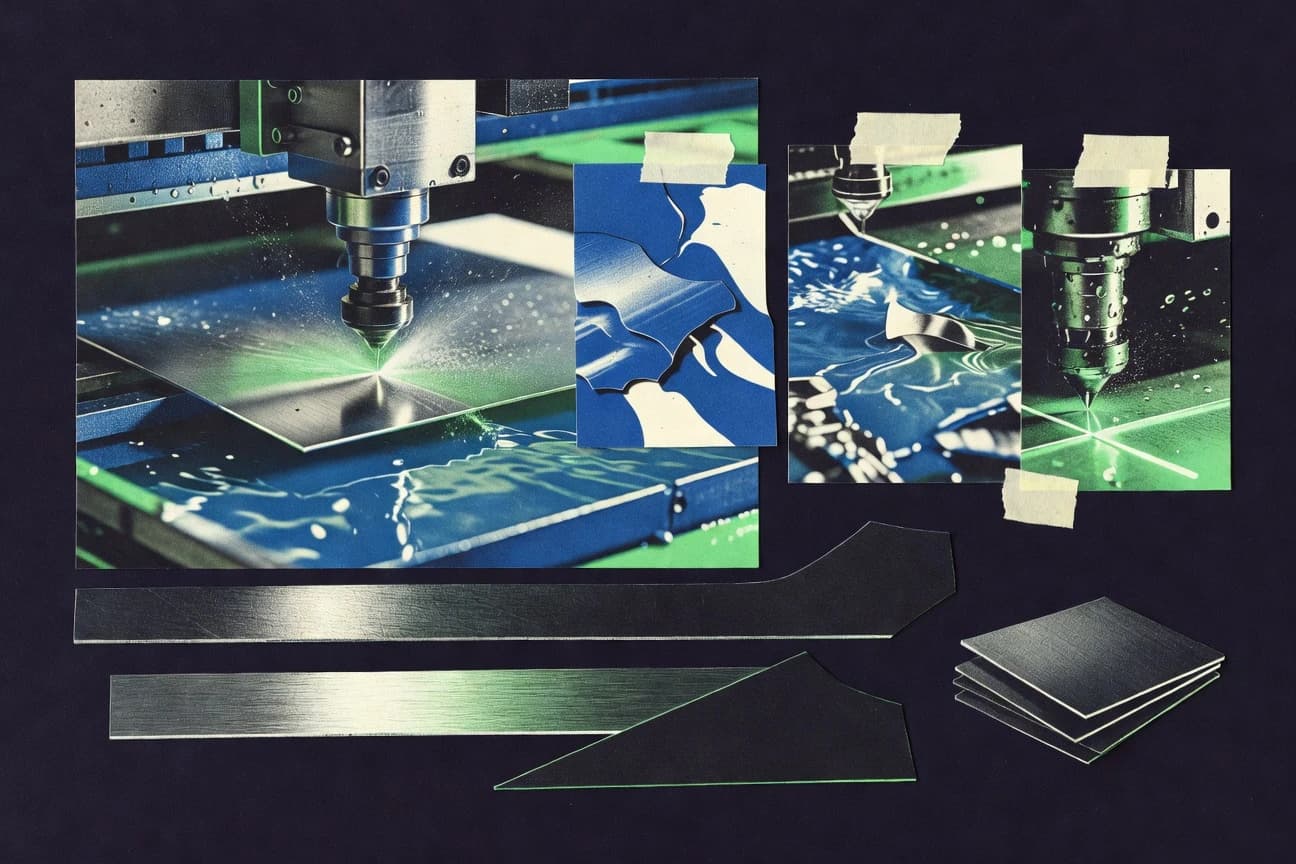

In 2022 the global waterjet cutting machine market was valued at USD 1.24 billion and it is projected to grow at a 6.8% CAGR through 2030, but the real story is how the process itself keeps changing what “possible” means on the shop floor. One pass with a waterjet can preserve material properties with zero heat affected zone while still achieving ±0.1 mm tolerances, and that combination shows up across aerospace trimming, titanium prototypes, and even 90% of frozen food portioning. Let’s look at the dataset where economics and precision meet, from 94,000 PSI cutting power to closed loop water reuse and garnet recovery.
Key Takeaways
- Waterjets produce no Heat Affected Zone (HAZ), preserving material properties in 100% of cuts.
- Waterjet cutting costs 30-50% less than laser for materials over 25mm thick.
- Waterjets cut any material including composites without delamination, unlike milling which causes 5-10% damage.
- Waterjet cutting machines utilize pressures up to 94,000 PSI for cutting materials up to 200mm thick with tolerances of ±0.1mm.
- Modern waterjet systems feature dynamic waterjet (DWJ) technology allowing 5-axis bevel cutting up to 60 degrees.
- Abrasive waterjets consume 0.5-1.0 kg of garnet per hour at cutting speeds of 100-500 mm/min.
- Aerospace industry uses waterjets for 65% of composite material trimming operations.
- Automotive sector employs waterjets for cutting 40% of prototype parts made from titanium and Inconel.
- Stone and tile fabrication utilizes waterjets for 75% of intricate marble inlays and countertops.
- The global waterjet cutting machine market size was valued at USD 1.24 billion in 2022 and is expected to grow at a CAGR of 6.8% from 2023 to 2030, reaching approximately USD 2.10 billion by 2030.
- North America held the largest market share of 35% in the waterjet cutting industry in 2022, driven by advanced manufacturing sectors.
- The abrasive waterjet cutting segment accounted for over 70% of the total market revenue in 2023 due to its precision in hard materials.
- Waterjet cutting systems recycle 85-95% of water used in closed-loop systems.
- Garnet abrasive recycling in waterjets recovers 60-70% reducing landfill waste by 500 tons/year per facility.
- Waterjet operations produce zero hazardous emissions, complying with OSHA and EPA standards 100%.
Waterjet cutting delivers clean, precise cuts with no HAZ and growing global demand, especially for thick and hard materials.
Related reading
01 · Category
Advantages & Comparisons20 stats
01
Waterjets produce no Heat Affected Zone (HAZ), preserving material properties in 100% of cuts.
02
Waterjet cutting costs 30-50% less than laser for materials over 25mm thick.
03
Waterjets cut any material including composites without delamination, unlike milling which causes 5-10% damage.
04
Kerf width in waterjets is 0.8-1.2mm, allowing nested parts with 15% less waste than plasma.
05
Waterjets operate 24/7 with consumable costs of $0.15per cutting minute.
06
No tool changes needed in waterjets, reducing setup time by 80% vs. EDM.
07
Waterjets achieve surface finish Ra 3.2µm straight from cut, eliminating secondary finishing in 70% cases.
08
Stack cutting up to 100 layers possible with waterjets, boosting productivity 10x over single-sheet processes.
09
Waterjets have unlimited part length on gantry systems vs. fixed bed limits in CNC routers.
10
Operating costs of waterjets are 40% lower than wire EDM for similar tolerances.
11
Waterjets handle reflective materials like copper without beam absorption issues of lasers.
12
Cold cutting by waterjets prevents warping, ideal for thin foils where lasers cause 20% distortion.
13
Waterjets cut faster than sawing for intricate shapes, 3-5x speed advantage.
14
Minimal fixturing required for waterjets, saving 50% labor vs. traditional machining.
15
Waterjets excel in small batch production with setup times under 5 minutes.
16
No hazardous fumes or gases from waterjets, unlike laser/plasma producing VOCs.
17
Waterjets maintain edge quality on layered materials, reducing rejects by 25% vs. shearing.
18
Consumables in waterjets last 8-10x longer than router bits.
19
Waterjets provide better tolerance on thick materials (±0.25mm up to 150mm) than oxy-fuel.
20
Energy consumption of waterjets is 60% less than electrochemical machining.
Interpretation
Advantages & Comparisons Interpretation
Waterjet cutting stands out in the advantages and comparisons category because it preserves material properties with zero HAZ while delivering a 30 to 50 percent cost advantage over laser for over 25 mm thickness and achieving nested part layouts using a 0.8 to 1.2 mm kerf for about 15 percent less waste.
02 · Category
Equipment & Technology29 stats
01
Waterjet cutting machines utilize pressures up to 94,000 PSI for cutting materials up to 200mm thick with tolerances of ±0.1mm.
02
Modern waterjet systems feature dynamic waterjet (DWJ) technology allowing 5-axis bevel cutting up to 60 degrees.
03
Abrasive waterjets consume 0.5-1.0 kg of garnet per hour at cutting speeds of 100-500 mm/min.
04
HyperJet® intensifier pumps deliver 90,000 PSI continuously with 55% efficiency.
05
Waterjet nozzles have orifice diameters as small as 0.010 inches for pure water and 0.014 for abrasive.
06
CAD/CAM software like FlowXpert integrates nesting algorithms reducing material waste by 20-30%.
07
Waterjet cutting heads can achieve taper control to less than 0.05 degrees using advanced mixing tubes.
08
Servo-driven ball screw systems in waterjets provide positioning accuracy of ±0.025mm.
09
Real-time pierce detection sensors in waterjets reduce setup time by 50%.
10
Waterjet pumps use hydraulic intensifiers with stroke rates up to 50 per minute.
11
Abrasive feed systems in waterjets handle 1-2 tons of garnet with hopper capacities of 500kg.
12
Waterjet cutting tables range from 1m x 1m to 6m x 3m with Z-axis travel up to 1m.
13
Intelligent nozzle cleaning systems extend mixing tube life to 100+ hours.
14
Waterjets integrate laser tracing for edge alignment within 0.1mm accuracy.
15
Ultra-high pressure tubing in waterjets rated to 100,000 PSI with 1/4-inch diameter.
16
Waterjet controllers use Ethernet/IP for Industry 4.0 connectivity and remote monitoring.
17
Passive abatement systems capture 99.9% of water mist and abrasives in waterjets.
18
Waterjet garnet recycling systems recover up to 70% of used abrasive.
19
Tilt-a-Jet® heads on waterjets automatically compensate taper up to ±7.5 degrees.
20
Waterjet systems support multi-head configurations for throughput up to 5x single head.
21
Quantum Leap® cutting models predict kerf width within 0.01mm accuracy.
22
Waterjet bridge-style gantries reduce deflection to <0.05mm over 4m spans.
23
Active vibration damping in waterjet bases improves stability for high-speed cuts.
24
Waterjets use CCD cameras for automated part inspection with 0.05mm resolution.
25
Modular waterjet platforms allow field upgrades from 3-axis to 5-axis in 4 hours.
26
Waterjet orifice gems made of sapphire withstand 100,000 PSI for 200+ hours.
27
HyperDrive™ pumps achieve 94,000 PSI with 1.0 GPM flow rates.
28
Waterjet cutting speeds for titanium average 200 mm/min at 60,000 PSI.
29
Waterjet systems feature collision detection sensors preventing head crashes 99% of time.
Interpretation
Equipment & Technology Interpretation
Equipment and technology in waterjet cutting is advancing rapidly with high-performance systems like 90,000 PSI HyperJet intensifiers and DWJ 5-axis bevel cutting up to 60 degrees, while tighter controls and CAD/CAM nesting can cut waste by 20 to 30 percent.
03 · Category
Industry Applications20 stats
01
Aerospace industry uses waterjets for 65% of composite material trimming operations.
02
Automotive sector employs waterjets for cutting 40% of prototype parts made from titanium and Inconel.
03
Stone and tile fabrication utilizes waterjets for 75% of intricate marble inlays and countertops.
04
Food processing industry applies waterjet cutting for 90% of frozen food portioning without contamination.
05
Aerospace composites like carbon fiber are cut by waterjets in 80% of OEM facilities for zero delamination.
06
Medical device manufacturing uses waterjets for 55% of titanium implants and prosthetics shaping.
07
Shipbuilding industry relies on waterjets for 60% of thick steel plate profiling up to 300mm.
08
Glass processing sector adopts waterjets for 70% of laminated and bulletproof glass shaping.
09
Electronics industry employs waterjets for 50% of PCB stencils and flexible circuit cutting.
10
Mining equipment fabrication uses waterjets for 45% of hardened steel wear parts.
11
Defense sector utilizes waterjets for 65% of armor plating and explosive ordnance components.
12
Furniture manufacturing applies waterjets for 30% of custom wood and upholstery patterns.
13
Oil & gas industry uses waterjets for 50% of pipeline flange and valve trimming.
14
Renewable energy sector cuts 40% of wind turbine blade molds with waterjets.
15
Packaging industry employs waterjets for 35% of custom plastic and foam inserts.
16
Textile and apparel uses waterjets for 25% of pattern making in denim and leather.
17
Construction materials fabrication relies on waterjets for 60% of architectural metal panels.
18
Power generation turbines are profiled by waterjets in 55% of repair shops.
19
Jewelry manufacturing uses waterjets for 20% of precious metal and gemstone inlays.
20
Railway components like bogies are cut by waterjets in 40% of European yards.
Interpretation
Industry Applications Interpretation
In industry applications, waterjet cutting is becoming a go to process across sectors, with especially strong adoption like 90% use in frozen food portioning and 75% for intricate stone and tile work, reflecting its value for precision and clean, low damage cutting.
More related reading
04 · Category
Market Size & Growth30 stats
01
The global waterjet cutting machine market size was valued at USD 1.24 billion in 2022 and is expected to grow at a CAGR of 6.8% from 2023 to 2030, reaching approximately USD 2.10 billion by 2030.
02
North America held the largest market share of 35% in the waterjet cutting industry in 2022, driven by advanced manufacturing sectors.
03
The abrasive waterjet cutting segment accounted for over 70% of the total market revenue in 2023 due to its precision in hard materials.
04
Asia-Pacific region is projected to register the fastest CAGR of 7.5% in the waterjet cutting market from 2024 to 2032.
05
The waterjet cutting market in Europe was valued at USD 350 million in 2022, with automotive industry contributing 25%.
06
Pure waterjet segment is anticipated to grow at 5.2% CAGR through 2030, mainly for soft materials like rubber and foam.
07
U.S. waterjet cutting industry generated USD 450 million in revenue in 2023, with 15% YoY growth.
08
The global market for waterjet cutting accessories reached USD 280 million in 2022, growing at 8% CAGR.
09
China dominated the Asia-Pacific waterjet market with 40% share in 2023, fueled by manufacturing boom.
10
Waterjet cutting services market in India is expected to reach USD 150 million by 2028 at 9.2% CAGR.
11
Middle East & Africa waterjet market grew by 12% in 2023 due to oil & gas sector investments.
12
The 3-axis waterjet systems segment held 55% market share in 2022 globally.
13
Global waterjet cutting machine installations reached 12,500 units in 2023.
14
Latin America waterjet market valued at USD 120 million in 2022, with 6.5% projected CAGR.
15
Robotic waterjet cutting segment to grow at 9.8% CAGR from 2023-2030.
16
Waterjet cutting market in aerospace contributed USD 250 million in 2023 globally.
17
The portable waterjet cutters market size was USD 180 million in 2022.
18
Global waterjet garnet abrasive consumption was 450,000 tons in 2023.
19
Waterjet machine aftermarket services generated USD 400 million in 2022.
20
Southeast Asia waterjet market expected to hit USD 200 million by 2030 at 8.3% CAGR.
21
Waterjet cutting in automotive sector grew 10% YoY in 2023 to USD 300 million.
22
Global waterjet software market valued at USD 150 million in 2023.
23
5-axis waterjet systems market share increased to 25% in 2023 from 20% in 2020.
24
Waterjet cutting job shops in the US numbered over 2,500 in 2023.
25
Global waterjet pump market reached USD 500 million in 2022.
26
India waterjet imports rose 15% to 450 machines in 2023.
27
Waterjet cutting market penetration in stone fabrication hit 40% in Europe 2023.
28
Global waterjet training services market at USD 50 million in 2023.
29
Australia waterjet market valued at USD 80 million in 2022 with 7% CAGR projected.
30
Waterjet cutting R&D investment globally was USD 120 million in 2023.
Interpretation
Market Size & Growth Interpretation
For the market size and growth outlook, the global waterjet cutting machine market is set to rise from USD 1.24 billion in 2022 with a 6.8% CAGR while Asia Pacific is projected to be the fastest mover at 7.5% from 2024 to 2032.
05 · Category
Sustainability & Safety19 stats
01
Waterjet cutting systems recycle 85-95% of water used in closed-loop systems.
02
Garnet abrasive recycling in waterjets recovers 60-70% reducing landfill waste by 500 tons/year per facility.
03
Waterjet operations produce zero hazardous emissions, complying with OSHA and EPA standards 100%.
04
Noise levels from waterjets average 85 dB, 20% quieter than plasma cutters with enclosures.
05
Waterjet sludge disposal is classified as non-hazardous, with 90% garnet inert.
06
Energy use per cut meter in waterjets is 2.5 kWh, 40% less than laser equivalents.
07
Operator safety protocols reduce high-pressure injury risk to <0.1% with deadman switches.
08
Waterjets eliminate chlorinated solvents used in traditional machining, cutting VOC emissions 100%.
09
Abrasive waterjets generate 50% less dust than dry abrasive processes with wet suppression.
10
Life cycle assessment shows waterjets have 30% lower CO2 footprint than laser for steel cutting.
11
Waterjet enclosures capture 99.5% of aerosols preventing respiratory hazards.
12
Annual garnet consumption per machine is 5-10 tons, with 65% recyclable.
13
Waterjets use biodegradable cutting fluids in 95% of systems.
14
Remote monitoring in waterjets reduces on-site visits by 70%, lowering travel emissions.
15
Waterjet cutting eliminates burrs, reducing post-process chemical deburring by 100%.
16
Fire risk in waterjet operations is zero due to non-thermal process.
17
Water recirculation systems in waterjets save 100,000 liters annually per machine.
18
Training programs reduce operator accidents by 90% in waterjet facilities.
19
Waterjets contribute to circular economy with 50% material reuse in nesting.
Interpretation
Sustainability & Safety Interpretation
Waterjet cutting strengthens Sustainability and Safety by recycling 85 to 95% of its water in closed-loop systems while producing zero hazardous emissions 100% compliant with OSHA and EPA standards.
report visual · Key figures
Waterjet Cutting: adoption and market growth signals
Key market-growth and regional-demand metrics suggest accelerating adoption of waterjet cutting systems.
6.8%
The global waterjet cutting machine market size was valued at USD 1.24 billion in 2022 and is expected to grow at a CAGR
35%
North America held the largest market share of 35% in the waterjet cutting industry in 2022, driven by advanced manufact
70%
The abrasive waterjet cutting segment accounted for over 70% of the total market revenue in 2023 due to its precision in
7.5%
Asia-Pacific region is projected to register the fastest CAGR of 7.5% in the waterjet cutting market from 2024 to 2032.
10%
Waterjet cutting in automotive sector grew 10% YoY in 2023 to USD 300 million.
12,500
Global waterjet cutting machine installations reached 12,500 units in 2023.
Reference
Cite This Report
This report is designed to be cited. We maintain stable URLs and versioned verification dates. Copy the format appropriate for your publication below.
APA
Leah Kessler. (2026, February 13). Waterjet Cutting Industry Statistics. Gitnux. https://gitnux.org/waterjet-cutting-industry-statistics
MLA
Leah Kessler. "Waterjet Cutting Industry Statistics." Gitnux, 13 Feb 2026, https://gitnux.org/waterjet-cutting-industry-statistics.
Chicago
Leah Kessler. 2026. "Waterjet Cutting Industry Statistics." Gitnux. https://gitnux.org/waterjet-cutting-industry-statistics.
Sources & references
39 datasets cited across this report