
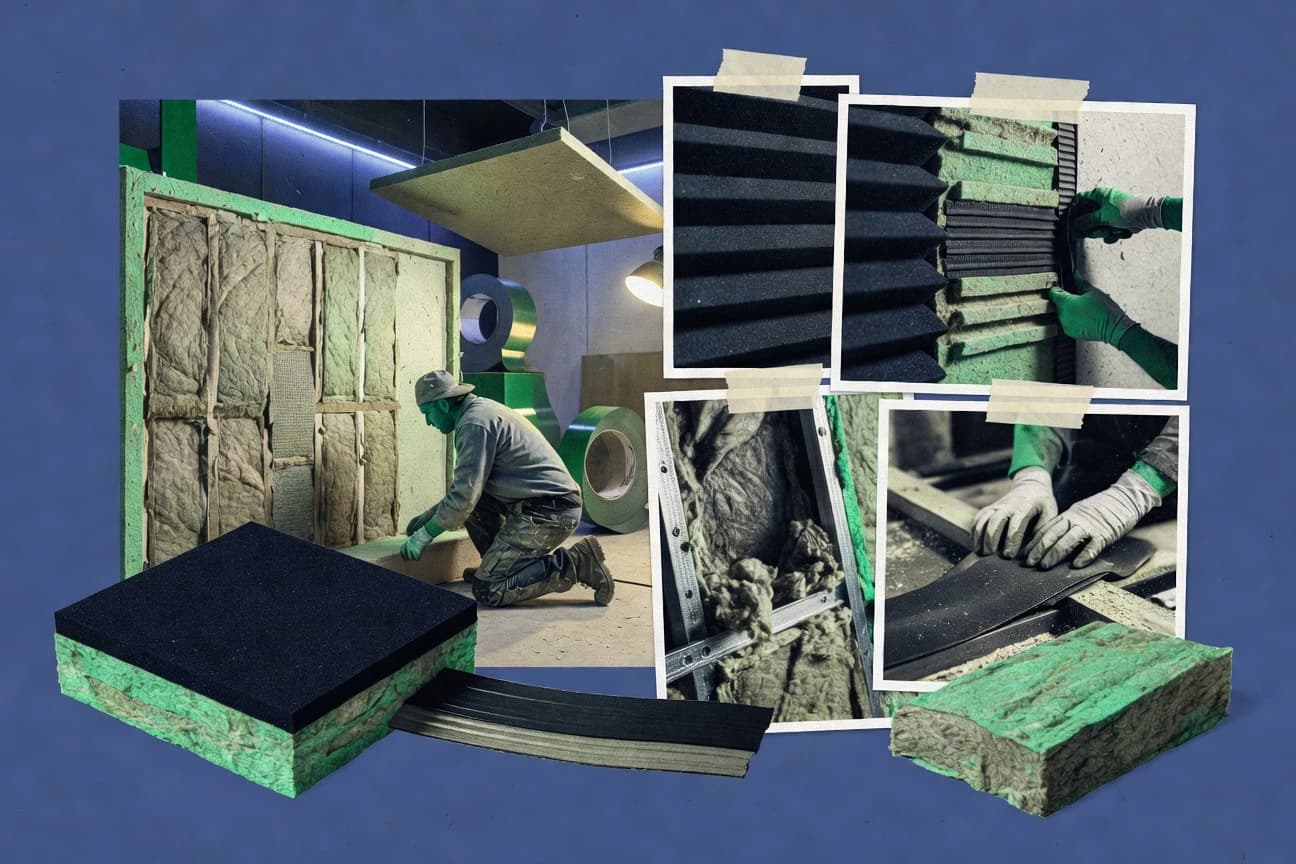

Soundproofing demand tracks both building activity and day-to-day noise pressures. In 2022, 35% of respondents said they were somewhat or very concerned about noise in the home, and 4.6 million existing homes were sold in the U.S., often prompting upgrades. Across the industry, demand also links to measurable performance testing—such as STC and airborne sound transmission loss—plus practical cost and timeline expectations for installed solutions.
Key Takeaways
- Brazil accounted for 6% of South America acoustic insulation/soundproofing demand in 2023 (country share)
- Spain accounted for 5% of Europe acoustic insulation/soundproofing demand in 2023 (country share)
- $11.9 billion global soundproofing panels market size in 2022, projected to reach $21.3 billion by 2030 (global CAGR 7.7%)
- 4.6 million existing homes were sold in the U.S. in 2022 (a large, recurring renovation trigger that can include soundproofing).
- $1.0 trillion US construction spending estimated for 2025 (baseline activity for building envelope/acoustics work)
- In the US, 2019–2020 BRFSS estimates 17.6% of adults reported fair or poor hearing (hearing impairment prevalence relevant to demand for noise reduction)
- 35% of survey respondents said they were somewhat or very concerned about noise in the home (consumer driver for interior soundproofing products).
- STC values: soundproofing systems for walls often marketed/engineered to improve STC by 10–20 points (STC improvement magnitude)
- ASTM E90 test method measures airborne sound transmission loss (TL) for assemblies; result is TL in decibels (dB)
- ASTM E413 test method calculates STC from test data using 1/3 octave band measurements (STC computed metric)
- 2–3 weeks typical timeline to soundproof a single medium room in the US (schedule metric)
- $8–$20 per square foot cost range for acoustic panels installed (installed cost metric)
- $1,500 average cost to soundproof a room with insulation and panels (room-level cost metric)
- In a 2022 survey, 38% of U.S. adults reported working from home at least some of the time (WFH increases home acoustics needs).
- In the EU, 2022 data show that noise-related complaints are among the most commonly reported local environmental issues (supporting adoption of noise-reduction solutions).
Global demand for soundproofing keeps rising, with growing budgets, home concerns, and major market expansion through 2030.
Related reading
01 · Category
Regional Demand2 stats
01
Brazil accounted for 6% of South America acoustic insulation/soundproofing demand in 2023 (country share)
02
Spain accounted for 5% of Europe acoustic insulation/soundproofing demand in 2023 (country share)
Interpretation
Regional Demand Interpretation
Within the Regional Demand segment, Brazil contributed 6% of South America’s acoustic insulation and soundproofing demand in 2023 while Spain added 5% of Europe’s, highlighting meaningful country-level demand pockets across both regions.
02 · Category
Market Size2 stats
01
$11.9 billion global soundproofing panels market size in 2022, projected to reach $21.3 billion by 2030 (global CAGR 7.7%)
02
4.6 million existing homes were sold in the U.S. in 2022 (a large, recurring renovation trigger that can include soundproofing).
Interpretation
Market Size Interpretation
The market size for soundproofing panels was valued at $11.9 billion in 2022 and is set to grow to $21.3 billion by 2030 at a 7.7% CAGR, and with 4.6 million existing homes sold in the U.S. in 2022 creating ongoing renovation demand, the industry appears positioned for sustained expansion.
03 · Category
Industry Trends5 stats
01
$1.0 trillion US construction spending estimated for 2025 (baseline activity for building envelope/acoustics work)
02
In the US, 2019–2020 BRFSS estimates 17.6% of adults reported fair or poor hearing (hearing impairment prevalence relevant to demand for noise reduction)
03
35% of survey respondents said they were somewhat or very concerned about noise in the home (consumer driver for interior soundproofing products).
04
2024 market forecasts indicate the global construction sector continued expanding, supporting sustained demand for building-envelope and acoustic solutions (construction cycle tailwind).
05
Noise in the workplace contributes to hearing loss risk and worker health issues, with occupational noise exposure listed by WHO as a major environmental health risk (health-policy tailwind for soundproofing/controls).
Interpretation
Industry Trends Interpretation
With US construction spending projected at $1.0 trillion in 2025 and 35% of consumers worried about noise at home, the industry outlook for soundproofing is being reinforced by growing health and workplace hearing-loss concerns, including 17.6% of US adults reporting fair or poor hearing.
More related reading
04 · Category
Performance Metrics12 stats
01
STC values: soundproofing systems for walls often marketed/engineered to improve STC by 10–20 points (STC improvement magnitude)
02
ASTM E90 test method measures airborne sound transmission loss (TL) for assemblies; result is TL in decibels (dB)
03
ASTM E413 test method calculates STC from test data using 1/3 octave band measurements (STC computed metric)
04
ISO 10140-2:2020 test method measures sound insulation in buildings; results are reported in frequency bands and weighted indices (dB-based)
05
ISO 717-1:2020 is used to derive weighted sound reduction indices for airborne sound (R_w or DnT,w, in dB)
06
ASTM C423 impact noise test method measures impact sound pressure level (L_n) in decibels (dB)
07
EN 14303:2022 specifies declared thermal conductivity and related properties for insulation products used in buildings including acoustic insulation layers (material performance metric)
08
ASHRAE 90.1 requires air leakage control at building envelope; airtightness targets are set as maximum cfm/ft² (performance metric used in envelope design affecting sound transmission)
09
Soundproofing typically targets both airborne and impact noise; impact noise control systems are assessed via IIC (in dB-based ratings)
10
A 10 dB reduction in sound level corresponds to a perceived halving of loudness for many situations (logarithmic decibel scale implication for acoustic performance targets).
11
ISO 9053-1:2018 provides test methods for sound absorption by materials in reverberation rooms, reporting sound absorption coefficients (α) used for acoustic panel selection.
12
EN 1793-1:2016 is used for determining noise reducing properties of sound barriers, including laboratory measurement of sound reduction index (Rw) (performance metric used in noise-control systems).
Interpretation
Performance Metrics Interpretation
Performance Metrics in soundproofing are typically quantified through decibel based testing and standardized indices, with marketed wall systems commonly targeting an STC gain of about 10 to 20 points while verification relies on methods like ASTM E90 and ISO 717-1 that translate measured sound transmission loss into single number ratings in dB.
05 · Category
Cost Analysis11 stats
01
2–3 weeks typical timeline to soundproof a single medium room in the US (schedule metric)
02
$8–$20 per square foot cost range for acoustic panels installed (installed cost metric)
03
$1,500average cost to soundproof a room with insulation and panels (room-level cost metric)
04
$1,200average cost to soundproof a home studio in the US (project-level cost metric)
05
$2,000average cost to soundproof a basement in the US (project-level cost metric)
06
$0.30–$1.50 per square foot for basic fiberglass insulation (material cost metric)
07
$1.50–$4.00 per square foot for acoustic mineral wool insulation (material cost metric)
08
10–20% installation labor premium for retrofits versus new construction when adding resilient channels/isolated drywall (labor premium metric)
09
U.S. residential remodeling expenditures reached $405 billion in 2023 (budget envelope for interior upgrades that can include acoustics).
10
Soundproofing/insulation installation labor is often the dominant cost share for retrofit acoustic work, frequently exceeding the material share in per-project budgets (labor portion driver).
11
In the U.S., the Producer Price Index for construction materials increased to 1.9% year-over-year growth in 2023 (cost pressure for acoustic insulation and related building products).
Interpretation
Cost Analysis Interpretation
For cost analysis, soundproofing typically costs about $8 to $20 per square foot for installed acoustic panels and runs roughly $1,500 for a single room, so most projects land in the low thousands while timelines are often just 2 to 3 weeks.
06 · Category
User Adoption2 stats
01
In a 2022 survey, 38% of U.S. adults reported working from home at least some of the time (WFH increases home acoustics needs).
02
In the EU, 2022 data show that noise-related complaints are among the most commonly reported local environmental issues (supporting adoption of noise-reduction solutions).
Interpretation
User Adoption Interpretation
With 38% of U.S. adults working from home at least some of the time and noise complaints ranking among the most common local environmental issues in the EU, user adoption of soundproofing solutions is being driven by everyday home and community noise pressures.
Reference
Cite This Report
This report is designed to be cited. We maintain stable URLs and versioned verification dates. Copy the format appropriate for your publication below.
APA
Christopher Morgan. (2026, February 13). Soundproofing Industry Statistics. Gitnux. https://gitnux.org/soundproofing-industry-statistics
MLA
Christopher Morgan. "Soundproofing Industry Statistics." Gitnux, 13 Feb 2026, https://gitnux.org/soundproofing-industry-statistics.
Chicago
Christopher Morgan. 2026. "Soundproofing Industry Statistics." Gitnux. https://gitnux.org/soundproofing-industry-statistics.
Sources & references
34 datasets cited across this report · attribution is report-level
+10 additional datasets cited (not shown individually)