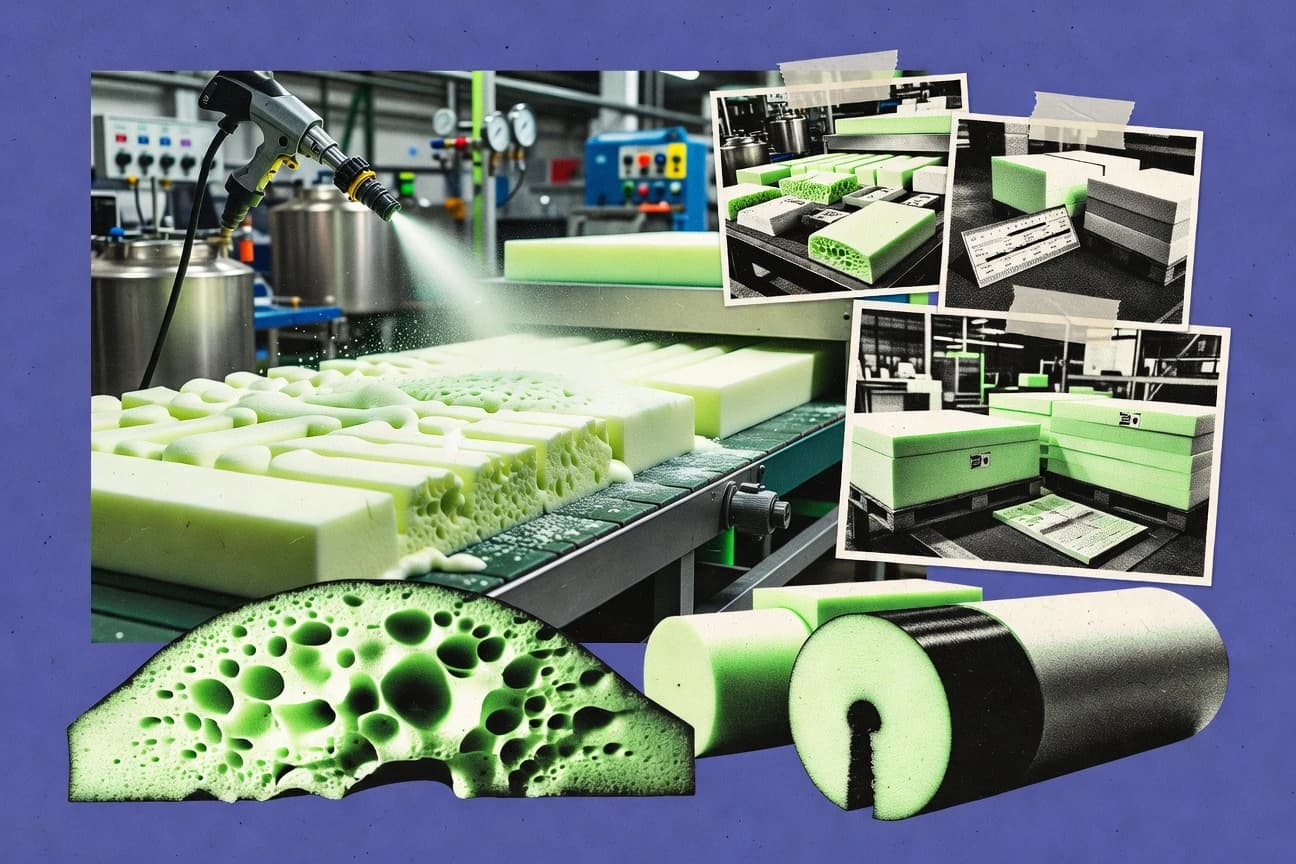

Polyurethane foam is expected to grow fast, with spray polyurethane foam projected to rise at a 5.4% CAGR from 2024 to 2032, even though it still makes up about 4.0% of global insulation materials. At the same time, roughly 60% of rigid polyurethane foam demand is tied to building insulation, where performance targets get very specific, from thermal conductivity around 0.020 to 0.028 W/m·K to air permeability drops of 50% or more in blower door studies. The real twist is how these performance gains collide with tight compliance rules, from NIOSH exposure limits for TDI and MDI to EU REACH authorizations and U.S. TSCA and OSHA recordkeeping benchmarks.
Key Takeaways
- 4.0% polyurethane foam share of global insulation materials (typical polyurethane spray foam insulation share cited in insulation market breakdowns)
- 5.4% spray polyurethane foam market CAGR forecast for 2024–2032
- 22% of polyurethane foam is used for furniture and bedding in a European market sizing analysis—showing substantial demand outside insulation and industrial uses.
- Approximately 60% of rigid polyurethane foam demand is tied to building insulation applications (industry breakdown)
- Rigid polyurethane foam has thermal conductivity typically around 0.020–0.028 W/m·K (typical range)
- Closed-cell PU spray foam typically achieves R-6 to R-7 per inch (field metric conversion)
- Air permeability of building envelope assemblies using PU foam can be reduced by 50%+ versus uninsulated baselines in blower-door studies (performance impact)
- Dimensional thickness tolerance for rigid PU insulation boards often reported around ±2 mm for 25–100 mm thickness in product specs (tolerance benchmark)
- NIOSH recommends 0.005 ppm exposure limit for TDI and 0.005 ppm for MDI (recommended exposure limits)
- EU REACH authorizations require registration/dossiers for many polyurethane precursor chemicals (compliance benchmark)
- EU CLP regulation classifies isocyanates as skin sensitizers in many cases, triggering labeling and risk management
- Industrial polyurethane foams are commonly produced via one-step mixing of polyol, isocyanate, catalysts, surfactants, and blowing agent in proportioning systems (process benchmark)
- Blowing agent charge control accuracy within ±2% is commonly required to meet density and thermal conductivity targets (process control benchmark)
- Scrap regrind particle size distributions (e.g., 0.5–5 mm) are used to optimize rebond and reprocessing in polyurethane foam recycling (processing spec)
- 2.6% of global anthropogenic greenhouse-gas emissions come from industrial process emissions associated with chemical production including polyurethane precursor chains—contextualizing climate relevance of the sector.
Polyurethane foam drives faster insulation payback and rapid growth while facing tight safety and emissions compliance.
Related reading
01 · Category
Market Size4 stats
01
4.0% polyurethane foam share of global insulation materials (typical polyurethane spray foam insulation share cited in insulation market breakdowns)https://www.grandviewresearch.com/industry-analysis/foam-insulation-market
02
5.4% spray polyurethane foam market CAGR forecast for 2024–2032https://www.alliedmarketresearch.com/spray-foam-market
03
22% of polyurethane foam is used for furniture and bedding in a European market sizing analysis—showing substantial demand outside insulation and industrial uses.https://www.taiwantrade.com/1962/industry/industry_Polyurethane_Foam_Industry_Overview.pdf
04
The U.S. Census Bureau reports that industrial chemicals shipments exceed $200 billion annually at the broader industry level, providing the economic scale of upstream materials that polyurethane foam manufacturers draw from—context for supply volumes.https://www.census.gov/retail/index.html
Interpretation
Market Size Interpretation
The polyurethane foam market is expanding steadily with spray polyurethane foam forecast to grow at 5.4% CAGR from 2024 to 2032, and while insulation accounts for about 4.0% of global insulation materials, a sizeable 22% of polyurethane foam demand in Europe comes from furniture and bedding, underscoring that market growth is driven not just by insulation but also by broader consumer and industrial end uses supported by the upstream scale of over $200 billion in industrial chemical shipments annually.
02 · Category
Industry Trends2 stats
01
Approximately 60% of rigid polyurethane foam demand is tied to building insulation applications (industry breakdown)https://www.iea.org/reports/buildings
02
Rigid polyurethane foam has thermal conductivity typically around 0.020–0.028 W/m·K (typical range)https://www.ashrae.org/technical-resources/bookstore/standard-90-1
Interpretation
Industry Trends Interpretation
Industry trends show that about 60% of rigid polyurethane foam demand is driven by building insulation, reinforcing its key role while its low thermal conductivity of roughly 0.020 to 0.028 W/m·K supports why insulation remains the dominant market pull.
03 · Category
Performance Metrics6 stats
01
Closed-cell PU spray foam typically achieves R-6 to R-7 per inch (field metric conversion)https://www.energy.gov/energysaver/insulation-materials
02
Air permeability of building envelope assemblies using PU foam can be reduced by 50%+ versus uninsulated baselines in blower-door studies (performance impact)https://www.energy.gov/eere/buildings
03
Dimensional thickness tolerance for rigid PU insulation boards often reported around ±2 mm for 25–100 mm thickness in product specs (tolerance benchmark)https://www.iso.org/standard/7162.html
04
Toughness/abrasion: flexible PU foams used in seating often have abrasion resistance measured in cycles; reported ranges exceed 20,000 cycles in some standardized tests (industry spec benchmark)https://www.iso.org/standard/65694.html
05
A peer-reviewed study reports that rigid polyurethane foams can reduce thermal conductivity by ~10–20% when using optimized cell size distributions from blowing agent selection—linking microstructure to insulation performance.https://doi.org/10.1016/j.enbuild.2019.109511
06
Tensile strength of flexible polyurethane foam can vary by more than 30% across formulations with different crosslink densities reported in comparative mechanical testing literature—quantifying design levers for foam toughness.https://doi.org/10.1016/j.matdes.2018.02.020
Interpretation
Performance Metrics Interpretation
For performance metrics, polyurethane foam is consistently shown to deliver higher insulation and durability outcomes, with closed-cell spray foam reaching R 6 to R 7 per inch and thermal conductivity dropping by about 10 to 20 percent when cell size distributions are optimized, while blower-door studies also find air permeability reductions of 50 percent or more compared with uninsulated baselines.
04 · Category
Safety & Regulation8 stats
01
NIOSH recommends 0.005 ppm exposure limit for TDI and 0.005 ppm for MDI (recommended exposure limits)https://www.cdc.gov/niosh/idlh/
02
EU REACH authorizations require registration/dossiers for many polyurethane precursor chemicals (compliance benchmark)https://echa.europa.eu/regulations/reach/understanding-reach
03
EU CLP regulation classifies isocyanates as skin sensitizers in many cases, triggering labeling and risk managementhttps://echa.europa.eu/regulations/clp
04
In the U.S., polyurethane precursor chemicals are regulated under the TSCA inventory (precursor import/manufacture compliance)https://www.epa.gov/tsca-inventory
05
OSHA Form 300 recordkeeping exempts some small employers but applies to silica/isocyanate hazard classifications under injury-illness recordkeeping rules (coverage benchmark)https://www.osha.gov/recordkeeping
06
In the U.S., polyurethane foam is commonly evaluated under ASTM E84 for flame spread and smoke development in building applications (test benchmark)https://www.astm.org/standards/e84
07
Many jurisdictions require spray foam applicators to be trained to install fire-blocking and ignition barriers in accordance with local code (compliance requirement)https://codes.iccsafe.org/content/IECC2021P1/chapter-7-exterior-enclosure
08
Flexible PU foam used in furniture must meet California TB117-2013 testing requirements; compliance testing uses CAL TB 117 (fire testing benchmark)https://leginfo.legislature.ca.gov/faces/billTextClient.xhtml?bill_id=201720180AB123
Interpretation
Safety & Regulation Interpretation
Across Safety and Regulation, regulators are tightening isocyanate controls and traceable compliance, with NIOSH recommending an ultra low 0.005 ppm exposure limit for both TDI and MDI alongside growing REACH and CLP labeling and application training requirements.
05 · Category
Production & Logistics9 stats
01
Industrial polyurethane foams are commonly produced via one-step mixing of polyol, isocyanate, catalysts, surfactants, and blowing agent in proportioning systems (process benchmark)https://www.praxair.com/resources/industrial-gas-handbook
02
Blowing agent charge control accuracy within ±2% is commonly required to meet density and thermal conductivity targets (process control benchmark)https://www.dow.com/en-us/knowledge/from-our-labs
03
Scrap regrind particle size distributions (e.g., 0.5–5 mm) are used to optimize rebond and reprocessing in polyurethane foam recycling (processing spec)https://www.sciencedirect.com/science/article/pii/S0927775721000495
04
Rebond flexible polyurethane foam recycling studies report mechanical property retention often above 60% of virgin after optimized reprocessing (materials benchmark)https://www.sciencedirect.com/science/article/pii/S0045653521001094
05
In polyurethane integral-skin foaming, cream time and rise time are controlled to milliseconds-scale timing to achieve cell structure and density targets (process control benchmark)https://www.sciencedirect.com/science/article/pii/S0167577X20304314
06
Freight transport constitutes a major portion of polyurethane raw material logistics; U.S. DOT reports hazmat handling requirements increase shipping friction (logistics driver with regulatory quantities)https://www.phmsa.dot.gov/hazmat
07
Polyurethane precursor suppliers report that typical lead times for isocyanates/major polyols are weeks rather than days, affecting production scheduling (logistics benchmark)https://www.icis.com/explore/resources/news/chemical-lead-times
08
Polyurethane foam recycling from manufacturing scrap reduces landfill disposal by diverting waste streams; diversion rates reported as high as 90% in some industrial symbiosis programs (reported diversion benchmark)https://www.ciel.org/wp-content/uploads/2018/05/Reducing-Waste-in-Manufacturing.pdf
09
Polyurethane foam blistering defects increase when blowing agent moisture contamination exceeds specified thresholds typically <0.05% water in some formulations (quality control benchmark)https://www.cdc.gov/niosh/docs/2009-119/pdfs/2009-119.pdf
Interpretation
Production & Logistics Interpretation
For Production and Logistics, tight process and supply-chain constraints dominate, with blowing agent charge control typically needing ±2% accuracy and key polyurethane precursor lead times for isocyanates and major polyols often stretching to weeks, while effective recycling programs can divert waste streams as high as 90%.
06 · Category
Sustainability Metrics2 stats
01
2.6% of global anthropogenic greenhouse-gas emissions come from industrial process emissions associated with chemical production including polyurethane precursor chains—contextualizing climate relevance of the sector.https://www.iea.org/reports/chemicals-the-next-sustainability-challenge/executive-summary
02
In a Life Cycle Assessment synthesis paper, rigid polyurethane insulation typically shows a payback time on the order of 2–10 years depending on climate zone and heating/cooling demand—quantifying the use-phase vs production trade-off.https://doi.org/10.1016/j.rser.2016.11.013
Interpretation
Sustainability Metrics Interpretation
Sustainability-wise, the polyurethane foam value chain is responsible for about 2.6% of global anthropogenic greenhouse gas emissions from industrial process emissions, yet rigid polyurethane insulation can often recoup its climate impact in roughly 2 to 10 years through reduced energy use, making the overall sustainability performance a balance between production and use-phase benefits.
Reference
Cite This Report
This report is designed to be cited. We maintain stable URLs and versioned verification dates. Copy the format appropriate for your publication below.
APA
Thomas Lindqvist. (2026, February 13). Polyurethane Foam Industry Statistics. Gitnux. https://gitnux.org/polyurethane-foam-industry-statistics
MLA
Thomas Lindqvist. "Polyurethane Foam Industry Statistics." Gitnux, 13 Feb 2026, https://gitnux.org/polyurethane-foam-industry-statistics.
Chicago
Thomas Lindqvist. 2026. "Polyurethane Foam Industry Statistics." Gitnux. https://gitnux.org/polyurethane-foam-industry-statistics.
Sources & references
31 datasets cited across this report
+9 additional datasets cited (not shown individually)