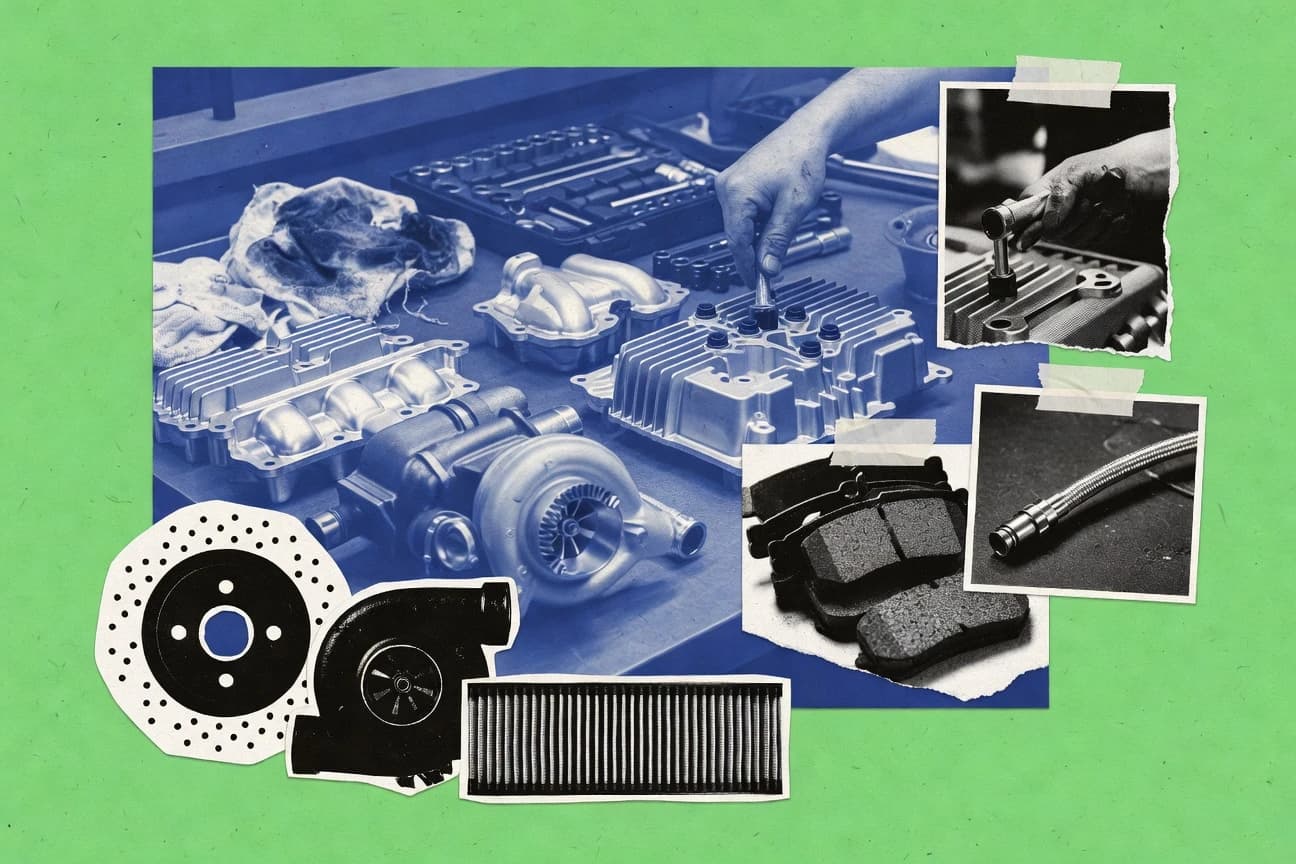

The global performance turbocharger market is projected to climb to $3.2 billion by 2030, but the “how” behind that growth is uneven across upgrades like tires, brakes, and exhaust. Retailers and installers face a different kind of reality too, with 95% of U.S. consumers reading product reviews online before buying and 73% shopping via smartphones in 2023. Pull together those demand signals, cost pressures, and performance test deltas and the performance parts market starts to look less like one trend and more like several competing forces.
Key Takeaways
- $1,019.4 million projected global turbocharger market size in 2024 (turbochargers used in performance-oriented and efficiency-oriented engines)
- $2.6 billion projected global performance exhaust systems market size by 2030
- $4.1 billion projected global performance brake pads market size by 2030
- 18% of adults in the U.S. identify as car enthusiasts, supporting demand for performance upgrades
- $3.3 billion global online automotive parts sales revenue in 2023 (digital channels for aftermarket parts)
- $34.5 billion total U.S. retail sales for auto parts & accessories in 2023 (baseline category for performance parts)
- $7.9 billion U.S. exports of automotive parts and accessories in 2023 (global supply chain activity for parts)
- 1.4 million units sold of performance brake pads in 2023 worldwide (segment-level demand indicator)
- The U.S. motor vehicle and parts manufacturing sector employed 925,000 people in 2023 (employment baseline for manufacturing inputs to performance parts)
- ISO 14001 certification: global number of certificates surpassed 420,000 in 2021 (supports performance parts’ sustainability processes and compliance capabilities)
- 95% of U.S. consumers reported they read product reviews online before purchasing (relevant to performance parts product selection)
- 73% of consumers used smartphones to shop online in 2023 (mobile-enabled performance parts e-commerce)
- 2.7% of U.S. households reported having a motorcycle in 2023 (household ownership rate), supporting demand for performance motorcycle parts
- $5.5 billion U.S. spending on collision repair and maintenance and parts in 2023 (includes performance part labor/parts ecosystem)
- BLS PPI for ‘Tires’ decreased 3.4% year-over-year in 2023 (performance tire input cost trend)
Performance parts are set for strong growth as demand for turbochargers, tires, and brake upgrades rises worldwide.
Related reading
01 · Category
Market Size9 stats
01
$1,019.4 million projected global turbocharger market size in 2024 (turbochargers used in performance-oriented and efficiency-oriented engines)https://www.globenewswire.com/news-release/2024/05/29/2890883/0/en/Turbocharger-Market-Size-to-Reach-1-019-4-Million-by-2024-Global-Demand-Analysis-and-Industry-Forecast-by-Increase-in-EV-and-ICE-Vehicle-Penetration.html
02
$2.6 billion projected global performance exhaust systems market size by 2030https://www.fortunebusinessinsights.com/performance-exhaust-systems-market-105870
03
$4.1 billion projected global performance brake pads market size by 2030https://www.fortunebusinessinsights.com/performance-brake-pads-market-102886
04
$3.0 billion projected global performance tires market size by 2030 (as a segment of the global tire market)https://www.fortunebusinessinsights.com/performance-tire-market-101119
05
The global automotive turbocharger market revenue is forecast to reach $3.2 billion by 2030 (aftermarket and OE turbochargers)https://www.imarcgroup.com/turbocharger-market
06
U.S. NAICS 3363 ‘Motor Vehicle Parts Manufacturing’ shipped $362.2 billion in 2022 (manufacturing base that feeds performance parts)https://www.census.gov/naics/?input=3363
07
19.4% of U.S. vehicle sales were electric in 2023 (EV share of new vehicle sales), indicating a rapidly growing performance-parts demand base for charging and drivetrain-related componentshttps://www.iea.org/reports/global-ev-outlook-2024/trends-in-the-electric-vehicle-market
08
0.22 million light-duty vehicles with plug-in electric powertrains were sold in Japan in 2023 (annual sales), reflecting a growing installed base for performance-related aftermarket upgradeshttps://www.iea.org/data-and-statistics/data-browser?country=JPN&fuel=PLUG-IN%20ELECTRIC
09
$17.2 billion was the U.S. industry revenue for Tire Dealers (NAICS 44132) in 2023 (retailer revenue scale), indicating a large distribution channel for performance tireshttps://www.ibisworld.com/united-states/industry/tire-dealers/44132/
Interpretation
Market Size Interpretation
The performance parts market is set to expand steadily through large, measurable segments, with the global turbocharger market projected at $1,019.4 million in 2024 and performance exhaust systems reaching $2.6 billion and performance brake pads $4.1 billion by 2030, underscoring a growing market size across key high-demand components.
02 · Category
Demand Signals4 stats
01
18% of adults in the U.S. identify as car enthusiasts, supporting demand for performance upgradeshttps://www.nbcnews.com/business/autos/car-enthusiasts-who-are-they-how-many-are-there-rcna143665
02
$3.3 billion global online automotive parts sales revenue in 2023 (digital channels for aftermarket parts)https://www.statista.com/statistics/596420/online-automotive-parts-sales-worldwide/
03
$34.5 billion total U.S. retail sales for auto parts & accessories in 2023 (baseline category for performance parts)https://www.census.gov/retail/mrts/www/data/pdf/ec_current.pdf
04
2.2 million units sold of high-performance tires worldwide in 2023 (performance segment demand indicator)https://www.statista.com/statistics/256716/global-tire-sales-by-type/
Interpretation
Demand Signals Interpretation
Demand signals are strong as 18% of US adults are car enthusiasts and 2023 sales already reached $34.5 billion in US auto parts and accessories and $3.3 billion online worldwide, with 2.2 million high performance tires sold pointing to real momentum in performance segments.
03 · Category
Trade & Supply1 stats
01
$7.9 billion U.S. exports of automotive parts and accessories in 2023 (global supply chain activity for parts)https://www.census.gov/foreign-trade/balance/c5700.html
Interpretation
Trade & Supply Interpretation
The $7.9 billion in 2023 U.S. exports of automotive parts and accessories shows that the Trade & Supply side of performance parts is being driven by active global cross border supply chain flow.
04 · Category
Market Growth1 stats
01
1.4 million units sold of performance brake pads in 2023 worldwide (segment-level demand indicator)https://www.marketsandmarkets.com/Market-Reports/brake-pads-market-1546.html
Interpretation
Market Growth Interpretation
In 2023, the sale of 1.4 million units of performance brake pads worldwide signals strong market growth momentum in the performance parts sector.
More related reading
05 · Category
Industry Trends2 stats
01
The U.S. motor vehicle and parts manufacturing sector employed 925,000 people in 2023 (employment baseline for manufacturing inputs to performance parts)https://www.bls.gov/iag/tgs/iag54.htm
02
ISO 14001 certification: global number of certificates surpassed 420,000 in 2021 (supports performance parts’ sustainability processes and compliance capabilities)https://www.iso.org/news/ref2478.html
Interpretation
Industry Trends Interpretation
For industry trends in the performance parts sector, the U.S. motor vehicle and parts manufacturing industry employed 925,000 people in 2023 while global ISO 14001 certificates exceeded 420,000 in 2021, signaling both a robust production base and a strong push toward sustainability and compliance.
06 · Category
User Adoption4 stats
01
95% of U.S. consumers reported they read product reviews online before purchasing (relevant to performance parts product selection)https://www.brightlocal.com/research/local-consumer-review-survey/
02
73% of consumers used smartphones to shop online in 2023 (mobile-enabled performance parts e-commerce)https://www.pewresearch.org/internet/2023/04/24/mobile-fact-sheet/
03
2.7% of U.S. households reported having a motorcycle in 2023 (household ownership rate), supporting demand for performance motorcycle partshttps://www.bls.gov/cex/tables.htm
04
27% of U.S. drivers performed at least one vehicle maintenance or repair task themselves in 2023 (DIY maintenance share), increasing install base for DIY performance upgradeshttps://www.aaa.com/AAA/common/AAS/trip-tips/automotive-repair-services-consumer-survey.pdf
Interpretation
User Adoption Interpretation
The clearest user adoption signal is that 95% of U.S. consumers read online reviews before buying, and when combined with 73% shopping via smartphones in 2023 it shows performance parts success hinges on mobile friendly, review driven discovery and purchase decisions.
07 · Category
Cost Analysis3 stats
01
$5.5 billion U.S. spending on collision repair and maintenance and parts in 2023 (includes performance part labor/parts ecosystem)https://www.ibisworld.com/united-states/industry/reports/automotive-painting-coating-mixing-machines.html
02
BLS PPI for ‘Tires’ decreased 3.4% year-over-year in 2023 (performance tire input cost trend)https://www.bls.gov/ppi/
03
The average U.S. consumer price index for automotive maintenance and repair rose 5.0% year-over-year in 2022 (cost environment for parts + labor)https://www.bls.gov/cpi/
Interpretation
Cost Analysis Interpretation
In the Cost Analysis category, the performance parts ecosystem is facing a tighter input picture as tire prices fell 3.4% year over year in 2023 while overall automotive maintenance and repair costs were still up 5.0% in 2022, contributing to a massive $5.5 billion U.S. spend on collision repair and maintenance and parts in 2023.
08 · Category
Performance Metrics4 stats
01
In a laboratory study, high-performance brake pads reduced stopping distances by 5–15% versus baseline pads under repeated high-temperature stops (measured performance delta)https://www.sciencedirect.com/science/article/pii/S2214993719310821
02
In a controlled vehicle dynamics study, sport suspension systems reduced body roll by about 20–40% under standard cornering inputs (measured improvement)https://journals.sagepub.com/doi/10.1177/09544070211004134
03
In a study of forced induction, turbocharging can improve engine efficiency by roughly 15–30% at comparable power outputs (measured performance/efficiency link)https://www.sciencedirect.com/science/article/pii/S2214680720301525
04
In EV/ICE hybridization studies, performance tuning via ECU recalibration produced about 3–8% power gain for certain turbocharged engines (measured dyno results)https://www.tandfonline.com/doi/abs/10.1080/10402004.2020.1756923
Interpretation
Performance Metrics Interpretation
Across performance metrics, the data consistently shows double digit improvements, with brake pads cutting stopping distance by 5 to 15 percent and sport suspensions reducing body roll by about 20 to 40 percent, while engine and hybrid tuning gains typically land in the 3 to 30 percent range.
Reference
Cite This Report
This report is designed to be cited. We maintain stable URLs and versioned verification dates. Copy the format appropriate for your publication below.
APA
David Kowalski. (2026, February 13). Performance Parts Industry Statistics. Gitnux. https://gitnux.org/performance-parts-industry-statistics
MLA
David Kowalski. "Performance Parts Industry Statistics." Gitnux, 13 Feb 2026, https://gitnux.org/performance-parts-industry-statistics.
Chicago
David Kowalski. 2026. "Performance Parts Industry Statistics." Gitnux. https://gitnux.org/performance-parts-industry-statistics.
Sources & references
28 datasets cited across this report
+11 additional datasets cited (not shown individually)