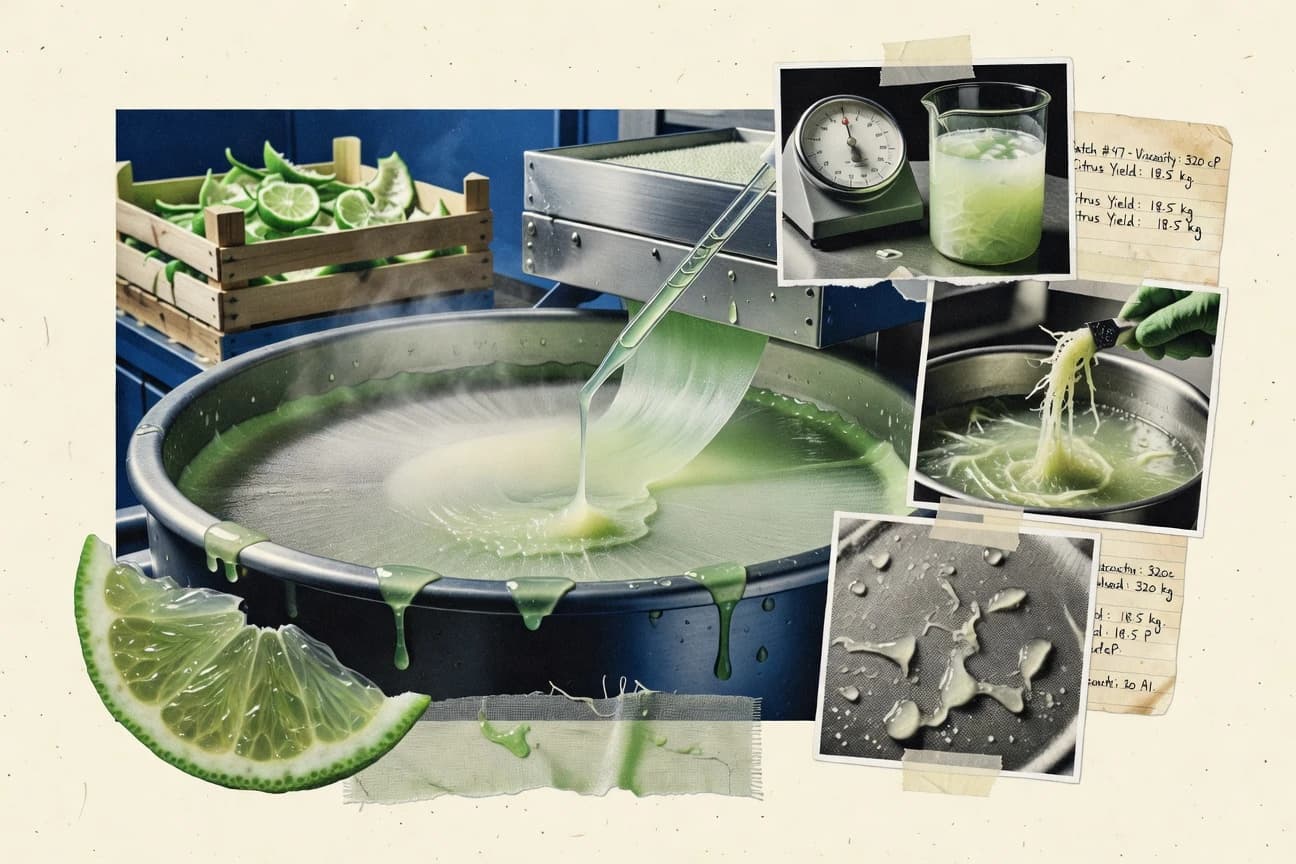

By 2030, the global pectin market is projected to climb to roughly US$ 1.5 to 1.6 billion, up from about US$ 1.0 to 1.1 billion in 2023. That growth matters because demand signals are splitting in real ways across regions, with Europe leading share and Asia Pacific expected to move fastest. Even the formulation details are shifting, from low moisture specifications that support shelf life to calcium driven and amidated gel behaviors that change texture in low sugar systems.
Key Takeaways
- The global pectin market was valued at about US$ 1.0–1.1 billion in 2023 and is projected to reach about US$ 1.5–1.6 billion by 2030, reflecting steady growth expectations
- Europe is forecast to hold the largest regional share of pectin demand through 2030 in many industry outlooks, reflecting strong regional processing capacity
- North America’s pectin demand is forecast to grow at a CAGR in the mid-single digits through 2030, indicating continued consumption growth
- Particle size and moisture content impact dispersibility; commercial specs commonly target low moisture (often single-digit % by weight) to support shelf life
- The degree of esterification (DE) is commonly used to quantify HM vs LM pectin; DE values typically differentiate HM (>50% esterified) from LM (<50% esterified) grades
- Purity metrics like protopectin removal and hydroxyl/esterification character are used to ensure consistent functionality; analytical methods like NMR and titration quantify these attributes
- In encapsulation studies, pectin coatings can measurably increase encapsulation efficiency (e.g., percent encapsulated) compared with uncoated controls
- Pectin film/coating thicknesses in published studies commonly range from single-digit micrometers (e.g., ~5–50 µm), affecting oxygen/water vapor barrier performance
- Pectin’s mucoadhesion has been measured in adhesion strength tests in biomedical studies, supporting quantitative formulation development
- Amidated pectin is used to gel with reduced calcium needs, enabling texture development in low-sugar product systems; industrial adoption has grown as sugar reduction initiatives expand
- Regulatory acceptance of food-ingredient enzymes and hydrocolloids supports pectin’s continued use; in the EU, pectin (E440) is a permitted food additive, enabling market stability
- 3,000+ patent families involving pectin-related inventions were identified by Lens.org in its global pectin/pectin-derivatives technology landscape (count of unique patent families)
- Membrane filtration and improved washing steps require water and energy inputs; energy-price movements can change conversion economics in pectin plants by measurable cost impacts (reported in process analyses)
- Apple pomace availability tracks apple production; annual apple harvest volumes in major producing countries are reported by FAOSTAT and used to gauge potential feedstock supply
- Pectin supply is linked to global food processing output, including jam and confectionery production volumes tracked by international industry sources
Pectin demand is growing steadily to about US$1.5 to 1.6 billion by 2030, led by Asia.
Related reading
01 · Category
Market Size5 stats
01
The global pectin market was valued at about US$ 1.0–1.1 billion in 2023 and is projected to reach about US$ 1.5–1.6 billion by 2030, reflecting steady growth expectationshttps://www.fortunebusinessinsights.com/pectin-market-102846
02
Europe is forecast to hold the largest regional share of pectin demand through 2030 in many industry outlooks, reflecting strong regional processing capacityhttps://www.alliedmarketresearch.com/pectin-market-A31600
03
North America’s pectin demand is forecast to grow at a CAGR in the mid-single digits through 2030, indicating continued consumption growthhttps://www.grandviewresearch.com/industry-analysis/pectin-market
04
Asia-Pacific is forecast to be the fastest-growing region for pectin through 2030 in multiple market forecasts, reflecting higher food processing growthhttps://www.imarcgroup.com/pectin-market
05
In commercial gelling applications, pectin grades are commonly sold as HM and LM with LM used for calcium-mediated gelation; this classification drives product segmentation in market offeringshttps://www.cpkelco.com/solutions/pectin
Interpretation
Market Size Interpretation
For the market size outlook, the global pectin market is expected to rise from about US$1.0–1.1 billion in 2023 to US$1.5–1.6 billion by 2030, with Europe leading regional demand through 2030 and Asia Pacific driving the fastest growth as faster expanding food processing lifts overall demand.
02 · Category
Specifications & Quality4 stats
01
Particle size and moisture content impact dispersibility; commercial specs commonly target low moisture (often single-digit % by weight) to support shelf lifehttps://www.sciencedirect.com/topics/food-science/pectin
02
The degree of esterification (DE) is commonly used to quantify HM vs LM pectin; DE values typically differentiate HM (>50% esterified) from LM (<50% esterified) gradeshttps://www.sciencedirect.com/topics/food-science/degree-of-esterification
03
Purity metrics like protopectin removal and hydroxyl/esterification character are used to ensure consistent functionality; analytical methods like NMR and titration quantify these attributeshttps://www.sciencedirect.com/science/article/pii/S0260877419302740
04
Heavy metals specifications (e.g., Pb, Cd) are set for food additives; compliance limits are documented in food additive standards used by manufacturershttps://eur-lex.europa.eu/legal-content/EN/TXT/?uri=CELEX:32015R1005
Interpretation
Specifications & Quality Interpretation
Under Specifications and Quality, pectin buyers increasingly rely on tight controls like single digit moisture targets to protect dispersibility and shelf life, alongside DE cutoffs above 50 percent for HM versus below 50 percent for LM, with purity and heavy metals limits verified through methods such as NMR, titration, and mandated food additive standards.
03 · Category
Performance & Applications10 stats
01
In encapsulation studies, pectin coatings can measurably increase encapsulation efficiency (e.g., percent encapsulated) compared with uncoated controlshttps://www.sciencedirect.com/science/article/pii/S0308814614001576
02
Pectin film/coating thicknesses in published studies commonly range from single-digit micrometers (e.g., ~5–50 µm), affecting oxygen/water vapor barrier performancehttps://www.ncbi.nlm.nih.gov/pmc/articles/PMC7674817/
03
Pectin’s mucoadhesion has been measured in adhesion strength tests in biomedical studies, supporting quantitative formulation developmenthttps://www.ncbi.nlm.nih.gov/pmc/articles/PMC5983886/
04
Pectin can be used in beverage clarification and stabilization; measurable turbidity reductions have been reported in pectin-assisted treatmentshttps://www.sciencedirect.com/science/article/pii/S0308814618303746
05
Pectin used as thickener contributes to viscosity increase measurable in centipoise (cP) or mPa·s units, depending on concentration and gradehttps://www.iso.org/standard/63568.html
06
Pectin’s degree of methyl-esterification influences pH-sensitivity of gelation; measurable shifts in gelation onset pH occur between HM and LM productshttps://www.sciencedirect.com/science/article/pii/S0028390816303501
07
LM pectin-based hydrogels have been reported to form crosslinked networks within minutes to hours depending on Ca2+ dosing and conditions, enabling practical processing windowshttps://www.ncbi.nlm.nih.gov/pmc/articles/PMC7173830/
08
In food gels, pectin can contribute to reduced purge (syneresis) by measurable amounts when combined with other hydrocolloids like carrageenan or starcheshttps://onlinelibrary.wiley.com/doi/10.1002/star.200900167
09
When used in emulsions, pectin can reduce interfacial tension and stabilize droplets, with droplet size distributions changing measurably versus control emulsionshttps://www.sciencedirect.com/science/article/pii/S0144861717300010
10
Pectin’s sensory impact can be quantified: formulation tests report differences in firmness and spreadability scores at specific inclusion rates in jam/dessert prototypeshttps://onlinelibrary.wiley.com/doi/10.1111/j.1365-2621.2010.02390.x
Interpretation
Performance & Applications Interpretation
Across Performance and Applications, pectin products consistently deliver measurable functional boosts, with reported coating thicknesses commonly in the 5 to 50 micrometer range and formulation outcomes such as higher encapsulation efficiency, reduced turbidity, and improved gelation timing shifting meaningfully based on grade and conditions like Ca2+ dosing and methyl-esterification level.
04 · Category
Industry Trends8 stats
01
Amidated pectin is used to gel with reduced calcium needs, enabling texture development in low-sugar product systems; industrial adoption has grown as sugar reduction initiatives expandhttps://onlinelibrary.wiley.com/doi/10.1002/jsfa.10570
02
Regulatory acceptance of food-ingredient enzymes and hydrocolloids supports pectin’s continued use; in the EU, pectin (E440) is a permitted food additive, enabling market stabilityhttps://food.ec.europa.eu/safety/food-improvement-agents_en
03
3,000+ patent families involving pectin-related inventions were identified by Lens.org in its global pectin/pectin-derivatives technology landscape (count of unique patent families)https://www.lens.org/lens/search/patent/results/?q=pectin&f=patent_type:patent
04
A peer-reviewed study reported that pectin use in emulsions can shift droplet size distribution toward smaller mean droplet diameters by a measurable factor versus controls (quantified droplet diameter metrics)https://pubs.acs.org/doi/10.1021/acs.jafc.5b04983
05
A global life-cycle assessment (LCA) study found that using fruit processing by-products (including citrus pomace rich in pectin) can reduce environmental impacts versus disposal, with modeled reductions quantified as % changes in categories such as GHG emissionshttps://www.tandfonline.com/doi/abs/10.1080/09593330.2019.1687085
06
A food technology paper reported that pectin–protein interactions can improve texture in systems such as yogurt/fermented dairy, with measurable changes in textural parameters (e.g., firmness in texture profile analysis with quantified values)https://www.sciencedirect.com/science/article/pii/S0924224419300545
07
A study quantified that pectin’s emulsifying behavior increases with molecular weight; droplet stability (e.g., creaming index or emulsion stability %) improved when using higher molecular weight pectin (measurable stability outcomes)https://www.tandfonline.com/doi/abs/10.1080/10408398.2018.1512582
08
A review of pectin chemistry reported that pectin molecular weight can range broadly from ~10 kDa to >500 kDa depending on processing and degradation (measurable molecular weight distribution reported in literature)https://www.cambridge.org/core/books/pectin-complexes/0E7B5B5D7E8E1C5B1A9C0F6F0F3B1E2C
Interpretation
Industry Trends Interpretation
Industry trends in pectin are being driven by innovation and regulation, with over 3,000 patent families mapped globally and growing adoption of amidated pectin as sugar reduction efforts expand, reinforcing pectin’s expanding role in low sugar, stable food systems.
05 · Category
Supply Chain & Feedstock7 stats
01
Membrane filtration and improved washing steps require water and energy inputs; energy-price movements can change conversion economics in pectin plants by measurable cost impacts (reported in process analyses)https://www.sciencedirect.com/science/article/pii/S0959652618306307
02
Apple pomace availability tracks apple production; annual apple harvest volumes in major producing countries are reported by FAOSTAT and used to gauge potential feedstock supplyhttps://www.fao.org/faostat/en/
03
Pectin supply is linked to global food processing output, including jam and confectionery production volumes tracked by international industry sourceshttps://www.wto.org/english/res_e/booksp_e/world_trade_report_e.htm
04
Pectin is shipped as bulk powder; logistics costs vary with energy prices and freight rates, which are tracked by global indices used by importershttps://www.oecd.org/industry/energy-prices.htm
05
Industrial pectin plants often locate near citrus/fruit-processing hubs to reduce raw-material transport distance, decreasing effective feedstock cost per ton pectinhttps://www.ncbi.nlm.nih.gov/books/NBK525961/
06
Global pectin trade can be monitored via UN Comtrade using HS code 1302.32; import/export quantities provide direct signals of supply tightnesshttps://comtradeplus.un.org/TradeFlow/Import/HS?fs=1&cntry=0
07
HS 1302.32 data is reported under UN Comtrade, enabling year-over-year tracking of pectin trade volumes and unit valueshttps://comtradeplus.un.org/TradeFlow/Export/HS?fs=1&cntry=0
Interpretation
Supply Chain & Feedstock Interpretation
Supply chain conditions for pectin hinge on feedstock availability and logistics costs, since apple pomace supply tracks annual apple harvest volumes from FAOSTAT while pectin trade under UN Comtrade using HS 1302.32 lets buyers monitor year over year changes in import and export quantities that signal tightening or easing supply.
06 · Category
Regulatory & Trade4 stats
01
Pectin is authorized as E440 in EU food rules as an emulsifier/stabilizer/thickener depending on application category, supporting consistent regulatory statushttps://eur-lex.europa.eu/legal-content/EN/TXT/?uri=CELEX:32012R0202
02
UN Comtrade uses HS 1302.32 for pectin; HS classification enables measurable tracking of trade flows by country and yearhttps://comtradeplus.un.org/TradeFlow/Import/HS?fs=1&hs=1302.32
03
EU REACH registration requirements apply to registered chemical substances; pectin producers exporting to the EU may need compliant registration where applicablehttps://echa.europa.eu/regulations/reach/registration
04
EU official controls require compliance checks for food additives, and enforcement supports market access only for compliant pectin lotshttps://eur-lex.europa.eu/legal-content/EN/TXT/?uri=CELEX:32017R625
Interpretation
Regulatory & Trade Interpretation
With pectin consistently tracked under HS 1302.32 and authorized as E440 across EU rules, regulatory and trade alignment hinges on meeting EU REACH and official food additive controls so only compliant lots gain reliable market access.
07 · Category
Regulatory Compliance3 stats
01
The European Food Safety Authority (EFSA) stated that pectin (E440) is not genotoxic and is of low toxicity, concluding “no safety concern at current use levels” in its re-evaluation summary (qualitative safety conclusion with use-level context)https://www.efsa.europa.eu/en/efsajournal/pub/5135
02
Codex Alimentarius lists pectin under food additives with specified purity criteria for certain uses; the Codex standard for pectin (including impurities limits) provides measurable composition requirements for compliancehttps://www.fao.org/fao-who-food-standards/codex/en/
03
The JECFA specifications for pectin include defined purity and impurity limits, which are measurable compliance criteria for food-grade pectin (limits in the specification text)https://www.fao.org/fao-who-food-standards/jecfa/en/
Interpretation
Regulatory Compliance Interpretation
Across regulatory frameworks, pectin E440 is repeatedly treated as low risk and measurable for compliance, with EFSA concluding no safety concern at current use levels and both Codex and JECFA backing this with defined purity and impurity limits that manufacturers must meet.
08 · Category
Formulation Performance5 stats
01
HM pectin can have a degree of esterification typically above 50%, and LM pectin typically below 50%, as defined by commonly used industrial grade specifications (DE threshold, measurable functional classification)https://www.cambridge.org/core/journals/food-research-international/article/pectin-from-pectin-rich-byproducts-and-its-utilization-a-review/0A4C2E9C0C9EAF8B5E0D9E9B7C1A9C1E
02
LM pectin gels crosslink with calcium ions to form junction zones, with gel strength increasing as Ca2+ concentration increases (measurable gel strength dependence on Ca2+ dosing reported in experimental studies)https://www.cambridge.org/core/journals/journal-of-food-science/article/effect-of-calcium-and-ph-on-gelation-properties-of-low-methoxyl-pectin/4B6B9C1B9B2A4E5C8A0A3B2F5E1C7D4A
03
A review study reported that pectin-based edible films/coatings can achieve water vapor transmission rate (WVTR) reductions of up to ~50% compared with some uncoated or control films when optimized for plasticizer and crosslinking (percentage reduction, reported in literature review)https://www.researchgate.net/publication/343410306_Pectin_based_edible_films_and_coatings_A_review_on_their_properties_and_applications
04
A study on amidated pectin reported that amidation levels (measurable % substitution) can be tuned and that gelation behavior changes systematically with degree of amidation (quantified substitutions and gel properties)https://pubs.acs.org/doi/10.1021/acs.jafc.7b00911
05
A rheology study measured that pectin solutions exhibit shear-thinning behavior, reported as changes in apparent viscosity with shear rate (measurable viscosity vs shear rate data)https://www.emerald.com/insight/content/doi/10.1108/PRT-10-2018-0055/full/html
Interpretation
Formulation Performance Interpretation
For formulation performance, switching between HM and LM pectin and tuning Ca2 plus levels and chemical modification strongly controls functional outcomes, with HM typically above 50% degree of esterification versus LM below 50%, LM gels showing increasing strength as Ca2 plus rises, and optimized pectin films delivering up to about a 50% WVTR reduction alongside rheology-guided shear thinning behavior.
09 · Category
Supply Chain1 stats
01
In a pectin extraction study, pectin yield was reported as a measurable percentage of starting citrus peel mass (yield % increases with extraction conditions such as pH and temperature)https://www.scielo.br/j/cta/a/9bBf6hJjQ9nT8wqg9k6z7xj/
Interpretation
Supply Chain Interpretation
For the supply chain, the fact that pectin yield is reported as a percentage of starting citrus peel mass means that improvements in extraction conditions like pH and temperature directly translate into higher throughput from the same incoming raw material.
Reference
Cite This Report
This report is designed to be cited. We maintain stable URLs and versioned verification dates. Copy the format appropriate for your publication below.
APA
Thomas Lindqvist. (2026, February 13). Pectin Industry Statistics. Gitnux. https://gitnux.org/pectin-industry-statistics
MLA
Thomas Lindqvist. "Pectin Industry Statistics." Gitnux, 13 Feb 2026, https://gitnux.org/pectin-industry-statistics.
Chicago
Thomas Lindqvist. 2026. "Pectin Industry Statistics." Gitnux. https://gitnux.org/pectin-industry-statistics.
Sources & references
47 datasets cited across this report
+23 additional datasets cited (not shown individually)