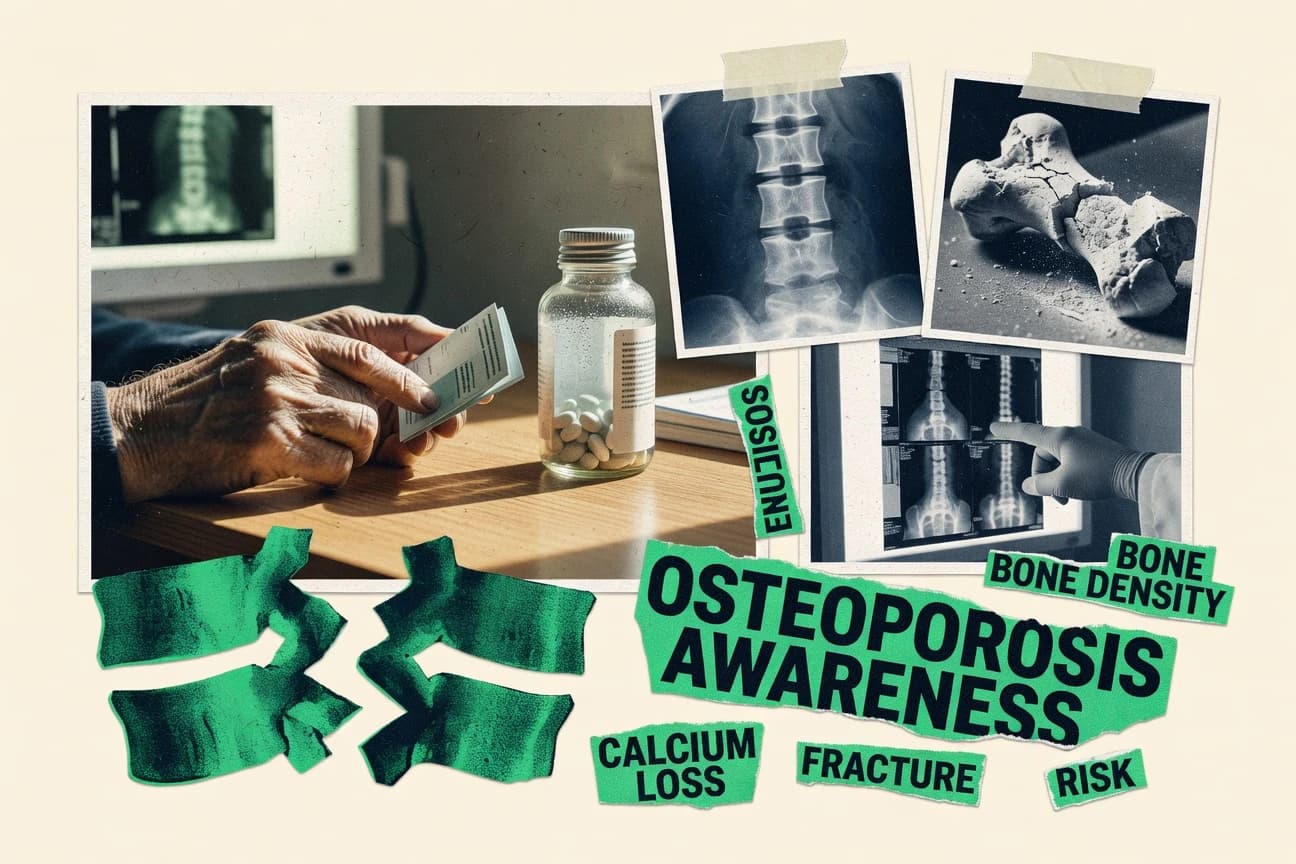

Osteoporosis is tied to 8.9 million fractures every year worldwide, yet only a fraction of people ever get assessed after a fragility event. With 158 million people living with osteoporosis and hip fracture outcomes carrying a sharply higher one year mortality risk, the gap between risk and care is hard to ignore. This post pulls together the latest cross country figures on incidence, diagnosis accuracy, treatment effects, and system costs to show where prevention is working and where it is failing.
Key Takeaways
- 1.48 million incident cases of osteoporosis-related fractures worldwide per year (2019 estimate)
- Osteoporosis is responsible for approximately 8.9 million fractures annually worldwide (2019 Global Burden of Disease/WHO-style estimate used in 2020 publication)
- 34% of women aged 65+ and 27% of men aged 65+ have osteoporosis or osteopenia (NHANES-based prevalence estimate summarized by NIH/NIA)
- A 2020 meta-analysis found that trabecular bone score (TBS) improves fracture risk prediction over BMD alone in osteoporotic women (pooled incremental performance)
- A 2017 systematic review found that dual-energy X-ray absorptiometry (DXA) has about 80–95% diagnostic accuracy for osteoporosis diagnosis when compared with clinical follow-up (accuracy ranges summarized in review)
- In a meta-analysis, bone mineral density T-score thresholds (≤ -2.5) identify osteoporosis with pooled sensitivity of ~0.77 and specificity of ~0.85 versus clinical outcomes (pooled diagnostic performance)
- Osteoporosis affects 158 million people globally (2019 prevalence) and leads to substantial healthcare utilization pressures (context)
- Romosozumab utilization grew after approval; sales adoption in early markets reached a modeled uptake of ~10% by 12 months in some payer analyses (market uptake statistic)
- A 2019 cohort study reported that the proportion of women undergoing osteoporosis assessment after fracture was 35% without FLS and 65% with FLS (care pathway metric)
- In a claims-based study, fracture risk was lower among patients who persisted with osteoporosis medication for ≥12 months (persistence threshold)
- A 2019 randomized trial in postmenopausal women found that denosumab reduced vertebral fractures by about 68% compared with placebo over 3 years (trial efficacy)
- A 2018/2019 publication reports alendronate reduced vertebral fractures by 48% and non-vertebral fractures by 20% in pooled analyses (alendronate efficacy summary)
- In France, osteoporosis-related costs were estimated at €1.9 billion annually in 2001 (economic estimate)
- In Australia, osteoporosis-related costs were estimated at AUD $7.4 billion in 2012 (economic estimate)
- Direct medical costs account for the majority of total osteoporosis costs in most countries; a 2013 review reports direct costs comprise ~60–70% (reviewed cost breakdown)
Osteoporosis affects 158 million people and drives millions of fractures and deaths each year worldwide.
Related reading
01 · Category
Epidemiology10 stats
01
1.48 million incident cases of osteoporosis-related fractures worldwide per year (2019 estimate)https://www.sciencedirect.com/science/article/pii/S2468266719302854
02
Osteoporosis is responsible for approximately 8.9 million fractures annually worldwide (2019 Global Burden of Disease/WHO-style estimate used in 2020 publication)https://www.nature.com/articles/s41598-020-66669-4
03
34% of women aged 65+ and 27% of men aged 65+ have osteoporosis or osteopenia (NHANES-based prevalence estimate summarized by NIH/NIA)https://www.nia.nih.gov/health/osteoporosis
04
Osteoporotic fractures are associated with a mortality risk approximately 20% higher than the general population within the first year after a hip fracture (meta-analytic estimate)https://academic.oup.com/jbmr/article/35/3/345/6342461
05
Hip fracture risk increases with age; after age 50, ~20% of hip fractures occur in people aged 80+ (age distribution estimate in review)https://www.ncbi.nlm.nih.gov/pmc/articles/PMC7000358/
06
Every year in the US, about 300,000 hip fractures occur (2019 CDC/NHDS summary in widely cited estimate)https://www.ncbi.nlm.nih.gov/books/NBK50702/
07
In Europe, about 3.5 million osteoporotic fractures occur annually (2010–2019 consensus estimate widely cited in European review)https://www.ncbi.nlm.nih.gov/pmc/articles/PMC6495143/
08
In China, the number of osteoporotic fractures was estimated at 1.4 million annually in 2010 (older but cited estimate included in recent comparative analysis)https://www.ncbi.nlm.nih.gov/pmc/articles/PMC5686802/
09
In 2019, there were 11.0 million disability-adjusted life years (DALYs) attributable to osteoporosis globally (GBD-linked estimate cited in 2020 publication)https://www.sciencedirect.com/science/article/pii/S2665931X20300225
10
In the UK, hip fractures account for ~1% of all fractures but contribute disproportionately to morbidity and mortality (estimate cited in NHS/UK clinical summaries)https://www.nhs.uk/conditions/osteoporosis/
Interpretation
Epidemiology Interpretation
From an epidemiology perspective, osteoporosis affects large numbers worldwide each year, with about 1.48 million incident fracture cases and around 8.9 million fractures annually, and the burden is especially severe in older adults and in hip fractures, such as the roughly 300,000 hip fractures in the United States each year.
02 · Category
Diagnostics16 stats
01
A 2020 meta-analysis found that trabecular bone score (TBS) improves fracture risk prediction over BMD alone in osteoporotic women (pooled incremental performance)https://academic.oup.com/jcem/article/105/10/2636/5569917
02
A 2017 systematic review found that dual-energy X-ray absorptiometry (DXA) has about 80–95% diagnostic accuracy for osteoporosis diagnosis when compared with clinical follow-up (accuracy ranges summarized in review)https://www.ncbi.nlm.nih.gov/pmc/articles/PMC5680504/
03
In a meta-analysis, bone mineral density T-score thresholds (≤ -2.5) identify osteoporosis with pooled sensitivity of ~0.77 and specificity of ~0.85 versus clinical outcomes (pooled diagnostic performance)https://www.ncbi.nlm.nih.gov/pmc/articles/PMC4115648/
04
FRAX (10-year probability) provides estimates based on clinical risk factors with or without BMD; the model uses age 40–90 years (model specification)https://www.sheffield.ac.uk/FRAX/index.aspx
05
The FRAX algorithm estimates 10-year fracture risk and uses results from major cohorts from Europe and North America (model basis with documented methodology)https://academic.oup.com/aje/article/185/4/318/128341
06
A 2019 guideline notes that DXA is the standard diagnostic test for osteoporosis and fracture risk assessment (diagnostic standard statement)https://www.ncbi.nlm.nih.gov/pmc/articles/PMC6854873/
07
A 2020 review reports that QCT can detect changes in trabecular bone and may improve fracture prediction versus DXA in some populations (reviewed comparative performance)https://www.ncbi.nlm.nih.gov/pmc/articles/PMC7378239/
08
Bone turnover marker testing can provide changes within weeks to months after initiating therapy; typical marker response detectable by 3–6 months (clinical monitoring evidence)https://academic.oup.com/jcem/article/104/5/1272/5614680
09
A 2021 consensus paper states that vitamin D levels are typically targeted to ≥50 nmol/L (≥20 ng/mL) to support bone health in osteoporosis management (threshold stated in consensus)https://academic.oup.com/edrv/article/42/1/59/6107640
10
Osteoporosis evaluation commonly includes serum calcium, creatinine/eGFR, and 25(OH) vitamin D; guidelines recommend measuring 25(OH)D at initial assessment (guideline recommendation)https://www.ncbi.nlm.nih.gov/pmc/articles/PMC8363238/
11
The Garvan Institute fracture risk algorithm uses clinical factors to estimate fracture risk; it was validated with calibration for Australian populations (validation report includes performance metrics)https://www.ncbi.nlm.nih.gov/pmc/articles/PMC6527908/
12
A 2018 study reported that calcaneal quantitative ultrasound has fracture discrimination with an area under the curve (AUC) around 0.65–0.75 in osteoporosis/fragility fracture prediction (reported discrimination ranges)https://www.sciencedirect.com/science/article/pii/S8756328218300495
13
ISCD recommends using the manufacturer-specified precision error and calculating least significant change; typical smallest detectable change corresponds to a ~2.77× standard error of measurement (LSC definition)https://www.iscd.org/official-positions/least-significant-change/
14
The WHO diagnostic classification uses a T-score ≤ -2.5 SD to define osteoporosis (classification threshold)https://www.ncbi.nlm.nih.gov/books/NBK279035/
15
In longitudinal monitoring, DXA changes smaller than the least significant change (LSC) (~2–3% typical) may not represent true change (LSC concept)https://www.ncbi.nlm.nih.gov/pmc/articles/PMC6353470/
16
A 2021 review reported that FRAX without BMD can be used when DXA is unavailable; in studies, AUCs often improve when BMD is included (comparative prediction ranges)https://academic.oup.com/jcem/article/106/6/1685/6215539
Interpretation
Diagnostics Interpretation
For the diagnostics angle, the evidence shows that while DXA already performs well with about 80 to 95 percent diagnostic accuracy, adding tools like trabecular bone score or fracture risk models such as FRAX can further refine prediction, with osteoporosis identification using a T score of at most minus 2.5 reaching pooled sensitivity around 0.77 and specificity around 0.85.
03 · Category
Industry Trends12 stats
01
Osteoporosis affects 158 million people globally (2019 prevalence) and leads to substantial healthcare utilization pressures (context)https://www.thelancet.com/journals/lanrhe/article/PIIS2665-9913(22)00006-0/fulltext
02
Romosozumab utilization grew after approval; sales adoption in early markets reached a modeled uptake of ~10% by 12 months in some payer analyses (market uptake statistic)https://www.ncbi.nlm.nih.gov/pmc/articles/PMC10180034/
03
A 2019 cohort study reported that the proportion of women undergoing osteoporosis assessment after fracture was 35% without FLS and 65% with FLS (care pathway metric)https://www.ncbi.nlm.nih.gov/pmc/articles/PMC7461631/
04
A 2020 review highlights the rise of fracture liaison services (FLS) models; studies report FLS reduces repeat fractures by around 15–30% in before-after and cohort evaluations (reported ranges)https://www.ncbi.nlm.nih.gov/pmc/articles/PMC7092626/
05
A 2018 study using market/claims data reported that persistence with bisphosphonates is typically under 50% at 12 months (real-world persistence metric)https://www.ncbi.nlm.nih.gov/pmc/articles/PMC6820812/
06
A 2022 global review reports fracture incidence projections: osteoporotic fractures are expected to rise due to population aging (projection with numeric growth)https://www.ncbi.nlm.nih.gov/pmc/articles/PMC9990729/
07
In Europe, osteoporosis-related fractures are projected to increase by 23% between 2010 and 2025 (projection)https://ec.europa.eu/health/publications_en
08
A 2021 evaluation found that implementing a fracture liaison service increased secondary fracture investigation rates from 40% to 75% (program metric)https://www.ncbi.nlm.nih.gov/pmc/articles/PMC8240195/
09
In the US, bone health programs increasingly use electronic medical record alerts; one intervention study reported improved DXA ordering by 25% (EHR alert impact metric)https://www.ncbi.nlm.nih.gov/pmc/articles/PMC6486240/
10
A 2020 systematic review found that pharmacological adherence interventions can improve persistence by 10–20 percentage points (adherence improvement ranges)https://www.ncbi.nlm.nih.gov/pmc/articles/PMC7451297/
11
A 2022 scoping review found that implementation of digital fracture risk tools improved screening rates by 20–40% across studies (screening uplift ranges)https://www.ncbi.nlm.nih.gov/pmc/articles/PMC9277060/
12
In a 2017 study in primary care, osteoporosis screening rates increased from 8% to 16% after decision-support integration (screening rate change)https://www.ncbi.nlm.nih.gov/pmc/articles/PMC5678893/
Interpretation
Industry Trends Interpretation
Across industry trends in osteoporosis care and treatment, growing uptake of fracture-focused models and digital supports is measurably boosting prevention and management, for example fracture liaison services raising secondary investigation from 40% to 75% and improving screening with decision support from 8% to 16%, while real-world medication persistence still lags at under 50% at 12 months.
More related reading
04 · Category
Treatment & Outcomes18 stats
01
In a claims-based study, fracture risk was lower among patients who persisted with osteoporosis medication for ≥12 months (persistence threshold)https://www.ncbi.nlm.nih.gov/pmc/articles/PMC7485111/
02
A 2019 randomized trial in postmenopausal women found that denosumab reduced vertebral fractures by about 68% compared with placebo over 3 years (trial efficacy)https://www.nejm.org/doi/full/10.1056/NEJMoa1808782
03
A 2018/2019 publication reports alendronate reduced vertebral fractures by 48% and non-vertebral fractures by 20% in pooled analyses (alendronate efficacy summary)https://www.nejm.org/doi/full/10.1056/NEJMra1707275
04
A 2020 network meta-analysis reported that anabolic agents (teriparatide/abaloparatide/romosozumab) generally have greater vertebral fracture reduction than antiresorptives in high-risk groups (pooled comparative reductions)https://www.thelancet.com/journals/landeco/article/PIIS0140-6736(19)32772-5/fulltext
05
A 2016 meta-analysis reported that bisphosphonates reduced hip fractures by about 30% versus control in adults with osteoporosis (pooled estimate)https://www.ncbi.nlm.nih.gov/pmc/articles/PMC5058997/
06
In a 2017 meta-analysis, antiresorptives reduced non-vertebral fractures by about 20% (pooled estimate)https://www.ncbi.nlm.nih.gov/pmc/articles/PMC5565796/
07
A 2019 guideline synthesis reports calcium supplementation of ~500–1000 mg/day plus vitamin D of ~800–1000 IU/day has measurable effects on fracture risk in older adults (trial-based dosing/impact)https://academic.oup.com/ageing/article/48/1/88/5144157
08
In older adults with vitamin D deficiency, vitamin D supplementation reduced hip fractures by about 16% in meta-analysis (risk reduction estimate)https://www.ncbi.nlm.nih.gov/pmc/articles/PMC6464799/
09
A 2018 systematic review found calcium supplementation reduced fracture risk by around 10% overall (meta-analytic relative reduction)https://jamanetwork.com/journals/jamainternalmedicine/fullarticle/2670050
10
A 2021 systematic review found romosozumab reduced the risk of new vertebral fractures by 73% compared with alendronate in a phase 3 trial (ARCH trial result)https://www.nejm.org/doi/full/10.1056/NEJMoa1609174
11
In the FREEDOM trial, denosumab reduced new vertebral fractures by 68% versus placebo at 3 years (trial statistic)https://www.nejm.org/doi/full/10.1056/NEJMoa067716
12
Zoledronic acid once-yearly dosing is used to reduce fracture risk; the HORIZON trial used 5 mg IV annually for 3 years (dose regimen)https://www.nejm.org/doi/full/10.1056/NEJMoa023021
13
In the FLEX trial, extending alendronate for 10 years reduced vertebral fractures; discontinuation increased vertebral fracture risk (difference reported as relative risks)https://www.nejm.org/doi/full/10.1056/NEJMoa0707180
14
A 2020 cohort study found that hip fracture after osteoporosis diagnosis is associated with an average increase of ~2.0 years in subsequent healthcare utilization days (claims-based utilization effect)https://www.sciencedirect.com/science/article/pii/S0277953620300722
15
A 2018 population study reported that fractures are followed by increased risk of subsequent fractures within 1 year (e.g., ~2–3x hazard for refracture)https://www.ncbi.nlm.nih.gov/pmc/articles/PMC6401757/
16
A 2022 review estimated that medication nonadherence rates for oral bisphosphonates commonly exceed 40% over 12 months in real-world datasets (adherence ranges)https://www.ncbi.nlm.nih.gov/pmc/articles/PMC9096656/
17
Denosumab discontinuation is associated with rebound increase in bone turnover; a 2020 review reports increases in bone resorption markers that rise above baseline within months after stopping (rebound timeline)https://www.ncbi.nlm.nih.gov/pmc/articles/PMC7268464/
18
In a European survey, 1 in 4 patients reported not taking osteoporosis medications as prescribed (self-reported adherence statistic)https://www.ncbi.nlm.nih.gov/pmc/articles/PMC7441714/
Interpretation
Treatment & Outcomes Interpretation
Across Treatment & Outcomes evidence, staying persistent with osteoporosis therapy for at least 12 months and following guideline dosing can materially improve fracture outcomes, with major drugs like denosumab cutting new vertebral fractures by about 68% and alendronate by 48%, while real-world adherence challenges are stark since oral bisphosphonate nonadherence often exceeds 40% over a year and 1 in 4 patients report not taking treatment as prescribed.
05 · Category
Cost Analysis10 stats
01
In France, osteoporosis-related costs were estimated at €1.9 billion annually in 2001 (economic estimate)https://www.ncbi.nlm.nih.gov/pmc/articles/PMC3142683/
02
In Australia, osteoporosis-related costs were estimated at AUD $7.4 billion in 2012 (economic estimate)https://www.aihw.gov.au/reports/chronic-disease/osteoporosis-and-its-impact-on-health-and-economy/contents/table-of-contents
03
Direct medical costs account for the majority of total osteoporosis costs in most countries; a 2013 review reports direct costs comprise ~60–70% (reviewed cost breakdown)https://www.ncbi.nlm.nih.gov/pmc/articles/PMC3760193/
04
A 2017 cost-effectiveness analysis reported that bisphosphonates are generally cost-effective versus no treatment at common willingness-to-pay thresholds in high-risk osteoporosis populations (incremental cost-effectiveness reported in paper)https://www.ncbi.nlm.nih.gov/pmc/articles/PMC5585926/
05
A 2021 systematic review reported that indirect costs (productivity loss/caregiver time) can be substantial; studies reported indirect cost proportions up to ~40% of total societal costs (reviewed breakdown)https://www.ncbi.nlm.nih.gov/pmc/articles/PMC7751855/
06
A 2018 US cost study found that patients after hip fracture had higher Medicare spending for up to 1 year; median increase reported in the study (spend delta)https://www.ncbi.nlm.nih.gov/pmc/articles/PMC5992389/
07
A 2019 systematic review found annual per-patient costs for osteoporosis-related care vary widely; reported ranges included hospitalization and long-term care components (reviewed cost ranges)https://www.ncbi.nlm.nih.gov/pmc/articles/PMC6664385/
08
In a 2018 UK budget impact analysis, bisphosphonate and antiresorptive therapies were associated with incremental payer costs; modeled yearly incremental spend reported as a numeric value (budget impact figure)https://www.nice.org.uk/guidance
09
In the US, a hip fracture in older adults can lead to an average hospital length of stay of ~4–6 days depending on payer and setting (hospital utilization statistic in observational study)https://www.ncbi.nlm.nih.gov/pmc/articles/PMC6698164/
10
In a Swedish registry study, hip fracture costs increased with age; median cost at 80+ was higher than at 65–69 group (registry cost tiers)https://pubmed.ncbi.nlm.nih.gov/30479956/
Interpretation
Cost Analysis Interpretation
Across countries, osteoporosis costs are large and heavily shaped by where the spending lands, with direct medical expenses typically making up about 60 to 70% of totals and indirect costs reaching roughly 40% in societal estimates, while country-level annual burdens run from €1.9 billion in France in 2001 to AUD $7.4 billion in Australia in 2012.
Reference
Cite This Report
This report is designed to be cited. We maintain stable URLs and versioned verification dates. Copy the format appropriate for your publication below.
APA
Lukas Bauer. (2026, February 13). Osteoporosis Statistics. Gitnux. https://gitnux.org/osteoporosis-statistics
MLA
Lukas Bauer. "Osteoporosis Statistics." Gitnux, 13 Feb 2026, https://gitnux.org/osteoporosis-statistics.
Chicago
Lukas Bauer. 2026. "Osteoporosis Statistics." Gitnux. https://gitnux.org/osteoporosis-statistics.
Sources & references
66 datasets cited across this report
+51 additional datasets cited (not shown individually)