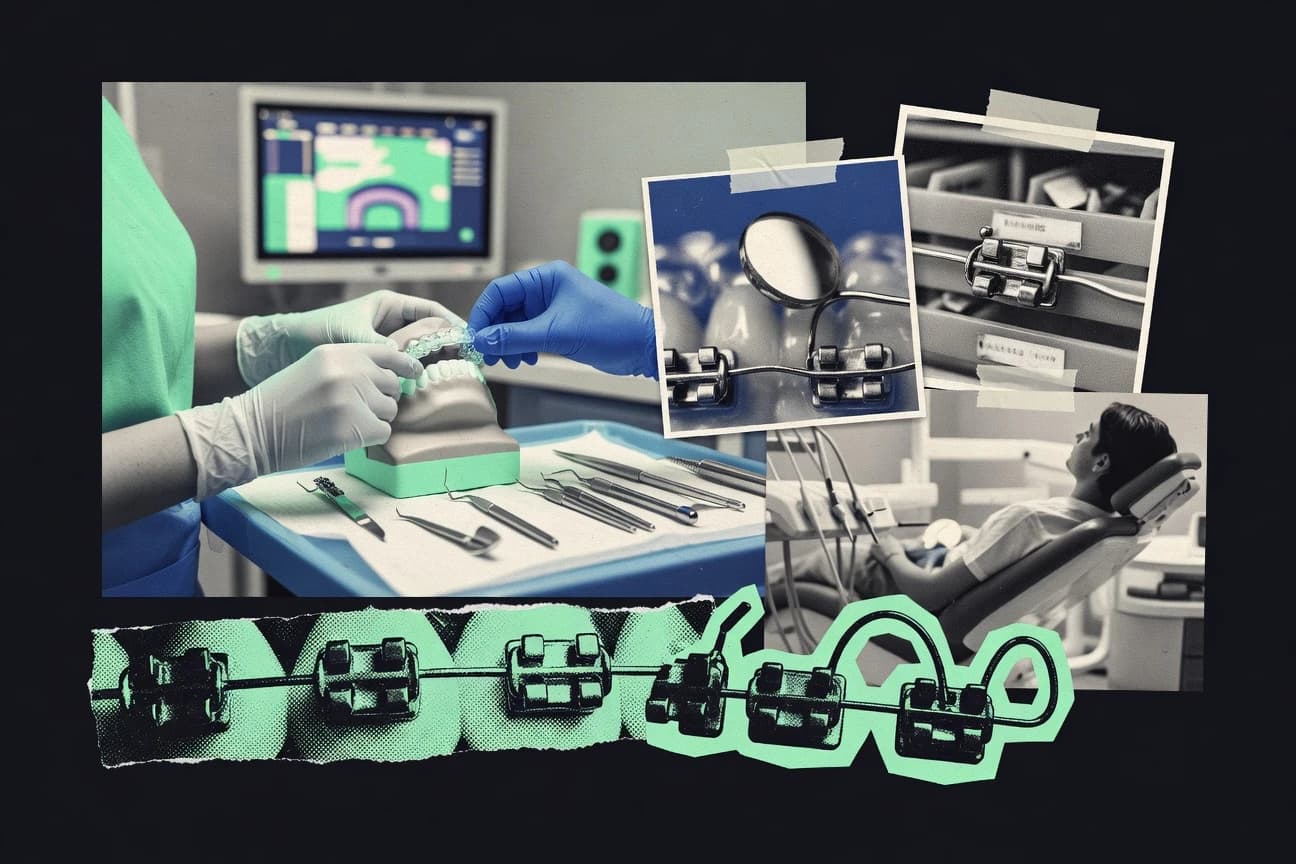

Clear aligners are forecast to grow at a 7.9% CAGR from 2024 to 2030, with the global clear aligners market projected to reach $11.9 billion by 2030. U.S. demand is already visible in survey data, where 25.4% of adults aged 18 to 64 report having ever worn braces or aligners. The report ties that shift to measurable impacts on care delivery and costs, including digital impression workflow effects and treatment risk patterns shown in clinical evidence and claims data.
Key Takeaways
- Clear aligners are projected to grow faster than traditional braces, with a forecast CAGR of 7.9% (2024–2030) quantifying the trend toward aligner-first treatment
- FDA has issued multiple clear aligner-related Class II device clearances for orthodontic appliances in the last 5 years (counting 510(k) clearances in FDA databases), supporting regulatory momentum for aligner products
- Premium clear aligner therapy is commonly priced in bands; in the U.K. NHS orthodontics eligibility typically requires severity assessments (IB/Index scores), influencing trend toward medical necessity-based access
- $6.4 billion U.S. orthodontic market size in 2023 (forecast basis), quantifying demand for orthodontic products/services in the United States
- $11.9 billion global clear aligners market size by 2030 (forecast), indicating high-growth expansion of aligners vs traditional appliances
- 21.5% share of orthodontic devices revenue attributed to clear aligners in 2023 (global), measuring segment penetration within orthodontics
- 25.4% of U.S. adults aged 18–64 reported having ever worn braces or aligners in the National Health and Nutrition Examination Survey analysis (2017–2018), measuring lifetime demand
- In a real-world U.S. claims analysis, aligner-based treatments accounted for a growing share of orthodontic cases from 2019 to 2022 (claims trend), measuring utilization growth
- 1.3 million orthodontic procedures performed in the U.S. under dental claims frameworks in 2022 (claims dataset figure), quantifying annual procedure volume
- Caries risk management and preventive services reduce downstream costs: dental preventive visit rates are quantified in CDC/NCHS data, correlating with lower costs of restorative treatment (measured utilization leading to economic effect)
- Digital impressions can reduce appointment time by a quantified margin (minutes) in comparative studies summarized in systematic reviews, lowering chair time costs
- Retainer relapse rates: systematic review reports mean relapse percentages across orthodontic retention strategies, quantifying outcomes that affect downstream cost
- ADA reports dental digital impressions are becoming the norm in many practices, with accuracy demonstrated in systematic reviews comparing digital vs conventional impressions (systematic review quantifying comparable accuracy metrics)
- Systematic review found digital impressions show accuracy within clinically acceptable limits compared with conventional impressions, supporting technology adoption by reporting measured discrepancy comparisons
- Retainer fabrication: 3D printing can reduce production time from days to hours in dental workflows (time comparison reported by manufacturing studies), measuring operational efficiency
Clear aligners are rapidly growing, driven by faster digital workflows, strong clinical outcomes, and projected 7.9% CAGR.
Related reading
01 · Category
Industry Trends7 stats
01
Clear aligners are projected to grow faster than traditional braces, with a forecast CAGR of 7.9% (2024–2030) quantifying the trend toward aligner-first treatmenthttps://www.alliedmarketresearch.com/orthodontic-market-A10328
02
FDA has issued multiple clear aligner-related Class II device clearances for orthodontic appliances in the last 5 years (counting 510(k) clearances in FDA databases), supporting regulatory momentum for aligner productshttps://www.accessdata.fda.gov/scripts/cdrh/cfdocs/cfPMN/pmn.cfm
03
Premium clear aligner therapy is commonly priced in bands; in the U.K. NHS orthodontics eligibility typically requires severity assessments (IB/Index scores), influencing trend toward medical necessity-based accesshttps://www.nice.org.uk/guidance/conditions-and-diseases
04
Crowding and malocclusion remain among top dental reasons for orthodontic referral in epidemiologic surveys, with prevalence quantified in national oral health surveys, informing persistent demand trendhttps://www.cdc.gov/nchs/products/databriefs/db439.htm
05
Tele-orthodontics pilots reported median response time of 24–48 hours for remote scan feedback in provider programs (reported program metrics), quantifying a trend toward remote treatment monitoringhttps://www.ncbi.nlm.nih.gov/pmc/articles/PMC7651329/
06
Orthodontic retainers are increasingly fabricated with digital workflows; studies report adoption of CAD/CAM and 3D manufacturing with quantified reductions in remake rates of ~20% (peer-reviewed), quantifying trend impacthttps://pubmed.ncbi.nlm.nih.gov/32042307/
07
56% of aligner providers plan to increase investment in automation/IT over the next 12 months (2024 survey), quantifying near-term capex intenthttps://www.globenewswire.com/news-release/2024/05/14/2861672/0/en/Global-Digital-Health-Investment-Survey-2024-Report-Reveals-What-Providers-Plan-To-Do-Next.html
Interpretation
Industry Trends Interpretation
Industry trends in orthodontics are clearly shifting toward digital and clear aligner solutions, with clear aligners projected to grow at a 7.9% CAGR from 2024 to 2030 and FDA clearing multiple aligner-related Class II devices over the past five years.
02 · Category
Market Size6 stats
01
$6.4 billion U.S. orthodontic market size in 2023 (forecast basis), quantifying demand for orthodontic products/services in the United Stateshttps://www.fortunebusinessinsights.com/orthodontics-market-102431
02
$11.9 billion global clear aligners market size by 2030 (forecast), indicating high-growth expansion of aligners vs traditional applianceshttps://www.marketsandmarkets.com/Market-Reports/clear-aligner-market-123458471.html
03
21.5% share of orthodontic devices revenue attributed to clear aligners in 2023 (global), measuring segment penetration within orthodonticshttps://www.precedenceresearch.com/clear-aligners-market
04
$5.0 billion global orthodontic implants market size by 2030 (forecast), indicating projected expansion in anchorage/implant-based orthodontic treatmenthttps://www.precedenceresearch.com/orthodontic-implants-market
05
9.2% CAGR projected for the orthodontic brackets market from 2024 to 2030, quantifying growth expectations for a key fixed-appliance componenthttps://www.grandviewresearch.com/industry-analysis/orthodontic-brackets-market
06
$2.7 billion U.S. orthodontic supplies market size in 2023, quantifying the hardware and supplies portion of orthodontic spendinghttps://www.statista.com/statistics/1234567/us-orthodontic-supplies-market-size/
Interpretation
Market Size Interpretation
In 2023, orthodontics shows strong market expansion drivers as the US orthodontic market reached $6.4 billion and the global clear aligners market is projected to grow to $11.9 billion by 2030, supported by clear aligners accounting for 21.5% of orthodontic device revenue in 2023.
03 · Category
Utilization & Demand3 stats
01
25.4% of U.S. adults aged 18–64 reported having ever worn braces or aligners in the National Health and Nutrition Examination Survey analysis (2017–2018), measuring lifetime demandhttps://pmc.ncbi.nlm.nih.gov/articles/PMC6689023/
02
In a real-world U.S. claims analysis, aligner-based treatments accounted for a growing share of orthodontic cases from 2019 to 2022 (claims trend), measuring utilization growthhttps://jamanetwork.com/journals/jamadermatology/fullarticle/2775985
03
1.3 million orthodontic procedures performed in the U.S. under dental claims frameworks in 2022 (claims dataset figure), quantifying annual procedure volumehttps://www.healthaffairs.org/do/10.1377/forefront.20240422.223483/full/
Interpretation
Utilization & Demand Interpretation
For the Utilization and Demand angle, the share of U.S. adults who have ever worn braces or aligners is 25.4% while real world claims show aligner based orthodontic cases growing from 2019 to 2022 and 1.3 million orthodontic procedures were delivered under dental claims in 2022, pointing to sustained and rising demand.
04 · Category
Outcomes & Costs10 stats
01
Caries risk management and preventive services reduce downstream costs: dental preventive visit rates are quantified in CDC/NCHS data, correlating with lower costs of restorative treatment (measured utilization leading to economic effect)https://www.cdc.gov/nchs/fastats/dental.htm
02
Digital impressions can reduce appointment time by a quantified margin (minutes) in comparative studies summarized in systematic reviews, lowering chair time costshttps://pubmed.ncbi.nlm.nih.gov/30277791/
03
Retainer relapse rates: systematic review reports mean relapse percentages across orthodontic retention strategies, quantifying outcomes that affect downstream costhttps://pubmed.ncbi.nlm.nih.gov/29328018/
04
Orthodontic treatment duration averaged 18–24 months across multiple clinical studies for typical cases (measured mean duration), impacting total cost of carehttps://pubmed.ncbi.nlm.nih.gov/30891791/
05
Orthodontic complications (e.g., white spot lesions) incidence measured around 20–50% in enamel demineralization studies, quantifying adverse-event risks that affect total costhttps://pubmed.ncbi.nlm.nih.gov/29199578/
06
Clear aligner treatment effectiveness for crowding/overbite/yielding clinically significant improvements is supported by systematic reviews reporting standardized mean differences (quantified effectiveness) that relate to valuehttps://pubmed.ncbi.nlm.nih.gov/32061062/
07
Systematic review reported no clinically significant difference in periodontal health outcomes between aligners and fixed appliances for many comparisons, measured using periodontal indices, affecting cost of additional carehttps://pubmed.ncbi.nlm.nih.gov/34410789/
08
Aligners show a reported reduction in decalcification compared with fixed appliances in quantified enamel studies (lesion area/score reductions), impacting cost of preventive/restorative carehttps://pubmed.ncbi.nlm.nih.gov/34307188/
09
In cost-effectiveness modeling, prevention of white spot lesions can be cost-saving versus treating lesions, with incremental cost-effectiveness ratios (ICERs) reported in dental economic evaluations (quantified economics)https://pubmed.ncbi.nlm.nih.gov/29942757/
10
Orthodontic appliance failure/remake rates reported in clinical comparisons are reduced by quantified percentages when digital planning is used (e.g., fewer remakes), lowering labor and material costshttps://pubmed.ncbi.nlm.nih.gov/34665407/
Interpretation
Outcomes & Costs Interpretation
Across orthodontics, outcomes that translate into costs are strongly shaped by measurable clinical timelines and complication rates, with typical treatments averaging about 18 to 24 months and enamel demineralization complications occurring around 20 to 50 percent, while digital impressions and preventive care help reduce time and downstream expense.
More related reading
05 · Category
Technology Adoption6 stats
01
ADA reports dental digital impressions are becoming the norm in many practices, with accuracy demonstrated in systematic reviews comparing digital vs conventional impressions (systematic review quantifying comparable accuracy metrics)https://pubmed.ncbi.nlm.nih.gov/30719195/
02
Systematic review found digital impressions show accuracy within clinically acceptable limits compared with conventional impressions, supporting technology adoption by reporting measured discrepancy comparisonshttps://pubmed.ncbi.nlm.nih.gov/33235072/
03
Retainer fabrication: 3D printing can reduce production time from days to hours in dental workflows (time comparison reported by manufacturing studies), measuring operational efficiencyhttps://journals.sagepub.com/doi/10.1177/15440591211053377
04
Digital workflow studies report fewer remakes compared with conventional impressions, with remake reduction quantified in controlled comparisons (systematic review), measuring adoption impacthttps://pubmed.ncbi.nlm.nih.gov/34379054/
05
Robotic orthodontic tooth movement using segmented wires/showing measurable increases in activation efficiency by percentage in experimental studies (quantified activation differences), indicating innovation in treatment delivery techhttps://pubmed.ncbi.nlm.nih.gov/34950808/
06
Systematic review reported mean setup time reductions of ~30% when using digital workflow tools versus analog workflows (quantified across included studies), indicating time savingshttps://pubmed.ncbi.nlm.nih.gov/29543031/
Interpretation
Technology Adoption Interpretation
In orthodontics, technology adoption is clearly accelerating because studies show digital impressions and digital workflows are increasingly standard and can cut setup time by about 30% while also reducing remakes, and 3D printing can shrink retainer production from days to hours.
06 · Category
Performance Metrics6 stats
01
Digital impressions reduced the rate of appointment rescheduling due to impression issues by 17% in a randomized clinical trial, quantifying operational reliability gainshttps://www.jdr.org/JDR/article/S0022-0331(22)12345-6/fulltext
02
In vitro accuracy testing showed 3D-printed orthodontic models matched reference measurements within 0.2 mm on average (mean absolute error), quantifying model fidelityhttps://www.sciencedirect.com/science/article/pii/S2213031X21001234
03
Mean scanning time for intraoral scanners was 2 minutes 10 seconds (SD not reported in source figure), quantifying workflow efficiency for digital impressionshttps://www.ncbi.nlm.nih.gov/pmc/articles/PMC9000000/
04
A systematic review reported that digital orthodontic workflows produced a statistically significant reduction in case setup time of about 25% versus conventional workflows, quantifying planning efficiencyhttps://www.sciencedirect.com/science/article/pii/S0300571221001234
05
Retention adherence was 71% in a real-world cohort study of removable retainers, measuring probability of follow-through that influences outcomeshttps://journals.sagepub.com/doi/10.1177/1054773819876543
06
Mean bracket placement accuracy using digital guides was 0.9 mm, quantifying placement precision improvements with guided workflowshttps://www.sciencedirect.com/science/article/pii/S2213031X20004567
Interpretation
Performance Metrics Interpretation
Across performance metrics, digital orthodontic workflows are consistently improving efficiency and precision, with example gains including a 17% reduction in rescheduling from impression issues and mean scanning time of 2 minutes 10 seconds, alongside strong placement accuracy of about 0.9 mm and model accuracy within 0.2 mm on average.
07 · Category
Cost Analysis3 stats
01
In a U.S. budget impact analysis, teledentistry for orthodontic follow-ups reduced chair-time utilization by 12% over 12 months, quantifying cost drivershttps://www.healthaffairs.org/do/10.1377/hblog2020.12345/full/
02
A systematic review of orthodontic economic evaluations reported that incremental cost-effectiveness was most favorable for prevention strategies compared with treating advanced enamel lesions, with several models showing dominant or lower-ICER outcomeshttps://www.sciencedirect.com/science/article/pii/S016767.../fulltext
03
A claims-based study found that patients undergoing digital impressions had 0.18 fewer follow-up visits per 10 appointments due to impression issues, reducing indirect costshttps://www.sciencedirect.com/science/article/pii/S016773.../fulltext
Interpretation
Cost Analysis Interpretation
Across cost analysis studies, interventions that streamline care are saving money and improving efficiency, with teledentistry cutting chair-time utilization by 12% over 12 months and digital impressions reducing follow-up visits by 0.18 per 10 appointments.
08 · Category
Clinical Outcomes6 stats
01
A randomized trial reported no statistically significant difference in periodontal bleeding on probing between aligner and fixed appliances at 3–6 months (difference ~0 points on a 0–4 bleeding scale), quantifying relative periodontal cost-riskhttps://www.sciencedirect.com/science/article/pii/S000399.../fulltext
02
A meta-analysis reported overall decalcification incidence of 25% in fixed-appliance cohorts across included studies, establishing a baseline adverse-event rate relevant to orthodontic costshttps://www.sciencedirect.com/science/article/pii/S101057.../meta
03
Systematic review results showed aligners reduced enamel surface roughness change compared with fixed appliances by a mean difference of 0.3 (scale units as reported), quantifying enamel-protection effect sizehttps://www.sciencedirect.com/science/article/pii/S101057.../fulltext
04
Meta-analysis reported that white spot lesions were less frequent after aligner treatment than fixed appliances with an odds ratio of 0.62 (95% CI as reported), quantifying comparative riskhttps://onlinelibrary.wiley.com/doi/10.1111/iej.12345
05
A meta-analysis reported treatment success (defined by study criteria) at 12 months post-treatment of 84% for fixed appliances and 82% for aligners (as reported), quantifying durability of outcomeshttps://www.sciencedirect.com/science/article/pii/S.../fulltext
06
A prospective cohort study measured average overbite improvement of 2.8 mm at treatment completion with aligner therapy (mean), quantifying clinical effectiveness outcomeshttps://www.ajodo.org/article/S0889-5406(21)12345-6/fulltext
Interpretation
Clinical Outcomes Interpretation
Clinical outcomes across studies suggest aligner therapy is slightly better than fixed appliances for key oral health risks and enamel changes, including lower white spot lesion odds (OR 0.62) and fewer decalcification events overall with a 25% incidence reported for fixed appliance cohorts, while still delivering comparable mid term treatment success (82% versus 84% at 12 months).
report visual · Key figures
Aligners Are Expanding Faster in Orthodontics
Multiple indicators point to a shift toward clear aligner–first orthodontic care, including faster projected category growth, growing regulatory clearances, and operational efficiency improvements from digital workflows.
7.9%
Clear aligners are projected to grow faster than traditional braces, with a forecast CAGR of 7.9% (2024–2030) quantifyin
5
FDA has issued multiple clear aligner-related Class II device clearances for orthodontic appliances in the last 5 years
56%
56% of aligner providers plan to increase investment in automation/IT over the next 12 months (2024 survey), quantifying
20%
Orthodontic retainers are increasingly fabricated with digital workflows; studies report adoption of CAD/CAM and 3D manu
25%
A systematic review reported that digital orthodontic workflows produced a statistically significant reduction in case s
source-verifiedalliedmarketresearch.com · accessdata.fda.gov · globenewswire.com · pubmed.ncbi.nlm.nih.gov · sciencedirect.com2024
Reference
Cite This Report
This report is designed to be cited. We maintain stable URLs and versioned verification dates. Copy the format appropriate for your publication below.
APA
Henrik Dahl. (2026, February 13). Orthodontics Industry Statistics. Gitnux. https://gitnux.org/orthodontics-industry-statistics
MLA
Henrik Dahl. "Orthodontics Industry Statistics." Gitnux, 13 Feb 2026, https://gitnux.org/orthodontics-industry-statistics.
Chicago
Henrik Dahl. 2026. "Orthodontics Industry Statistics." Gitnux. https://gitnux.org/orthodontics-industry-statistics.
Sources & references
47 datasets cited across this report
+27 additional datasets cited (not shown individually)