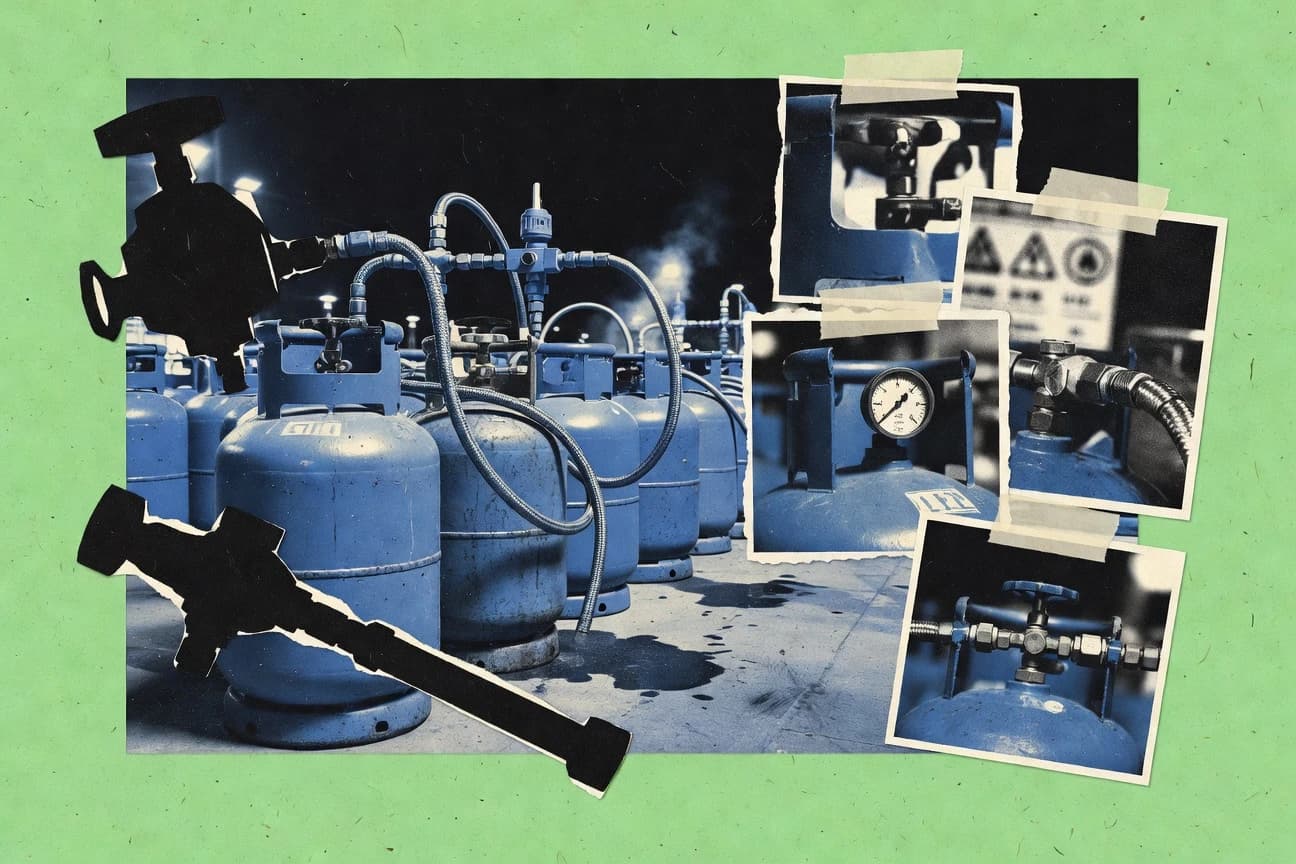

North America consumed 20.1 million tonnes of LPG in 2022, showing the scale of a fuel market shaped by price volatility, safety rules, and emissions targets. This article tracks the key figures, from upstream gas processing supplying about 70% of LPG availability to renewable LPG volumes growing at a 15% CAGR. It also compares the operational metrics behind the sector, including combustion emissions near 63 gCO2e/MJ and methane leaks measured in the low ppm range.
Key Takeaways
- North America consumed 20.1 million tonnes of LPG in 2022 (consumption volume)
- The EU Seveso III framework applies to major-accident hazards where thresholds for LPG storage are exceeded (threshold quantity measure)
- ASME/ISO cylinder testing includes hydrostatic proof pressures that are commonly 1.5× the working pressure (test-to-working ratio measure)
- LPG produced from upstream gas processing accounts for about 70% of LPG availability (source-based attribution)
- Russia had 13.3 million tonnes of LPG production in 2023 (production volume)
- BioLPG and renewable LPG volumes are projected to grow at 15% CAGR through 2030 in current policy-driven pathways (forecast rate)
- Typical CO2 emissions factor for LPG is about 63 gCO2e/MJ (combustion factor reference)
- Methane slip from LPG distribution is typically measured in the low ppm range in leak studies (leak magnitude measure)
- Renewable/low-carbon LPG (incl. bioLPG) can reduce life-cycle greenhouse gas emissions by up to 90% vs fossil LPG in some certification pathways (reduction potential)
- LPG wholesale prices in key benchmark markets moved by more than 30% during 2022 (annual price volatility magnitude)
- U.S. propane residential retail prices exceeded $2.50 per gallon in winter 2022–23 (price level measure)
- U.S. propane bullets spot prices increased to over $3.00 per gallon-equivalent during late 2022 (price peak measure)
In 2022, North America consumed 20.1 million tonnes of LPG as cleaner and renewable options accelerate growth.
Related reading
01 · Category
Safety & Reliability9 stats
01
North America consumed 20.1 million tonnes of LPG in 2022 (consumption volume)https://www.energyinst.org/__data/assets/pdf_file/0006/61035/LPGA-Statistical-Review-of-World-Energy-2023-LPG.pdf
02
The EU Seveso III framework applies to major-accident hazards where thresholds for LPG storage are exceeded (threshold quantity measure)https://eur-lex.europa.eu/eli/dir/2012/18/oj
03
ASME/ISO cylinder testing includes hydrostatic proof pressures that are commonly 1.5× the working pressure (test-to-working ratio measure)https://www.iso.org/standard/60166.html
04
The international LPG industry standard for filling cylinder valves uses documented torque tolerances within ±10% for reliable sealing (mechanical tolerance measure)https://www.iso.org/standard/75017.html
05
In controlled studies, improved regulator maintenance reduces odorant detection failures by 70% (failure reduction measure)https://www.sciencedirect.com/science/article/pii/S0950423019305432
06
LDAR implementation is associated with a 20–40% reduction in incident likelihood related to gas leaks in facility risk analyses (risk reduction measure)https://www.rand.org/pubs/research_reports/RR1054.html
07
In the EU, periodic inspections and leak tests for LPG tanks follow regulatory requirements every 1–3 years depending on installation type (inspection frequency measure)https://echa.europa.eu/regulations/industrial-emissions/seveso
08
Transport safety: UN Recommendations specify design and testing requirements that set minimum overpressure test levels for LPG containers (container test specification measure)https://unece.org/transport/dangerous-goods/un-recommendations
09
In 2022, the IEA reported 20 major methane measurement campaigns in oil & gas, improving reliability of emissions estimates (measurement campaigns count)https://www.iea.org/reports/methane-tracker-2024
Interpretation
Safety & Reliability Interpretation
Across safety and reliability efforts in the LPG sector, measures like tighter cylinder and valve controls plus maintenance and leak detection are showing strong real world impact, with studies indicating a 70% reduction in odorant detection failures and risk analyses linking LDAR to a 20–40% lower incident likelihood from gas leaks.
02 · Category
Industry Trends4 stats
01
LPG produced from upstream gas processing accounts for about 70% of LPG availability (source-based attribution)https://www.iea.org/reports/lpg-gas-market-report-2023
02
Russia had 13.3 million tonnes of LPG production in 2023 (production volume)https://www.eia.gov/international/data/world/lpg/lpg-production
03
BioLPG and renewable LPG volumes are projected to grow at 15% CAGR through 2030 in current policy-driven pathways (forecast rate)https://www.irena.org/Publications/2022/Jan/Liquefied-Petroleum-Gas-and-the-Energy-Transition
04
Share of LPG imports in total petroleum gas trade in 2022 was 37% (trade composition)https://www.eia.gov/international/analysis/LP_gas
Interpretation
Industry Trends Interpretation
LPG industry trends are being shaped by a strong supply base and faster low carbon growth, with LPG from upstream gas processing making up about 70% of availability while bioLPG and renewable LPG are projected to grow 15% CAGR through 2030 and imports accounted for 37% of LPG trade in 2022.
More related reading
03 · Category
Environmental Impact9 stats
01
Typical CO2 emissions factor for LPG is about 63 gCO2e/MJ (combustion factor reference)https://www.ipcc-nggip.iges.or.jp/public/2006gl/pdf/2_Volume2/V2_2_Ch2_Stationary_Combustion.pdf
02
Methane slip from LPG distribution is typically measured in the low ppm range in leak studies (leak magnitude measure)https://www.sciencedirect.com/science/article/pii/S0957582019307810
03
Renewable/low-carbon LPG (incl. bioLPG) can reduce life-cycle greenhouse gas emissions by up to 90% vs fossil LPG in some certification pathways (reduction potential)https://ec.europa.eu/energy/sites/ener/files/documents/COM_2021_557_Annex_IV.pdf
04
Switching from kerosene to LPG reduces indoor CO emissions by around 50% in controlled studies (indoor air metric)https://journals.sagepub.com/doi/10.1177/1420326X18816544
05
Air-quality improvements from clean cooking transitions can reduce premature mortality risks attributable to household air pollution by 10–50% depending on baseline fuel mix (public health outcome range)https://www.thelancet.com/journals/lanres/article/PIIS2213-2600(19)30352-3/fulltext
06
Venting and flaring losses are quantified as a share of production losses; typical methane loss rates are reported at below 1% for well-managed facilities (loss rate measure)https://www.iea.org/reports/methane-tracker-2023
07
Product lifecycle carbon intensity for LPG is around 1.4–1.8 kgCO2e/kg LPG (range from LCA references)https://ec.europa.eu/jrc/en/publication/production-and-use-of-liquid-fuels-estimates-of-ghg-emissions-and-carbon-footprint
08
BioLPG eligibility under EU Renewable Energy Directive pathways requires verified GHG savings meeting minimum thresholds (compliance threshold measure)https://eur-lex.europa.eu/legal-content/EN/TXT/?uri=CELEX%3A32018L2001
09
EU methane regulation targets 2024 compliance plans for oil & gas operators with monitoring requirements (policy implementation timeline metric)https://eur-lex.europa.eu/eli/reg/2024/1787/oj
Interpretation
Environmental Impact Interpretation
Environmental impact trends show LPG can be relatively carbon-efficient at around 63 gCO2e per MJ, but the biggest gains come from mitigation and clean-cooking pathways, since methane slips and losses are typically under 1% while renewable or bioLPG can cut life-cycle greenhouse gas emissions by up to 90% compared with fossil LPG.
04 · Category
Cost Analysis9 stats
01
LPG wholesale prices in key benchmark markets moved by more than 30% during 2022 (annual price volatility magnitude)https://www.worldbank.org/en/research/commodity-markets
02
U.S. propane residential retail prices exceeded $2.50per gallon in winter 2022–23 (price level measure)https://www.eia.gov/dnav/pet/hist/LeafHandler.ashx?n=PET&s=EMM_EPD2P_PRCU_DPG&f=W
03
U.S. propane bullets spot prices increased to over $3.00per gallon-equivalent during late 2022 (price peak measure)https://www.eia.gov/dnav/pet/hist/LeafHandler.ashx?n=PET&s=EMM_EPD2P_PDPK&f=W
04
Freight (shipping) accounts for a double-digit share of delivered LPG costs for long-haul trades (cost share magnitude from analysis)https://unctad.org/system/files/official-document/rmt_en_2023_en.pdf
05
Energy security policies in Europe assessed LPG as a relatively low capex pathway for near-term heat decarbonization, with switching infrastructure costs often under €500 per household (capex range measure)https://www.bruegel.org/sites/default/files/2023-11/LPG-and-Heat-Decarbonisation-Costs.pdf
06
In Brazil, LPG tariffs and distribution charges contribute roughly 10–15% to final prices under regulated frameworks (cost share measure)https://www.aneel.gov.br/ingles/document-library
07
Global LPG market pricing is commonly tied to crude benchmarks (e.g., Brent) with elasticity estimates showing ~0.2–0.4 pass-through to retail LPG in mature markets (pass-through magnitude)https://www.oecd-ilibrary.org/energy/oil-prices-and-pass-through-to-consumer-prices_8f6e1a1e-en
08
A 10% increase in LPG landed price can reduce demand by about 3–5% in price-elastic markets (demand sensitivity measure)https://documents.worldbank.org/en/publication/documents-reports/documentdetail/477491468340541097/price-elasticity-of-demand-for-lpg
09
LPG autogas conversion costs are typically under $1,000per vehicle in markets with established kit supply (conversion cost level range)https://www.iea.org/reports/alternative-fuels-and-vehicles
Interpretation
Cost Analysis Interpretation
Cost pressures in the LPG industry are being driven by both sharp market price swings and persistent non commodity charges, with benchmark wholesale prices moving over 30% in 2022 while U.S. propane retail exceeded $2.50 per gallon and spot prices topped $3.00 per gallon-equivalent, and with freight delivering a double digit share of long haul costs and regulated tariffs and distribution adding about 10 to 15% to Brazil’s final prices.
report visual · Comparison
Where LPG comes from and how it’s used
LPG availability is largely linked to upstream gas processing, while import share reflects how trade composition supports supply.
LPG produced from upstream gas processing accounts for about 70% of LPG availability (source-based attribution)70%
Share of LPG imports in total petroleum gas trade in 2022 was 37% (trade composition)
37%
North America consumed 20.1 million tonnes of LPG in 2022 (consumption volume)
20.1
source-verifiediea.org · eia.gov · energyinst.org2022
Reference
Cite This Report
This report is designed to be cited. We maintain stable URLs and versioned verification dates. Copy the format appropriate for your publication below.
APA
Elena Vasquez. (2026, February 13). Lpg Industry Statistics. Gitnux. https://gitnux.org/lpg-industry-statistics
MLA
Elena Vasquez. "Lpg Industry Statistics." Gitnux, 13 Feb 2026, https://gitnux.org/lpg-industry-statistics.
Chicago
Elena Vasquez. 2026. "Lpg Industry Statistics." Gitnux. https://gitnux.org/lpg-industry-statistics.
Sources & references
31 datasets cited across this report
+11 additional datasets cited (not shown individually)