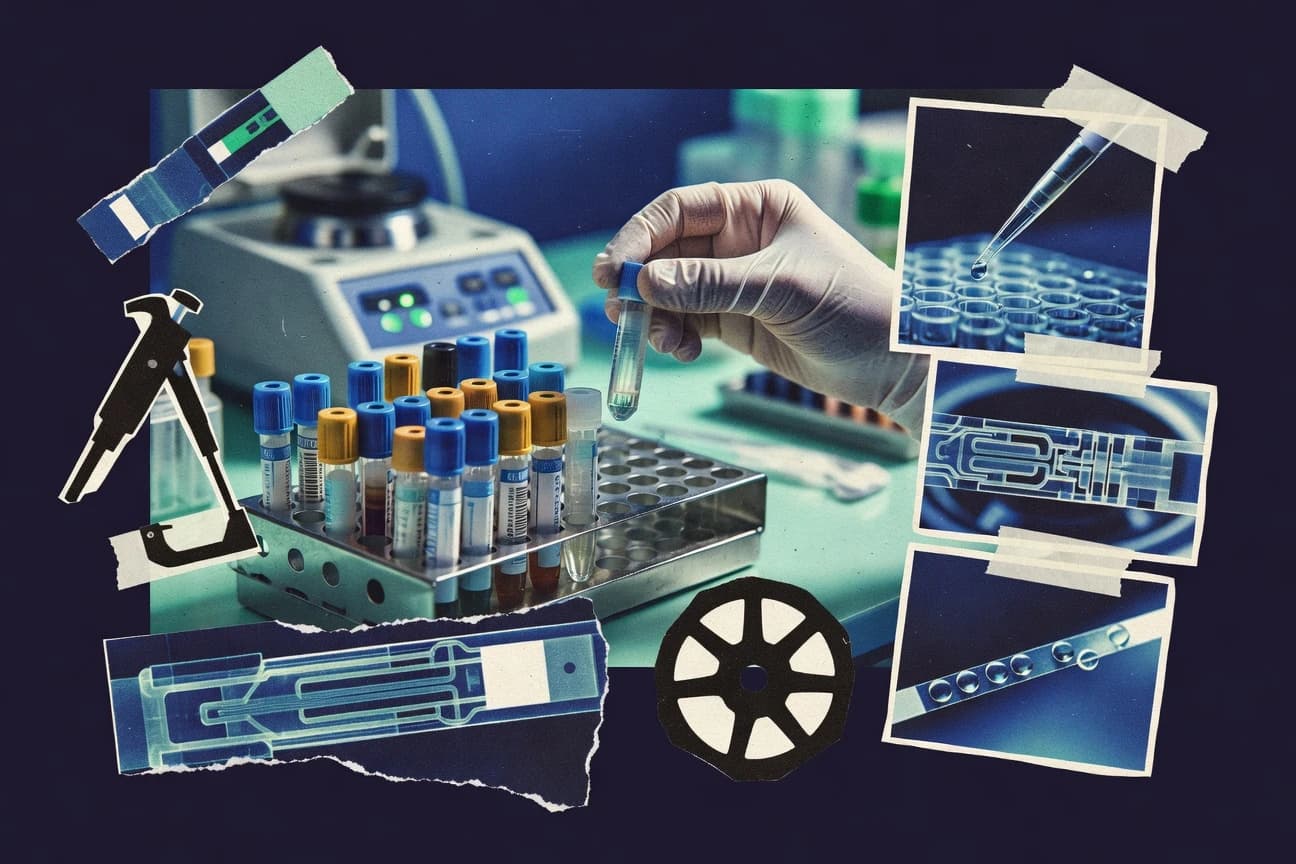

Laboratory diagnostics face escalating operational pressures while handling massive test volumes. Cybersecurity incidents affected 41% of labs in one recent year, and supply chain disruptions led to delayed tests for 80% of facilities. This article presents key statistics on market growth, quality metrics, and persistent industry challenges.
Key Takeaways
- $76.2 billion global laboratory diagnostics market size in 2023
- $128.3 billion projected global laboratory diagnostics market size by 2032
- 3.5% projected CAGR for the global in vitro diagnostics market during 2024–2032 (Fortune Business Insights)
- 2.3 million molecular tests were performed in the United States for SARS-CoV-2 in the week ending April 2, 2022
- 41% of laboratories reported that cybersecurity incidents affected lab operations in 2022
- 1 in 3 laboratory staff reported that quality-control review is time-consuming (survey result, 2021)
- 40% of laboratory professionals reported being affected by reagent or consumable shortages at least once in the previous 12 months in 2022
- 80% of laboratories reported that supply chain disruptions led to delayed or canceled tests during 2021
- ≥80% of clinical chemistry assays require calibration verification at least annually under manufacturer and quality system guidance
- CLIA requires laboratories to perform proficiency testing at least twice per year for each analyte when PT is offered
- 3% reduction in sample rejection rates after implementation of standardized specimen collection and transport protocols in a 2020 multicenter study
- 0.5% of results required re-testing due to pre-analytical errors in a 2019 evaluation of clinical lab workflows
- 4.1% of specimens were rejected in the pre-analytical phase in a 2021 systematic review of clinical laboratory specimen errors
- In 2021, 10.8% of U.S. adults had used at-home diagnostic tests in the previous 12 months
- 65% of clinical laboratories reported adopting barcoding for specimen identification in 2020
Laboratory diagnostics is expanding fast while supply chain and preanalytical errors continue to strain lab efficiency.
Related reading
01 · Category
Market Size10 stats
01
$76.2 billion global laboratory diagnostics market size in 2023https://www.precedenceresearch.com/laboratory-diagnostics-market
02
$128.3 billion projected global laboratory diagnostics market size by 2032https://www.fortunebusinessinsights.com/lab-diagnostics-market-102024
03
3.5% projected CAGR for the global in vitro diagnostics market during 2024–2032 (Fortune Business Insights)https://www.fortunebusinessinsights.com/in-vitro-diagnostics-market-102026
04
$4.2 billion projected global point-of-care testing market size by 2032 (Fortune Business Insights)https://www.fortunebusinessinsights.com/point-of-care-testing-market-105868
05
$2.4 billion projected global microbiology testing market size by 2032 (Fortune Business Insights)https://www.fortunebusinessinsights.com/microbiology-testing-market-102438
06
~US$18.1 billion projected global clinical chemistry market size by 2032 (IMARC)https://www.imarcgroup.com/clinical-chemistry-market
07
$17.0 billion projected global hematology analyzer market size by 2032 (IMARC)https://www.imarcgroup.com/hematology-analyzer-market
08
$3.0 billion projected global urinalysis market size by 2032 (IMARC)https://www.imarcgroup.com/urinalysis-market
09
$14.9 billion projected global immunoassay market size by 2032 (IMARC)https://www.imarcgroup.com/immunoassay-market
10
$7.5 billion projected global coagulation testing market size by 2032 (IMARC)https://www.imarcgroup.com/coagulation-testing-market
Interpretation
Market Size Interpretation
The laboratory diagnostics market is already valued at $76.2 billion in 2023 and is set to more than double to $128.3 billion by 2032, with a steady 3.5% CAGR during 2024 to 2032 that signals sustained market expansion across key segments like point-of-care testing projected to reach $4.2 billion.
02 · Category
Industry Trends3 stats
01
2.3 million molecular tests were performed in the United States for SARS-CoV-2 in the week ending April 2, 2022https://covid.cdc.gov/covid-data-tracker/
02
41% of laboratories reported that cybersecurity incidents affected lab operations in 2022https://www.sans.org/reading-room/whitepapers/industry/cybersecurity-survey-2022-healthcare-labs/
03
1 in 3 laboratory staff reported that quality-control review is time-consuming (survey result, 2021)https://www.tandfonline.com/doi/full/10.1080/10408398.2021.1901053
Interpretation
Industry Trends Interpretation
In the Industry Trends landscape, laboratories are handling massive diagnostic demand with 2.3 million SARS-CoV-2 molecular tests in a single week in the US while cyber incidents already affected 41% of labs in 2022 and one in three staff say quality control reviews are time-consuming, pointing to mounting operational pressure beyond just test volumes.
03 · Category
Supply Chain2 stats
01
40% of laboratory professionals reported being affected by reagent or consumable shortages at least once in the previous 12 months in 2022https://www.who.int/publications/i/item/9789240043114
02
80% of laboratories reported that supply chain disruptions led to delayed or canceled tests during 2021https://academic.oup.com/clinchem/advance-article/doi/10.1093/clinchem/hvaa190
Interpretation
Supply Chain Interpretation
Supply chain pressures are severely impacting lab operations, with 80% of laboratories reporting delayed or canceled tests in 2021 and 40% of laboratory professionals experiencing reagent or consumable shortages at least once over the prior 12 months in 2022.
04 · Category
Regulatory & Quality2 stats
01
≥80% of clinical chemistry assays require calibration verification at least annually under manufacturer and quality system guidancehttps://www.iso.org/standard/61711.html
02
CLIA requires laboratories to perform proficiency testing at least twice per year for each analyte when PT is offeredhttps://www.ecfr.gov/current/title-42/chapter-IV/subchapter-G/part-493/subpart-I
Interpretation
Regulatory & Quality Interpretation
For the Regulatory and Quality side of Laboratory Diagnostics, at least 80% of clinical chemistry assays must be calibrated with annual verification under manufacturer and quality guidance, and CLIA further intensifies oversight by requiring proficiency testing at least twice per year per analyte whenever PT is offered.
More related reading
05 · Category
Performance Metrics3 stats
01
3% reduction in sample rejection rates after implementation of standardized specimen collection and transport protocols in a 2020 multicenter studyhttps://academic.oup.com/clinchem/article/66/7/999/5892987
02
0.5% of results required re-testing due to pre-analytical errors in a 2019 evaluation of clinical lab workflowshttps://journals.sagepub.com/doi/10.1177/0264619619875981
03
4.1% of specimens were rejected in the pre-analytical phase in a 2021 systematic review of clinical laboratory specimen errorshttps://www.sciencedirect.com/science/article/pii/S1871402121001787
Interpretation
Performance Metrics Interpretation
Across recent studies, performance metrics show consistent improvement and control of pre-analytical quality, with sample rejection slipping by 3% after standardized collection and transport protocols in 2020, while re-testing due to pre-analytical errors stays low at 0.5% in 2019 and rejected specimens account for 4.1% in the 2021 review.
06 · Category
User Adoption2 stats
01
In 2021, 10.8% of U.S. adults had used at-home diagnostic tests in the previous 12 monthshttps://www.cdc.gov/nchs/nhis/index.htm
02
65% of clinical laboratories reported adopting barcoding for specimen identification in 2020https://www.jointcommission.org/resources/news-and-multimedia/newsletters/newsletters/behavioral-health/fast-facts/issue-30/
Interpretation
User Adoption Interpretation
Under the user adoption angle, the gap is clear as only 10.8% of U.S. adults used at home diagnostic tests in the prior 12 months in 2021 while 65% of clinical laboratories had already adopted barcoding for specimen identification by 2020.
07 · Category
Cost Analysis4 stats
01
12% of clinical laboratory organizations reported budget increases in 2024 specifically for laboratory automationhttps://www.blackbookmarketresearch.com/reports/lab-automation-market-2024-us-survey
02
25% of laboratory costs are attributed to labor in a 2020 cost structure analysis for clinical diagnostics operationshttps://academic.oup.com/clinchem/article/66/10/1318/6381874
03
2.5% mean reduction in operating costs per test after automation and workflow redesign (meta-analysis, 2018–2020)https://www.ncbi.nlm.nih.gov/pmc/articles/PMC7440599/
04
7.1% of laboratory operating expense reported as spend on reagents and consumables in 2019–2020 survey datahttps://www.ncbi.nlm.nih.gov/books/NBK459368/
Interpretation
Cost Analysis Interpretation
From a cost analysis perspective, clinical labs are channeling automation spending while labor still drives a quarter of costs and automation plus workflow redesign is cutting operating costs per test by about 2.5%, alongside reagents and consumables accounting for 7.1% of operating expenses.
report visual · Comparison
Laboratory Diagnostics Market Scale & Growth Outlook
The global laboratory diagnostics market is set to grow substantially from 2023 to 2032, with high single-digit CAGR projected for the broader in vitro diagnostics segment.
$128.3 billion projected global laboratory diagnostics market size by 2032$128.3 billion
$76.2 billion global laboratory diagnostics market size in 2023
$76.2 billion
3.5% projected CAGR for the global in vitro diagnostics market during 2024–2032 (Fortune Business Insights)
3.5%
source-verifiedprecedenceresearch.com · fortunebusinessinsights.com2032
Reference
Cite This Report
This report is designed to be cited. We maintain stable URLs and versioned verification dates. Copy the format appropriate for your publication below.
APA
Emilia Santos. (2026, February 13). Laboratory Diagnostics Industry Statistics. Gitnux. https://gitnux.org/laboratory-diagnostics-industry-statistics
MLA
Emilia Santos. "Laboratory Diagnostics Industry Statistics." Gitnux, 13 Feb 2026, https://gitnux.org/laboratory-diagnostics-industry-statistics.
Chicago
Emilia Santos. 2026. "Laboratory Diagnostics Industry Statistics." Gitnux. https://gitnux.org/laboratory-diagnostics-industry-statistics.
Sources & references
26 datasets cited across this report
+10 additional datasets cited (not shown individually)