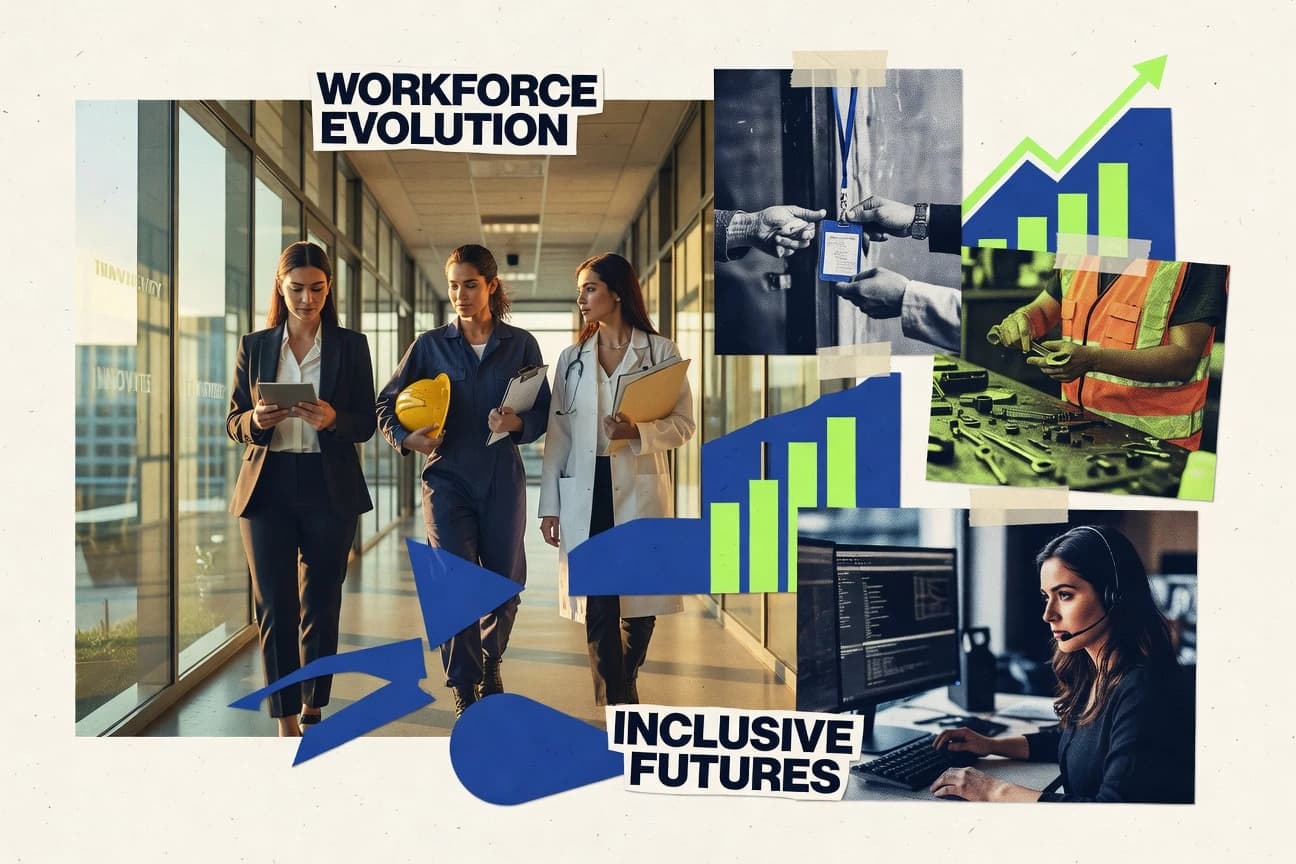

Women now hold 43% of board seats in S&P 500 companies, a record high. This progress contrasts with persistent gaps, as women comprise 46% of entry-level financial jobs but only 33% of senior roles.
Key Takeaways
- Women made up 43.0% of board seats in S&P 500 companies in 2024, showing progress in corporate governance representation
- Women represented 45.0% of the workforce in education but only 37.0% of school principal roles in OECD countries in 2022, showing leadership pipeline gaps in education
- In the U.S. financial services industry, women held 46.0% of entry-level jobs but only 33.0% of senior leadership roles in 2023 (industry report), showing a leadership pipeline gap
- In the U.S., women’s share of employment increased from 45.0% in 1994 to 46.6% in 2024, reflecting long-run growth in women’s workforce presence
- Women were 47.7% of employment in Brazil in 2023 (ILO modelled estimate), quantifying female employment share
- Women’s unemployment rate in the U.S. was 4.0% in 2020 (pandemic year), showing sensitivity of female joblessness during shocks
- Women accounted for 73.0% of registered nurses employment in the U.S. in 2023, showing strong occupational concentration
- Women accounted for 70.0% of elementary and middle school teachers in the U.S. in 2023, reflecting sectoral segregation
- Women accounted for 26.0% of software developers in the U.S. in 2023, showing underrepresentation in technical occupations
- UN Women reports that 1 in 3 women experience gender-based violence in their lifetime (global estimate), quantifying exposure to violence affecting labor participation
- OECD reports that women spend about 2.0 times as many hours per day on unpaid care and domestic work as men in many OECD countries (global comparative statistic), affecting paid work availability
- WHO estimates that globally, women aged 15–49 experience intimate partner violence at a prevalence of about 27% over their lifetime, linking violence to labor market outcomes
Women are gaining ground overall, but leadership, technical roles, and STEM engineering remain far less represented.
Related reading
01 · Category
Leadership Representation3 stats
01
Women made up 43.0% of board seats in S&P 500 companies in 2024, showing progress in corporate governance representationhttps://www.spglobal.com/en/research-insights/sector-insights/gender-diversity-at-s-and-p-500-companies
02
Women represented 45.0% of the workforce in education but only 37.0% of school principal roles in OECD countries in 2022, showing leadership pipeline gaps in educationhttps://www.oecd.org/education/education-at-a-glance/
03
In the U.S. financial services industry, women held 46.0% of entry-level jobs but only 33.0% of senior leadership roles in 2023 (industry report), showing a leadership pipeline gaphttps://www2.deloitte.com/us/en/insights/industry/financial-services/women-in-financial-services.html
Interpretation
Leadership Representation Interpretation
Across leadership representation, women’s share often drops sharply from broader participation to top roles, as seen when board seats reached 43.0% in S&P 500 companies in 2024 but only 37.0% of school principals and 33.0% of senior leadership positions in U.S. financial services were held by women despite higher overall workforce representation.
02 · Category
Labor Force Participation7 stats
01
In the U.S., women’s share of employment increased from 45.0% in 1994 to 46.6% in 2024, reflecting long-run growth in women’s workforce presencehttps://www.bls.gov/cps/cpsaat01.htm
02
Women were 47.7% of employment in Brazil in 2023 (ILO modelled estimate), quantifying female employment sharehttps://www.ilo.org/ilostat/
03
Women’s unemployment rate in the U.S. was 4.0% in 2020 (pandemic year), showing sensitivity of female joblessness during shockshttps://www.bls.gov/cps/cpsaat03.htm
04
In the U.S., women were 43.4% of full-time workers in 2024, indicating full-time roles still include more menhttps://www.bls.gov/cps/cpsaat18.htm
05
Women are 48% of the U.S. labor force in 2024 when including marginally attached workers (as labor force components indicate), demonstrating broad representationhttps://www.bls.gov/cps/tables.htm
06
In the U.S., 13.0% of women were out of the labor force due to family responsibilities in 2024, measuring labor force detachment reasonshttps://www.bls.gov/cps/cpsaat23.htm
07
In OECD countries, men’s labor force participation rate was 70.8% in 2023, quantifying the gender participation gaphttps://data.oecd.org/emp/labour-force-participation-rate.htm
Interpretation
Labor Force Participation Interpretation
Overall, women’s participation in the U.S. labor force has remained high and slowly rising, reaching 48% in 2024 including marginally attached workers, yet 13.0% of women were still out of the labor force because of family responsibilities, showing that household constraints continue to shape labor force participation.
More related reading
03 · Category
Industry Trends & Segregation14 stats
01
Women accounted for 73.0% of registered nurses employment in the U.S. in 2023, showing strong occupational concentrationhttps://www.bls.gov/oes/current/oes291141.htm
02
Women accounted for 70.0% of elementary and middle school teachers in the U.S. in 2023, reflecting sectoral segregationhttps://www.bls.gov/oes/current/oes252022.htm
03
Women accounted for 26.0% of software developers in the U.S. in 2023, showing underrepresentation in technical occupationshttps://www.bls.gov/oes/current/oes151123.htm
04
In the U.S., women comprised 43% of the labor force in 2023 for business and finance-related occupations, indicating higher representation in certain office roleshttps://www.bls.gov/cps/cpsaat11.htm
05
Women were 58.0% of healthcare practitioners and technical occupations in the U.S. in 2023, illustrating concentration in healthcare roleshttps://www.bls.gov/oes/current/oes291000.htm
06
Women represented 35% of the workforce in manufacturing in the U.S. in 2023, indicating a skew toward men in industrial productionhttps://www.bls.gov/cps/cpsaat02.htm
07
Women are 36.0% of financial analysts in the U.S. according to occupational data in 2023, reflecting representation in finance roleshttps://www.bls.gov/oes/current/oes132011.htm
08
Women accounted for 49.0% of the legal profession workforce in the U.S. in 2023, indicating near parity among lawyershttps://www.bls.gov/oes/current/oes231011.htm
09
Women are 39.0% of architects in the U.S. in 2023, showing partial representation in design and planninghttps://www.bls.gov/oes/current/oes151131.htm
10
In the U.S., women were 29% of STEM workers in 2023 (as estimated by the NSF), quantifying STEM labor representationhttps://ncses.nsf.gov/pubs/nsf23300/
11
Women represented 19% of engineers in the U.S. in 2023, reflecting major underrepresentation in engineeringhttps://www.bls.gov/oes/current/oes172011.htm
12
In the U.S., women are 36% of law enforcement and protective service occupations in 2023, showing underrepresentation in protective serviceshttps://www.bls.gov/oes/current/oes432011.htm
13
Women comprise 58% of teacher assistants in the U.S. in 2023, indicating high female representation in support education roleshttps://www.bls.gov/oes/current/oes252031.htm
14
Women represent 34% of medical and health services managers in the U.S. in 2023, reflecting uneven leadership within healthcare administrationhttps://www.bls.gov/oes/current/oes291151.htm
Interpretation
Industry Trends & Segregation Interpretation
Across key U.S. industries, women show sharp segregation by occupation, including dominance in care and education roles like 73.0% of registered nurses and 70.0% of elementary and middle school teachers, while they remain underrepresented in technical and industrial work such as just 26.0% of software developers and 35% of manufacturing employment.
04 · Category
Work Life & Wellbeing3 stats
01
UN Women reports that 1 in 3 women experience gender-based violence in their lifetime (global estimate), quantifying exposure to violence affecting labor participationhttps://www.unwomen.org/en/what-we-do/ending-violence-against-women/facts-and-figures
02
OECD reports that women spend about 2.0 times as many hours per day on unpaid care and domestic work as men in many OECD countries (global comparative statistic), affecting paid work availabilityhttps://www.oecd.org/gender/data/unpaid-work/
03
WHO estimates that globally, women aged 15–49 experience intimate partner violence at a prevalence of about 27% over their lifetime, linking violence to labor market outcomeshttps://www.who.int/news-room/fact-sheets/detail/violence-against-women
Interpretation
Work Life & Wellbeing Interpretation
Work Life & Wellbeing for women is strongly shaped by safety and time burdens, with 1 in 3 women reporting gender-based violence in their lifetime and women also doing about 2.0 times as much unpaid care work as men, alongside intimate partner violence affecting around 27% of women aged 15 to 49 over their lifetime.
report visual · Projection
Women’s Workforce Participation Over Time
Women’s share of employment in the U.S. has grown over the long run.
45 Percent
Start
-0.15%
CAGR · 30y
43 Percent
Projected
19942024
source-verifiedbls.gov · spglobal.com · oecd.org2024
Reference
Cite This Report
This report is designed to be cited. We maintain stable URLs and versioned verification dates. Copy the format appropriate for your publication below.
APA
Priyanka Sharma. (2026, February 13). Females In The Workforce Statistics. Gitnux. https://gitnux.org/females-in-the-workforce-statistics
MLA
Priyanka Sharma. "Females In The Workforce Statistics." Gitnux, 13 Feb 2026, https://gitnux.org/females-in-the-workforce-statistics.
Chicago
Priyanka Sharma. 2026. "Females In The Workforce Statistics." Gitnux. https://gitnux.org/females-in-the-workforce-statistics.
Sources & references
27 datasets cited across this report
+18 additional datasets cited (not shown individually)