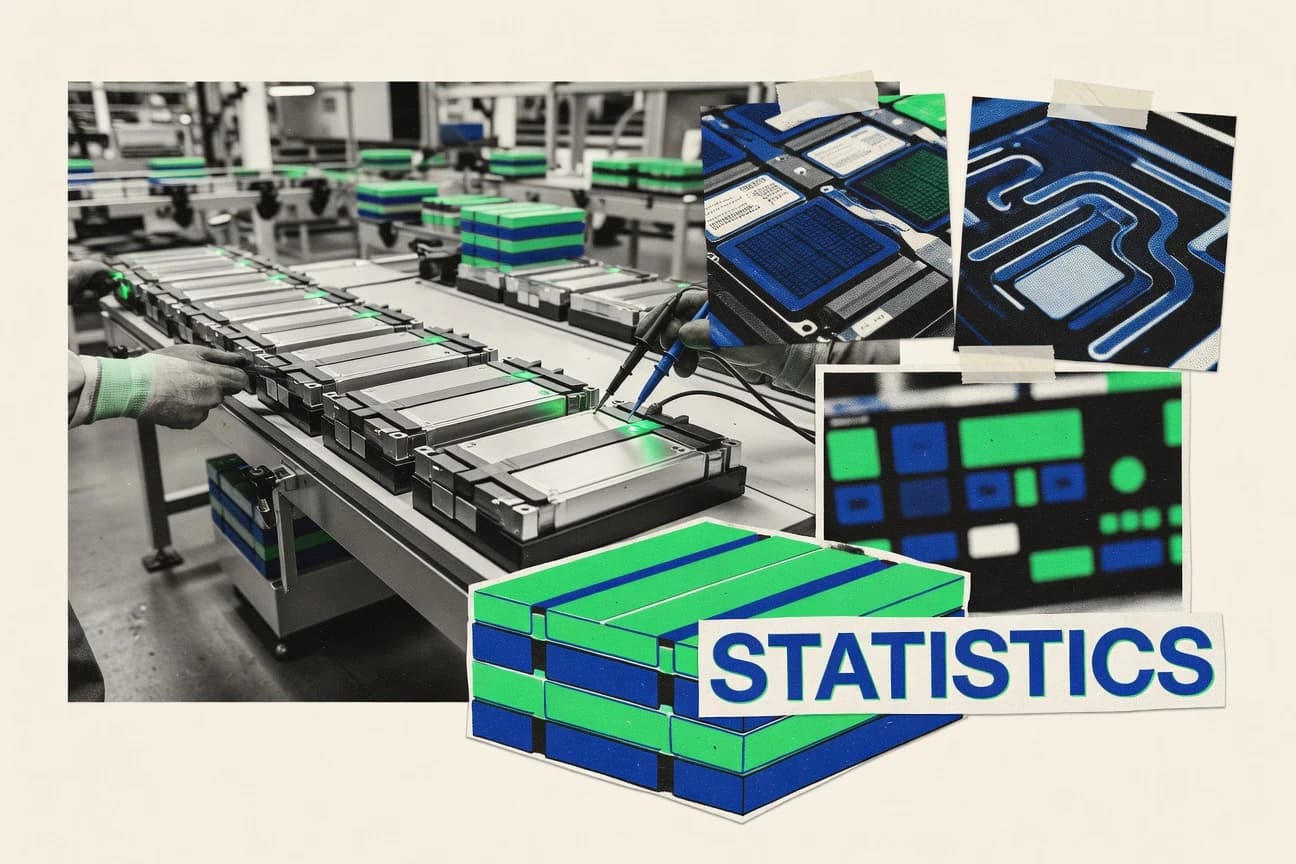

A 2025 energy transition bill of roughly $1.9 trillion is being framed around battery supply chains, even as chemistry preferences shift fast enough to change what gets built next. In the background, the lithium ion pack average is down to $139 per kWh in 2023, yet materials concentration risks and tightening rules for passports and recycling are still reshaping cost and supply planning. This post stitches together the latest benchmarks and forecasts so you can see where performance, investment, and geopolitics collide for EV batteries.
Key Takeaways
- The share of high-nickel cathodes (e.g., NMC) declined in favor of LFP in IEA’s 2024 Outlook, reflecting changes in cost and supply preferences.
- International Energy Agency estimated that demand for lithium could increase by about 40x by 2040 in its reference scenario, driving upstream expansion needs.
- International Energy Agency estimated that demand for cobalt could rise by about 19x by 2040 in its reference scenario, affecting battery chemistries and recycling incentives.
- $1.9 trillion is estimated to be required globally to support the energy transition through 2030, with battery supply chains included—underscoring EV battery investment needs.
- $10.0 billion in venture funding for battery startups was recorded in 2023 in a publicly available survey by PitchBook (battery sector).
- $38.4 billion of global lithium-ion battery investment was projected by 2030 for supply chain expansion in a 2024 market outlook by BNEF citing industry estimates.
- A $31.5 billion global EV battery market size was projected for 2030 in a 2022 industry forecast, reflecting major growth from current levels.
- The global Li-ion battery recycling market was expected to reach $6.2 billion by 2030 in a 2023 report by Fortune Business Insights, indicating growing secondary material flows.
- $139/kWh was the average lithium-ion battery pack price in 2023 in BNEF’s Battery Pack Price Survey, continuing the decline from prior years.
- 65% of total battery value is tied to materials and energy intensive refining steps in a 2022 analysis by IEA on critical minerals and value chains.
- 91% of the world’s lithium refining capacity was concentrated in three countries in 2023 according to USGS and IEA cross-references, affecting battery supply risk.
- 70% of cobalt mine production was from the Democratic Republic of the Congo in 2022, influencing EV battery supply chains.
- 52% of global nickel production was from Indonesia, the Philippines, and Russia in 2022 per USGS data, impacting NCA/NMC materials availability.
- The EU Battery Regulation sets a requirement for “battery passport” information availability by 2026 for industrial batteries and 2027 for vehicle batteries.
- China’s “Administrative Measures for Recycling of New Energy Vehicle Power Batteries” required compliant recycling from producers effective 2020, covering EV battery lifecycle obligations.
Battery costs keep falling and investment surges, but material supply concentration is the biggest risk.
Related reading
01 · Category
Industry Trends5 stats
01
The share of high-nickel cathodes (e.g., NMC) declined in favor of LFP in IEA’s 2024 Outlook, reflecting changes in cost and supply preferences.https://www.iea.org/reports/global-ev-outlook-2024/batteries-and-raw-materials
02
International Energy Agency estimated that demand for lithium could increase by about 40x by 2040 in its reference scenario, driving upstream expansion needs.https://www.iea.org/reports/the-role-of-critical-minerals-in-clean-energy-transitions/lithium
03
International Energy Agency estimated that demand for cobalt could rise by about 19x by 2040 in its reference scenario, affecting battery chemistries and recycling incentives.https://www.iea.org/reports/the-role-of-critical-minerals-in-clean-energy-transitions/cobalt
04
International Energy Agency estimated that demand for nickel could rise by about 25x by 2040 in its reference scenario, shaping NMC/NCA usage and supply chain planning.https://www.iea.org/reports/the-role-of-critical-minerals-in-clean-energy-transitions/nickel
05
International Energy Agency projected that graphite demand could rise by about 25x by 2040 in its reference scenario, relevant for anode materials supply.https://www.iea.org/reports/the-role-of-critical-minerals-in-clean-energy-transitions/graphite
Interpretation
Industry Trends Interpretation
Industry Trends are shifting toward new battery material strategies as the IEA projects demand for key inputs to surge by 40x for lithium, 25x for nickel and graphite, and 19x for cobalt by 2040, even as high nickel cathodes lose share to LFP in the 2024 Outlook.
02 · Category
Investment & Financing3 stats
01
$1.9 trillion is estimated to be required globally to support the energy transition through 2030, with battery supply chains included—underscoring EV battery investment needs.https://www.iea.org/reports/world-energy-investment-2023/special-focus-batteries
02
$10.0 billion in venture funding for battery startups was recorded in 2023 in a publicly available survey by PitchBook (battery sector).https://pitchbook.com/news/reports/battery-sector-report-2024
03
$38.4 billion of global lithium-ion battery investment was projected by 2030 for supply chain expansion in a 2024 market outlook by BNEF citing industry estimates.https://about.bnef.com/blog/batteries-supply-chain-under-pressure-from-demand-growth/
Interpretation
Investment & Financing Interpretation
Investment in EV battery supply chains is scaling rapidly, with $38.4 billion projected for global lithium ion battery investment by 2030 and an estimated $1.9 trillion needed globally through 2030, while venture funding for battery startups reached $10.0 billion in 2023, signaling accelerating capital commitment across both financing stages.
03 · Category
Market Size2 stats
01
A $31.5 billion global EV battery market size was projected for 2030 in a 2022 industry forecast, reflecting major growth from current levels.https://www.globenewswire.com/en/news-release/2022/01/20/2361714/0/en/Electric-Vehicle-Battery-Market-Size-is-Expected-to-Reach-31-5-Billion-by-2030.html
02
The global Li-ion battery recycling market was expected to reach $6.2 billion by 2030 in a 2023 report by Fortune Business Insights, indicating growing secondary material flows.https://www.fortunebusinessinsights.com/li-ion-battery-recycling-market-106415
Interpretation
Market Size Interpretation
From a Market Size perspective, the EV battery market is projected to reach $31.5 billion by 2030, signaling rapid primary growth alongside rising scale in recycling as the Li ion battery recycling market is expected to hit $6.2 billion by 2030.
04 · Category
Cost Analysis2 stats
01
$139/kWh was the average lithium-ion battery pack price in 2023 in BNEF’s Battery Pack Price Survey, continuing the decline from prior years.https://about.bnef.com/blog/battery-pack-prices-fall-but-some-categories-increase-in-2023/
02
65% of total battery value is tied to materials and energy intensive refining steps in a 2022 analysis by IEA on critical minerals and value chains.https://www.iea.org/reports/the-role-of-critical-minerals-in-clean-energy-transitions/battery-supply-chains
Interpretation
Cost Analysis Interpretation
From a cost analysis perspective, battery pack prices fell to an average of $139 per kWh in 2023, while a 2022 IEA review found that 65% of battery value still hinges on materials and energy intensive refining, meaning cost reductions may continue on packs but remain heavily constrained by upstream supply and processing.
More related reading
05 · Category
Risk & Constraints6 stats
01
91% of the world’s lithium refining capacity was concentrated in three countries in 2023 according to USGS and IEA cross-references, affecting battery supply risk.https://www.usgs.gov/centers/national-minerals-information-center/lithium-statistics-and-information
02
70% of cobalt mine production was from the Democratic Republic of the Congo in 2022, influencing EV battery supply chains.https://www.usgs.gov/centers/national-minerals-information-center/cobalt-statistics-and-information
03
52% of global nickel production was from Indonesia, the Philippines, and Russia in 2022 per USGS data, impacting NCA/NMC materials availability.https://www.usgs.gov/centers/national-minerals-information-center/nickel-statistics-and-information
04
34% of global graphite production came from China in 2022 per USGS, relevant for anode supply for EV batteries.https://www.usgs.gov/centers/national-minerals-information-center/graphite-statistics-and-information
05
A 2023 life cycle assessment (LCA) reported that battery manufacturing can account for a substantial share of GHG emissions, with numbers varying by electricity mix and cell chemistry.https://www.sciencedirect.com/science/article/pii/S0959652622010447
06
S&P Global estimated that lithium supply deficits could widen if upstream expansions lag EV growth, with the report quantifying supply risk for battery metals.https://www.spglobal.com/commodityinsights/en/market-insights/latest-news/metals/040324-lithium-demand-to-rise-supply-deficit-risk-will-grow
Interpretation
Risk & Constraints Interpretation
With lithium refining concentrated in just three countries at 91% in 2023 and major inputs like cobalt and graphite similarly dominated by a few geographies, EV battery supply faces a tightening Risk & Constraints profile where 2022 production shares and potential lithium deficits could amplify shortages even as demand accelerates.
06 · Category
Policy & Regulation4 stats
01
The EU Battery Regulation sets a requirement for “battery passport” information availability by 2026 for industrial batteries and 2027 for vehicle batteries.https://eur-lex.europa.eu/eli/reg/2023/1542/oj
02
China’s “Administrative Measures for Recycling of New Energy Vehicle Power Batteries” required compliant recycling from producers effective 2020, covering EV battery lifecycle obligations.https://www.mee.gov.cn/ywdt/zhxw/202006/t20200624_780806.shtml
03
The Inflation Reduction Act’s Advanced Manufacturing Production Credit provides up to $35/kWh for qualifying battery cells and module manufacturing (fulfills EV battery cost and supply policy).https://www.irs.gov/credits-deductions/advanced-manufacturing-production-credit
04
The EU Ecodesign for Sustainable Products Regulation (ESPR) includes environmental performance requirements that can apply to batteries; requirements are laid out in the regulation text effective 2024.https://eur-lex.europa.eu/eli/reg/2024/1781/oj
Interpretation
Policy & Regulation Interpretation
Under Policy and Regulation, the clearest trend is a rapid move toward traceability and environmental accountability, with the EU Battery Regulation requiring battery passport information by 2026 for industrial batteries and 2027 for vehicle batteries as China’s 2020 producer recycling rules expand lifecycle obligations.
07 · Category
Performance Metrics8 stats
01
A typical lithium-ion cell lifetime target of 1,000–2,000 full equivalent cycles at moderate conditions is discussed in peer-reviewed research on calendar and cycle aging.https://www.sciencedirect.com/science/article/pii/S0378775321005931
02
Thermal runaway propagation risk mitigation can reduce propagation likelihood; a review study reports that optimized venting and design can significantly delay spread in pack-level tests.https://www.sciencedirect.com/science/article/pii/S0951832021001953
03
Vehicle battery packs commonly use NMC or LFP chemistries with distinct energy density ranges; peer-reviewed reviews report LFP energy density typically lower than NMC but superior cycle life.https://www.sciencedirect.com/science/article/pii/S2589776220300127
04
In a 2021 study, controlled cycling at 25°C improved capacity retention compared with elevated temperatures, reinforcing thermal management’s impact on degradation.https://www.sciencedirect.com/science/article/pii/S2213305419308593
05
A 2020 peer-reviewed meta-analysis found that increasing charging rate can increase degradation; higher C-rates generally worsen cycle life due to faster lithium plating risk.https://www.sciencedirect.com/science/article/pii/S2352152X20300648
06
A 2022 study on direct recycling reported recovery rates for key metals (Li, Ni, Co) can exceed 90% under optimized conditions, demonstrating viability of closed-loop processing.https://www.sciencedirect.com/science/article/pii/S0923057X22006063
07
Recycled cobalt recovery rates in commercial processes often achieve 95%+ for cobalt under established refining routes, as described in industry reviews.https://www.researchgate.net/publication/354190950_Lithium_ion_battery_recycling_processes_and_recovery_of_metals_a_review
08
CATL reported energy density and cycle-life targets for its Qilin cell line; investor materials cited ~1,000+ km range equivalent and >2,000 cycles in testing narratives.https://www.catl.com/en/news/519.html
Interpretation
Performance Metrics Interpretation
Across performance metrics, the industry trend is pushing toward longer usable life and safer operation, aiming for 1,000 to 2,000 full equivalent cycles while also showing that better thermal management and optimized charging conditions can preserve capacity and reduce degradation, even as recycling targets like over 90% recovery for key metals support the long term viability of these high performance packs.
Reference
Cite This Report
This report is designed to be cited. We maintain stable URLs and versioned verification dates. Copy the format appropriate for your publication below.
APA
Megan Gallagher. (2026, February 13). Electric Vehicle Battery Industry Statistics. Gitnux. https://gitnux.org/electric-vehicle-battery-industry-statistics
MLA
Megan Gallagher. "Electric Vehicle Battery Industry Statistics." Gitnux, 13 Feb 2026, https://gitnux.org/electric-vehicle-battery-industry-statistics.
Chicago
Megan Gallagher. 2026. "Electric Vehicle Battery Industry Statistics." Gitnux. https://gitnux.org/electric-vehicle-battery-industry-statistics.
Sources & references
30 datasets cited across this report
+17 additional datasets cited (not shown individually)