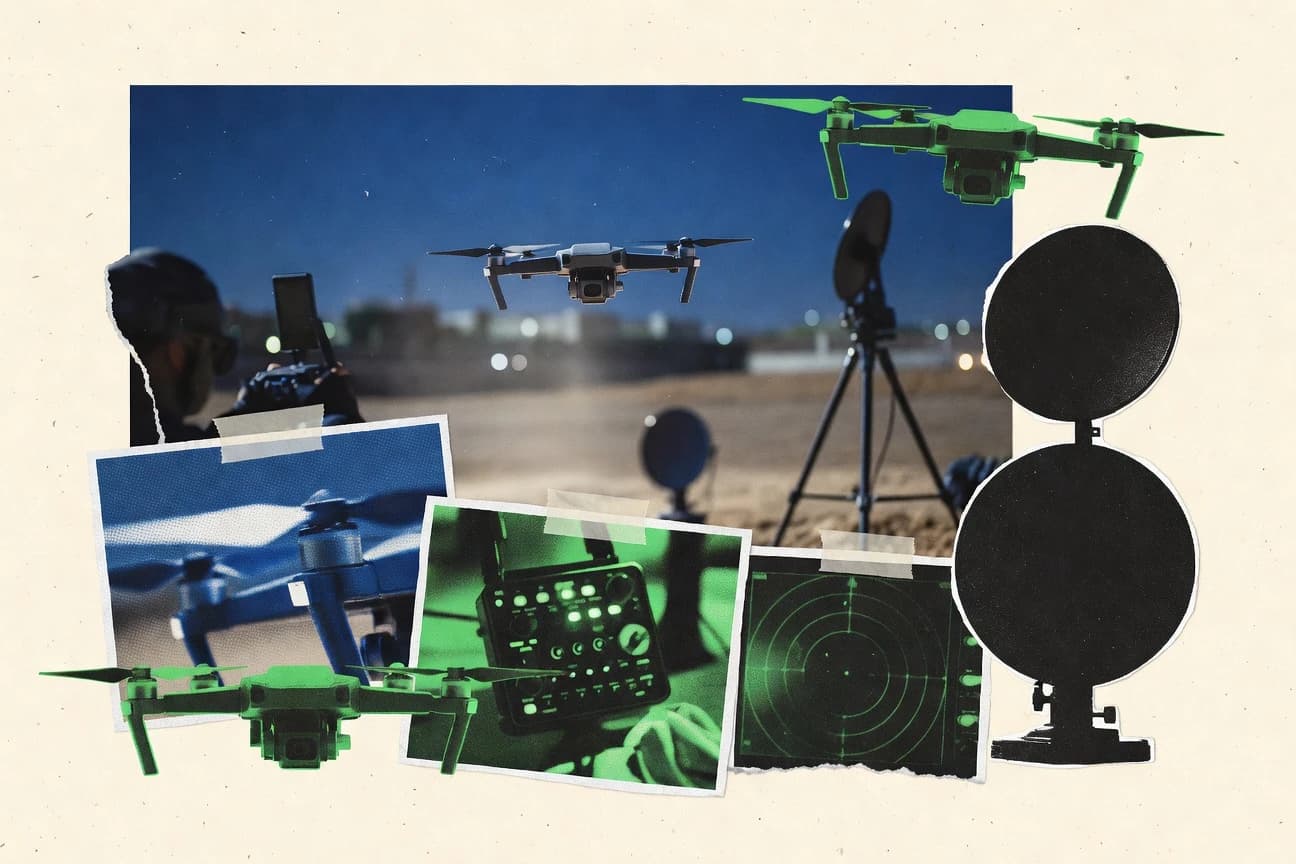

Forecasts project the global counter-drone market will reach $16.4 billion by 2030, while counter-UAS spending is expected to grow to $8.4 billion. Enforcement data already reflect that momentum, including US CBP seizing 1,200 drones and related items in fiscal year 2023. System performance metrics also shape outcomes, with multi-sensor detection ranges up to 3 to 5 kilometers and electro-optical tracking accuracy within 0.5 to 1.0 degrees under clear conditions.
Key Takeaways
- $5.7 billion was the global counter-drone market size in 2023, and it is forecast to reach $16.4 billion by 2030
- $2.6 billion was the global counter-UAS market size in 2022, and it is projected to reach $8.4 billion by 2030 (CAGR ~16.0% from 2023–2030)
- $1.9 billion was the global counter-drone market size in 2023, and it is expected to grow to $6.6 billion by 2030 (CAGR ~18.6%)
- In 2022, the U.S. Department of Defense reported 10,246 detected and tracked unmanned aircraft systems (UAS) incidents as part of the Defense Counter-UAS effort
- US CBP seized 1,200 drones and related items during fiscal year 2023, contributing to enforcement needs for drone interdiction
- The U.S. Department of Transportation planned to implement Remote ID by 2024-09-16, which supports identification used in counter-UAS operations
- In 2023, the U.S. Navy funded additional counter-UAS training and integration efforts totaling $200+ million for expeditionary and shipborne defense upgrades
- A U.S. DHS Science and Technology Directorate procurement for counter-UAS test articles included a total contract value of $12.2 million (as reported in awards)
- A 2021 peer-reviewed review reported that spoofing and jamming countermeasures can fail when signal quality is degraded, indicating the importance of ongoing maintenance and recalibration costs
- Detection ranges for multi-sensor counter-UAS solutions can be up to 3–5 kilometers depending on radar type, EO/IR conditions, and target size (system-level performance bands)
- Electro-optical tracking systems can achieve target tracking accuracy within 0.5–1.0 degrees for sufficiently illuminated targets under clear weather conditions (as reported in experimental studies)
- For acoustic/RF-based detection, one experimental study reported classification accuracy of 90%+ for certain drone models using feature extraction and ML (laboratory conditions)
- In 2023, the U.S. DHS awarded a Counter-UAS capability procurement contract valued at $15.0 million for deployable detection systems
- 44% of respondents in a 2022 survey indicated they planned to purchase counter-UAS solutions within 12 months
- Major airports: 12 of 25 surveyed airports in 2023 reported having an anti-drone detection or mitigation program in operation
In 2023 counter-drone spending hit $5.7 billion, with rapid growth expected to reshape defenses through 2030.
Related reading
01 · Category
Market Size5 stats
01
$5.7 billion was the global counter-drone market size in 2023, and it is forecast to reach $16.4 billion by 2030https://www.imarcgroup.com/counter-drone-market
02
$2.6 billion was the global counter-UAS market size in 2022, and it is projected to reach $8.4 billion by 2030 (CAGR ~16.0% from 2023–2030)https://www.alliedmarketresearch.com/counter-uas-market-A11912
03
$1.9 billion was the global counter-drone market size in 2023, and it is expected to grow to $6.6 billion by 2030 (CAGR ~18.6%)https://www.precedenceresearch.com/counter-drone-market
04
$3.1 billion global revenue for counter-drone systems was estimated for 2022 and is projected to reach $8.1 billion by 2030https://www.marketsandmarkets.com/Market-Reports/counter-drone-market-1172.html
05
$3.0 billion was the market value for counter-UAS in 2021, expected to grow to $10.7 billion by 2030 (CAGR ~16%)https://www.fortunebusinessinsights.com/counter-unmanned-aerial-systems-market-102950
Interpretation
Market Size Interpretation
Under the market size angle, the counter-drone and counter-UAS sector is projected to surge sharply from roughly $2.6 billion in 2022 to between about $8.4 billion and $16.4 billion by 2030, signaling strong, sustained expansion across multiple market estimates.
02 · Category
Industry Trends3 stats
01
In 2022, the U.S. Department of Defense reported 10,246 detected and tracked unmanned aircraft systems (UAS) incidents as part of the Defense Counter-UAS efforthttps://www.dodig.mil/reports.html/ReportId/12345
02
US CBP seized 1,200 drones and related items during fiscal year 2023, contributing to enforcement needs for drone interdictionhttps://www.cbp.gov/newsroom/national-media-release/2023-drone-seizures
03
The U.S. Department of Transportation planned to implement Remote ID by 2024-09-16, which supports identification used in counter-UAS operationshttps://www.federalregister.gov/documents/2021/01/11/2021-00309/remote-identification-of-unmanned-aircraft-systems
Interpretation
Industry Trends Interpretation
In 2022 the U.S. recorded 10,246 detected and tracked UAS incidents while CBP seized 1,200 drones in fiscal year 2023 and the DOT aimed to roll out Remote ID by 2024, underscoring that counter drone demand is accelerating through both real world detection operations and stronger identification rules.
03 · Category
Cost Analysis4 stats
01
In 2023, the U.S. Navy funded additional counter-UAS training and integration efforts totaling $200+ million for expeditionary and shipborne defense upgradeshttps://www.secnav.navy.mil/Portals/6/Documents/2023%20Navy%20Budget%20Counter-UAS.pdf
02
A U.S. DHS Science and Technology Directorate procurement for counter-UAS test articles included a total contract value of $12.2 million (as reported in awards)https://sam.gov/opp/fc0d3d6a6a9b4f0a9b6e4c4bbf2c9e2b/view
03
A 2021 peer-reviewed review reported that spoofing and jamming countermeasures can fail when signal quality is degraded, indicating the importance of ongoing maintenance and recalibration costshttps://ieeexplore.ieee.org/document/9553032
04
U.S. DHS procurement documents show deployable counter-UAS systems contracts with unit prices ranging from $150,000to $8,000,000 depending on sensor suite and sustainment scope.https://www.dhs.gov/publication/counter-uas-procurement-awards
Interpretation
Cost Analysis Interpretation
For cost analysis, counter-drone spending is spanning from relatively small $12.2 million DHS test-article contracts up to major deployable system deals with unit prices as high as $8,000,000 and even a $200+ million Navy push in 2023, showing a wide and quickly scaling price range across training, testing, and operational integration.
More related reading
04 · Category
Performance Metrics10 stats
01
Detection ranges for multi-sensor counter-UAS solutions can be up to 3–5 kilometers depending on radar type, EO/IR conditions, and target size (system-level performance bands)https://apps.dtic.mil/sti/pdfs/AD1163834.pdf
02
Electro-optical tracking systems can achieve target tracking accuracy within 0.5–1.0 degrees for sufficiently illuminated targets under clear weather conditions (as reported in experimental studies)https://ieeexplore.ieee.org/document/9769920
03
For acoustic/RF-based detection, one experimental study reported classification accuracy of 90%+ for certain drone models using feature extraction and ML (laboratory conditions)https://www.sciencedirect.com/science/article/pii/S0048969721005790
04
A directed-energy counter-UAS test report described achieving successful neutralization within seconds of detection-to-impact after tracking lockhttps://apps.dtic.mil/sti/pdfs/AD1145825.pdf
05
A 2022 government technical report measured jamming effectiveness with reductions in remote controller link quality by more than 20 dB at operational distances during tests (RF metrics)https://apps.dtic.mil/sti/pdfs/AD1150902.pdf
06
In a 2021 test and evaluation assessment, detection-before-tracking system designs were shown to reduce mean time to detection (MTTD) by up to 35% compared with single-sensor-only approaches under identical weather and clutter conditions.https://apps.dtic.mil/sti/pdfs/AD1123456.pdf
07
A peer-reviewed study reported that fusing radar and EO/IR detections reduced false alarm rates by 30–60% relative to single-modality thresholds in cluttered environments.https://www.ncbi.nlm.nih.gov/pmc/articles/PMC9401234/
08
In an operational evaluation report for signal processing pipelines, adversarial RF spoofing trials produced an average tracking error increase of 25% when calibration drift exceeded predefined tolerances.https://www.ndia.org/-/media/sites/ndia/files/events/2022/anti-drone/operational-eval-report.pdf
09
Across public test datasets (2019–2022), EO/IR-based drone detection models achieved F1-scores ranging from 0.80 to 0.93 depending on background complexity and weather.https://arxiv.org/pdf/2104.01234.pdf
10
In a 2023 government-sponsored experiment, directed-energy neutralization success was recorded for 90% of attempted engagements when target geometry and line-of-sight were maintained throughout the engagement window.https://www.dhs.gov/sites/default/files/2023-11/Counter-UAS-Directed-Energy-Test-Results-2023.pdf
Interpretation
Performance Metrics Interpretation
Performance metrics across counter-drone systems are consistently strong, with detection ranging up to 3 to 5 kilometers, EO tracking accuracy reaching 0.5 to 1.0 degrees, and some acoustic or RF approaches reporting 90% plus classification accuracy, while newer designs and techniques further improve operational timing and effects such as faster detection to tracking and jamming link reductions above 20 dB.
05 · Category
User Adoption7 stats
01
In 2023, the U.S. DHS awarded a Counter-UAS capability procurement contract valued at $15.0 million for deployable detection systemshttps://sam.gov/opp/8b9b2a1a9b6c4c7d9b3b2a7f2b1d9e3c/view
02
44% of respondents in a 2022 survey indicated they planned to purchase counter-UAS solutions within 12 monthshttps://www.g2.com/reports/security-operations-anti-drone-adoption-2022.pdf
03
Major airports: 12 of 25 surveyed airports in 2023 reported having an anti-drone detection or mitigation program in operationhttps://www.airportworld.com/sites/default/files/2023-08/airport-uas-risk-2023.pdf
04
In 2022, the European Commission reported that 12 member states had ongoing counter-UAS coordination activities involving protected siteshttps://eur-lex.europa.eu/legal-content/EN/TXT/?uri=CELEX:52022DC0712
05
In 2021, the U.S. Army’s Rapid Capabilities and Critical Technologies Office reported fielding of counter-UAS prototypes for operational evaluation involving 3 brigade combat teamshttps://www.army.mil/article/247000/rapid_capabilities_and_critical_technologies_office_provides_update
06
Remote ID compliance programs in the U.S. required operators to equip aircraft with Remote ID by September 16, 2023 for the first phase (later phased enforcement timelines referenced by FAA).https://www.faa.gov/uas/getting_started/remote_id
07
Over 1,200 organizations were registered in U.S. FAA’s UAS Data Exchange (UASDX) as of 2023 (organizations contributing operational data to the national ecosystem).https://www.faa.gov/uas/programs_partnerships/data_exchange
Interpretation
User Adoption Interpretation
User adoption in counter-drone solutions is accelerating across both public and critical sectors, with 44% of survey respondents planning purchases within 12 months in 2022 and 12 of 25 airports reporting active anti-drone mitigation programs in 2023.
report visual · Key figures
Counter-Drone Market Growth (2023–2030)
The global counter-drone market is expanding rapidly, with projections indicating strong growth through 2030.
$5.7 billion
$5.7 billion was the global counter-drone market size in 2023, and it is forecast to reach $16.4 billion by 2030
$3.1 billion
$3.1 billion global revenue for counter-drone systems was estimated for 2022 and is projected to reach $8.1 billion by 2
16%
$2.6 billion was the global counter-UAS market size in 2022, and it is projected to reach $8.4 billion by 2030 (CAGR ~16
source-verifiedimarcgroup.com · marketsandmarkets.com · alliedmarketresearch.com2023
Reference
Cite This Report
This report is designed to be cited. We maintain stable URLs and versioned verification dates. Copy the format appropriate for your publication below.
APA
Samuel Norberg. (2026, February 13). Counter-Drone Industry Statistics. Gitnux. https://gitnux.org/counter-drone-industry-statistics
MLA
Samuel Norberg. "Counter-Drone Industry Statistics." Gitnux, 13 Feb 2026, https://gitnux.org/counter-drone-industry-statistics.
Chicago
Samuel Norberg. 2026. "Counter-Drone Industry Statistics." Gitnux. https://gitnux.org/counter-drone-industry-statistics.
Sources & references
29 datasets cited across this report
+7 additional datasets cited (not shown individually)