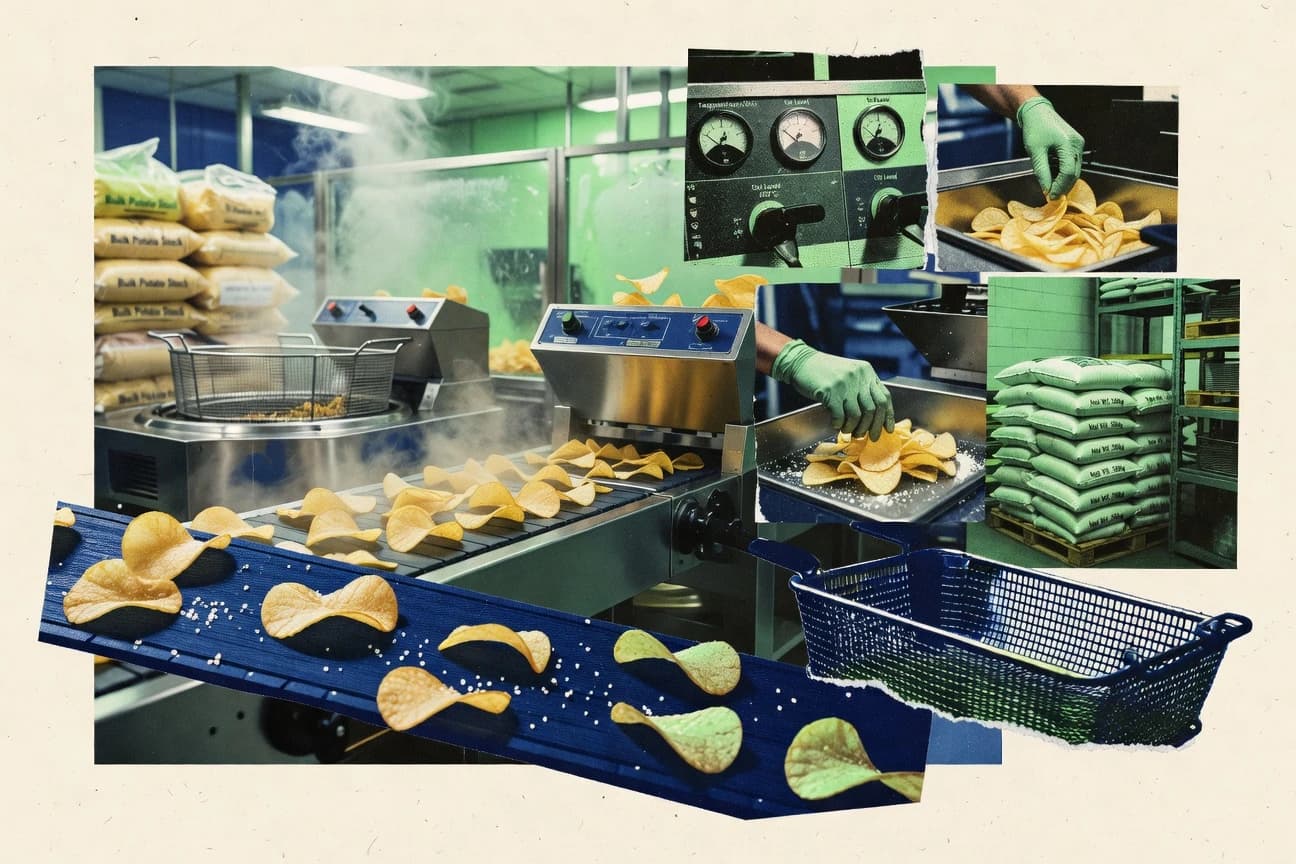

With global potato chips demand reaching 3.3 million tonnes in 2023, the category is still a momentum play, but the cost and compliance pressures behind each pack are tightening. From 2025 style energy and packaging strains to 17 FDA Class I food safety recalls in 2023, chips industry statistics reveal how pricing, flavor trends, and manufacturing risk all move at once. We break down the figures behind market growth, retail performance, and the practical limits manufacturers manage, including yield, frying economics, and shelf life targets.
Key Takeaways
- The global potato chips market volume was 3.3 million tonnes in 2023, reflecting unit demand
- The global snack food market is forecast to grow to $265.6 billion by 2030
- In the United States, the snack food market is forecast to grow to $65.1 billion by 2030
- In 2023, the potato chips category had a 6.1% value growth rate in the United States (year-over-year), indicating category expansion
- In 2024, salted potato chips accounted for 48% of U.S. potato chip sales by value, showing the largest flavor segment
- In 2023, the FDA issued 17 Class I recalls related to food safety hazards (highest severity classification), relevant to manufacturing risk environment
- In 2022, the average U.S. recycling rate for plastics was about 5.4%, influencing the waste management economics for plastic chip bags
- In 2022, the U.S. industrial electricity consumption increased by 2.1%, creating operational pressure for energy-intensive frying steps
- In 2023, global potato yield averaged 17.5 tonnes per hectare, affecting raw potato costs and supply
- In 2023, natural gas spot prices averaged about $2.60 per MMBtu in the United States, impacting energy costs for frying
- In 2023, West Texas Intermediate (WTI) averaged about $77.7 per barrel, influencing transportation and packaging-related cost pressures
- Over 90% of potato chips consumed in the United States are produced by a small set of large manufacturers, indicating high consolidation of production capacity (share measure reported by industry analyses)
- In 2024, potato chips manufacturers increasingly deployed high-automation packaging lines, where modern snack lines can achieve up to 200 packs per minute on high-speed form-fill-seal systems
- A typical industrial deep fryer for chips operates at approximately 170–190°C oil temperature, controlling browning and texture (reported as operational range by equipment specs)
- A typical potato chip's acrylamide content targets are influenced by frying time/temperature; peer-reviewed studies report acrylamide levels on the order of hundreds of micrograms per kilogram in some chip samples
In 2023, potato chips demand stayed strong with a 3.3 million tonne global market and rising U.S. pricing support.
Related reading
01 · Category
Market Size9 stats
01
The global potato chips market volume was 3.3 million tonnes in 2023, reflecting unit demandhttps://www.fortunebusinessinsights.com/industry-reports/potato-chips-market-100255
02
The global snack food market is forecast to grow to $265.6 billion by 2030https://www.grandviewresearch.com/industry-analysis/snack-food-market
03
In the United States, the snack food market is forecast to grow to $65.1 billion by 2030https://www.grandviewresearch.com/industry-analysis/us-snack-food-industry
04
In Canada, the potato chip market was valued at $1.9 billion in 2023https://www.grandviewresearch.com/industry-analysis/canada-potato-chips-market
05
In China, the potato chips market is expected to reach $X by 2030https://www.grandviewresearch.com/industry-analysis/china-potato-chips-market
06
In 2023, the U.S. average retail price for potato chips increased by about 1.2% versus 2022 (consumer price measure basis)https://www.bls.gov/cpi/data.htm
07
In 2024, U.S. real disposable personal income growth was 2.1% year-over-year, supporting demand for discretionary snacks like chipshttps://fred.stlouisfed.org/series/DSPIC96
08
In 2023, the world population was 8.05 billion, providing underlying headroom for food/snack consumption growthhttps://data.worldbank.org/indicator/SP.POP.TOTL
09
The share of U.S. retail snack sales accounted for by potato chips was 15% in 2023 (with other snack categories comprising the rest)https://www.snackandbakery.com/articles/101380-top-10-snacks-and-sweets-brands-2023
Interpretation
Market Size Interpretation
The chips market is expanding beyond pure volume, with global potato chips reaching 3.3 million tonnes in 2023 and the broader snack food market forecast to rise to $265.6 billion by 2030, supported by rising U.S. disposable income and a 15% share of retail snack sales coming specifically from potato chips.
02 · Category
Industry Trends2 stats
01
In 2023, the potato chips category had a 6.1% value growth rate in the United States (year-over-year), indicating category expansionhttps://www.iriworldwide.com/insights
02
In 2024, salted potato chips accounted for 48% of U.S. potato chip sales by value, showing the largest flavor segmenthttps://www.foodbusinessnews.net/articles/19012-us-chip-sales-salt
Interpretation
Industry Trends Interpretation
In the Industry Trends for U.S. potato chips, the category grew by 6.1% in 2023 year over year while salted flavors led in 2024 with 48% of sales by value, signaling strong momentum behind mainstream taste preferences.
03 · Category
Sustainability & Risk8 stats
01
In 2023, the FDA issued 17 Class I recalls related to food safety hazards (highest severity classification), relevant to manufacturing risk environmenthttps://www.fda.gov/safety/recalls-market-withdrawals-safety-alerts
02
In 2022, the average U.S. recycling rate for plastics was about 5.4%, influencing the waste management economics for plastic chip bagshttps://www.epa.gov/facts-and-figures-about-materials-waste-and-recycling/plastics-material-specific-data
03
In 2022, the U.S. industrial electricity consumption increased by 2.1%, creating operational pressure for energy-intensive frying stepshttps://www.eia.gov/electricity/data/
04
In 2023, Scope 1 and 2 emissions reporting under the GHG Protocol is used widely; companies can measure emissions with standardized methods impacting reporting for chip manufacturers (method adopted broadly)https://ghgprotocol.org/standards
05
In 2023, the EU set a target that 90% of packaging must be collected for recycling by 2030 under the amended directive framework (collection target metric)https://eur-lex.europa.eu/legal-content/EN/TXT/?uri=CELEX%3A32018L0852
06
In 2023, the CDC estimated about 48 million people in the U.S. get sick from foodborne illnesses each year, underpinning the overall safety stakes for chip manufacturinghttps://www.cdc.gov/foodborneburden/index.html
07
In 2023, U.S. manufacturing labor productivity index increased by 2.0%, affecting unit economics for packaged food production including chipshttps://fred.stlouisfed.org/series/PRS30006092
08
In 2023, the U.S. CPI for food at home increased by 3.0%, affecting retail chip affordability and pricing strategieshttps://www.bls.gov/cpi/
Interpretation
Sustainability & Risk Interpretation
With food safety risk remaining high as the FDA issued 17 Class I recalls in 2023 and packaging recycling targets tightening with the EU aiming for 90% collection by 2030, chip manufacturers face growing sustainability and compliance pressure even as low U.S. plastic recycling rates of about 5.4% and rising energy use add to operational risk.
04 · Category
Inputs & Pricing6 stats
01
In 2023, global potato yield averaged 17.5 tonnes per hectare, affecting raw potato costs and supplyhttps://www.fao.org/faostat/en/
02
In 2023, natural gas spot prices averaged about $2.60per MMBtu in the United States, impacting energy costs for fryinghttps://fred.stlouisfed.org/series/DHHNGSP
03
In 2023, West Texas Intermediate (WTI) averaged about $77.7per barrel, influencing transportation and packaging-related cost pressureshttps://fred.stlouisfed.org/series/DCOILWTICO
04
In 2023, the U.S. PPI for plastics materials and resin (index) was 250.4, relevant for plastic bags and flexible packaging filmshttps://fred.stlouisfed.org/series/PCU326140326140
05
In 2023, the U.S. PPI for paperboard containers and packaging (index) was 293.0, relevant for secondary packaging for chips shipmentshttps://fred.stlouisfed.org/series/PCU322299322299
06
In 2022, average U.S. electricity retail price for industrial customers was 11.35 cents per kWh, a key operating cost driver for chip lineshttps://www.eia.gov/electricity/data/browser/
Interpretation
Inputs & Pricing Interpretation
In the Inputs & Pricing picture, chips makers faced tightly linked cost pressures in 2023 as potato yields averaged 17.5 tonnes per hectare while energy and logistics stayed high, with natural gas at about $2.60 per MMBtu, WTI around $77.7 per barrel, and packaging inputs rising through a 250.4 plastics materials and resin PPI and a 293.0 paperboard containers and packaging PPI.
More related reading
05 · Category
Production & Technology11 stats
01
Over 90% of potato chips consumed in the United States are produced by a small set of large manufacturers, indicating high consolidation of production capacity (share measure reported by industry analyses)https://www.ibisworld.com/united-states/market-research-reports/snack-food-manufacturing-industry/
02
In 2024, potato chips manufacturers increasingly deployed high-automation packaging lines, where modern snack lines can achieve up to 200 packs per minute on high-speed form-fill-seal systemshttps://www.totani.com/automation/high-speed-packaging-machines/
03
A typical industrial deep fryer for chips operates at approximately 170–190°C oil temperature, controlling browning and texture (reported as operational range by equipment specs)https://www.researchgate.net/publication/260116171_Deep_fat_frying_technology_and_process_modelling
04
Browning reactions in potato frying are strongly driven by reducing sugars and amino acids, which accelerates at higher oil temperatures typically used for chips (kinetics relationship)https://onlinelibrary.wiley.com/doi/10.1002/food.200800122
05
Vacuum frying can reduce oil uptake by roughly 25%–50% versus atmospheric frying (percentage reduction reported in peer-reviewed comparative studies)https://www.sciencedirect.com/science/article/pii/S0308814613001128
06
Coated/surfaced potato chips oil uptake typically ranges from about 30%–40% by weight in conventional frying, as summarized in food engineering literaturehttps://www.sciencedirect.com/topics/food-science-and-technology/oil-uptake
07
The 2023 U.S. food manufacturing sector reported energy use of about 6.2 quadrillion BTU, relevant to energy intensity considerations for fried snacks productionhttps://www.eia.gov/consumption/manufacturing/data/sector/
08
CO2 emissions from U.S. industrial sector are measured in millions of metric tons; food manufacturing contributed 28.6 million metric tons in 2022 (sector greenhouse gas inventory figure)https://www.epa.gov/ghgemissions/inventory-us-greenhouse-gas-emissions-and-sinks
09
In the EU, the General Food Law (Regulation (EC) No 178/2002) establishes that food business operators must ensure traceability; traceability is a legal compliance metric affecting chip supply chainshttps://eur-lex.europa.eu/legal-content/EN/TXT/?uri=CELEX%3A32002R0178
10
Shelf-life for many potato chips is targeted at about 3–6 months under typical packaging conditions to control moisture and oxidation (range used across industry/food science references)https://www.sciencedirect.com/topics/food-science-and-technology/shelf-life-of-potato-chips
11
Modified atmosphere packaging (MAP) commonly uses reduced oxygen levels (often below 1% O2) to limit oxidation in snack foods like chips (oxygen targets reported in MAP packaging studies)https://www.sciencedirect.com/science/article/pii/S0260877408000525
Interpretation
Production & Technology Interpretation
In the Production & Technology side of chips, manufacturing is highly consolidated with over 90% of U.S. potato chips made by a small group of large producers, and this scale is increasingly matched by automation such as modern packaging lines hitting up to 200 packs per minute.
06 · Category
Performance & Nutrition5 stats
01
A typical potato chip's acrylamide content targets are influenced by frying time/temperature; peer-reviewed studies report acrylamide levels on the order of hundreds of micrograms per kilogram in some chip sampleshttps://www.ncbi.nlm.nih.gov/pmc/articles/PMC5342114/
02
Acrylamide formation in fried foods increases strongly with higher frying temperatures (kinetic relationship), so temperature reductions measurably lower acrylamidehttps://www.ncbi.nlm.nih.gov/books/NBK234273/
03
Under EU guidance, maximum levels for acrylamide are set per food category; for potato chips, reference levels are established to reduce exposure (regulatory benchmark)https://eur-lex.europa.eu/legal-content/EN/TXT/?uri=CELEX%3A32011R0122
04
The FDA's allowable food contact limits for acrylamide are not set as a single numeric maximum; instead, FDA focuses on mitigation and monitoring for reduced acrylamide in foodshttps://www.fda.gov/food/chemicals/acrylamide
05
The EU sets reference intake values such as sodium 6 g/day for labeling purposes, relevant for comparing chip sodium intensityhttps://eur-lex.europa.eu/eli/reg/2011/1169/oj
Interpretation
Performance & Nutrition Interpretation
For the Performance and Nutrition angle, potato chip acrylamide can reach hundreds of micrograms per kilogram and rises strongly with higher frying temperatures, meaning simply lowering fry temperature and staying within EU category reference levels can measurably improve nutrition outcomes.
07 · Category
User Adoption4 stats
01
In 2023, the U.S. population reached 334.9 million, defining the consumer base for chipshttps://data.worldbank.org/indicator/SP.POP.TOTL?locations=US
02
In 2023, the U.K. population was 67.7 million, defining a major Western European demand base for packaged chipshttps://data.worldbank.org/indicator/SP.POP.TOTL?locations=GB
03
In 2023, India’s population was 1.43 billion, indicating large potential for future chip consumption growthhttps://data.worldbank.org/indicator/SP.POP.TOTL?locations=IN
04
In 2022, U.S. households reported buying salty snacks on average 3.5 times per month (frequency measure from consumer expenditure surveys and panel reporting)https://www.bls.gov/cex/
Interpretation
User Adoption Interpretation
User adoption for chips is clearly broad and rising, with the U.S. consumer base at 334.9 million people and U.S. households buying salty snacks 3.5 times per month, while India’s 1.43 billion population signals major upside for future growth.
Reference
Cite This Report
This report is designed to be cited. We maintain stable URLs and versioned verification dates. Copy the format appropriate for your publication below.
APA
Stefan Wendt. (2026, February 13). Chips Industry Statistics. Gitnux. https://gitnux.org/chips-industry-statistics
MLA
Stefan Wendt. "Chips Industry Statistics." Gitnux, 13 Feb 2026, https://gitnux.org/chips-industry-statistics.
Chicago
Stefan Wendt. 2026. "Chips Industry Statistics." Gitnux. https://gitnux.org/chips-industry-statistics.
Sources & references
45 datasets cited across this report
+24 additional datasets cited (not shown individually)