
GITNUXSOFTWARE ADVICE
Healthcare MedicineTop 10 Best Medical Records Scanning Software of 2026
Top 10 medical records scanning software ranked by OCR quality, indexing, security, and workflow fit for healthcare records teams, with tool comparisons.

How we ranked these tools
Core product claims cross-referenced against official documentation, changelogs, and independent technical reviews.
Analyzed video reviews and hundreds of written evaluations to capture real-world user experiences with each tool.
AI persona simulations modeled how different user types would experience each tool across common use cases and workflows.
Final rankings reviewed and approved by our editorial team with authority to override AI-generated scores based on domain expertise.
Score: Features 40% · Ease 30% · Value 30%
Gitnux may earn a commission through links on this page — this does not influence rankings. Editorial policy
M-Files is the best fit for regulated teams that need governed capture-to-chart assembly with configurable workflows, while GlobalSearch works well when operations teams handle frequent batch scanning and want consistent OCR and indexing before chart assembly.
Editor’s top 3 picks
Three quick recommendations before you dive into the full comparison below — each one leads on a different dimension.
M-Files
Metadata and workflow configuration that ties scanned documents to records with controlled routing and auditability.
Built for fits when regulated teams need governed capture-to-chart assembly with configurable workflows..
OpenText Documentum
Editor pickPolicy-driven retention and audit logging for scanned documents inside enterprise records lifecycles.
Built for fits when enterprise governance and auditability matter more than scanner-side intelligence..
GlobalSearch
Editor pickPatient matching plus encounter-level indexing keeps scanned pages grouped correctly for assembled chart outputs.
Built for fits when operations teams run frequent batch scanning and need consistent indexing before chart assembly..
Comparison Table
M-Files
enterpriseM-Files captures scanned documents and organizes healthcare records through metadata-driven content management.
Metadata and workflow configuration that ties scanned documents to records with controlled routing and auditability.
M-Files fits medical records scanning programs that need capture-to-archive control, because its metadata and workflow configuration govern how documents become records. Scanned images can be processed into searchable PDFs while classification and indexing are driven by rules tied to document attributes. For governance, role-based access control and audit logging support traceability across ingestion, review, and release activities. Automation can reduce manual index entry by mapping extracted values to document properties and routing documents through approval steps.
A key tradeoff is that M-Files requires up-front configuration of metadata schemas and workflow logic to match each facility’s document types and routing rules. High-volume scanning teams often pair M-Files with capture hardware such as an automatic document feeder to avoid bottlenecks at the imaging workstation. This setup works best when there is a stable encounter structure to key indexing and when document quality issues like skew or faint prints are handled by the capture process feeding M-Files.
- +Metadata-driven workflows route scanned charts through review and approval
- +RBAC with audit logs tracks access and changes across release-of-information steps
- +Configurable indexing rules reduce manual field entry for encounter organization
- +API and integrations support extending classification and metadata capture logic
- –Up-front schema and workflow configuration takes time for each document set
- –Complex patient matching often depends on consistent source naming and capture fields
- –Governed release workflows can require process tuning by administrators
- –High-throughput throughput depends on capture hardware and scanner calibration
Health information management teams
Govern chart assembly for scanned encounters
Faster indexing and fewer manual fixes
Release-of-information coordinators
Control access during request processing
Tighter audit trail for disclosures
Show 2 more scenarios
Imaging operations teams
Standardize capture output quality
More consistent searchable PDF archives
Batch capture feeds documents into governed metadata-driven classification and review queues.
Integration engineers
Automate indexing and routing
Less manual workflow orchestration
API-driven integration and automation handle metadata mapping and workflow initiation from upstream systems.
Best for: Fits when regulated teams need governed capture-to-chart assembly with configurable workflows.
OpenText Documentum
enterpriseOpenText Documentum manages controlled healthcare documents, scanned records, metadata, and retention policies.
Policy-driven retention and audit logging for scanned documents inside enterprise records lifecycles.
OpenText Documentum is built for document governance, so scanned outputs can be stored with controlled metadata, retention rules, and traceable access events. Administrators can enforce access boundaries through role-based permissions and maintain visibility via audit logs for releases and edits. Automation typically centers on integration and workflow configuration rather than scanner-side logic, which fits teams running enterprise content processes.
A tradeoff is that Documentum capacity depends on the surrounding capture stack, because OCR quality and scan hygiene are not the same capability as the core records governance. It fits facilities that already have a capture vendor or enterprise imaging service and need strong document management integration, patient context mapping, and controlled lifecycle handling.
- +Retention and access control enforcement for regulated document lifecycles
- +Audit logs that track document access and change events
- +Workflow integration patterns for connecting capture outputs to enterprise context
- +Metadata-driven retrieval that supports consistent chart assembly handling
- –Scan-image quality features depend on the external capture stack
- –Administration and governance configuration can take significant planning time
- –Patient matching and encounter indexing require integration work
- –Optimizing throughput often depends on deployment tuning rather than UI settings
Hospital compliance teams
Govern release-of-information for scanned records
Stronger audit traceability
Enterprise content operations
Route scans into governed document folders
Less manual filing
Show 2 more scenarios
Health system records managers
Control lifecycle edits and deletions
Reduced unauthorized changes
Role-based controls restrict document changes and enforce lifecycle rules on stored images.
Release-of-information teams
Prepare governed exports from stored scans
Fewer access incidents
Access rules and audit logs support controlled dissemination of release packages.
Best for: Fits when enterprise governance and auditability matter more than scanner-side intelligence.
GlobalSearch
SMBGlobalSearch captures, OCRs, indexes, and routes scanned documents for healthcare and other regulated organizations.
Patient matching plus encounter-level indexing keeps scanned pages grouped correctly for assembled chart outputs.
GlobalSearch targets the end-to-end scanning workflow from intake to searchable PDF output, including deskew and image-quality cleanup steps used during high-volume document scanning. OCR drives text extraction for downstream search, while indexing and metadata capture support encounter-level assembly for chart-ready documents. Document classification and patient matching workflows are positioned for repeatable batch runs across multiple scanners and document types.
A key tradeoff is that recognition accuracy depends on upfront configuration of document types and matching rules, which requires governance to prevent misindexing. GlobalSearch works best when scanning teams can standardize intake sources and document templates so batch jobs produce consistent metadata for release-of-information and chart assembly workflows.
- +Batch scanning workflow supports consistent chart assembly and encounter indexing
- +OCR outputs searchable documents for fast retrieval during chart review
- +Image cleanup steps reduce deskew and speckle issues in captured pages
- +Document classification and patient matching reduce manual sorting effort
- –Recognition and matching require setup discipline to avoid indexing errors
- –Advanced configuration adds overhead for teams with highly variable source documents
- –Complex mixed-chart batches can increase review time per document
- –Integration validation effort increases when EHR routing must be tightly controlled
Health system release-of-information
Batch intake to assembled chart exports
Fewer rework rounds
Medical records operations teams
High-volume document intake indexing
Faster retrieval
Show 1 more scenario
Clinics supporting chart completion
Assemble mixed document types
More complete charts
Image cleanup and metadata capture improve scan readability before chart assembly review.
Best for: Fits when operations teams run frequent batch scanning and need consistent indexing before chart assembly.
DocuWare
SMBDocuWare provides cloud document capture, OCR, indexing, and workflow management for medical records.
DocuWare’s workflow-connected capture ties indexing and document handling steps to auditable, permissioned processes.
DocuWare fits medical record scanning programs that need document capture tied directly to governed workflows. It combines scanner batch ingestion with rule-based indexing, classification, and secure storage inside its document management and workflow layers.
Administration controls and audit trails support retention and access patterns for release-of-information handling and chart assembly. Automation can route documents to the right patient and process step using configured capture fields and workflow actions.
- +Workflow routing can connect scan capture to downstream medical record steps
- +Batch ingestion supports high-throughput document intake with consistent indexing rules
- +Audit trail and retention configuration support healthcare governance needs
- +Extensible integrations can connect capture to enterprise systems
- –Patient matching and indexing accuracy depends heavily on capture configuration
- –Initial workflow design and governance setup require process ownership
- –Advanced capture tuning can take time to reach stable quality across document types
- –Some niche scan features may require additional component configuration
Best for: Fits when organizations need governed scan intake that routes documents through medical record workflows.
3M M*Modal
vertical specialistClinical documentation and speech understanding platform that includes medical record scanning and document conversion capabilities.
Indexing that ties scanned pages to clinical encounter context for faster chart assembly and downstream clinical workflows.
3M M*Modal supports document scanning for medical records with conversion to searchable outputs and metadata capture for retrieval.
The product emphasizes clinical intake mapping through patient matching and encounter indexing so scanned content lands in the correct chart context.
Document quality controls such as deskewing and image cleanup are used to improve OCR results on low-quality paper.
Audit trail capabilities support regulated governance needs during document release and access tracking.
- +Patient matching and encounter indexing designed for clinical intake
- +Image cleanup improves OCR readability on scanned charts
- +Audit trail coverage for release-of-information style workflows
- +Tight integration to clinical documentation systems for downstream use
- –Workflow configuration can be complex across document categories
- –Advanced capture quality tuning needs administrator attention
- –Deep integration depends on the surrounding M*Modal environment
- –Limited evidence of plug-and-play support for non-clinical repositories
Best for: Fits when organizations need chart-grade scanning with patient matching and audit trails for regulated retrieval.
Epic Document Management
vertical specialistEHR vendor offering integrated document scanning and media management modules for incoming clinical paperwork.
Epic Document Management’s chart-integrated handling of scanned documents within Epic workflows.
Epic Document Management is a records scanning and document management solution built around Epic’s clinical ecosystem. It supports document scanning workflows used to assemble chart content, then route documents through Epic-aligned indexing and retrieval paths.
Core capabilities center on ingesting scanned images into Epic-based document handling with quality controls for readability and downstream patient matching. It fits organizations that standardize capture and release-of-information flows inside an Epic-centered operating model.
- +Epic-aligned workflow for chart assembly and document retrieval
- +Strong governance alignment through Epic-centric access patterns
- +Clear path for routing scanned documents into clinical context
- +Quality safeguards for scanned content readability
- –Best outcomes depend on an Epic-centric deployment and data flow
- –Limited appeal for non-Epic environments that need generic scanning capture
- –Integration depth can increase implementation and change-management work
- –Automation and capture extensibility feel less vendor-neutral than scanners-first suites
Best for: Fits when scanning and chart assembly must integrate tightly with an Epic-based clinical record workflow.
FileHold
SMBFileHold provides document scanning, OCR, indexing, permissions, and retention management.
FileHold’s release-of-information workflow support ties document versions to governed access paths and audit logging.
FileHold focuses on medical record scanning workflows built around structured capture and controlled document lifecycle rather than generic file upload. It supports batch and high-volume scanning with recognition and indexing for chart assembly, so scanned pages can become searchable chart content.
Document quality and image processing steps are designed to reduce failures like skewed pages and low legibility. Governance features such as audit trails and controlled access support compliance-oriented release-of-information workflows.
- +Structured capture and indexing reduce manual chart rework
- +Audit trail support strengthens medical document governance
- +Batch-oriented workflow fits high-volume scanning operations
- +Recognition and image cleanup improve PDF readability
- –Advanced workflow automation depends on configuration discipline
- –Integration depth with EHR systems can require specialist setup
- –Complex permission models can slow initial deployment
- –Image quality rules can need tuning per document source
Best for: Fits when mid-size practices need structured scan capture, governed access, and reliable chart assembly without custom development.
Laserfiche
enterpriseLaserfiche captures, indexes, routes, and stores scanned healthcare documents.
Release-of-information workflow management tied to scanned document batches and governed access controls.
Laserfiche is a medical records scanning solution that focuses on turning scanned charts into managed, governed content with workflow and auditability. It supports document capture with OCR for searchable output, plus structured indexing so charts can be found by encounter and patient context.
Built for high-volume operations, it can route batches through QA and release-of-information style workflows rather than only storing images. Integrations with clinical systems and document management tools connect scan results to downstream health record processes.
- +Workflow-driven indexing that routes scanned batches through medical release steps
- +OCR plus structured metadata capture supports searchable PDFs and chart retrieval
- +Administrative audit trails track access and workflow events for managed retention
- +Integration options help connect scanned documents to existing clinical document flows
- –Higher governance overhead for consistent patient matching across mixed-quality scans
- –Capture configuration and indexing rules require careful design to avoid misclassification
- –Advanced automation depends on tuning workflows and batch templates per site
Best for: Fits when regulated teams need governed scan-to-workflow processing with searchable chart content and strong auditing.
IBM FileNet Content Manager
enterpriseIBM FileNet Content Manager stores, classifies, governs, and routes scanned healthcare documents.
Configurable FileNet workflow governance that ties scanned content, metadata, and access policies to repeatable release-of-information processing.
IBM FileNet Content Manager ingests and governs scanned medical documents through an enterprise ECM workflow model tied to persistent content storage and versioning. It supports indexing and metadata capture so scanned pages can be linked to the right patient and case records used by downstream chart assembly and release-of-information workflows.
Automation is driven through workflow configuration and integration endpoints that connect scanning results to wider clinical or back-office systems. Audit logging and access controls align with regulated document handling needs where retention and retrieval must be consistently enforced.
- +Strong workflow governance with persistent versioning for regulated document handling
- +Metadata indexing supports consistent retrieval across long-lived medical archives
- +Enterprise integration patterns support connecting capture output to existing EHR and HIM systems
- +Audit trail supports traceability across content access and workflow steps
- –Requires substantial ECM configuration to model patient-facing and ROI workflows correctly
- –Scanning capture orchestration depends on connected components rather than a single capture UI
- –Advanced governance settings add administrative overhead during operational tuning
- –High-volume throughput design depends on infrastructure choices outside the ECM layer
Best for: Fits when healthcare organizations need enterprise governance for scanned records across many departments and systems.
Revver
SMBRevver stores, scans, indexes, and routes business documents through digital workflows.
Encounter-centric chart assembly that ties scanned pages to patient identifiers and encounter grouping for downstream ROIs.
Revver is a medical records scanning tool that targets document intake workflows rather than general-purpose imaging. It converts scanned charts into searchable outputs using built-in OCR pipelines and document cleanup steps like deskewing and blank-page handling.
Revver also focuses on indexing and patient matching so encounters can be assembled into chart-ready structures for downstream review and release-of-information flows. Governance features concentrate on permissions and auditability to support controlled access to patient documents.
- +Document cleanup steps reduce unusable scans for chart assembly
- +Indexing and patient matching support encounter-level chart grouping
- +Searchable output generation helps locate content inside scanned pages
- +Permissions and audit trail support controlled access to patient files
- –HL7 and FHIR integration support is not consistently strong for all workflows
- –Automation coverage depends heavily on setup of classification rules
- –High-volume throughput depends on scanner and ingestion configuration
- –Complex chart assembly still requires human review for edge cases
Best for: Fits when mid-size records teams need searchable chart scanning plus indexing for controlled release-of-information review.
Conclusion
After evaluating 10 healthcare medicine, M-Files stands out as our overall top pick — it scored highest across our combined criteria of features, ease of use, and value, which is why it sits at #1 in the rankings above.
Use the comparison table and detailed reviews above to validate the fit against your own requirements before committing to a tool.
How to Choose the Right medical records scanning software
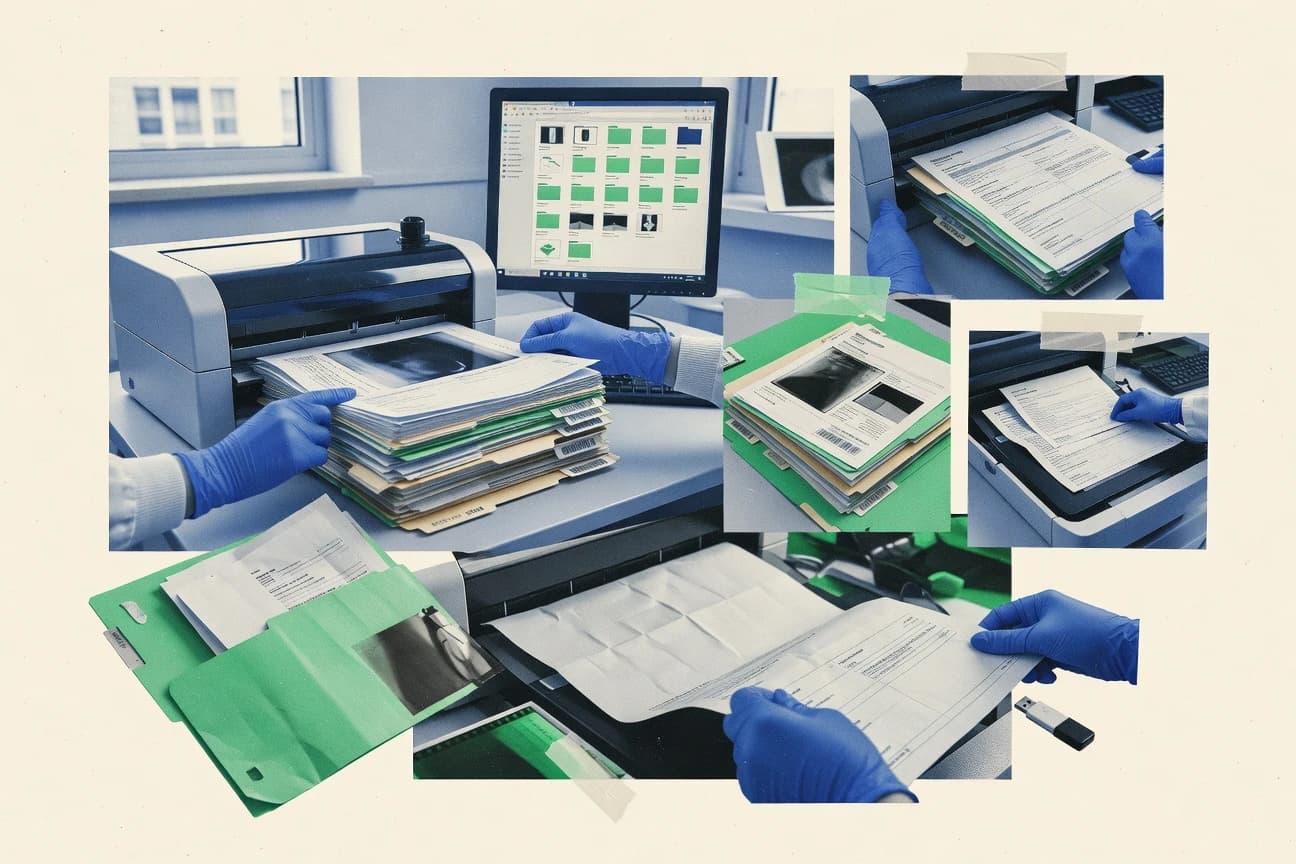
This buyer's guide covers medical records scanning software tools and how teams should evaluate them for chart assembly, searchable outputs, and governed release-of-information workflows.
Tools covered include M-Files, OpenText Documentum, GlobalSearch, DocuWare, 3M M*Modal, Epic Document Management, FileHold, Laserfiche, IBM FileNet Content Manager, and Revver.
The guide focuses on integration depth, automation and API surface, and administrative governance controls based on how these products handle patient matching, encounter-level indexing, auditability, and batch ingestion quality.
Medical records scanning systems that convert paper charts into governed, searchable chart content
Medical records scanning software ingests paper and produces scanned outputs that support indexing, patient matching, and chart assembly workflows beyond basic image storage. Tools such as GlobalSearch and DocuWare apply OCR and structured metadata capture so scanned pages become retrievable chart components.
These systems reduce manual sorting and rework by routing documents into governed workflows with audit trails, retention enforcement, and controlled access patterns for release-of-information steps. Teams that run batch scanning operations, medical records departments, and compliance-focused document governance groups use these platforms to keep scanned content linked to the right patient and encounter.
Evaluation criteria for chart assembly, OCR quality, and governed release workflows
Evaluation should focus on how scanned pages become chart-ready structures with correct grouping and auditable routing. M-Files and IBM FileNet Content Manager lead when governance controls and workflow configuration define how documents move through regulated steps.
Scanned image cleanup and recognition controls also matter because OCR accuracy and metadata extraction directly affect patient matching and encounter indexing. FileHold and 3M M*Modal emphasize image processing and clinical-context indexing to reduce unreadable captures and improve downstream retrieval.
Metadata-first workflow routing from capture to chart assembly
M-Files and DocuWare tie scanned document capture fields to workflow actions so indexing drives routing into chart assembly and approval steps. This matters when release-of-information steps must remain traceable and when document classification must control where pages land.
Encounter-level indexing and patient matching to prevent mis-grouping
GlobalSearch and Revver implement patient matching plus encounter-level grouping so assembled outputs reflect correct chart boundaries. This matters for mixed batches where encounter-level indexing reduces manual correction during chart completeness checks.
Policy-driven retention and audit logging for regulated document lifecycles
OpenText Documentum and Laserfiche emphasize audit logs and retention or release workflow management for governed access across scanned content. This matters when compliance teams require traceability for document access and workflow events.
Image cleanup quality controls that improve OCR on real-world scans
FileHold and 3M M*Modal focus on image cleanup steps such as skew and legibility handling so OCR output remains usable for indexing. This matters because OCR errors can cascade into incorrect indexing and downstream patient matching.
Integration patterns that connect scanning results to clinical or enterprise systems
M-Files and IBM FileNet Content Manager support API and enterprise workflow integration patterns that connect capture outputs to wider systems. This matters when documents must map into existing retrieval workflows or route into EHR-centered media handling.
Batch ingestion consistency for high-volume throughput
GlobalSearch and DocuWare support repeatable batch scanning operations with configurable recognition and metadata capture steps. This matters when frequent runs require consistent document classification and reduced rework per mixed chart batch.
Decision framework for selecting a medical records scanning tool by workflow and governance needs
Selection should start with how scanned content must move through regulated steps. M-Files and OpenText Documentum fit when routing, retention, and audit trails define correctness more than scanner-side capture alone.
Then the choice should account for how patient matching and encounter indexing must behave under real source variability. GlobalSearch and Revver support encounter-centric grouping, while Epic Document Management narrows the fit to organizations that operate scanning inside Epic clinical workflows.
Map chart assembly and release-of-information steps to the tool’s workflow model
Choose M-Files when governed capture-to-chart assembly must tie metadata and workflow configuration to controlled routing and auditability. Choose Laserfiche when release-of-information workflow management should be tied to scanned document batches and governed access controls.
Define how patient matching and encounter grouping must work on your source documents
Choose GlobalSearch when batch scanning must keep encounter-level indexing consistent so assembled chart outputs group correctly. Choose Revver when encounter-centric chart assembly must tie scanned pages to patient identifiers and encounter grouping for downstream ROI review.
Align OCR and image cleanup expectations with the quality problems seen in paper intake
Choose FileHold when image quality rules need to reduce failures such as skewed pages and low legibility so scanned content becomes readable for indexing. Choose 3M M*Modal when chart-grade scanning must improve OCR readability and support encounter indexing tied to clinical intake.
Select integration depth based on where the rest of the record lifecycle already runs
Choose IBM FileNet Content Manager when enterprise governance needs persistent content storage and workflow configuration tied to repeatable release-of-information processing across departments. Choose Epic Document Management when scanning and chart assembly must integrate tightly with Epic-based clinical record workflows.
Pick an administration model that matches team bandwidth for configuration and tuning
Choose DocuWare when workflow-connected capture and audit trails must route scanned documents through medical record workflows, but plan for initial workflow design and governance setup ownership. Choose OpenText Documentum when retention and audit logging enforcement must be policy-driven, but plan for administration and governance configuration time.
Which teams should evaluate which medical records scanning tools
Different teams prioritize different failure modes such as mis-indexing, unclear auditability, and inconsistent chart assembly from mixed batches. The best fit depends on whether workflows are governed by a records management platform, a clinical EHR ecosystem, or batch scanning operations.
The following segments align with the best-fit guidance for each tool based on how it handles routing, indexing, OCR quality, and governed access.
Regulated teams needing configurable capture-to-chart workflows with routing traceability
M-Files fits regulated teams because metadata and workflow configuration tie scanned documents to records with controlled routing and auditability. The model reduces manual field entry through configurable indexing rules and supports governed release workflows.
Enterprise governance groups that treat scanned documents as lifecycle-managed records
OpenText Documentum fits when retention and audit logs must enforce document lifecycles with role-based controls. IBM FileNet Content Manager fits when persistent content storage and workflow governance must manage scanned records and their access policies across many departments.
Operations teams running frequent batch scanning with consistent indexing before chart assembly
GlobalSearch fits teams that run repeatable batch scanning operations and need OCR outputs plus consistent document classification and patient matching behavior. DocuWare fits teams that require batch ingestion and rule-based indexing that routes scanned documents through governed workflows.
Healthcare organizations operating chart assembly inside a clinical documentation or Epic environment
3M M*Modal fits when chart-grade scanning must tie patient matching and encounter indexing to clinical intake and provide audit trails for regulated retrieval. Epic Document Management fits when scanning and chart assembly must integrate tightly with Epic-based document handling workflows.
Mid-size records teams needing controlled release-of-information handling with structured scan capture
FileHold fits mid-size practices because structured capture and indexing support governed access and reliable chart assembly without custom development. Revver fits mid-size records teams that need encounter-centric chart assembly with searchable outputs for controlled release-of-information review.
Pitfalls that cause indexing errors, governance gaps, or slow batch throughput
Medical records scanning tools fail when teams underestimate configuration discipline or when capture inputs vary beyond what the indexing rules can handle. Several reviewed tools highlight that patient matching and encounter indexing accuracy depend on capture fields and setup consistency.
Governance also becomes a bottleneck when release workflows require process tuning but administrators lack time for tuning batch templates and governance settings.
Treating workflow and indexing configuration as a one-time setup
M-Files and DocuWare both require up-front schema and workflow configuration to route scanned charts correctly and support auditable steps. GlobalSearch also depends on recognition and matching setup discipline to avoid indexing errors across batch runs.
Underestimating how sensitive patient matching is to naming and capture field consistency
M-Files and 3M M*Modal both report that complex patient matching depends on consistent source naming and capture quality for encounter indexing. Revver and Laserfiche also require careful classification and patient matching across mixed-quality scans.
Expecting image cleanup to be automatic without tuning per document source
FileHold and 3M M*Modal both need administrator attention for capture quality tuning and image cleanup rules to work across document types. Laserfiche reports that indexing rules and batch templates require careful design to avoid misclassification.
Choosing an enterprise governance platform without planning for ECM or integration workload
IBM FileNet Content Manager requires substantial ECM configuration to model patient-facing and ROI workflows correctly and its capture orchestration depends on connected components. OpenText Documentum also notes administration and governance configuration can take significant planning time when patient matching and encounter indexing require integration work.
How We Selected and Ranked These Tools
We evaluated M-Files, OpenText Documentum, GlobalSearch, DocuWare, 3M M*Modal, Epic Document Management, FileHold, Laserfiche, IBM FileNet Content Manager, and Revver using features performance, ease of use, and value, with features carrying the most weight because chart assembly outcomes depend on indexing, workflow routing, and OCR output. Overall scores use a weighted average where features account for forty percent and ease of use and value each account for thirty percent.
Editorial research relied on the concrete capability descriptions and quantified ratings provided for each tool, so the ranking reflects how each product handles workflow-connected capture, encounter-level indexing, retention enforcement, and audit logging in practice. M-Files ranked highest because its metadata and workflow configuration ties scanned documents to records with controlled routing and auditability while also reporting a features score of 9.4, Which lifted its features-weighted contribution.
Frequently Asked Questions About medical records scanning software
How do integrations and APIs differ across M-Files, DocuWare, and IBM FileNet Content Manager?
What SSO and access-control model should be expected in OpenText Documentum versus Laserfiche?
When migrating from an existing scanning setup, how do data migration and metadata mapping work in M-Files and GlobalSearch?
Which tool handles encounter-level indexing better for assembling chart-ready outputs?
How does document classification and patient matching work in GlobalSearch compared with 3M M*Modal?
What breaks if an organization needs scanner-side quality assurance but chooses only a basic document store?
When should admin controls and audit logging be prioritized in OpenText Documentum versus DocuWare?
How do extensibility and configuration differ between M-Files and Epic Document Management?
What technical requirements show up around searchable output formats in FileHold and Laserfiche?
Tools reviewed
Primary sources checked during evaluation.
Referenced in the comparison table and product reviews above.
- Healthcare MedicineTop 10 Best Medical Document Scanning Software of 2026
- Healthcare MedicineTop 10 Best Personal Medical Records Software of 2026
- Healthcare MedicineTop 10 Best Physical Therapy Electronic Medical Records Software of 2026
- Healthcare MedicineTop 10 Best Patient Medical Record And History Software of 2026
- Education LearningTop 10 Best Student Health Records Software of 2026
Keep exploring
Comparing two specific tools?
Software Alternatives
See head-to-head software comparisons with feature breakdowns, pricing, and our recommendation for each use case.
Explore software alternatives→In this category
Healthcare Medicine alternatives
See side-by-side comparisons of healthcare medicine tools and pick the right one for your stack.
Compare healthcare medicine tools→