
GITNUXSOFTWARE ADVICE
Fashion ApparelTop 10 Best AI Real Person Generator of 2026
A ranking of 10 ai real person generator tools covers image quality, features, and ease of use for creators, marketers, and design teams.

How we ranked these tools
Core product claims cross-referenced against official documentation, changelogs, and independent technical reviews.
Analyzed video reviews and hundreds of written evaluations to capture real-world user experiences with each tool.
AI persona simulations modeled how different user types would experience each tool across common use cases and workflows.
Final rankings reviewed and approved by our editorial team with authority to override AI-generated scores based on domain expertise.
Score: Features 40% · Ease 30% · Value 30%
Gitnux may earn a commission through links on this page — this does not influence rankings. Editorial policy
Editor’s top 3 picks
Three quick recommendations before you dive into the full comparison below — each one leads on a different dimension.
RAWSHOT AI
RAWSHOT AI turns a fashion shoot into seven selectable blocks instead of an empty text field, then lets users save the complete setup as a Stack. The same block logic carries from still images to video, while the orchestration layer keeps selections consistent across a catalogue.
Built for rAWSHOT AI is best for emerging labels, DTC retailers, marketplaces and apparel operators needing consistent on-model imagery across repeated product launches..
Fotor
Editor pickAI Face Generator paired with Fotor’s portrait editor supports prompt-to-retouch workflows in one browser workspace.
Built for fits when creators need fictional portraits with immediate editing for social profiles, campaigns, and concept work..
Generated.photos
Editor pickAttribute-based face generation combines granular portrait controls with downloadable assets and an integrated developer API.
Built for fits when teams need controllable synthetic portraits for product design, content production, or API-based image workflows..
Comparison Table
RAWSHOT AI
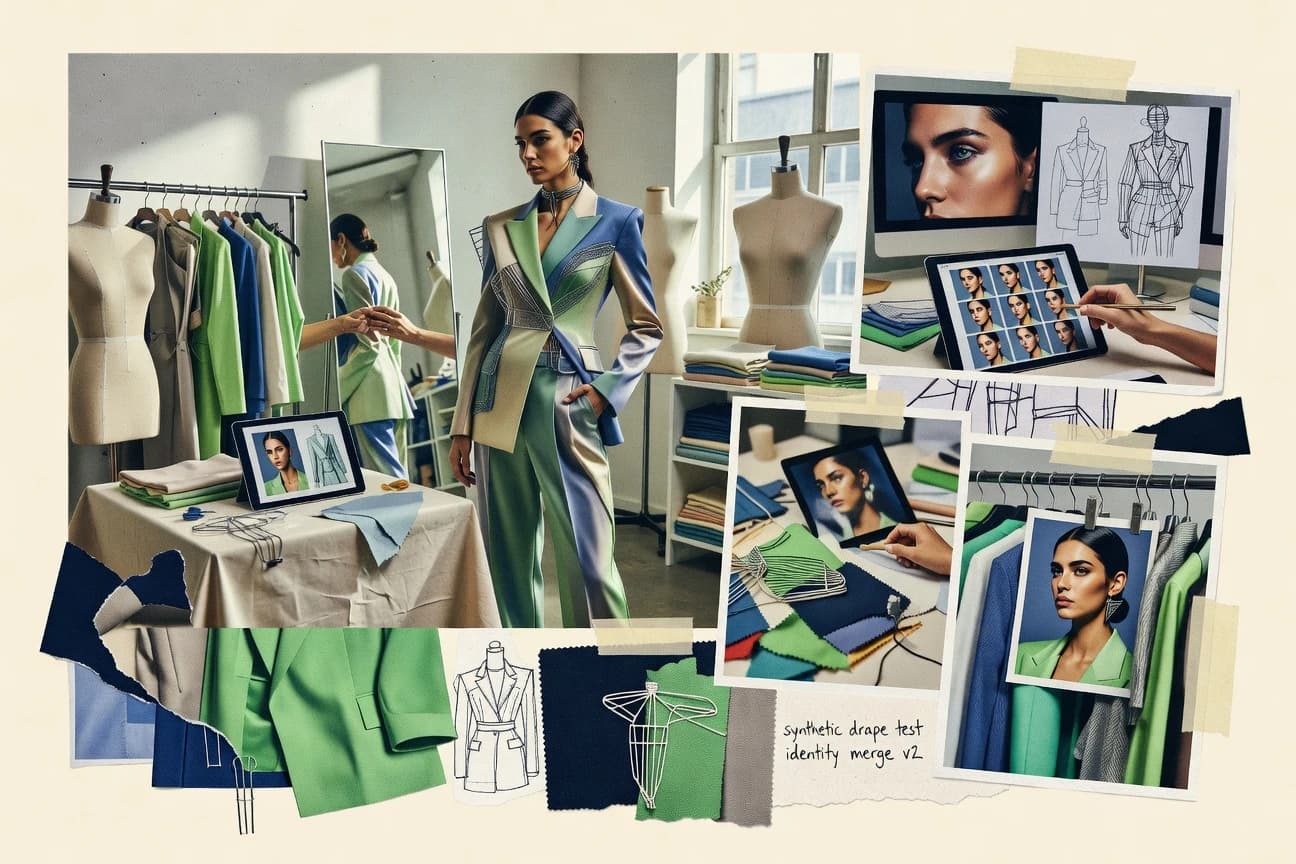
AI fashion photography and videoRAWSHOT AI creates original on-model fashion photos and short videos from real garments using selectable models, styling, backgrounds, lighting, poses and camera compositions.
RAWSHOT AI turns a fashion shoot into seven selectable blocks instead of an empty text field, then lets users save the complete setup as a Stack. The same block logic carries from still images to video, while the orchestration layer keeps selections consistent across a catalogue.
RAWSHOT AI combines a seven-step photoshoot flow with more than 1,800 licence-free synthetic models, including more than 600 children's models; no child was cast, photographed, or used as a likeness reference. Users can build private models from a published attribute set, combine up to four garments, select frames, views, poses, expressions and makeup, then save the configuration for repeatable catalogue production. Still images are available in 2K and 4K, while short videos support up to three five-second scenes at 720p or 1080p.
The tradeoff is a fixed option-based workflow: teams cannot enter free text, request a specific real person, or apply a collection of visual filters inside the product. That limitation is useful for DTC brands preparing 10–200 SKU drops, because saved Stacks and wardrobe management help maintain consistent treatment across many products. Browser and REST API access have full parity, supporting single generations through runs of more than 10,000 images.
- +Full commercial rights forever, with no recurring licensing on library models.
- +More than 1,800 synthetic models, including more than 600 children's models; no child was cast, photographed, or used as a likeness reference.
- +Saved Stacks provide repeatable catalogue treatments across large product collections.
- +C2PA content credentials, layered watermarking and per-image attribute documentation are included on outputs.
- –Users cannot improvise beyond the available blocks because there is no free-text input.
- –The product ships one garment-focused image style, so stylised or graded treatments require post-production.
- –The model inventory contains synthetic composites only and cannot recreate a specific real person.
Emerging fashion labels
Launch collections without physical samples
Earlier collection merchandising
DTC apparel retailers
Produce imagery across 200 SKUs
Consistent catalogue presentation
Show 2 more scenarios
Marketplace sellers
Prepare listing images for apparel
Faster listing preparation
RAWSHOT AI generates multiple catalogue-oriented compositions for garments destined for online marketplaces.
Compliance-sensitive fashion brands
Publish labelled synthetic-model imagery
Traceable campaign assets
C2PA credentials, watermarking and detailed output records support transparent use of synthetic models in apparel marketing.
Best for: RAWSHOT AI is best for emerging labels, DTC retailers, marketplaces and apparel operators needing consistent on-model imagery across repeated product launches.
Fotor
SMBPhoto editing suite that includes an AI face and person image generator.
AI Face Generator paired with Fotor’s portrait editor supports prompt-to-retouch workflows in one browser workspace.
Fotor’s AI Face Generator accepts text prompts for age, gender presentation, hairstyle, clothing, mood, and background direction. AI Headshot and AI Avatar workflows provide preset routes for professional portraits and stylized profile images. Photorealistic output suits profile imagery, fictional characters, social content, and concept development.
The browser workflow favors fast visual iteration over detailed production control. Pose, camera angle, seed reuse, and repeatable character settings receive less emphasis than prompt-based creation. Social teams can generate a fictional profile portrait, remove its background, retouch the face, and prepare it for publication in one workspace.
- +Text prompts generate fictional human portraits without requiring a source photograph
- +AI Headshot and AI Avatar modes cover professional and stylized profile imagery
- +Built-in retouching and background removal support post-generation editing
- +Face swap adds alternate portrait and creative composition workflows
- –Pose and camera controls are limited compared with dedicated portrait generators
- –Repeatable seed and character-locking controls are not prominent
- –High-detail results may require manual retouching around hair, hands, and accessories
Social media teams
Create fictional campaign characters
Faster campaign asset production
Independent creators
Produce profile and avatar images
Ready-to-publish profile assets
Show 1 more scenario
Marketing designers
Build persona concept boards
Broader visual persona coverage
Designers generate varied faces and edit clothing, backgrounds, and retouching for presentation concepts.
Best for: Fits when creators need fictional portraits with immediate editing for social profiles, campaigns, and concept work.
Generated.photos
specialistLibrary and generator of AI-created photos of people who do not exist.
Attribute-based face generation combines granular portrait controls with downloadable assets and an integrated developer API.
Generated.photos fits design teams, researchers, and developers that need realistic human portraits without arranging photography. Its browser tools provide structured controls instead of relying only on text prompts, while its API supports automated image requests inside applications and content workflows. The service also offers a human generator for broader character compositions beyond isolated headshots.
The main tradeoff is narrower scene control than general image models, since the strongest workflow centers on faces and preset attributes. Generated.photos works well for prototype profiles, synthetic user records, advertising mockups, and training interfaces that require varied portraits without using real people's likenesses.
- +Attribute filters provide direct control over age, expression, pose, hair, and appearance.
- +A dedicated API supports automated portrait generation inside applications and content pipelines.
- +Downloadable portraits suit prototypes, mockups, profile placeholders, and synthetic datasets.
- +The human generator extends coverage beyond individual headshots.
- –Scene composition and detailed body posing remain more limited than general image generators.
- –Fine-grained identity locking is not the central workflow for repeated character production.
- –Generated portraits can require manual selection when exact visual attributes matter.
- –Governance features such as audit logs and role controls receive limited emphasis.
Product design teams
Populate prototype user profiles
More realistic interface prototypes
Marketing production teams
Create campaign portrait variations
Faster concept iteration
Show 2 more scenarios
Application developers
Automate profile image creation
Automated synthetic profiles
Developers connect the API to onboarding, testing, or demo workflows that need generated user portraits.
Research data teams
Build diverse portrait datasets
Broader test coverage
Researchers assemble labeled image collections using controlled demographic and visual attributes for testing computer vision systems.
Best for: Fits when teams need controllable synthetic portraits for product design, content production, or API-based image workflows.
Ideogram
generalText-to-image generator with strong rendering of people and integrated typography.
Prompt-guided composition control keeps face, lighting, and pose aligned across rapid iterations.
Ideogram turns text prompts into images with an emphasis on consistent, production-ready visual concepts rather than purely exploratory drafts. It supports iterative generation with prompt refinement, seed control, and style guidance to keep outputs aligned with the requested human look.
The workflow favors fast portrait generation and batch creation for teams that need many variations with predictable composition. Its core strength for AI real person generation is managing prompt adherence to faces, lighting, and scene framing in a single interaction loop.
- +High prompt adherence for faces, lighting, and scene framing
- +Seed reproducibility supports versioning of near-identical outputs
- +Batch generation fits production runs for portrait variations
- +Iterative prompt refinement reduces rework for human images
- –Identity locking is limited for long-running character continuity
- –More complex full-body control needs multiple prompt iterations
Best for: Fits when teams need consistent portrait images with repeatable variations for briefs, mockups, or content pipelines.
Perchance
specialistFree community-driven platform hosting multiple AI person and face generators.
The editable community generator ecosystem lets users publish custom portrait workflows instead of using only a fixed image form.
Perchance generates prompt-based portraits through a browser interface with no account required for standard use. Its distinct feature is an open generator ecosystem where users can create, edit, and share custom pages instead of relying on one fixed portrait workflow.
The AI Image Generator supports text prompts, negative prompts, image dimensions, and downloadable results. Output consistency and fine-grained identity controls remain limited.
- +Browser-based generation works without mandatory account creation.
- +Custom generator pages support reusable prompts and community sharing.
- +Negative prompts provide direct control over unwanted visual elements.
- +Simple controls make portrait generation accessible to casual users.
- –Identity locking is unavailable for maintaining one person across generations.
- –Output quality varies between community generators and prompt configurations.
- –No documented native API supports automated batch portrait generation.
- –Advanced pose and facial control remain limited.
Best for: Fits when users need quick browser-based portraits and customizable community generators without an integration-heavy workflow.
Leonardo.ai
generalGenerative AI platform with fine-tuned models for photorealistic character art.
Identity-oriented generation controls that keep face appearance closer across variations in a batch.
Leonardo.ai is a diffusion-based image generator aimed at creating photorealistic human portraits from text prompts with repeatable controls. It supports identity-oriented workflows such as character consistency and face-focused generation settings, which help reduce drift across a batch.
The interface is designed for quick iteration with seed-based reproducibility and prompt refinement loops that target skin texture fidelity and lighting consistency. It also exposes creation as an API-style workflow for automation, including parameterized runs and high-volume generation.
- +Strong prompt-to-portrait fidelity for realistic skin texture and lighting
- +Identity-focused workflows reduce face drift across multi-image sets
- +Seed reproducibility supports consistent iteration for art direction
- +Automation-friendly generation flow supports batch creation
- –Identity consistency weakens on extreme pose or full-body prompts
- –Some advanced controls require prompt and settings tuning
- –Artifacts can appear around hair edges and fine facial details
- –High throughput generation can hit resolution ceiling constraints
Best for: Fits when teams need repeatable photoreal portrait generation with identity consistency for marketing and concepting.
Stability AI
API-firstMaker of Stable Diffusion models capable of photorealistic human generation.
Open Stable Diffusion checkpoints let teams customize model behavior, inference infrastructure, and portrait-generation workflows beyond a fixed web interface.
Stability AI combines open Stable Diffusion model weights with a hosted image API, giving developers more deployment control than dedicated avatar applications. Stable Image supports text-to-image generation, image-to-image editing, inpainting, outpainting, upscaling, and prompt-driven portrait creation.
Photorealistic output is attainable, but repeatable identity consistency requires careful prompting, image references, seeds, and post-processing. The product suits teams building custom portrait workflows rather than users seeking a polished real-person generator with built-in profile management.
- +Open model weights support self-hosting, fine-tuning, and custom inference pipelines.
- +Stable Image API covers generation, editing, inpainting, outpainting, and upscaling.
- +ControlNet integrations provide more precise pose, composition, and edge guidance.
- +Large community ecosystem supplies checkpoints, extensions, workflows, and implementation examples.
- –Stable Diffusion outputs can show inconsistent facial identity across separate generations.
- –The API and open-model routes require more engineering than dedicated avatar interfaces.
- –Safety, consent, and synthetic identity controls depend heavily on the deployment team.
- –Model selection and checkpoint compatibility can complicate production standardization.
Best for: Fits when developers need customizable portrait generation with API access, self-hosting options, and control over inference workflows.
Rosebud AI
specialistAI platform for generating visual assets including photorealistic people and characters.
Seed reproducibility with prompt iteration control reduces facial drift during batch generation runs.
Rosebud AI is an AI real person image generator focused on producing human portraits from text prompts with consistent facial identity cues. The workflow centers on prompt-to-image generation plus iteration controls like seeds and refinements to reduce prompt drift across batches.
It also supports image-to-prompt style generation so existing likeness can inform the next variations. Integration options are available through an API surface designed for programmatic batch creation and automated production pipelines.
- +Seed-based variation makes outputs easier to reproduce and iterate
- +Image-to-prompt flow helps carry a reference likeness into new renders
- +Prompt refinements reduce drift during multi-image batch runs
- +API supports automated generation for high-volume portrait production
- –Identity consistency is limited when inputs conflict or prompts are underspecified
- –Full-body generation and strict pose control are weaker than portrait-focused results
- –Artifact suppression varies across lighting and skin-texture heavy prompts
- –Deep governance controls like RBAC and detailed audit logs are not clear
Best for: Fits when teams need repeatable portrait generation via prompts and seeds, plus automated batch output through an API.
Picsart
SMBCreative platform offering AI-generated portraits and people images.
Prompt-driven generation combined with in-editor refinement tools for rapid portrait iterations.
Picsart turns text prompts into AI-generated human images inside its editor and generation workflow. It supports portrait-focused creation with style controls, background handling, and iterative prompting for closer alignment to the target look.
The identity-consistency workflow is geared toward editing and refinements rather than strict identity locking across many sessions. Automation is mainly driven through generation flows inside the product UI, with limited evidence of a first-party API for programmatic batch identity generation.
- +Integrated prompt-to-image generation inside a full photo editor workflow
- +Style and composition controls help converge faster than prompt-only tools
- +Strong handling of portrait crops with consistent framing and backgrounds
- +Iteration loop supports quick revisions for prompt adherence
- –Identity consistency is limited when reusing the same person across long projects
- –Batch generation and seed reproducibility options are not clearly exposed for automation
- –Fine pose and gaze direction control is less granular than specialized generators
- –No clearly documented API surface for external orchestration or on-prem inference
Best for: Fits when creators need fast portrait-style human images and iterative edits in one workspace.
Midjourney
generalText-to-image model renowned for highly photorealistic human renders.
Omni Reference carries a selected person or object into new Midjourney scenes and compositions.
Midjourney serves designers and marketers who need polished synthetic portraits for concepts, campaigns, and editorial mockups. Its web app and Discord bot generate images from text prompts, image references, style references, and remix controls. Midjourney produces strong photorealistic output, but it lacks a dedicated identity workflow, official API generation, and reliable control over a person across many images.
- +Produces detailed portrait lighting, skin textures, clothing, and environments from short prompts.
- +Omni Reference places a selected person or object into new compositions.
- +Web and Discord interfaces support prompt history, remixing, and image variations.
- –Identity consistency weakens across poses, expressions, outfits, and camera angles.
- –No official public API supports automated image generation workflows.
- –Text rendering, hands, jewelry, and small facial details can require repeated generations.
- –Limited controls exist for exact age, anatomy, gaze direction, and facial geometry.
Best for: Fits when creative teams need visually convincing portrait concepts without dependable identity continuity or programmatic generation.
Conclusion
After evaluating 10 fashion apparel, RAWSHOT AI stands out as our overall top pick — it scored highest across our combined criteria of features, ease of use, and value, which is why it sits at #1 in the rankings above.
Use the comparison table and detailed reviews above to validate the fit against your own requirements before committing to a tool.
Tools reviewed
Primary sources checked during evaluation.
Referenced in the comparison table and product reviews above.
How to Choose the Right ai real person generator
This buyer’s guide covers RAWSHOT AI, Fotor, Generated.photos, Ideogram, Perchance, Leonardo.ai, Stability AI, Rosebud AI, Picsart, and Midjourney for teams and creators generating realistic human portraits from prompts.
The tool set spans fashion and product catalog workflows in RAWSHOT AI, prompt-to-retouch portrait editing in Fotor, and developer-oriented automation via Generated.photos and Stability AI.
The selection criteria prioritize how each ai real person generator handles repeatability, identity continuity, and integration surfaces like API-based generation.
What an ai real person generator does for photorealistic portrait and identity consistency
An ai real person generator creates photorealistic human images from text prompts, with some tools adding repeatable controls such as seed reproducibility and prompt-guided composition constraints. Ideogram focuses on prompt adherence that keeps face, lighting, and scene framing aligned across iterations with seed reproducibility for versioning.
For integration and workflow automation, Generated.photos combines attribute-based face generation with a dedicated developer API so teams can batch synthetic portraits inside applications and content pipelines. RAWSHOT AI targets commercial production by turning a fashion shoot into selectable blocks that users save as a Stack and reuse consistently across a catalogue, with the same block orchestration carried into video generation.
Evaluation criteria for realistic human image generators
Repeatable output matters for campaigns that reuse one visual identity across multiple portraits, poses, or product launches. Ideogram, Leonardo.ai, and Rosebud AI provide different controls for carrying visual traits between generations.
Integration depth separates browser-only tools from systems that can run inside production workflows. Generated.photos and Stability AI provide developer paths, while RAWSHOT AI and Fotor concentrate on structured or editor-based creation.
Identity continuity and repeatable variations
Leonardo.ai uses identity-oriented controls to reduce face drift across batches, while Ideogram combines seed reproducibility with prompt-guided control for near-identical portrait iterations.
API and automation surface
Generated.photos provides an API for automated attribute-based portrait generation, and Stability AI supports API workflows for generation, editing, inpainting, outpainting, and upscaling.
Structured production workflows
RAWSHOT AI replaces an empty prompt field with seven selectable fashion-shoot blocks and saves the full configuration as a reusable Stack. Fotor combines fictional portrait generation, AI Headshot, AI Avatar, and browser-based retouching in one workspace.
Customization and community workflow design
Stability AI supports self-hosting, fine-tuning, and custom inference pipelines through open Stable Diffusion checkpoints. Perchance lets users publish editable community generators with reusable prompts.
Reference-based scene transfer
Rosebud AI uses image-to-prompt processing to carry a reference likeness into new renders, while Midjourney's Omni Reference places a selected person or object into new scenes and compositions.
How to choose an AI real person generator by workflow architecture
The first decision is the production model. RAWSHOT AI serves repeatable apparel catalogues through fixed blocks and Stacks, while Fotor, Picsart, and Midjourney give creators more open-ended prompt and editing workflows.
The second decision is operational control. Generated.photos and Stability AI suit application pipelines and custom infrastructure, while Perchance, Fotor, and Picsart prioritize direct browser use with less engineering.
Choose structured catalogue production or freeform creation
Select RAWSHOT AI when garment launches need the same selectable shoot configuration across many products. Select Fotor, Picsart, or Midjourney when each portrait can use a different prompt, edit, visual style, or scene.
Choose an API pipeline or a browser workspace
Use Generated.photos for attribute-driven portraits inside an application and Stability AI for custom inference or self-hosted deployments. Use Perchance, Fotor, or Picsart when people need immediate browser generation without an integration project.
Set the required level of character continuity
Use Leonardo.ai when a batch must keep facial appearance closer across variations, or use Ideogram when prompt and seed control matter more than long-running character identity. Avoid Midjourney and Perchance for projects that require one person to remain consistent across many poses and outfits.
Decide how much post-generation editing belongs in the same tool
Choose Fotor or Picsart when portrait generation and photo editing need to share one browser workspace. Choose RAWSHOT AI when the primary requirement is consistent on-model apparel imagery rather than broad retouching or compositing.
Choose managed controls or model-level customization
Choose Stability AI when teams need open checkpoints, fine-tuning, self-hosting, and control over inference infrastructure. Choose Generated.photos when a managed portrait API with direct attribute filters is more useful than maintaining model infrastructure.
Audience segments for AI-generated real person imagery
Different tools serve different production constraints. RAWSHOT AI addresses recurring apparel catalogues, while Generated.photos and Stability AI address application and infrastructure requirements.
Creative teams may prioritize editing, references, or visual iteration over automation. Fotor, Picsart, Midjourney, and Rosebud AI place those controls closer to the creation workspace.
Apparel brands and online marketplaces
RAWSHOT AI supports repeated garment launches with seven shoot blocks, reusable Stacks, and more than 1,800 synthetic models. Its workflow carries the same block logic from still images into video.
Product teams and developers embedding synthetic portraits
Generated.photos supplies attribute filters for age, expression, pose, hair, and appearance through a dedicated developer API. Stability AI adds self-hosting, fine-tuning, and custom inference options.
Social, campaign, and profile-content creators
Fotor combines fictional portrait creation with AI Headshot, AI Avatar, and immediate retouching. Picsart adds prompt-driven image generation to a broader photo-editing workspace.
Concept artists and visual direction teams
Midjourney creates detailed portraits with clothing, lighting, and environments from short prompts. Ideogram supports rapid composition iterations with repeatable seeds for related mockups.
Common mistakes in selecting a real person image generator
A convincing single portrait does not prove that a tool can maintain the same character across a campaign. Leonardo.ai, Ideogram, Rosebud AI, and Midjourney differ substantially in how they carry facial traits between outputs.
Workflow fit also depends on control depth and delivery method. Stability AI requires more engineering than a dedicated avatar interface, while RAWSHOT AI limits improvisation by design through its block-based system.
Choosing a tool from one attractive sample image
Test the same subject across poses, expressions, outfits, and camera angles. Midjourney and Perchance can produce convincing individual portraits but do not maintain one person reliably across long projects.
Treating a prompt editor as an automation platform
Use Generated.photos for an application-facing portrait API or Stability AI for custom pipelines. Fotor and Picsart keep generation inside browser editors and do not present the same integration depth.
Expecting open-ended prompting from RAWSHOT AI
RAWSHOT AI uses seven selectable blocks instead of free-text input. That constraint supports consistent apparel production but limits improvised scenes and requires post-production for stylized treatments.
Assuming reference transfer equals permanent identity continuity
Rosebud AI carries a reference likeness through image-to-prompt processing, and Midjourney uses Omni Reference for new compositions. Both still require testing across difficult poses, clothing changes, and camera angles.
How We Selected and Ranked These Tools
We evaluated RAWSHOT AI, Fotor, Generated.photos, Ideogram, Perchance, Leonardo.ai, Stability AI, Rosebud AI, Picsart, and Midjourney for portrait quality, repeatability, workflow controls, editing, and integration surfaces. Features accounted for 40% of each score, while ease of use and value accounted for 30% each.
RAWSHOT AI ranked first because its seven-block fashion workflow, reusable Stacks, synthetic model library, and still-to-video orchestration address repeated commercial production with clear operational controls. We also considered API access, self-hosting, developer workflows, and the practical limits of identity continuity across varied poses and scenes.
Frequently Asked Questions About ai real person generator
Which AI real person generator is best for repeatable synthetic portraits?
How do developers integrate AI real person generation into an application?
What tradeoff separates open model workflows from browser-based portrait generators?
When should an apparel team choose a fashion-specific generator instead of a general portrait tool?
What happens when a generated person must remain recognizable across many images?
Can teams move existing portrait assets and workflows between these tools?
Which tools offer extensibility beyond a fixed image-generation form?
What security and consent checks should teams apply before using generated people commercially?
- Fashion ApparelTop 10 Best AI Persona Generator of 2026
- Fashion ApparelTop 10 Best AI Natural Light Studio Photography Generator of 2026
- Fashion ApparelTop 10 Best AI Photorealistic Generator of 2026
- Fashion ApparelTop 10 Best AI Image Character Generator of 2026
- Fashion ApparelTop 10 Best AI Plus Size Fashion Model Generator of 2026
Keep exploring
Comparing two specific tools?
Software Alternatives
See head-to-head software comparisons with feature breakdowns, pricing, and our recommendation for each use case.
Explore software alternatives→In this category
Fashion Apparel alternatives
See side-by-side comparisons of fashion apparel tools and pick the right one for your stack.
Compare fashion apparel tools→