
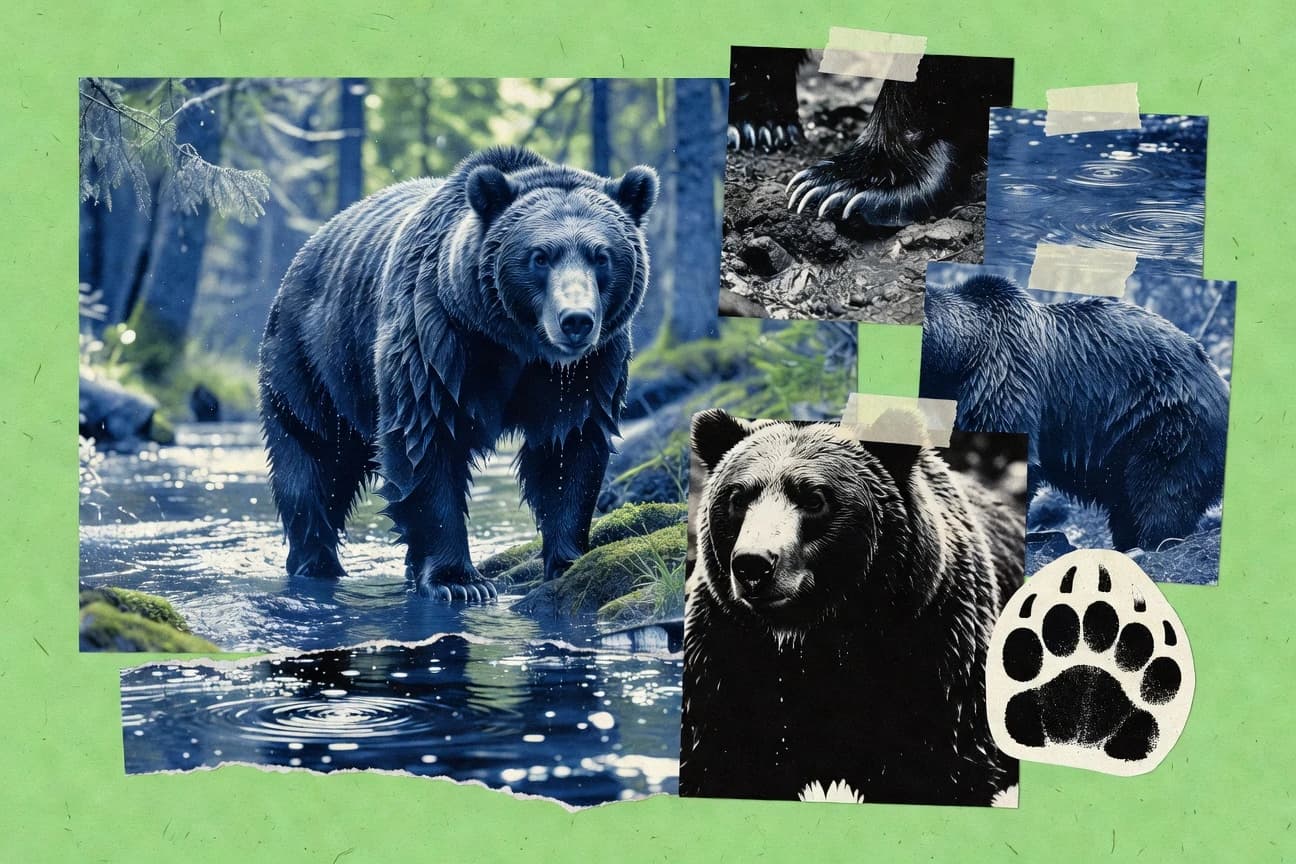

Bear populations stretch from North America’s forests to the Arctic Circle, but each species faces different pressures. Grizzlies in the contiguous U.S. number about 1,800, while polar bears total around 26,000 across 19 subpopulations and are vulnerable as sea ice shrinks. Explore how foods—from seasonal plants and salmon to high-fat prey—intersect with breeding timing, cub survival, and changing habitats.
Key Takeaways
- Grizzly bear populations in the lower 48 states listed as threatened under ESA since 1975.
- Global brown bear population stable at ~200,000, but subspecies like grizzly down to 180,000.
- Polar bears classified Vulnerable by IUCN, with 8 of 19 subpopulations declining due to sea ice loss.
- Grizzly bears are omnivores, with diet 90% plant matter including berries, roots, and grasses in summer.
- During hyperphagia, grizzlies consume up to 90 pounds (41 kg) of food daily to gain fat for hibernation.
- Salmon provides 50-80% of caloric intake for coastal grizzlies in late summer and fall.
- Brown bears inhabit North America, Europe, and Asia, with a total population estimated at 200,000 individuals.
- Grizzly bears in the contiguous U.S. are found primarily in Alaska, Montana, Wyoming, and Idaho, numbering about 1,800.
- Polar bears range across the Arctic Circle in 19 subpopulations, totaling around 26,000 individuals.
- The average adult male grizzly bear weighs between 400 to 790 pounds (180 to 360 kg), with some individuals reaching up to 1,500 pounds (680 kg) during hyperphagia in fall.
- Female grizzly bears typically weigh 290 to 440 pounds (130 to 200 kg), but can reach 800 pounds (360 kg) when pregnant.
- Grizzly bears stand 3.3 to 4.1 feet (1 to 1.3 meters) at the shoulder and up to 8 feet (2.4 meters) tall when standing on hind legs.
- Female grizzly bears reach sexual maturity at 4-6 years, males at 5-7 years.
- Grizzlies breed in May-July, with delayed implantation; cubs born January-February in dens.
- Litter size for grizzlies is 1-4 cubs, average 2, weighing 1-1.5 pounds at birth.
Grizzlies rely on rich seasonal food, yet polar bears face sea ice loss and major declines.
Related reading
01 · Category
Conservation And Threats21 stats
01
Grizzly bear populations in the lower 48 states listed as threatened under ESA since 1975.
02
Global brown bear population stable at ~200,000, but subspecies like grizzly down to 180,000.
03
Polar bears classified Vulnerable by IUCN, with 8 of 19 subpopulations declining due to sea ice loss.
04
Projected 30% polar bear decline by 2050 under moderate warming scenarios.
05
American black bears Least Concern, population increasing due to habitat recovery and hunting management.
06
Asiatic black bear Vulnerable, populations reduced 30-50% last 30 years from poaching and habitat loss.
07
Sloth bear Vulnerable, hunted for body parts and habitat converted to agriculture.
08
Sun bear Vulnerable, threatened by deforestation and pet trade capturing 1,000+ annually.
09
Giant panda population increased from 1,114 in 2014 to 1,864 in 2014 wild census, now Vulnerable.
10
Spectacled bear Vulnerable, with 18,000-28,000 left, threatened by cattle ranching conflicts.
11
Grizzly recovery goal in Yellowstone: 700 bears, currently ~700 achieved in 2023.
12
Climate change reduces whitebark pine, key food, threatening 20% grizzly mortality.
13
Polar bears face nutritional stress, body condition declined 12% in some subpopulations since 1980s.
14
Black bear-human conflicts rise 20% yearly in some states due to attractants.
15
Asiatic black bear poaching for bile used in TCM, gallbladders worth $500-1,000 each.
16
Sloth bear capture for dancing cruel trade affects 50% females with cubs.
17
Sun bears in bile farms number 1,000-5,000 in Southeast Asia.
18
Panda habitat expanded by 11.8% through 1.2 million acres of reserves in China.
19
Spectacled bear electrocution on fences kills 10-20% of individuals annually in Venezuela.
20
Roadkill accounts for 15% of grizzly mortalities in Canadian Rockies.
21
Vehicle collisions kill ~300,000 black bears globally per year.
Interpretation
Conservation And Threats Interpretation
Conservation and threats for bears are moving in starkly different directions, with polar bears projected to decline by about 30% by 2050 as 8 of 19 subpopulations fall from sea ice loss, while American black bears are increasing and Asiatic black bears have already lost 30 to 50% of their population over the past 30 years.
02 · Category
Diet And Foraging23 stats
01
Grizzly bears are omnivores, with diet 90% plant matter including berries, roots, and grasses in summer.
02
During hyperphagia, grizzlies consume up to 90 pounds (41 kg) of food daily to gain fat for hibernation.
03
Salmon provides 50-80% of caloric intake for coastal grizzlies in late summer and fall.
04
Army cutworm moths are a high-fat food source, with bears eating up to 40,000 moths per day in alpine areas.
05
Polar bears primarily eat ringed and bearded seals, consuming 100 pounds (45 kg) of fat per seal.
06
Polar bears can survive months without eating, relying on fat reserves during summer fasting.
07
Black bears eat 5,000-8,000 calories daily in fall, focusing on acorns, huckleberries, and nuts.
08
Black bears raid bird feeders and garbage, but natural diet includes 85% vegetation like skunk cabbage.
09
Asiatic black bears consume 30% insects, including termites, and 70% fruits like figs and persimmons.
10
Sloth bears specialize in insects, sucking up 50,000 termites and ants daily using gap-toothed mouths.
11
Sun bears eat honey, bees, small vertebrates, and fruits, using long tongues up to 10 inches (25 cm).
12
Giant pandas eat 20-40 pounds (9-18 kg) of bamboo shoots daily, comprising 99% of their diet.
13
Pandas have a pseudo-thumb for gripping bamboo, digesting only 17% due to carnivore gut adaptation.
14
Spectacled bears eat 30% bromeliads, cacti fruits, and 70% animal matter like deer and birds.
15
Brown bears scavenge whale carcasses, gaining thousands of calories from blubber in coastal areas.
16
Grizzlies dig whitebark pine nuts, a key food providing 3,300 calories per pound.
17
Polar bears hunt by still-hunting at breathing holes, success rate 20-30% per stalk.
18
Black bears forage nuts from beech trees, which can produce 1,000 pounds per tree in mast years.
19
Asiatic black bears raid cornfields and apiaries, leading to human conflicts.
20
Sloth bears eat Solanum fruits and honey, traveling 6 miles daily for food.
21
Sun bears consume 100+ plant species and palm civets in Borneo forests.
22
Pandas switch bamboo parts seasonally: leaves in summer (91% nutrition), stems in winter.
23
Spectacled bears cache food in trees and eat livestock when natural foods scarce.
Interpretation
Diet And Foraging Interpretation
Across Bear species, diet and foraging strategies center on huge seasonal fat buildup and calorie-rich prey, from grizzlies eating up to 90 pounds of food per day during hyperphagia and getting 50 to 80 percent of their calories from salmon to polar bears relying on fat by consuming about 100 pounds of seal fat per seal and then fasting for months.
03 · Category
Habitat And Range20 stats
01
Brown bears inhabit North America, Europe, and Asia, with a total population estimated at 200,000 individuals.
02
Grizzly bears in the contiguous U.S. are found primarily in Alaska, Montana, Wyoming, and Idaho, numbering about 1,800.
03
Polar bears range across the Arctic Circle in 19 subpopulations, totaling around 26,000 individuals.
04
American black bears occupy forests across North America, from Alaska to Mexico, with 800,000-900,000 in the U.S.
05
Asiatic black bears live in forests from southeastern Iran to Japan, with populations fragmented and declining.
06
Sloth bears are native to the Indian subcontinent, inhabiting forests and grasslands in India, Sri Lanka, Nepal, Bhutan.
07
Sun bears inhabit tropical forests of Southeast Asia, from eastern India to Sumatra, at elevations up to 6,500 feet.
08
Giant pandas are endemic to bamboo forests in central China, specifically Sichuan, Shaanxi, and Gansu provinces.
09
Spectacled bears range from Venezuela to Bolivia in the Andes, preferring cloud forests at 1,000-15,000 feet elevation.
10
Kamchatka brown bears in Russia number over 18,000 and inhabit coastal areas rich in salmon.
11
Kodiak bears are isolated to Kodiak Archipelago, Alaska, with a population of about 3,500 individuals.
12
Grizzlies prefer alpine meadows, subalpine forests, and river valleys in Yellowstone ecosystem.
13
Polar bears den on sea ice or coastal land in winter, migrating with ice packs annually.
14
Black bears den in hollow trees, caves, or brush piles during hibernation from October to April.
15
Asiatic black bears range up to 12,000 feet in the Himalayas, preferring dense oak forests.
16
Sloth bears forage in dry deciduous forests and scrublands, avoiding dense evergreen areas.
17
Sun bears are arboreal, living in lowland dipterocarp forests threatened by logging.
18
Pandas require 3,000-5,000 square miles of habitat for viable populations due to bamboo dependency.
19
Spectacled bears use Andean páramo and montane forests, traveling up to 12 miles daily.
20
Grizzly bears in coastal Alaska forage in estuaries with sedges and spawning salmon runs.
Interpretation
Habitat And Range Interpretation
Across the Habitat and Range category, bears span multiple continents yet many populations remain relatively small and regionally concentrated, from about 1,800 grizzly bears mostly in Alaska, Montana, Wyoming, and Idaho to roughly 26,000 polar bears across 19 Arctic subpopulations.
04 · Category
Physical Attributes20 stats
01
The average adult male grizzly bear weighs between 400 to 790 pounds (180 to 360 kg), with some individuals reaching up to 1,500 pounds (680 kg) during hyperphagia in fall.
02
Female grizzly bears typically weigh 290 to 440 pounds (130 to 200 kg), but can reach 800 pounds (360 kg) when pregnant.
03
Grizzly bears stand 3.3 to 4.1 feet (1 to 1.3 meters) at the shoulder and up to 8 feet (2.4 meters) tall when standing on hind legs.
04
The hump on a grizzly bear's shoulders is composed of dense muscle that powers their powerful forelimbs for digging.
05
Grizzly bears have concave facial profiles, long curved claws up to 4 inches (10 cm) long, and rounded ears.
06
Polar bears have black skin under white fur, which absorbs heat, and their fur consists of a dense undercoat and long guard hairs.
07
Male polar bears average 900 to 1,600 pounds (410 to 726 kg), while females average 330 to 650 pounds (150 to 295 kg).
08
Polar bears have 42 teeth, including sharp canines for tearing meat and molars for crushing bone.
09
The average black bear weighs 130 to 660 pounds (60 to 300 kg), with males larger than females.
10
American black bears have straight facial profiles and shorter claws than grizzlies, measuring about 2 inches (5 cm).
11
Asiatic black bears have a distinctive white V-shaped chest mark and weigh 220 to 440 pounds (100 to 200 kg).
12
Sloth bears have shaggy black fur, a light muzzle, and weigh 200 to 320 pounds (90 to 145 kg).
13
Sun bears are the smallest bears, weighing 60 to 150 pounds (27 to 65 kg) with short black fur and a yellow chest crescent.
14
Panda bears have distinctive black-and-white markings and weigh up to 250 pounds (113 kg) for males.
15
Spectacled bears have light facial markings resembling glasses and weigh 130 to 340 pounds (59 to 154 kg).
16
Grizzly bears can run up to 35 miles per hour (56 km/h) in short bursts.
17
Polar bears have a bite force of around 1,200 pounds per square inch (psi).
18
Black bears can climb trees at speeds up to 15 feet per second when young.
19
Brown bears have a sense of smell 7 times more powerful than a bloodhound's, detecting food up to 20 miles away.
20
Grizzly bear claws are longer than a grizzly's paw is wide, aiding in digging and catching salmon.
Interpretation
Physical Attributes Interpretation
Within the Physical Attributes category, grizzly bears show clear sexual and size variation, with adult males typically weighing 400 to 790 pounds while females usually range from 290 to 440 pounds, yet both can be far larger at extremes such as males up to about 1,500 pounds and females up to around 800 pounds when pregnant.
05 · Category
Reproduction And Life Cycle25 stats
01
Female grizzly bears reach sexual maturity at 4-6 years, males at 5-7 years.
02
Grizzlies breed in May-July, with delayed implantation; cubs born January-February in dens.
03
Litter size for grizzlies is 1-4 cubs, average 2, weighing 1-1.5 pounds at birth.
04
Grizzly cubs stay with mother 2-3 years, learning foraging before dispersing.
05
Grizzly females produce litters every 2-4 years if food abundant.
06
Polar bear females mature at 4-6 years, breed every 3 years, denning 4-8 months pregnant.
07
Polar bear litters average 1-3 cubs, born weighing 1-2 pounds (0.45-0.9 kg) blind and hairless.
08
Polar cubs emerge from dens at 10-15 weeks, weighing 20-25 pounds (9-11 kg).
09
Black bears first breed at 3-5 years, litters every 1.5-2 years in good habitat.
10
Black bear cubs number 1-6, average 3, born in January while mother hibernates.
11
Asiatic black bear females give birth to 1-3 cubs every 2 years after maturity at 4-5 years.
12
Sloth bear gestation is 6-7 months, litters 1-3 cubs, with males not participating in rearing.
13
Sun bears breed year-round, litters 1-2 cubs, cubs independent at 18 months.
14
Giant panda twins occur in 5% of births, but usually only one survives due to maternal care limits.
15
Pandas mate March-May, cubs born August-September weighing 3-4 ounces (90-113 g).
16
Spectacled bears breed year-round, gestation 215-240 days with delayed implantation, litters 1-2.
17
Brown bear lifespan in wild is 20-25 years, up to 30; in captivity 35+ years.
18
Grizzly males may kill cubs to bring female into estrus, infanticide observed in 20-30% cases.
19
Polar bears have 50-60% cub survival to year 2, dependent on sea ice conditions.
20
Black bears live 12-15 years in wild, females can produce 10-12 litters lifetime.
21
Asiatic black bears have home ranges 10-50 square miles, males larger than females.
22
Sloth bears carry cubs on back until 9-12 months old.
23
Sun bear cubs nurse 18 months, mothers aggressive protecting them up to 3 years.
24
Panda cubs stay with mother 18 months, reaching 100 pounds (45 kg) at independence.
25
Spectacled bear females with cubs have 30% larger home ranges for foraging.
Interpretation
Reproduction And Life Cycle Interpretation
Across both grizzlies and polar bears, reproduction follows a spaced, seasonally timed cycle in which females typically reach sexual maturity around 4 to 6 years and produce litters infrequently, with grizzlies breeding in May to July but giving birth in January to February and polar bears denning for 4 to 8 months after breeding every 3 years.
report visual · Key figures
Bear species: vulnerability and population signals
Across bear species, many populations face measurable declines or pressures from habitat loss, poaching, and climate-driven changes.
8
Polar bears classified Vulnerable by IUCN, with 8 of 19 subpopulations declining due to sea ice loss.
30%
Projected 30% polar bear decline by 2050 under moderate warming scenarios.
-50%
Asiatic black bear Vulnerable, populations reduced 30-50% last 30 years from poaching and habitat loss.
20%
Climate change reduces whitebark pine, key food, threatening 20% grizzly mortality.
18,000
Spectacled bear Vulnerable, with 18,000-28,000 left, threatened by cattle ranching conflicts.
Reference
Cite This Report
This report is designed to be cited. We maintain stable URLs and versioned verification dates. Copy the format appropriate for your publication below.
APA
Helena Kowalczyk. (2026, February 13). Bear Statistics. Gitnux. https://gitnux.org/bear-statistics
MLA
Helena Kowalczyk. "Bear Statistics." Gitnux, 13 Feb 2026, https://gitnux.org/bear-statistics.
Chicago
Helena Kowalczyk. 2026. "Bear Statistics." Gitnux. https://gitnux.org/bear-statistics.
Sources & references
53 datasets cited across this report · attribution is report-level