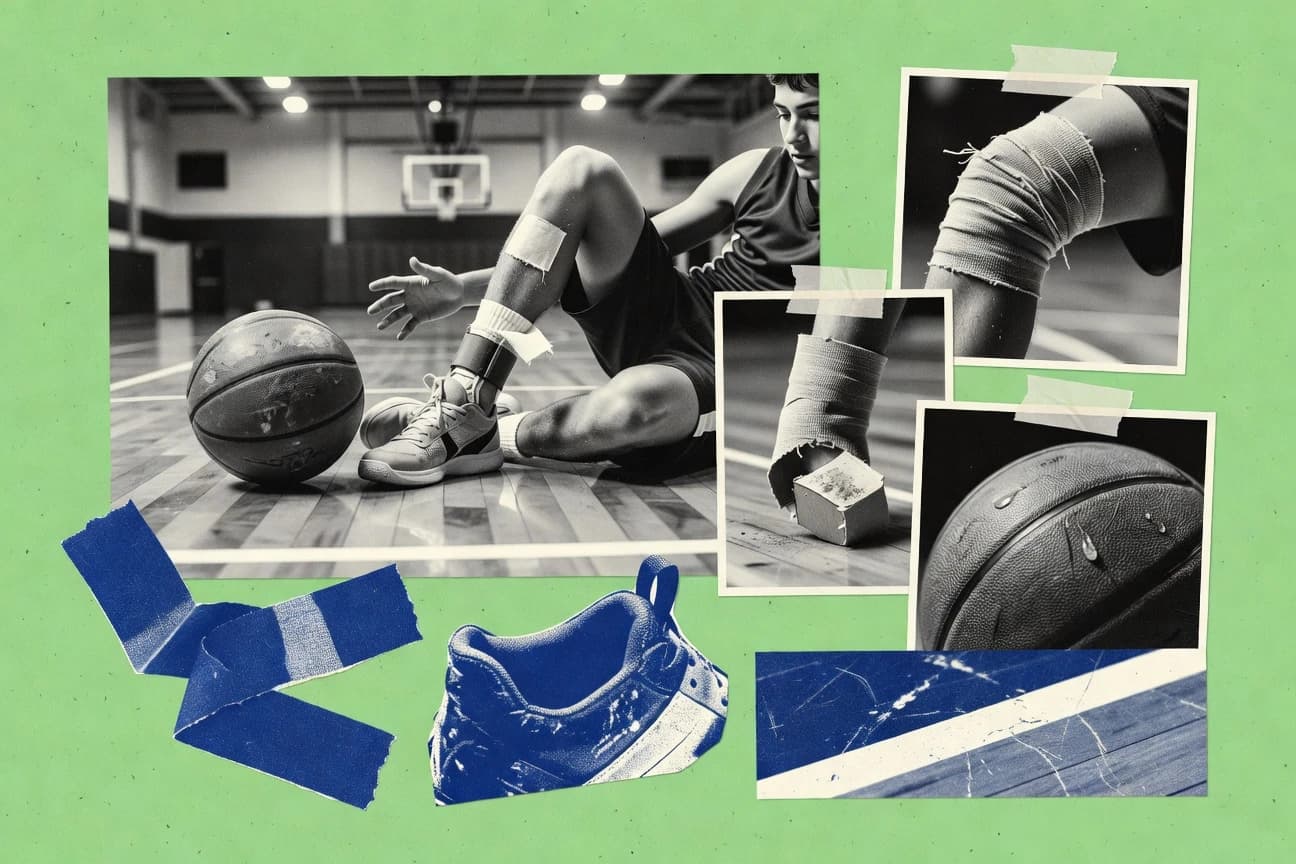

Lateral ankle sprains make up 13 to 20 percent of basketball injuries. Recurrence rates reach 73 percent. Concussions account for 10.8 percent of NCAA basketball injuries.
Key Takeaways
- Lateral ankle sprains comprise 13-20% of all basketball injuries, with recurrence rates up to 73%
- Concussions account for 10.8% of all basketball injuries in NCAA
- In NCAA Division I men's basketball from 1988-2004, lower extremity injuries accounted for 56.9% of all injuries with an overall injury rate of 8.24 per 1000 athlete-exposures
- ACL tears represent 0.12 per 1000 exposures in men's basketball but 0.39 in women's
- Shoulder injuries comprise 8-15% of basketball trauma
Basketball injuries are common, and understanding the most frequent types can help players train smarter.
Related reading
01 · Category
Ankle Injuries27 stats
01
Lateral ankle sprains comprise 13-20% of all basketball injuries, with recurrence rates up to 73%
02
In NBA players, ankle sprains cause 15% of missed games, averaging 9.7 games missed per injury
03
High school basketball ankle injury rate: 1.4 per 1000 exposures, 45% lateral sprains
04
NCAA basketball ankle sprain incidence: 2.6 per 1000 A-E in games for men
05
Chronic ankle instability affects 40% of basketball players post-sprain
06
Ankle fractures in basketball: 0.3 per 1000 exposures, often from inversion mechanisms
07
Female basketball players have 25% higher ankle sprain risk than males
08
Tape prophylaxis reduces ankle sprain recurrence by 50% in basketball
09
Peroneal tendon subluxation occurs in 15% of severe ankle sprains in athletes
10
Youth basketball ankle injuries: 17% of total, with 30% requiring >1 week absence
11
NBA ankle sprain severity: Grade I 60%, Grade II 30%, Grade III 10%
12
Contact-related ankle injuries: 69% in basketball games
13
Ankle sprain surgery rates: 2-5% in professional basketball careers
14
Inversion ankle sprains peak in landing from rebounds, 40% of cases
15
Bracing reduces ankle injury risk by 71% in previously injured players
16
Ankle syndesmotic sprains: 10-20% of ankle injuries, longer recovery
17
High school boys' basketball ankle sprains: 1.6 per 1000 exposures
18
Recurrent ankle sprains lead to 30% early retirement in pros
19
Ankle injury cost in NBA: $1.2 million per severe sprain in lost wages
20
Plantar flexion inversion mechanism in 85% of basketball ankle sprains
21
Ankle orthoses effectiveness: 39% risk reduction in basketball
22
Deltoid ligament injuries rare, <5% of ankle sprains
23
Ankle sprain RTP time: 10 days average in college basketball
24
Female collegiate ankle injury rate 1.9x higher in cutting maneuvers
25
Anterior talofibular ligament tear in 70% of grade II/III sprains
26
Ankle impingement post-sprain affects 20% of players
27
Basketball ankle sprain prevention programs reduce incidence by 35%
Interpretation
Ankle Injuries Interpretation
Across basketball ankle injuries, lateral sprains dominate at 13 to 20% and can recur as often as 73%, and with chronic ankle instability reported in 40% of players after a sprain this pattern shows why ankle care and prevention must be a priority.
02 · Category
Head And Concussion27 stats
01
Concussions account for 10.8% of all basketball injuries in NCAA
02
NBA concussion incidence: 1.5 per 1000 player-games
03
High school basketball concussions: 0.89 per 10,000 exposures
04
Female basketball players have 2x concussion risk vs. males
05
RTP after concussion: average 10.4 days in college basketball
06
Head contact causes 81% of concussions in basketball
07
Post-concussion syndrome in 15-30% of athletes, longer in contact sports
08
Youth basketball concussions rose 46% from 2010-2016
09
Cervical spine injuries: 0.5 per 1000 exposures, often with head trauma
10
Facial lacerations: 5% of injuries, from elbows/balls
11
Concussion reporting compliance: only 50% in high school athletes
12
Orbital fractures rare, 0.1 per 1000, from finger pokes
13
Baseline ImPACT testing reduces mismanagement by 20%
14
Repeated concussions lead to 3x CTE risk in pros
15
Nasal fractures: 2.3 per 1000 exposures in games
16
Neck sprains: 1.2% of total injuries, whiplash mechanism
17
Concussion symptoms resolve in 80% within 7 days
18
Helmet use negligible in basketball, but mouthguards reduce dental trauma by 60%
19
Second impact syndrome: <1% but fatal
20
Temporal bone fractures: associated with 20% severe head injuries
21
Visual pathway concussions: 10% report photophobia persisting >1 month
22
Stingers (burner) in neck: 3% of head/neck injuries, transient
23
Dental injuries: 1-2 per 1000 exposures, mostly avulsions
24
Neuropsychological deficits persist 1 month in 15% post-concussion
25
Ear injuries (cauliflower): rare in basketball <0.5%
26
Concussion baseline testing mandatory in 40 states for high school
27
Headaches post-concussion: 70% incidence, migraine-like
Interpretation
Head And Concussion Interpretation
In the Head And Concussion category, concussions represent 10.8% of NCAA basketball injuries and head contact drives 81% of them, showing that preventing direct head impact could be key to reducing the most common concussion mechanism.
03 · Category
Incidence Rates30 stats
01
In NCAA Division I men's basketball from 1988-2004, lower extremity injuries accounted for 56.9% of all injuries with an overall injury rate of 8.24 per 1000 athlete-exposures
02
During the 2018-2019 NBA regular season, the injury incidence rate was 15.2 injuries per 100 players per season, primarily affecting the lower extremities
03
High school basketball players experienced 4.5 injuries per 1000 athlete-exposures, with 40% occurring during practice
04
In youth basketball leagues, the overall injury rate is 6.2 per 1000 hours of play, higher in games than practices
05
Professional basketball players in Europe had an injury rate of 10.8 per 1000 hours during competitions from 2010-2014
06
Women's NCAA basketball saw 7.1 injuries per 1000 athlete-exposures, with time-loss injuries at 3.5
07
In Australian National Basketball League, injury incidence was 18.4 per 100 players over 82 games
08
College basketball injury surveillance from 2009-2014 reported 5.9 injuries per 1000 exposures overall
09
Adolescent basketball players had 8.9 injuries per 1000 training hours
10
NBA players missed 10.1 games per injury on average during 2017-2018 season
11
In recreational basketball, injury rate is 3.8 per 1000 hours, mostly sprains
12
Elite youth basketball injury rate was 4.7 per 1000 hours in Sweden
13
During March Madness, injury risk increases by 25% due to fatigue
14
WNBA players had 12.3 injuries per 1000 player-games
15
Japanese professional basketball injury rate is 9.5 per 1000 hours
16
In 2020 Olympics qualifying basketball, injury incidence was 22.4 per 1000 exposures
17
High school girls' basketball: 3.9 injuries per 1000 exposures
18
FIBA World Cup 2019 saw 16.7 injuries per 100 teams
19
U.S. Service Academy basketball injury rate: 12.4 per 1000 person-days
20
Indoor basketball vs. outdoor: 5.2 vs. 7.1 injuries per 1000 hours
21
NCAA men's basketball game injury rate: 13.4 per 1000 exposures
22
Youth club basketball: 7.8 injuries per 1000 hours
23
Professional basketball training injury rate: 3.4 per 1000 hours
24
Postseason NBA injury surge: 18% increase in incidence
25
Women's professional basketball: 14.2 injuries per 100 player-seasons
26
Street basketball injury rate: 9.2 per 1000 hours
27
College women's basketball practice injuries: 4.8 per 1000 exposures
28
Elite basketball players: 11.3 injuries per season per 100 players
29
Pediatric basketball ER visits: 118,000 annually in US
30
Time-loss injuries in NCAA basketball: 46% of total
Interpretation
Incidence Rates Interpretation
Across basketball levels, incidence rates consistently show that injuries are common in the sport, with the highest burden appearing in NCAA Division I men where lower extremity injuries made up 56.9% of all injuries, underscoring how quickly injury risk accumulates in everyday play and competition.
More related reading
04 · Category
Knee Injuries26 stats
01
ACL tears represent 0.12 per 1000 exposures in men's basketball but 0.39 in women's
02
Non-contact ACL injuries comprise 88% in female basketball players
03
NBA ACL reconstruction RTP rate: 79%, average 12 months absence
04
Patellofemoral pain syndrome affects 25% of basketball players annually
05
Meniscal tears in basketball: 15% of knee surgeries, often with ACL
06
Knee sprains grade III: 0.15 per 1000 A-E in NCAA games
07
Female athletes have 4-6x higher ACL injury risk due to neuromuscular factors
08
Osgood-Schlatter disease in 11-17% of adolescent basketball players
09
MCL injuries: 70% heal non-operatively in 3-6 weeks
10
Knee osteoarthritis post-ACL: 50% within 10 years in pros
11
Jumpers knee (patellar tendinopathy): 32% prevalence in elite players
12
Posterolateral corner injuries rare, <1% of knee trauma in basketball
13
Knee dislocation: 0.02 per 1000 exposures, high vascular risk
14
Quadriceps tendon ruptures: 2x more common than patellar in NBA
15
IT band syndrome: 12% of overuse knee injuries
16
ACL graft failure rate: 5.5% in basketball athletes
17
High school knee injury rate: 1.1 per 1000 exposures
18
Plyometric training reduces ACL risk by 74% in women
19
Chondromalacia patellae in 20% of jump-intensive players
20
Knee hyperextension injuries: 8% of non-contact knee trauma
21
Bone bruises with ACL: 80% concomitant MRI finding
22
Patellar dislocation: 0.07 per 1000 A-E, higher in females
23
Tendinopathy RTP: 4-6 weeks with eccentric loading
24
Multiligament knee injuries: 25% require surgery
25
Collegiate knee surgery rate: 0.23 per 1000 A-E
26
Valgus collapse mechanism in 70% female ACL tears
Interpretation
Knee Injuries Interpretation
For basketball knee injuries, the standout trend is that ACL tears are far higher in women at 0.39 per 1000 exposures than in men at 0.12, and non contact ACL injuries make up 88% of cases in female players.
05 · Category
Other Injuries And General25 stats
01
Shoulder injuries comprise 8-15% of basketball trauma
02
Finger fractures: most common hand injury, 25% of upper extremity
03
Lumbar strains: 12% of all injuries, from twisting jumps
04
Hamstring strains: 9% incidence, eccentric loading
05
Wrist sprains: 4.2 per 1000 exposures in games
06
Stress fractures: 5% of injuries, tibia/navicular common
07
Elbow dislocations rare, 0.2 per 1000, hyperextension
08
Hip pointers: contusions 3% of injuries
09
Thoracic outlet syndrome in 2% of overhead athletes
10
Metatarsal stress fractures: 20% of foot overuse injuries
11
Rotator cuff tears: 1-2% acute, higher chronic in pros
12
Back injuries cause 15% missed games in NBA
13
Eye injuries: corneal abrasion 60%, from fingers
14
Achilles tendon ruptures: 0.1 per 1000, 6-12 month RTP
15
Labral tears shoulder: 10% in throwers, MR arthrogram diagnostic
16
Plantar fasciitis: 8% prevalence, night pain classic
17
UCL elbow sprains: rare but increasing with shooting form
18
Rib fractures: 1.5% from contact
19
Quadriceps contusions: 5% of thigh injuries, myositis ossificans risk
20
Scaphoid fractures: 30% of hand fractures missed initially
21
Spondylolysis: 15% in low back pain athletes, pars defect
22
Mallet finger: buttonhole deformity from ball impact
23
Gluteal strains: 4% hamstring misdiagnosed
24
Pectoralis major rupture: weight room related
25
Sesamoiditis: 5% forefoot pain in jumpers
Interpretation
Other Injuries And General Interpretation
For the Other Injuries And General category, the pattern is that a variety of less spotlighted injuries are still significant, with stress fractures making up 5% of injuries, shoulder injuries reaching 8 to 15%, and lumbar strains accounting for 12%, showing that basketball trauma is widely distributed beyond the most common problem areas.
report visual · Breakdown
Where basketball injuries concentrate: ankles + concussions
Ankle sprains dominate basketball injury patterns, while concussions account for a meaningful share—together highlighting the need to target head and ankle prevention.
15%
In NBA players, ankle sprains cause 15% of missed games, averaging 9.7 games missed per injury
85%
Plantar flexion inversion mechanism in 85% of basketball ankle sprains
Reference
Cite This Report
This report is designed to be cited. We maintain stable URLs and versioned verification dates. Copy the format appropriate for your publication below.
APA
Elena Vasquez. (2026, February 13). Basketball Injury Statistics. Gitnux. https://gitnux.org/basketball-injury-statistics
MLA
Elena Vasquez. "Basketball Injury Statistics." Gitnux, 13 Feb 2026, https://gitnux.org/basketball-injury-statistics.
Chicago
Elena Vasquez. 2026. "Basketball Injury Statistics." Gitnux. https://gitnux.org/basketball-injury-statistics.
Sources & references
5 datasets cited across this report