
Key Takeaways
- Basal cell carcinoma typically presents as a pearly nodule with telangiectasia on sun-exposed skin, most commonly on the face (80% of cases).
- Nodular BCC subtype accounts for 60-80% of cases, characterized by rolled borders and central ulceration.
- Superficial BCC appears as erythematous patches resembling eczema, comprising 15-20% of BCCs.
- Basal cell carcinoma (BCC) represents about 80% of all malignant skin tumors in whites, with an estimated 3.6 million cases diagnosed annually in the US.
- The incidence rate of BCC in the US has increased by over 10% per year since 1994, reaching 43.6 cases per 100,000 person-years by 2012.
- In Australia, BCC incidence is the highest globally at 1,015 per 100,000 person-years in men and 624 in women aged 60-69.
- Basal cell carcinoma has a 99% 5-year survival rate when detected early and treated appropriately.
- Local recurrence rate for incompletely excised BCC is 39% at 5 years with no further treatment.
- Metastatic BCC occurs in <0.1% cases, with median survival 8-10 months post-metastasis.
- Ultraviolet radiation exposure is the primary risk factor for basal cell carcinoma, responsible for up to 90% of cases in fair-skinned individuals.
- Fair skin (Fitzpatrick types I-II) increases BCC risk by 2-3 fold compared to darker skin types.
- History of severe sunburns before age 20 doubles the lifetime BCC risk.
- Surgical excision with 4mm margins clears 98% of low-risk BCCs (Mohs preferred for high-risk).
- Mohs micrographic surgery achieves 99% cure rate for primary BCC, 94% for recurrent.
- Topical imiquimod 5% cream cures 82-90% superficial BCCs after 6-12 weeks.
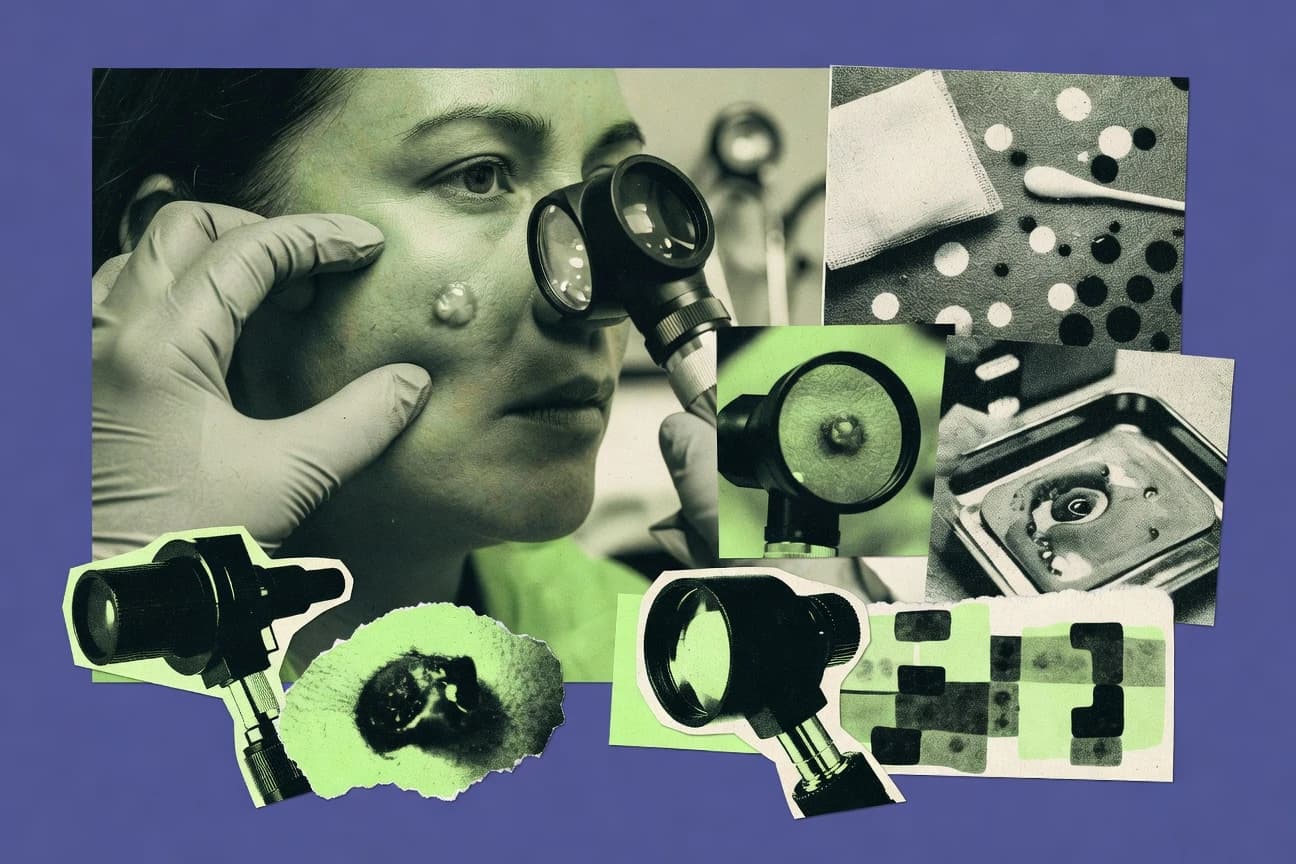
Most basal cell cancers are common on sun exposed face skin, and early treatment is highly curable.
Related reading
01 · Category
Diagnosis And Pathology27 stats
Diagnosis And Pathology Interpretation
02 · Category
Epidemiology30 stats
Epidemiology Interpretation
03 · Category
Prognosis And Prevention29 stats
Prognosis And Prevention Interpretation
More related reading
04 · Category
Risk Factors28 stats
Risk Factors Interpretation
05 · Category
Treatment26 stats
Treatment Interpretation
Basal Cell Carcinoma: Typical Presentation & Diagnostic Findings
Most BCCs present on sun-exposed face/neck and are confirmed by dermoscopy and histopathology characteristic features.
Basal cell carcinoma incidence is rising
Incidence of basal cell carcinoma has increased over time in the US and other regions, indicating a growing epidemiologic burden.
Prognosis & Prevention in Basal Cell Carcinoma
Early detection and appropriate treatment lead to very high survival, while targeted prevention measures can substantially reduce future BCC risk.
Key Risk Factors for Basal Cell Carcinoma
UV exposure and genetic/medical susceptibility factors substantially increase basal cell carcinoma risk.
Treatment outcomes by approach (cure/clearance/response)
Cure rates are highest with surgical approaches (Mohs/excision), while medical therapies show more variable response rates for superficial and advanced disease.
Cite This Report
This report is designed to be cited. We maintain stable URLs and versioned verification dates. Copy the format appropriate for your publication below.
James Okoro. (2026, February 13). Basal Cell Carcinoma Statistics. Gitnux. https://gitnux.org/basal-cell-carcinoma-statistics
James Okoro. "Basal Cell Carcinoma Statistics." Gitnux, 13 Feb 2026, https://gitnux.org/basal-cell-carcinoma-statistics.
James Okoro. 2026. "Basal Cell Carcinoma Statistics." Gitnux. https://gitnux.org/basal-cell-carcinoma-statistics.