
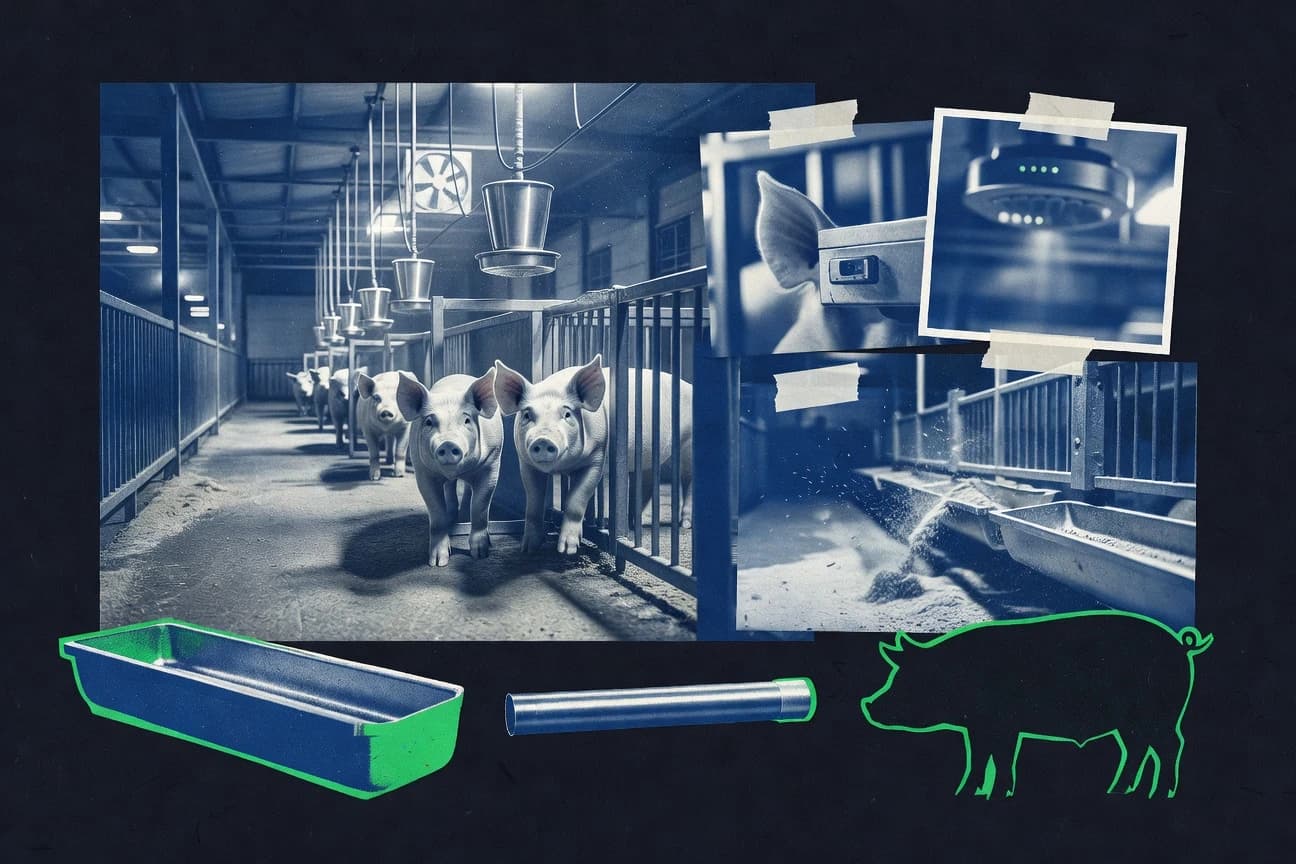

By 2032, AI in agriculture is projected to reach a $7.8 billion market, but the shift in the pork sector is already visible in hard operational outcomes like a 60% cut in routine labor for observation and up to a 10% feed cost reduction from sensor based decision support. Globally, pork production sits at 111.7 million tonnes in 2022, while regulatory pressure and disease risks such as African swine fever in 50+ countries keep pushing farms and processors to measure more, faster, and with less tolerance for error. Let’s look at how these drivers translate into quantified gains in feed efficiency, mortality reduction, grading quality, and supply chain waste.
Key Takeaways
- 111.7 million tonnes of pork was produced globally in 2022, indicating the approximate current scale of global pork output.
- $7.8 billion global market size for AI in agriculture is projected by 2032 (market revenue).
- $11.1 billion global market size for AI in animal health is projected by 2029.
- In a 2021 study, 58% of livestock farmers reported using at least one data-driven practice for disease monitoring (share of farmers using data-driven practices).
- A 2020 report by Gartner estimates that by 2025, 80% of enterprise activities will use AI in some form (share of enterprise activities).
- Gartner also estimated that by 2024, 75% of organizations will have deployed AI governance mechanisms (share).
- Median reduction in feed cost reported in a 2019 review of precision livestock farming is about 10% when implementing decision-support from sensor data (feed cost reduction).
- A 2021 peer-reviewed study of automated feeding in pigs reports improved feed efficiency by 5% compared to conventional feeding (feed efficiency increase).
- A 2018 study on vision-based detection in livestock reports sensitivity of 90% for detecting abnormal behavior patterns in pigs (detection sensitivity).
- An OECD study on agri-food automation reported that predictive maintenance can reduce maintenance costs by 20–40% in manufacturing settings (maintenance cost reduction).
- A 2020 peer-reviewed paper on predictive maintenance in supply-chain operations found maintenance cost reductions of 18% on average when using ML models (maintenance cost reduction).
- In a 2019 economic analysis of precision livestock farming, sensor-based monitoring was linked to a 2–5% reduction in overall production costs for pig producers (production cost reduction).
- A 2022 report on food loss and waste indicates that reducing avoidable losses via better monitoring and forecasting can cut waste by around 10% in processing and distribution (waste reduction).
- FAO estimates global food loss and waste at 14% along the supply chain (food loss percentage).
- In the EU, Regulation (EU) 2017/625 requires official controls for food and feed, driving adoption of automated inspection tools with traceability requirements (regulatory driver measured as the existence of official control obligation).
AI is set to scale across pork production, cutting feed, labor, and losses while improving health detection.
Related reading
01 · Category
Market Size5 stats
01
111.7 million tonnes of pork was produced globally in 2022, indicating the approximate current scale of global pork output.
02
$7.8 billion global market size for AI in agriculture is projected by 2032 (market revenue).
03
$11.1 billion global market size for AI in animal health is projected by 2029.
04
The global pork processing market is forecast to reach $372.2 billion by 2030 (revenue).
05
FAOSTAT records 2022 with 42.6 million pigs in Germany (head).
Interpretation
Market Size Interpretation
With global pork production reaching 111.7 million tonnes in 2022 and pork processing revenue forecast to hit $372.2 billion by 2030, the market scale signals strong headroom for AI investment as agriculture AI is projected to grow to $7.8 billion by 2032 and animal health AI to $11.1 billion by 2029.
02 · Category
User Adoption3 stats
01
In a 2021 study, 58% of livestock farmers reported using at least one data-driven practice for disease monitoring (share of farmers using data-driven practices).
02
A 2020 report by Gartner estimates that by 2025, 80% of enterprise activities will use AI in some form (share of enterprise activities).
03
Gartner also estimated that by 2024, 75% of organizations will have deployed AI governance mechanisms (share).
Interpretation
User Adoption Interpretation
On the user adoption front, the momentum is clear as 58% of livestock farmers used at least one data driven disease monitoring practice in 2021 and Gartner forecasts that by 2025 80% of enterprise activities will use AI while 75% of organizations will have AI governance mechanisms by 2024.
03 · Category
Performance Metrics18 stats
01
Median reduction in feed cost reported in a 2019 review of precision livestock farming is about 10% when implementing decision-support from sensor data (feed cost reduction).
02
A 2021 peer-reviewed study of automated feeding in pigs reports improved feed efficiency by 5% compared to conventional feeding (feed efficiency increase).
03
A 2018 study on vision-based detection in livestock reports sensitivity of 90% for detecting abnormal behavior patterns in pigs (detection sensitivity).
04
A 2020 study on machine learning for pig disease detection reports accuracy of 0.92 (model accuracy) for classification tasks using imaging data.
05
In a 2017 paper on AI-enabled monitoring, automated systems reduced time spent on routine observation by 60% (labor/time reduction).
06
A 2022 meta-analysis on precision livestock farming reported average reductions in mortality of about 6% when sensors/decision support are used (mortality reduction).
07
A 2021 case study in food processing automation reports throughput gains of 10–20% using AI-assisted scheduling and vision inspection (throughput improvement range).
08
In a 2022 peer-reviewed study, automated grading using machine learning reduced rework rates by 25% in meat processing workflows (rework reduction).
09
A 2020 peer-reviewed evaluation found ML-based carcass classification improved prediction of carcass quality by R²=0.86 compared to traditional statistical models (model fit).
10
A 2019 paper on electronic nose data with ML for pork spoilage classification reported F1-score of 0.88 in differentiating spoilage stages (classification F1-score).
11
A 2021 study on ML for meat quality prediction using spectroscopy reported mean absolute error of 0.35 (MAE) for pH estimation of pork samples (prediction error).
12
A 2018 review reported that real-time data from RFID and AI analytics can reduce shrinkage in cold-chain operations by 5–10% (shrinkage reduction).
13
A 2021 paper reports that ML-based early detection in livestock can reduce time-to-detection by 30–50% (detection timeliness improvement).
14
A 2019 study using AI to monitor pig behavior detects estrus-related behaviors with 85% classification accuracy (accuracy).
15
A 2022 study on AI-based image analysis for pig carcass assessment achieved 94% accuracy in defect classification (accuracy).
16
A 2020 peer-reviewed study reports ML-based prediction of pig growth with RMSE of 0.74 kg (growth prediction error).
17
A 2018 paper on sensor-fusion for pig health monitoring reports improved prediction of disease occurrence with AUROC 0.89 (area under ROC).
18
A 2021 paper on refrigeration monitoring using ML reports a 25% reduction in temperature excursions (excursion reduction).
Interpretation
Performance Metrics Interpretation
Across performance metrics, AI in the pork industry consistently delivers measurable gains, including about a 10% feed cost reduction and roughly 5% better feed efficiency, while also improving detection and classification quality such as 0.92 accuracy and F1-score of 0.88 for spoilage detection.
More related reading
04 · Category
Cost Analysis9 stats
01
An OECD study on agri-food automation reported that predictive maintenance can reduce maintenance costs by 20–40% in manufacturing settings (maintenance cost reduction).
02
A 2020 peer-reviewed paper on predictive maintenance in supply-chain operations found maintenance cost reductions of 18% on average when using ML models (maintenance cost reduction).
03
In a 2019 economic analysis of precision livestock farming, sensor-based monitoring was linked to a 2–5% reduction in overall production costs for pig producers (production cost reduction).
04
A 2020 study in Journal of Cleaner Production reported that implementing AI-driven energy optimization reduced energy costs by 12% in agricultural facilities (energy cost reduction).
05
A 2018 study on wastewater and odor management using ML models in livestock facilities reports a 15% reduction in treatment costs (treatment cost reduction).
06
A 2023 report by World Economic Forum estimates AI can reduce fraud and waste in supply chains by $0.6–$1.4 trillion globally (global value-at-risk reduction).
07
A 2020 FAO report estimates that early warning systems can reduce losses by up to 10–30% in outbreaks (loss reduction range).
08
A 2019 paper on AI-enabled inventory forecasting in food supply chains reduced stockouts by 12% (stockout reduction).
09
A 2023 peer-reviewed paper reports that farm-level precision feeding reduced antibiotic usage by 25% in pig systems (antibiotic reduction).
Interpretation
Cost Analysis Interpretation
Across cost analysis findings for the pork industry, AI and related analytics consistently cut key expenses, such as reducing maintenance costs by 20 to 40% with predictive maintenance, lowering energy bills by 12% through optimization, and cutting production costs by 2 to 5% with precision livestock monitoring.
05 · Category
Industry Trends7 stats
01
A 2022 report on food loss and waste indicates that reducing avoidable losses via better monitoring and forecasting can cut waste by around 10% in processing and distribution (waste reduction).
02
FAO estimates global food loss and waste at 14% along the supply chain (food loss percentage).
03
In the EU, Regulation (EU) 2017/625 requires official controls for food and feed, driving adoption of automated inspection tools with traceability requirements (regulatory driver measured as the existence of official control obligation).
04
In the U.S., FSIS requires establishments to implement a HACCP plan; the regulation is codified at 9 CFR 417 (requirement drives data-driven process control).
05
In the U.S., FSIS has codified pathogen risk-based sampling as part of performance standards; this is part of 9 CFR 96 (testing framework enabling AI-supported analytics).
06
WOAH reports that African swine fever is present in 50+ countries (country count).
07
A 2022 OECD report shows that the global digital trade value exceeds $4 trillion annually (context for data/traceability infrastructure)
Interpretation
Industry Trends Interpretation
Industry Trends in the pork sector are increasingly shaped by the push for smarter, traceable oversight, since cutting avoidable processing and distribution waste by about 10% through better monitoring and forecasting and implementing data driven controls under rules like 9 CFR 417 and 9 CFR 96 align with the reality that food loss and waste is still about 14% across supply chains while African swine fever spreads across 50 plus countries.
Reference
Cite This Report
This report is designed to be cited. We maintain stable URLs and versioned verification dates. Copy the format appropriate for your publication below.
APA
Helena Kowalczyk. (2026, February 13). AI In The Pork Industry Statistics. Gitnux. https://gitnux.org/ai-in-the-pork-industry-statistics
MLA
Helena Kowalczyk. "AI In The Pork Industry Statistics." Gitnux, 13 Feb 2026, https://gitnux.org/ai-in-the-pork-industry-statistics.
Chicago
Helena Kowalczyk. 2026. "AI In The Pork Industry Statistics." Gitnux. https://gitnux.org/ai-in-the-pork-industry-statistics.
Sources & references
42 datasets cited across this report · attribution is report-level
+28 additional datasets cited (not shown individually)