
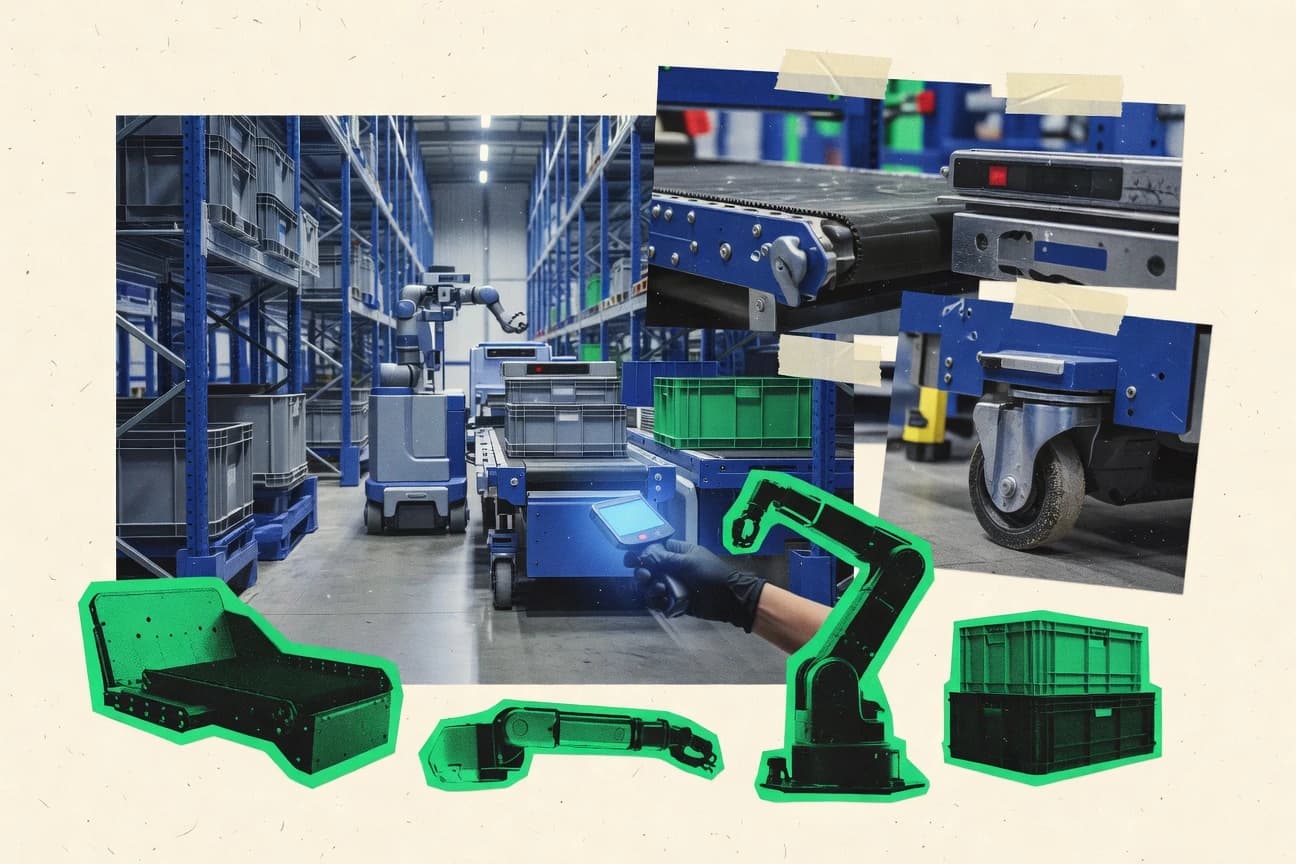

Digital transformation is no longer just a roadmap for material handling. With 2024 estimates putting global WMS software at $7.6 billion and digital supply chain technologies at $15.7 billion, the investment signal is clear that visibility and orchestration are moving from pilots into core operations. But the real shift shows up in the operational details, where scan and validation delays, predictive uptime, and connected control networks can separate smooth flow from constant disruption.
Key Takeaways
- $7.6 billion estimated 2024 global market value for warehouse management systems (WMS) software — a key digital layer in material handling and warehousing
- $4.8 billion estimated 2024 global market value for robotic process automation (RPA) — relevant for automating paperwork, workflows, and back-office operations in logistics/material handling
- $7.3 billion estimated 2024 global market value for warehouse automation — quantifies demand for automation technologies often combined with digital transformation (software + controls)
- 60% of organizations said they have at least one AI-related initiative in production — indicates momentum that can translate into predictive operations and automation in material handling
- 52% of organizations said they expect AI to significantly change their business in 1–2 years — timeframe pressure for adoption of analytics in operations
- 64% of supply chain leaders said they are investing in advanced analytics — indicating an industry shift toward digitized forecasting, visibility, and planning
- 0.4 seconds average additional scan/validation time can be achieved with handheld barcode/RFID scanning at scale — measurable latency related to system performance
- Machine vision inspection systems can achieve detection accuracies of 95% or higher in controlled industrial settings (computer vision performance benchmarking), supporting automated inspection and quality checks in material handling
- Top-performing warehouses achieve 5–10% higher order accuracy with barcode/RFID-enabled processes versus manual-only processes (supply chain operations benchmarking), supporting digitized validation in material handling
- Worldwide, enterprises using cybersecurity risk quantification tools increased by 27% in 2023 — digital transformation increases the security budget and controls needed
- Ransomware cost surveys report an average ransomware cost of $4.5 million (global, by incident) — key cost dimension driving investment in digital controls
- IoT adoption can reduce energy costs by 10–30% in industrial contexts — cost impact for connected facilities and handling systems
- In 2023, 56% of organizations using AI analytics reported increased operational efficiency — directly relevant to operations in handling
- In 2024, 63% of supply chain organizations reported using some form of real-time visibility tool — adoption of tracking and data sharing
- 1 in 3 warehouses reported adopting automated guided vehicles (AGVs) by 2024 — adoption metric for automated material handling
Digital supply chain and warehouse automation are rapidly expanding, boosting visibility, productivity, and resilience.
Related reading
- Digital Transformation In IndustryDigital Transformation In The Logistics Industry Statistics
- Digital Transformation In IndustryDigital Transformation In The Motion Picture Industry Statistics
- Digital Transformation In IndustryDigital Transformation In The Real Estate Industry Statistics
- Digital Transformation In IndustryDigital Transformation In The Maritime Industry Statistics
01 · Category
Market Size9 stats
01
$7.6 billion estimated 2024 global market value for warehouse management systems (WMS) software — a key digital layer in material handling and warehousing
02
$4.8 billion estimated 2024 global market value for robotic process automation (RPA) — relevant for automating paperwork, workflows, and back-office operations in logistics/material handling
03
$7.3 billion estimated 2024 global market value for warehouse automation — quantifies demand for automation technologies often combined with digital transformation (software + controls)
04
$15.7 billion estimated 2024 global market value for digital supply chain technologies — indicates market pull for end-to-end visibility and orchestration
05
$34.9 billion estimated 2024 global market value for Industrial Ethernet switches — a core enabling technology for connected smart warehouses and material handling lines
06
$11.7 billion estimated 2024 global market value for AI in manufacturing software — supports predictive maintenance and optimization used in material handling
07
$2.3 billion estimated 2024 global market value for predictive maintenance — reflects spend on predictive analytics for uptime in handling equipment
08
$3.6 billion estimated 2024 global market value for industrial edge computing — supports low-latency control and analytics at facilities
09
$1.5 billion estimated 2024 global market value for computer vision in manufacturing — relevant for automated inspection, safety, and tracking in material handling
Interpretation
Market Size Interpretation
In the market size view of digital transformation for material handling, investment is clearly concentrated in core connectivity and end-to-end orchestration, with $34.9 billion for Industrial Ethernet switches and $15.7 billion for digital supply chain technologies together signaling massive scale for connected, data-driven warehouses.
02 · Category
Industry Trends7 stats
01
60% of organizations said they have at least one AI-related initiative in production — indicates momentum that can translate into predictive operations and automation in material handling
02
52% of organizations said they expect AI to significantly change their business in 1–2 years — timeframe pressure for adoption of analytics in operations
03
64% of supply chain leaders said they are investing in advanced analytics — indicating an industry shift toward digitized forecasting, visibility, and planning
04
90% of supply chain and logistics organizations report they have experienced disruption in the past 12 months (survey year 2023/2024), driving priority for digital risk visibility and response planning
05
68% of warehouse and distribution center operators say they expect technology (including automation and software) to improve productivity over the next 3 years, reflecting investment momentum for digital material handling
06
Data from the U.S. Bureau of Labor Statistics shows that employment in transportation and material moving occupations in the U.S. was 5.9 million in May 2023, underscoring labor pressure that digital automation targets
07
U.S. warehouse storage and handling labor (NAICS 4931) accounted for 3.0% of total employment in the logistics sector (U.S. Census / BLS-linked industry employment breakdown), motivating productivity-focused digital transformation
Interpretation
Industry Trends Interpretation
Across the material handling industry, momentum is unmistakable as 60% of organizations already have AI in production and 64% of supply chain leaders are investing in advanced analytics, with the urgency heightened by 90% reporting disruption in the past year and labor pressure reflected in 5.9 million transportation and material moving jobs, pointing to digital transformation that prioritizes predictive, automated, and more resilient operations.
03 · Category
Performance Metrics6 stats
01
0.4 seconds average additional scan/validation time can be achieved with handheld barcode/RFID scanning at scale — measurable latency related to system performance
02
Machine vision inspection systems can achieve detection accuracies of 95% or higher in controlled industrial settings (computer vision performance benchmarking), supporting automated inspection and quality checks in material handling
03
Top-performing warehouses achieve 5–10% higher order accuracy with barcode/RFID-enabled processes versus manual-only processes (supply chain operations benchmarking), supporting digitized validation in material handling
04
Real-time monitoring of equipment parameters can reduce unplanned downtime by about 10–20% in industrial asset programs (industrial predictive monitoring benchmarking)
05
A peer-reviewed study reports that digital traceability systems can improve inventory accuracy by 10–25% compared with non-digitized processes (systematic study of supply chain traceability impacts, 2021–2022 range)
06
A 2020 peer-reviewed study on warehouse order picking optimization shows that route optimization algorithms can reduce travel distance by up to 20–30% (algorithm benchmarking), supporting digital pick-path planning
Interpretation
Performance Metrics Interpretation
Performance Metrics show that digital transformation is delivering measurable gains across warehouse and materials handling operations, including 10 to 20% reductions in unplanned downtime, 5 to 10% higher order accuracy, and up to 20 to 30% less pick travel distance.
More related reading
04 · Category
Cost Analysis6 stats
01
Worldwide, enterprises using cybersecurity risk quantification tools increased by 27% in 2023 — digital transformation increases the security budget and controls needed
02
Ransomware cost surveys report an average ransomware cost of $4.5 million (global, by incident) — key cost dimension driving investment in digital controls
03
IoT adoption can reduce energy costs by 10–30% in industrial contexts — cost impact for connected facilities and handling systems
04
Implementing ERP and connected operations can reduce inventory by 10–20% — cost impact for material handling supply chain flows
05
29% of surveyed organizations cited cybersecurity as a top investment priority for digital transformation in supply chain and logistics (survey year 2023), reflecting security-driven adoption of connected material handling
06
Industrial organizations report that network segmentation and secure industrial communications can reduce the blast radius of incidents, with 60% indicating “significant” reduction in risk impact (cybersecurity survey year 2022/2023)
Interpretation
Cost Analysis Interpretation
Cost pressures from cybersecurity and efficiency gains are driving digital transformation in material handling, as ransomware incidents average $4.5 million, 27% more enterprises added risk quantification tools in 2023, and IoT can cut energy costs by 10–30% while ERP and connected operations reduce inventory by 10–20%.
05 · Category
User Adoption6 stats
01
In 2023, 56% of organizations using AI analytics reported increased operational efficiency — directly relevant to operations in handling
02
In 2024, 63% of supply chain organizations reported using some form of real-time visibility tool — adoption of tracking and data sharing
03
1 in 3 warehouses reported adopting automated guided vehicles (AGVs) by 2024 — adoption metric for automated material handling
04
57% of enterprises adopted RFID in some capacity (2023 survey of supply chain tech) — adoption metric for automated identification and tracking
05
63% of organizations report they are using predictive analytics for supply chain planning and operations (survey year 2023/2024), supporting predictive maintenance, demand sensing, and optimization in material handling
06
SCADA/industrial control communications adoption: 80% of critical infrastructure organizations use some form of network-based monitoring for operational visibility (ICS security survey year 2022/2023)
Interpretation
User Adoption Interpretation
For the user adoption angle, the clearest trend is that adoption is accelerating across core material handling capabilities, with 63% of supply chain organizations using real-time visibility tools in 2024 and 63% also using predictive analytics, while 1 in 3 warehouses had adopted AGVs by 2024.
Reference
Cite This Report
This report is designed to be cited. We maintain stable URLs and versioned verification dates. Copy the format appropriate for your publication below.
APA
Aisha Okonkwo. (2026, February 13). Digital Transformation In The Material Handling Industry Statistics. Gitnux. https://gitnux.org/digital-transformation-in-the-material-handling-industry-statistics
MLA
Aisha Okonkwo. "Digital Transformation In The Material Handling Industry Statistics." Gitnux, 13 Feb 2026, https://gitnux.org/digital-transformation-in-the-material-handling-industry-statistics.
Chicago
Aisha Okonkwo. 2026. "Digital Transformation In The Material Handling Industry Statistics." Gitnux. https://gitnux.org/digital-transformation-in-the-material-handling-industry-statistics.
Sources & references
34 datasets cited across this report · attribution is report-level
+10 additional datasets cited (not shown individually)