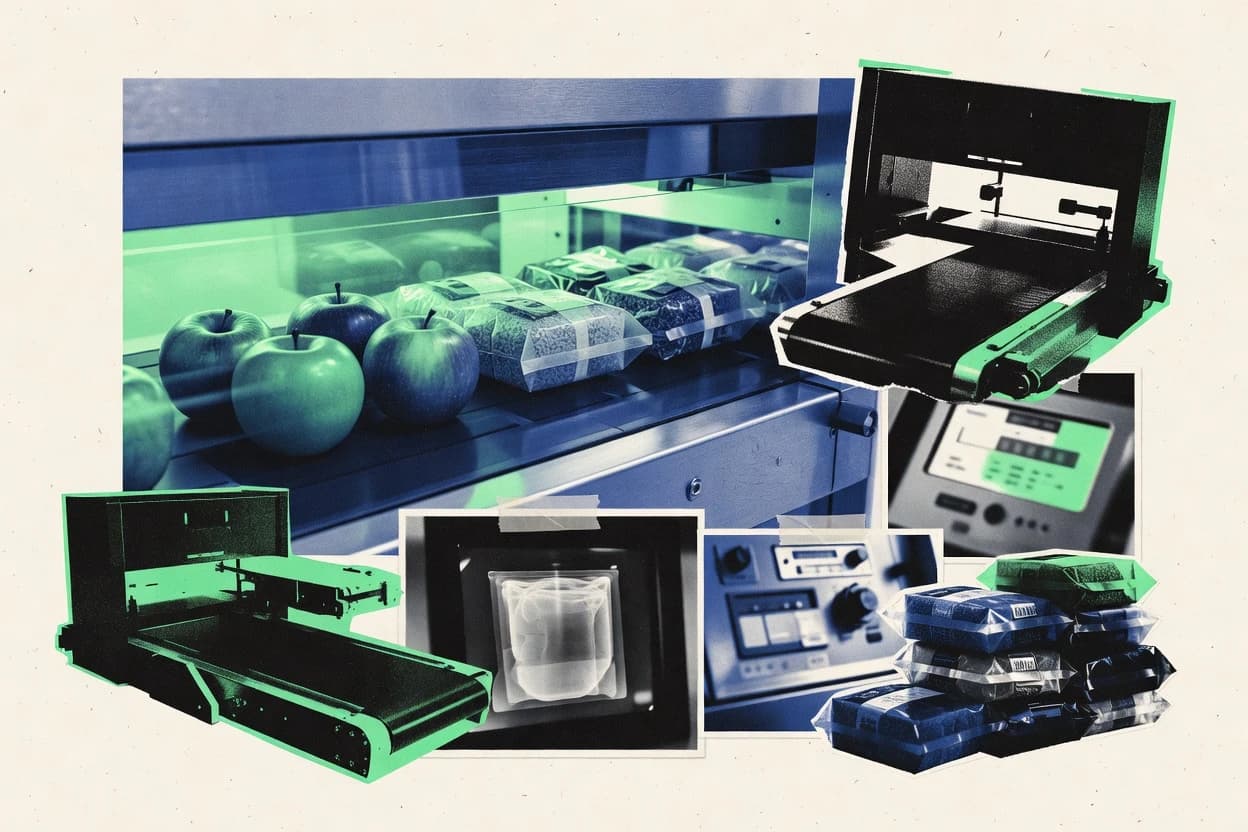

01 Industry overview
The x-ray food industry at a glance
The global food-inspection devices market was valued at $2.20 billion in 2025, with X-ray inspection representing 38.2% of revenue and North America accounting for 33.5%.
- $2.20B[5]
- Food inspection devices, 2025
- 6.6%[5]
- Forecast CAGR, 2026–2035
- 38.2%[5]
- X-ray inspection share, 2025
- 33.5%[5]
- North America share, 2025
- Market size
- The global food-inspection devices market was valued at $2.20 billion in 2025 and is estimated at $2.35 billion in 2026. X-ray inspection is one of the principal device categories covered by the market.[5]
- Forecast & CAGR
- The market is projected to reach $4.18 billion by 2035, representing a 6.6% compound annual growth rate from 2026 to 2035. The report identifies X-ray inspection as the largest device segment in 2025, at 38.2% of revenue.[5]
- Market share & regions
- North America held the largest regional share at 33.5% of global food-inspection devices revenue in 2025. Asia Pacific is identified as the fastest-growing region over 2026–2035, while the United States led the North American market in 2025.[5]
- Segmentation
- X-ray inspection accounted for 38.2% of the market in 2025, ahead of other device categories such as metal detectors, checkweighers and vision inspection systems. Meat, poultry and seafood was the largest application group, with a 35.0% share in 2025.[5]
- Key players & concentration
- Named suppliers in the food X-ray inspection market include Thermo Fisher Scientific, Mettler-Toledo, Loma Systems, Ishida, Anritsu Infivis, Sesotec, MinebeaMitsumi and Bühler. The available public market summary identifies leading companies but does not disclose a reliable combined market share or concentration ratio.[6]
- Trends, drivers & challenges
- Growth is associated with food-safety requirements, contamination prevention, the economics of inline inspection and the integration of X-ray, weighing and other inspection functions. The market summary also identifies local manufacturing in emerging markets and rising food-safety alerts in Europe as drivers.[5]
- Consumer behavior & competition
- Food manufacturers use X-ray systems to detect foreign materials and support product-integrity controls, while competition includes suppliers offering combined X-ray, metal-detection, checkweighing and vision platforms. The available sources do not provide a reliable consumer adoption rate or quantified brand-level competitive shares.[7][5]
- Regulation
- In the United States, 21 CFR Part 179 permits X-ray sources for food inspection under specified conditions, including X-ray tube sources operating at no more than 500 kilovolt peak for the listed inspection use. FDA guidance also states that food irradiation uses must comply with applicable approvals, dose limits and labeling requirements.[8][7]
- Latest news
- A market update published in October 2026 estimates the global food-inspection devices market at $2.35 billion for 2026 and maintains a forecast of $4.18 billion by 2035. It reports a 6.6% CAGR for 2026–2035, with X-ray inspection holding the largest device share in 2025.[5]
02 Ranking
Top 10 Companies in the X-ray Food Industry
The leading companies in the x-ray food industry, ranked on market impact, performance, momentum, innovation and brand popularity.
Updated November 22, 2026 · Next review December 22, 2026
Wipotec stands out for packaged through liquid product inspection because it supplies X-ray systems for packaged, unpackaged, liquid and pumpable food products, while Mettler-Toledo International focuses on food and pharmaceutical production inspection since it supplies Safeline X-ray inspection systems.
Ranked by Overall score · How we score ↓
Editor's top 3 picks
Where to start, by need.
#1 Overall · Leader in x-ray inspection systems
Wipotec
DE
Ranked #1 · 9.2 · X-ray inspection systems
Why we picked it: It supplies X-ray systems that cover multiple food product formats, including liquid and pumpable products.
#2 overall
Mettler-Toledo International
CH
Ranked #2 · 8.9 · X-ray inspection systems
Why we picked it: It supplies Safeline X-ray inspection systems used in food and pharmaceutical production.
#3 overall
Illinois Tool Works
US
Ranked #3 · 8.9 · X-ray inspection systems
Why we picked it: It manufactures Loma Systems X-ray inspection equipment for food and pharmaceutical production lines.
Pick 1 is the #1 company overall. No other segment places in the top 5, so picks 2 and 3 follow rank.
Full ranking
| # | Company | Overall ↓ | Impact | Performance | Momentum | Innovation | Company snapshot |
|---|---|---|---|---|---|---|---|
| 1 | Wipotec X-ray inspection systems · DE | 9.2 | 8.2 | 9.9 | 9.9 | 9.9 | |
Company snapshot · Wipotec · Data as of November 22, 2026 Wipotec supplies X-ray systems for packaged, unpackaged, liquid and pumpable food products.[9]
| |||||||
| 2 | Mettler-Toledo International X-ray inspection systems · CH | 8.9 | 9.7 | 9.1 | 8.3 | 7.9 | |
Company snapshot · Mettler-Toledo International · Data as of November 22, 2026 METTLER TOLEDO supplies Safeline X-ray inspection systems for food and pharmaceutical production.[10]
| |||||||
| 3 | Illinois Tool Works X-ray inspection systems · US | 8.9 | 9.9 | 8.6 | 8.2 | 9.1 | |
Company snapshot · Illinois Tool Works · Data as of November 22, 2026 ITW's Loma Systems manufactures X-ray inspection equipment for food and pharmaceutical production lines.[11]
| |||||||
| 4 | Ishida X-ray inspection systems · JP | 8.9 | 8.9 | 8.5 | 8.9 | 9.9 | |
Company snapshot · Ishida · Data as of November 22, 2026 Ishida manufactures X-ray inspection equipment and integrated packing lines for food producers.[12]
| |||||||
| 5 | Thermo Fisher Scientific X-ray inspection systems · US | 8.8 | 9.6 | 8.2 | 8.7 | 7.0 | |
Company snapshot · Thermo Fisher Scientific · Data as of November 22, 2026 Thermo Fisher sells Xpert conveyor X-ray systems for packaged and bulk food inspection.[13]
| |||||||
| 6 | MULTIVAC Food packaging and integrated X-ray inspection · DE | 8.7 | 8.2 | 9.4 | 8.8 | 9.1 | |
Company snapshot · MULTIVAC · Data as of November 22, 2026 MULTIVAC is listed among leading suppliers of packaged-food X-ray inspection systems.[14]
| |||||||
| 7 | Anritsu Food X-ray, metal detection and checkweighing · JP | 8.7 | 9.3 | 8.0 | 8.7 | 9.9 | |
Company snapshot · Anritsu · Data as of November 22, 2026 Anritsu's PQA business provides X-ray systems primarily for food and pharmaceutical inspection.[15]
| |||||||
| 8 | Techik Instrument (Shanghai) Food X-ray, sorting and inspection systems · CN | 8.7 | 8.2 | 8.9 | 9.3 | 9.1 | |
Company snapshot · Techik Instrument (Shanghai) · Data as of November 22, 2026 Techik is identified as a major supplier of food X-ray inspection machines and contaminant-detection equipment.[16]
| |||||||
| 9 | Fortress Technology Food X-ray and contaminant inspection systems · CA | 8.2 | 7.0 | 8.4 | 8.8 | 9.1 | |
Company snapshot · Fortress Technology · Data as of November 22, 2026 Fortress Technology is identified among specialized suppliers of food inspection devices including X-ray systems.[16]
| |||||||
| 10 | Minebea Intec Food X-ray, weighing and inspection systems · DE | 8.0 | 8.2 | 7.4 | 7.2 | 9.1 | |
Company snapshot · Minebea Intec · Data as of November 22, 2026 Minebea Intec's Dymond systems inspect packaged food for foreign objects, fill levels and completeness.[17]
| |||||||
How we score
- Impact (30%): scale and weight in the market (revenue, market share, employees, market position).
- Performance (20%): recent revenue growth and operating margin; an analyst assessment where a company does not publish them.
- Momentum (20%): growth trajectory and future potential.
- Innovation (15%): R&D intensity and how technologically advanced the company is.
Popularity (brand search demand, 15%) counts toward Overall but is not published as a column. Overall leaves out what is not known.
Scale Scores are shown on a 7–10 scale with one decimal; bars start at 7.0.
Cadence Recalculated when new figures are published; next review December 22, 2026.
Independence. Rankings are editorially independent. Scores, ranks, picks and the verdict follow the method above; no company can pay to change them.
Cite this ranking
APA
Samuel Norberg. (2026, November 22). Top 10 companies in the x-ray food industry. In X-ray Food Industry Statistics. Gitnux. https://gitnux.org/x-ray-food-industry-statistics/#top-companies
X-ray food inspection equipment market share by application
Confectionery and Cereals holds the largest share at 28.3%.
03 Trends & forecasts
Top 10 X-ray Food Industry Trends & Forecasts 2027
What is changing in the x-ray food industry, with the evidence behind each trend and a forecast for 2027.
Forecasts were generated by an AI model from the cited evidence. They are estimates, not guarantees.
01X-ray investment remains the priority
High confidenceA 2025 Meat Institute benchmarking survey found that X-ray was the most frequently mentioned inspection technology for investment, driven by customer requirements, packaging applications and detection performance. The same survey reported growing interest in AI-enabled vision systems and replacement of older metal detectors.[18]
Forecast 2027: In 2027, X-ray systems should continue to receive the largest share of new inspection-equipment budgets, particularly in packaged meat, prepared foods and high-value export production. Demand will increasingly favor systems that combine contamination detection with quality checks.
02Foreign-material risk sustains demand
High confidenceThe 2025 EU RASFF summary recorded approximately 220 foreign-body hazards among food-safety notifications. A separate analysis of U.S. FDA recall data found that foreign material was named in 70 food recalls during 2025, or about 12.2% of the year’s events in that dataset.[19][20]
Forecast 2027: Foreign-material incidents should remain a durable purchasing driver in 2027, even if total recall counts fluctuate. Food producers are likely to expand inspection coverage from final-pack checks toward earlier checks of ingredients, bulk materials and semi-finished products.
03Dual-energy detection moves mainstream
High confidenceEagle Product Inspection announced an enhanced dual-energy X-ray technology in April 2026, while LOMA launched its X5DE dual-energy system in North America in 2025. Both suppliers emphasize improved detection of low-density contaminants such as bone, rubber, glass and plastic.[21][22]
Forecast 2027: By 2027, dual-energy capability should shift from a premium differentiator toward a standard option for difficult products, especially overlapping packs, meat products and products containing low-density foreign material. Adoption will be fastest where conventional single-energy systems generate excessive false rejects.
04AI reduces false rejects
High confidenceMettler Toledo introduced the X56 DXD+ in 2026 as a dual-energy, photon-counting X-ray system with AI capabilities. The system is designed to improve detection of low-density contaminants while reducing unnecessary product rejects in products with variable thickness, density or overlapping textures.[23]
Forecast 2027: In 2027, AI will be used primarily to improve classification, product setup and reject decisions rather than to replace validated inspection controls. Vendors will compete on measurable reductions in false rejects, changeover time and operator intervention.
05Hyperspectral X-ray broadens detection
Medium confidenceThe World Bank’s AI repository describes Xnext’s XSpectra system as using X-ray hyperspectral imaging and deep learning across up to 1,024 energy levels for inline detection of contaminants including plastic, bone, wood and rubber. The described system is designed to operate in milliseconds without slowing production lines.[24]
Forecast 2027: In 2027, hyperspectral and multispectral systems should remain an emerging segment but gain reference installations in difficult bulk and high-speed applications. Wider adoption will depend on validation data, maintenance simplicity and a clear payback against dual-energy systems.
06Integrated inspection platforms gain ground
High confidenceThe 2025 Meat Institute survey reported investment interest in X-ray, AI-enabled vision and upgraded metal detectors. Major suppliers increasingly position X-ray alongside checkweighing, metal detection and vision, reflecting demand for multiple controls in one production line.[18][23]
Forecast 2027: In 2027, competition should increasingly center on integrated platforms rather than standalone X-ray hardware. Food manufacturers will favor suppliers that can combine inspection, weighing, reject handling, data capture and service under one validation framework.
07Traceability spending is delayed, not cancelled
High confidenceFDA states that the Food Traceability Rule’s original compliance date was January 20, 2026, but Congress directed FDA not to enforce it before July 20, 2028. FDA expects covered firms to maintain traceability plans and key data elements for relevant critical tracking events.[7]
Forecast 2027: In 2027, traceability-related investment should shift toward preparation, system integration and data readiness rather than enforcement-driven equipment purchases. X-ray suppliers that connect inspection results to lot, batch and reject records will be better positioned for the 2028 deadline.
08Packaging rules raise inspection complexity
Medium confidenceThe European Commission states that food packaging must be traceable throughout its lifecycle and that PFAS restrictions apply to food-contact packaging placed on the EU market after August 12, 2026. Packaging changes can alter product density, barrier layers and the inspection characteristics of finished packs.[25][26]
Forecast 2027: In 2027, packaging-material transitions should increase the need for product-specific X-ray recipes and validation. Suppliers will emphasize systems that can handle multilayer, recycled and lower-density packaging without materially increasing false rejects.
09Food-processing automation supports adoption
Medium confidenceThe U.S. Bureau of Labor Statistics projects food-processing equipment-worker employment to grow 5% from 2025 to 2035 and reports approximately 36,600 openings per year over the decade. The labor requirement strengthens the economic case for automated inline inspection and automated reject handling.[27]
Forecast 2027: In 2027, labor availability should continue to favor inspection systems with automatic setup assistance, remote diagnostics and simpler operator interfaces. Plants will increasingly evaluate X-ray purchases as part of broader automation programs rather than as isolated safety upgrades.
10Meat and prepared foods lead demand
High confidenceThe 2025 Meat Institute survey identifies customer requirements and packaging applications as major reasons for X-ray investment. The 2025 RASFF summary also lists foreign bodies among the leading hazards, with processed foods and animal-product categories remaining important food-safety use cases.[18][19]
Forecast 2027: In 2027, meat, poultry, seafood and prepared meals should remain the core demand centers for food X-ray inspection. Growth will come from higher inspection rates per line, more difficult product formats and expanded checks of raw materials and finished packs.
04 Statistics
Market Intelligence
Market-intelligence figures separate food X-ray inspection equipment from food X-ray inspection machines, with the 2025 values at $2.20 billion and $897 million.
Market size, volume and shipments in the x-ray food industry
- US$242 million was the global 2025 market value for food X-ray inspection equipment, covering equipment used to inspect food products; Global Info Research reports the estimate in value terms.[1]
- US$2.03 billion was the global 2025 market value for X-ray food inspection equipment, covering equipment used for food-safety and quality-assurance inspection.[2]
- US$897 million was the global 2025 market value for food X-ray inspection machines, covering packaged-product, bulk, pipeline, combination, software and service segments.[3]
Forecast growth and shipments in the x-ray food industry
- The global food X-ray inspection equipment market is forecast to reach US$324 million by 2032, implying 4.3% compound annual growth from 2025 to 2032.[1]
- The global food X-ray inspection machines market is forecast to reach US$1.95 billion by 2035, growing at a compound annual rate of 8.1% from 2026 to 2035.[3]
- The global X-ray food inspection equipment market is forecast to reach US$2.94 billion by 2029, growing at a 9.8% compound annual rate during 2025–2029.[4]
Key questions about the x-ray food industry
What was the global market value for food inspection devices in 2025?
How fast is the food-inspection devices market expected to grow from 2026 to 2035?
Which companies lead the x-ray food industry?
Which technology area is the largest device category within food X-ray inspection?
How concentrated is competition among suppliers of food X-ray inspection devices?
What U.S. regulatory limit is specified for X-ray tube sources used for food inspection?
Cite This Report
This report is designed to be cited. We maintain stable URLs and versioned verification dates. Copy the format appropriate for your publication below.
Samuel Norberg. (2026, November 22). X-ray Food Industry Statistics. Gitnux. https://gitnux.org/x-ray-food-industry-statistics
Samuel Norberg. "X-ray Food Industry Statistics." Gitnux, 22 Nov 2026, https://gitnux.org/x-ray-food-industry-statistics.
Samuel Norberg. 2026. "X-ray Food Industry Statistics." Gitnux. https://gitnux.org/x-ray-food-industry-statistics.
Sources & references
27 sources cited across this report
pdf.marketpublishers.com
- 0e190a550a8c4c8c4b93-fcd009c875a5577fd4fe2f5b7e3bf4eb.ssl.cf2.rackcdn.com
douglasinsights.com
bevindustry.com
emergenresearch.com
htfmarketinsights.com
fda.gov
govinfo.gov
wipotec.com
mt.com
careers.itw.com
ishida.com
thermofisher.com
reports.valuates.com
- dl.cdn-anritsu.com
marketresearch.com
minebea-intec.com
meatinstitute.org
- salute.gov.it
fabrico.io
eaglepi.com
- loma.com
food-safety.com
airepository.worldbank.org
food.ec.europa.eu
bls.gov