
01 Industry overview
The soju industry at a glance
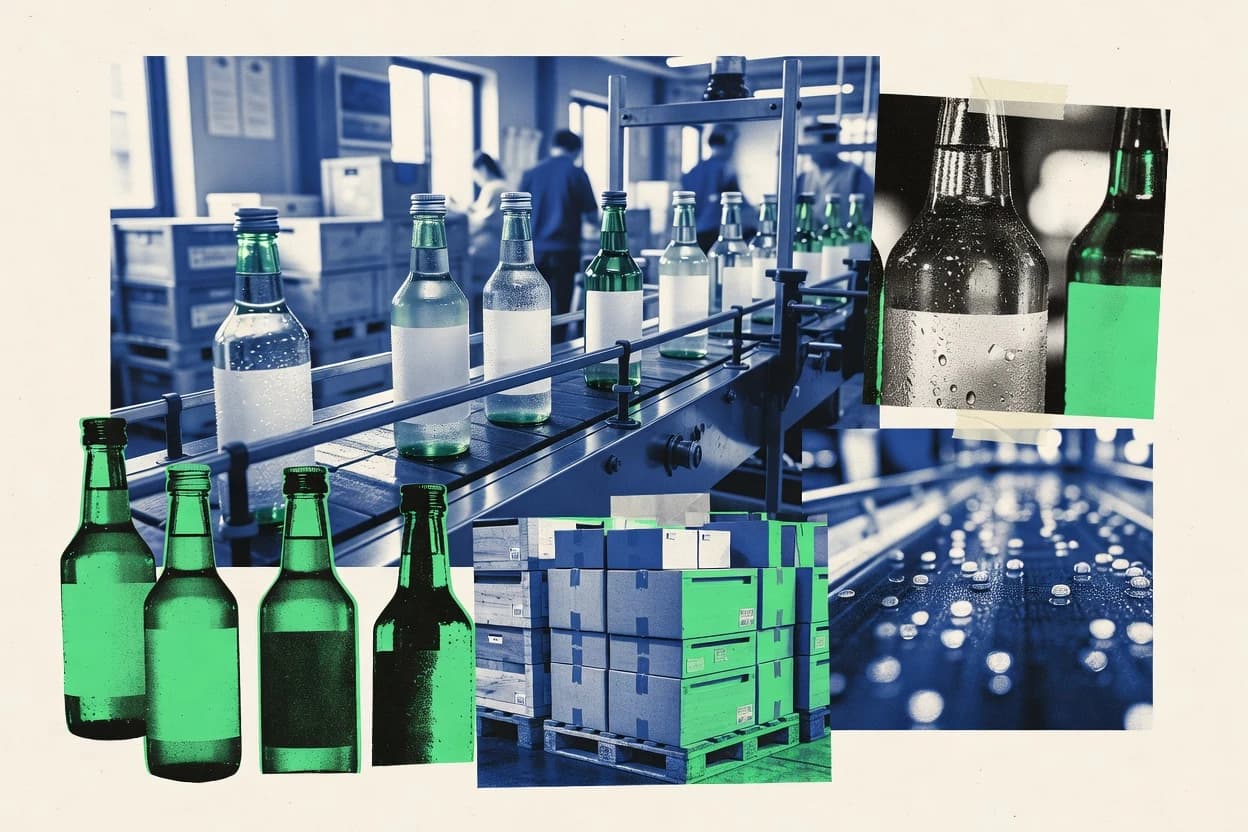
The global soju market is estimated at $6.1 billion in 2026, with growth driven by Korean-culture exports and flavored products despite declining domestic consumption in South Korea.
- $6.1B[2]
- Global market size, 2026
- 5.4%[2]
- Forecast CAGR, 2025–2030
- 64,975 tons
- South Korean exports, 2025
- 94.5M cases[16]
- Jinro sales volume, 2025
- Market size
- Grand View Research estimates the global soju market at $5.6 billion in 2024 and $6.1 billion in 2026. South Korea’s domestic soju market was reported at approximately 3.5 trillion won in 2024.[2][17]
- Forecast & CAGR
- The global market is forecast to reach $7.6 billion by 2030, representing a 5.4% compound annual growth rate from 2025 to 2030. A separate forecast estimates growth from $5.50 billion in 2025 to $7.29 billion in 2031 at a 4.8% CAGR for 2026–2031.[2][18]
- Market share & regions
- Asia Pacific held 33.8% of global soju revenue in 2024, while North America accounted for 20.2% in 2023. South Korean soju exports totaled $96.52 million and 64,975 tons in 2025, after reaching more than $200 million in 2024 under a broader customs classification.[2][3]
- Segmentation
- Distilled soju represented 71.3% of global revenue in 2023, bottled products held 48.5%, and off-trade channels accounted for 69.2%. The market is also segmented by diluted versus distilled products, bottles, cans and pouches, and on-trade versus off-trade distribution.[2]
- Key players & concentration
- HiteJinro is the leading South Korean soju producer, with about 65% of the domestic market; Lotte Chilsung held approximately 20% in 2024. Euromonitor also reported Hite Jinro at a 65% total-volume share of South Korean spirits in 2025, with Lotte Chilsung at 18%.[17][19]
- Pricing
- South Korea applies a 72% liquor-tax rate to soju under its liquor-tax framework. In 2026, qualifying low-alcohol mixed liquors below 8.5% ABV can receive a 30% liquor-tax reduction, while a new standard sales ratio for other liquor was set at 18%.[20][21]
- Trends, drivers & challenges
- Korean pop culture, dramas and social media continue to support overseas demand, while flavored and lower-alcohol products broaden the category. Domestic diluted-soju shipments fell from 862,000 kiloliters in 2022 to 793,000 kiloliters in 2025, reflecting moderation, changing drinking habits and weaker traditional group drinking.[22][23]
- Consumer behavior & competition
- Soju was consumed by more than half of South Korean on-premise users, but volume fell 6% and value declined 5.2% in the latest NielsenIQ on-premise comparison. Competition is increasingly focused on fruit flavors, low-sugar formulations, lower alcohol content, convenience-store distribution and overseas localization.[24][25]
- M&A
- In September 2024, AB InBev-owned Oriental Brewery agreed to acquire Jeju Soju from Shinsegae L&B, marking a major beer-company entry into the soju market. The transaction was intended to expand Jeju Soju’s production and export potential.[26]
- Regulation
- South Korea’s Liquor Tax Act defines alcoholic beverages as products containing at least 1% alcohol and sets classification criteria based on ingredients, alcohol content, nonvolatile materials and production methods. Soju is subject to liquor tax, with education tax added under the national tax framework.[20][27]
- Latest news
- In November 2026, HiteJinro was preparing to launch a 5.7% ABV canned Terra-and-Chamisul soju-beer product, with the applicable tax burden potentially reduced from the 72% base rate for qualifying low-alcohol mixed liquor. HiteJinro’s fruit-soju and other-liquor exports rose 5.0% year over year to 60.65 billion won in January–September 2026, while its conventional soju exports declined 16.2%.[21][23]
02 Ranking
Top 6 Companies in the Soju Industry
The leading companies in the soju industry, ranked on market impact, performance, momentum, innovation and brand popularity.
Updated November 20, 2026 · Next review December 20, 2026
HiteJinro stands out for export-and-scale soju because it held about 65% of South Korea’s soju market in 2024, while Sunyang Soju focuses on regional production since it posted a 12.8% operating margin with 9.3% revenue growth.
Ranked by Overall score · How we score ↓
Editor's top 3 picks
Where to start, by need.
#1 Overall · Leader in soju production
HiteJinro
KR
Ranked #1 · 8.9 · Soju production
Why we picked it: It combines a large domestic base with export growth, including fruit-soju and other-liquor exports rising 5.0% year over year in January–September 2026.
#2 overall
Sunyang Soju
KR
Ranked #2 · 8.9 · Soju production
Why we picked it: It operates as a Daejeon and Chungnam soju producer, with a 9.3% revenue growth and a 12.8% operating margin.
#3 overall
Hwayo
KR
Ranked #3 · 8.4 · Soju production
Why we picked it: It focuses on premium distilled soju made from rice in Yeoju, with a 9.7% operating margin.
Pick 1 is the #1 company overall. No other segment places in the top 5, so picks 2 and 3 follow rank.
Full ranking
| # | Company | Overall ↓ | Impact | Performance | Momentum | Innovation | Company snapshot |
|---|---|---|---|---|---|---|---|
| 1 | HiteJinro Soju production · KR | 8.9 | 9.9 | 8.2 | 7.9 | 9.2 | |
Company snapshot · HiteJinro · Data as of November 20, 2026 HiteJinro commands about 65% of South Korea’s soju market.[7]
| |||||||
| 2 | Sunyang Soju Soju production · KR | 8.9 | 7.0 | 9.9 | 9.9 | 9.9 | |
Company snapshot · Sunyang Soju · Data as of November 20, 2026 Sunyang Soju is one of seven leading regional Korean liquor companies.[3]
| |||||||
| 3 | Hwayo Soju production · KR | 8.4 | 7.2 | 9.0 | 8.6 | 9.9 | |
Company snapshot · Hwayo · Data as of November 20, 2026 Hwayo produces premium distilled soju made from rice in Yeoju.[28]
| |||||||
| 4 | Muhak Soju production · KR | 8.1 | 8.4 | 8.0 | 7.9 | 7.7 | |
Company snapshot · Muhak · Data as of November 20, 2026 Muhak manufactures and sells Good Day soju and other alcoholic beverages.[29]
| |||||||
| 5 | Daesun Distilling Soju production · KR | 7.6 | 8.4 | 7.0 | 7.0 | 7.7 | |
Company snapshot · Daesun Distilling · Data as of November 20, 2026 Daesun Distilling produces C1 and Daesun soju for the Busan market.[30]
| |||||||
| 6 | Kumbokju Daegu regional soju producer; Charm Soju · KR | 7.1 | 7.0 | 7.2 | 7.1 | 7.0 | |
Company snapshot · Kumbokju · Data as of November 20, 2026 Charm Soju is Kumbokju’s flagship product and a leading Daegu regional brand.[31]
| |||||||
How we score
- Impact (30%): scale and weight in the market (revenue, market share, employees, market position).
- Performance (20%): recent revenue growth and operating margin; an analyst assessment where a company does not publish them.
- Momentum (20%): growth trajectory and future potential.
- Innovation (15%): R&D intensity and how technologically advanced the company is.
Popularity (brand search demand, 15%) counts toward Overall but is not published as a column. Overall leaves out what is not known.
Scale Scores are shown on a 7–10 scale with one decimal; bars start at 7.0.
Cadence Recalculated when new figures are published; next review December 20, 2026.
Independence. Rankings are editorially independent. Scores, ranks, picks and the verdict follow the method above; no company can pay to change them.
Cite this ranking
APA
Samuel Norberg. (2026, November 20). Top 6 companies in the soju industry. In Soju Industry Statistics. Gitnux. https://gitnux.org/soju-industry-statistics/#top-companies
South Korea soju market share by company
Hitejinro holds the largest share at 65%.
03 Trends & forecasts
Top 10 Soju Industry Trends & Forecasts 2027
What is changing in the soju industry, with the evidence behind each trend and a forecast for 2027.
Forecasts were generated by an AI model from the cited evidence. They are estimates, not guarantees.
01Domestic volumes continue declining
High confidenceSouth Korean diluted-soju shipments fell from 862,000 kiloliters in 2022 to 793,000 kiloliters in 2025. NielsenIQ also reported that on-premise soju volume declined 6% and value fell 5.2% in its latest comparison.[24][9]
Forecast 2027: Domestic soju volume is likely to decline again in 2027, probably by low-single digits, as younger consumers drink less frequently and traditional group drinking weakens. Producers will increasingly depend on exports, flavored products and premium lines to offset the contraction.
02Exports remain the main growth engine
High confidenceSouth Korean soju exports reached 64,975 tons and $96.52 million in 2025. HiteJinro reported separate export revenue of 192.0 billion won in 2025, up from 179.9 billion won in 2024.[32][33]
Forecast 2027: Exports should continue growing faster than the Korean domestic market in 2027, supported by wider distribution and Korean-food demand. Growth is likely to remain concentrated in North America, Southeast Asia and selected European markets rather than being evenly distributed worldwide.
03Fruit flavors gain export share
High confidenceHiteJinro's exports of other liquors, including fruit soju, reached 60.65 billion won in January–September 2026, up 5.0% year over year, while conventional soju exports declined 16.2%. Lotte Chilsung reported that U.S. sales of sweetened soju rose about 30% annually between 2021 and 2025.[23][34]
Forecast 2027: Fruit and other flavored soju should take a larger share of overseas sales in 2027, particularly among first-time consumers. Producers will likely prioritize familiar fruit profiles, seasonal launches and market-specific flavors over a single standardized global range.
04Alcohol content moves lower
High confidenceHiteJinro lowered Chamisul Fresh from 16% to 15.7% ABV in 2026, while Oriental Brewery launched 15% ABV Chalrang. Industry coverage also identifies lower alcohol content as a response to moderation and cleaner-taste preferences.[22][9]
Forecast 2027: By 2027, mainstream soju portfolios will likely include more products around 15% ABV or below, while traditional-strength products remain important for core consumers. The most successful launches will combine lower alcohol with recognizable soju taste rather than simply reducing strength.
05Zero-sugar positioning expands
Medium confidenceOriental Brewery launched zero-sugar Chalrang in 2026, explicitly linking the product to the shift toward lower-alcohol and sugar-free soju. Zero-sugar positioning has also become a recurring point of differentiation for major brands such as Saero and newer entrants.[33][9]
Forecast 2027: Zero-sugar claims will remain central to product development and advertising in 2027, especially for products targeting younger and health-conscious drinkers. Competition will shift toward taste quality and credible calorie or sugar communication as the claim becomes less distinctive.
06Canned formats broaden occasions
Medium confidenceHiteJinro was preparing a 5.7% ABV canned Terra-and-Chamisul mixed product in November 2026. The product is designed for the growing market for lighter, portable and cocktail-like alcoholic drinks.[23][21]
Forecast 2027: Cans and other single-serve formats should expand in 2027, especially in convenience retail, outdoor consumption and mixed-drink occasions. Growth will likely come more from hybrid and ready-to-drink products than from simply repackaging standard bottled soju.
07At-home channels gain importance
High confidenceNielsenIQ reported that South Korean 2025 on-premise volumes for spirits and soju were 10.6% below 2024 levels, while off-premise volumes held up better. The market overview also identifies off-trade as the dominant channel, accounting for 69.2% of global soju revenue in 2023.[24]
Forecast 2027: In 2027, convenience stores, supermarkets and e-commerce-linked retail will remain more resilient than bars and restaurants. Brands will emphasize multipacks, small formats and food-pairing communication to capture at-home occasions.
08K-culture sustains overseas trial
High confidenceHiteJinro's Jinro sold 94.5 million standard 9-liter cases worldwide in the latest annual ranking and was named the world's top-selling spirit for the 25th consecutive year. The company exports to 91 countries and uses social media, sports sponsorships and music partnerships to build awareness.[33][26]
Forecast 2027: Korean entertainment, food and tourism will continue to support trial and brand recognition in 2027. The category will need to convert cultural curiosity into repeat consumption through local food pairings, cocktails and clearer explanations of how soju differs from vodka and other spirits.
09Localization replaces one-size-fits-all exports
High confidenceHiteJinro has described its overseas strategy as hyper-local, while Oriental Brewery has tested separate export products in the United States and in Malaysia, Singapore, Taiwan and Canada. Overseas consumers also tend to drink soju alone or with finger foods rather than in traditional Korean meal settings.[26][34]
Forecast 2027: In 2027, localization will become a clearer competitive requirement: different ABVs, flavors, pack sizes and serving suggestions will be used by market. Companies with local distributors and on-premise education are likely to outperform brands relying only on Korean cultural visibility.
10Premium distilled soju develops
Medium confidenceSouth Korean distilled-soju shipments increased from 1,929 kiloliters in 2020 to 4,739 kiloliters in 2024, while shipment value rose from 44.8 billion won to 132.3 billion won. Premium brands are benefiting from greater interest in pairing, provenance and craft production.[35]
Forecast 2027: Premium distilled soju should continue gaining value share in 2027 even while mass-market diluted soju declines. The segment will remain smaller than mainstream soju but should attract restaurants, specialty retailers and consumers trading up for meals or gifts.
04 Statistics
Market Intelligence
This section frames 2026 demand with a $6.1 billion global estimate and ties it to export-led growth, including 64,975 tons of South Korean exports in 2025.
Market size, volume and shipments in the soju industry
- KRW 3.994 trillion was the value of soju shipped to South Korea’s market in 2023, including domestic shipments and imports, according to National Tax Service data.[1]
- USD 5.6 billion was the estimated 2024 global soju market value, covering distilled and diluted soju across packaging and distribution channels.[2]
- 844,250 kilolitres of soju were shipped to South Korea’s market in 2023, including domestic shipments and imports, according to National Tax Service data.[1]
- More than USD 200 million of Korean soju was exported in 2024, while export weight reached a record 124,000 tonnes.[3]
Forecast growth and shipments in the soju industry
- The global soju market was forecast to grow at a 5.4% CAGR from 2025 to 2030, reaching USD 7.6 billion in 2030.[2]
- U.S. soju volume was forecast to grow at a 16% CAGR from 2024 to 2029, while total U.S. spirits volume was projected to decline 2%.[4]
- The global soju market was projected to increase from USD 6.1 billion in 2026 to USD 7.6 billion in 2030.[2]
Company counts and size structure in the soju industry
- The three largest spirits producers—Hite Jinro, Lotte Group and Muhak—accounted for nearly 87% of South Korea’s retail spirits volume in 2023, a parent-category concentration measure that includes soju.[5]
- South Korea had 22 licensed diluted-soju manufacturers and 244 licensed distilled-soju manufacturers in 2024, based on National Tax Service licensing statistics.[6]
- Lotte Chilsung held 20% of South Korea’s soju market in 2024, according to Nielsen Korea market data.[7]
- HiteJinro held 65% of South Korea’s KRW 3.5 trillion soju market in 2024, according to Nielsen Korea market data.[7]
Regional split of the soju industry
- The United States received 24.3% of South Korea’s soju exports in 2024, making it the largest export destination.[3]
- South Korean soju reached 95 export markets in 2024, with exports diversified to a record 46 countries including the United States and China.[3]
- China received 19.9% of South Korea’s soju exports in 2024, according to Korea Customs Service data.[3]
- Japan received 19.2% of South Korea’s soju exports in 2024, according to Korea Customs Service data.[3]
05 Statistics
Strategy & Growth
This section documents capacity plans that matter for throughput and provisioning timelines, including HiteJinro’s Vietnam plant targeting 70 million litres annual capacity in 2027.
Capacity expansion in the soju industry
- US$100 million is the announced investment for HiteJinro’s new soju plant in Thai Binh, Vietnam, scheduled to begin operations in 2027.[8]
- 70 million litres is the planned annual capacity of HiteJinro’s soju plant under construction in Thai Binh, Vietnam, with operations expected in 2027.[8]
- 600,000 litres is the annual production capacity of the Soju Story distilled-soju plant opened in Andong, South Korea, in 2026.[9]
06 Statistics
Pricing & Finance
This section tracks pricing pressure for buyers, including a 119.70 restaurant-soju consumer price index in October 2026 and an average retail price of 1,593 Korean won in May 2026.
Prices and price indices for soju
- 0.5% was the monthly increase in South Korea’s restaurant-soju consumer price index in October 2026, while the index stood at 119.70 against the 2020 base of 100.[10]
- 119.70 was the consumer price index for restaurant-served soju in South Korea in October 2026, with 2020 equal to 100; the index rose 3.5% year on year.[11]
- 1,593 Korean won was the average retail price of soju recorded by Korea Consumer Agency’s Chamgagyeok price portal in May 2026.[12]
07 Statistics
Trade & Footprint
This section isolates where growth is landing by destination and format, including fruit-flavoured exports reaching $96 million in 2024.
Imports and exports of soju
- US$80.1 million of soju was exported from South Korea in 2023, using the MFDS product category “soju (Korean distilled liquor)” rather than a customs code.[13]
- The United States, China and Japan accounted for 24.3%, 19.9% and 19.2% of South Korean soju exports, respectively, in 2024; Korea Customs Service reported 95 destination markets.[3]
- 63,419 tonnes of soju were exported from South Korea in 2023, under the MFDS product category “soju (Korean distilled liquor)” rather than a customs code.[13]
- Fruit-flavoured soju exports reached US$96 million in 2024, while regular soju represented 51.9% and fruit-flavoured products 48.1% of exports by flavour.[3]
08 Statistics
Sustainability
This section quantifies waste intensity and collection performance, including 0.0350 tonnes of waste per kilolitre in 2024 and a 100.30% bottle collection rate in South Korea.
Waste and circularity in the soju industry
- 0.0350 tonnes of waste were generated per kilolitre of product by HiteJinro’s soju and beer operations in 2024, down from 0.0631 tonnes per kilolitre in 2022.[14]
- 100.30% of HiteJinro’s South Korean soju bottles were collected for reuse or recycling in 2024, exceeding bottles released because returned stock included prior-period containers.[14]
- 88.8% is South Korea’s 2026 mandatory recycling rate for standard soju containers under the Act on the Promotion of Saving and Recycling of Resources.[15]
Key questions about the soju industry
What was the global soju market size in 2026?
How fast is the global soju market expected to grow after 2025?
Which companies lead the soju industry?
What technology or formulation shifts are visible in the category?
How concentrated is South Korea’s spirits retail volume, including soju?
Where do South Korean soju exports go most often?
Cite This Report
This report is designed to be cited. We maintain stable URLs and versioned verification dates. Copy the format appropriate for your publication below.
Samuel Norberg. (2026, November 20). Soju Industry Statistics. Gitnux. https://gitnux.org/soju-industry-statistics
Samuel Norberg. "Soju Industry Statistics." Gitnux, 20 Nov 2026, https://gitnux.org/soju-industry-statistics.
Samuel Norberg. 2026. "Soju Industry Statistics." Gitnux. https://gitnux.org/soju-industry-statistics.
Sources & references
35 sources cited across this report
apps.fas.usda.gov
grandviewresearch.com
korea.net
theiwsr.com
agriculture.canada.ca
- atfis.or.kr
en.yna.co.kr
en.nhandan.vn
en.sedaily.com
- namneun.com
hankyung.com
newsis.com
- kha.or.kr
ert.korcham.net
- homecdn.khff.or.kr
statista.com
mordorintelligence.com
euromonitor.com
- elaw.klri.re.kr
biz.chosun.com
biz.heraldcorp.com
en.news1.kr
nielseniq.com
- en.topdaily.kr
koreajoongangdaily.com
- data.go.kr
whisky.com
kind.krx.co.kr
- bn-korea.com
- english.visitkorea.or.kr
- financialfilings.com
koreaherald.com
- e-malt.com
securities.miraeasset.com