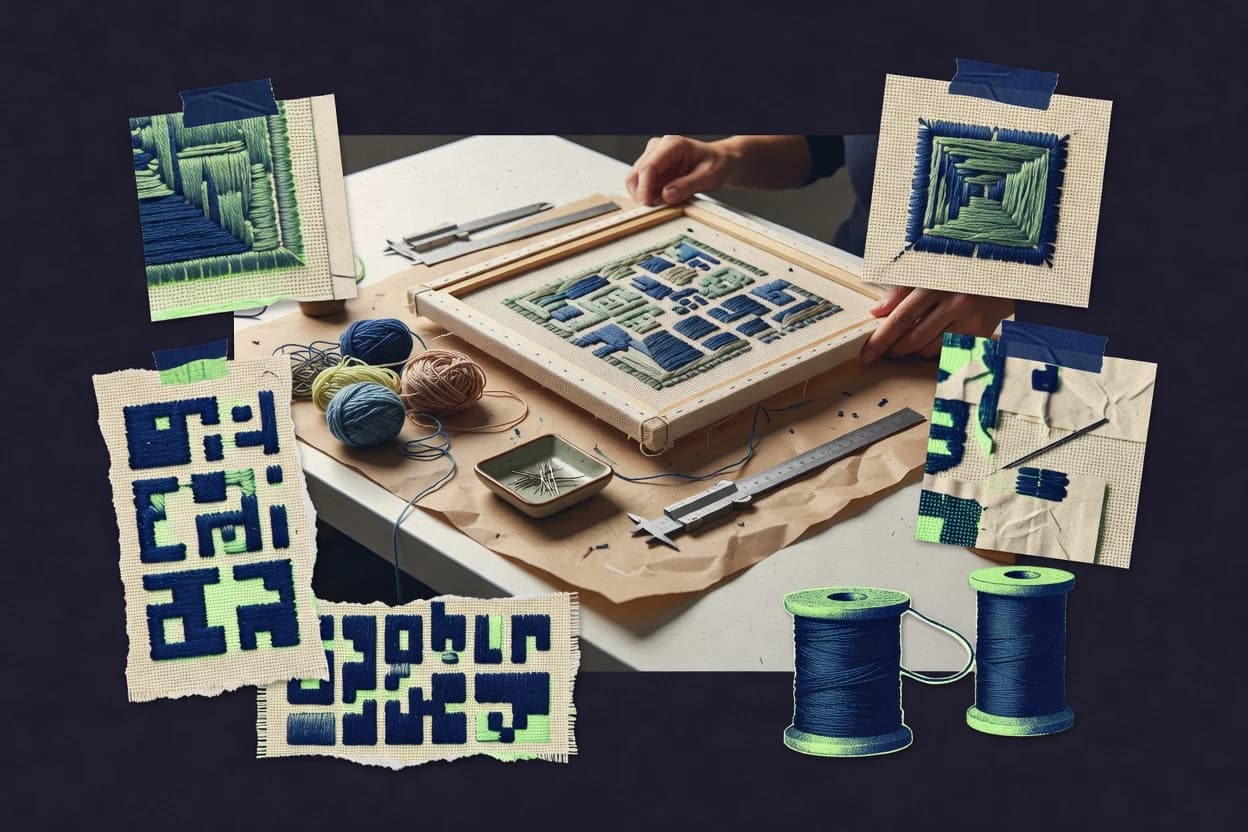

01 Industry overview
The needlepoint industry at a glance
The global embroidery and needlepoint retail market is projected at $2.12 billion in 2026, with renewed demand driven by online discovery, personalized products and younger consumers returning to analog hobbies.
- $2.12B[2]
- Global market size, 2026
- 3.89%[2]
- Forecast CAGR, 2026–2035
- 41%[2]
- North America share, 2026
- 38%[2]
- Threads market share, 2026
- Market size
- The global embroidery and needlepoint retail market is projected to reach $2.119 billion in 2026. The market definition covers threads, kits, canvases and accessories sold for needlepoint and related embroidery uses.[2]
- Forecast & CAGR
- The market is forecast to increase from $2.119 billion in 2026 to $2.990 billion by 2035, representing a 3.89% compound annual growth rate from 2026 to 2035.[2]
- Market share & regions
- North America is reported as the leading region, with 41% of global market share in 2026. The United States is identified as the largest national market, with a reported 34% global share and approximately 1,500 specialty needlepoint shops.[2]
- Segmentation
- Threads lead the product mix with a reported 38% share, while home décor is the largest application at 44%. Other reported product categories include kits, canvases and accessories, and other applications include clothing and crafts.[2]
- Key players & concentration
- The industry is fragmented across independent specialty shops, designers and online retailers, but premium canvas supply is concentrated: industry reporting says needlepoint users overwhelmingly rely on German manufacturer Zweigart for premium canvas. The market report identifies Aristeia Needlepoint and Garden Gate as leading U.S. specialty participants.[3][2]
- Pricing
- Reliable industry-wide pricing data were not identified. Available reporting indicates a premium-oriented segment built around hand-painted canvases, specialty threads, curated kits, finishing and stitch-guide services, but does not provide a comparable average price.[2]
- Trends, drivers & challenges
- Demand is being supported by social-media discovery, interest in analog hobbies and younger consumers seeking screen-free activities; Etsy searches for “needlepoint canvas” were reported up 172% year over year in early 2026. Supply is constrained by a continuing canvas shortage and dependence on one major premium-canvas manufacturer.[4][3]
- Consumer behavior & competition
- A 2025 survey of 113 needlework retailers found that 61% operated both physical and online businesses, 26% were online-only and 13% were brick-and-mortar-only. Threads and floss were the most frequently identified top-performing category, cited by 99 respondents, while needlepoint canvases were cited by 22.[5]
02 Ranking
Top 6 Companies in the Needlepoint Industry
The leading companies in the needlepoint industry, ranked on market impact, performance, momentum, innovation and brand popularity.
Updated November 20, 2026 · Next review December 20, 2026
DMC stands out for embroidery and needlework yarn and embroidery products because it manufactures and distributes yarn and embroidery products with 10% revenue growth, while Plaid Crafts focuses on needlepoint kits for every skill level since its Bucilla line includes needlepoint kits across skill levels.
Ranked by Overall score · How we score ↓
Editor's top 3 picks
Where to start, by need.
#1 Overall · Leader in embroidery threads
DMC
FR
Ranked #1 · 9.4 · Embroidery threads
Why we picked it: It manufactures and distributes yarn and embroidery products and reported 10% revenue growth.
Leader in needlepoint kits
Plaid Crafts
US
Ranked #2 · 9.4 · Needlepoint kits
Why we picked it: Its Bucilla line spans needlepoint kits for beginner through advanced stitchers.
Leader in hand-painted canvases
The Meredith Collection
US
Ranked #4 · 8.3 · Hand-painted canvases
Why we picked it: It focuses on hand-painted needlepoint canvases distributed through fine needlepoint shops.
Pick 1 is the #1 company overall. Picks 2 and 3 are the highest-ranked companies in the top 5 that add a new segment.
Full ranking
| # | Company | Overall ↓ | Impact | Performance | Momentum | Innovation | Company snapshot |
|---|---|---|---|---|---|---|---|
| 1 | DMC Embroidery threads · FR | 9.4 | 9.9 | 9.5 | 9.3 | 8.5 | |
Company snapshot · DMC · Data as of November 20, 2026 DMC Group manufactures and distributes yarn and embroidery products.[6]
| |||||||
| 2 | Plaid Crafts Needlepoint kits · US | 9.4 | 8.4 | 9.9 | 9.9 | 9.9 | |
Company snapshot · Plaid Crafts · Data as of November 20, 2026 Its Bucilla line includes needlepoint kits for every skill level.[7]
| |||||||
| 3 | RIOLIS Needlepoint kits · LT | 9.1 | 8.4 | 9.9 | 9.9 | 8.5 | |
Company snapshot · RIOLIS · Data as of November 20, 2026 RIOLIS describes itself as one of the world's leading manufacturers of stitching kits.[8]
| |||||||
| 4 | The Meredith Collection Hand-painted canvases · US | 8.3 | 7.0 | 8.5 | 9.9 | 8.5 | |
Company snapshot · The Meredith Collection · Data as of November 20, 2026 The Meredith Collection sells hand-painted canvases through fine needlepoint shops nationwide.[9]
| |||||||
| 5 | Melissa Shirley Designs Hand-painted canvases · US | 7.6 | 7.0 | 8.5 | 7.0 | 8.5 | |
Company snapshot · Melissa Shirley Designs · Data as of November 20, 2026 Melissa Shirley Designs is a recognized supplier of hand-painted needlepoint canvases.[10]
| |||||||
| 6 | Alice Peterson Company Hand-painted needlepoint canvases and kits, United States · US | 7.5 | 8.4 | 7.0 | 7.0 | 7.0 | |
Company snapshot · Alice Peterson Company · Data as of November 20, 2026 Alice Peterson has manufactured fine needlepoint since 1974 and offers over 1,800 hand-painted canvases.[11]
| |||||||
How we score
- Impact (30%): scale and weight in the market (revenue, market share, employees, market position).
- Performance (20%): recent revenue growth and operating margin; an analyst assessment where a company does not publish them.
- Momentum (20%): growth trajectory and future potential.
- Innovation (15%): R&D intensity and how technologically advanced the company is.
Popularity (brand search demand, 15%) counts toward Overall but is not published as a column. Overall leaves out what is not known.
Scale Scores are shown on a 7–10 scale with one decimal; bars start at 7.0.
Cadence Recalculated when new figures are published; next review December 20, 2026.
Independence. Rankings are editorially independent. Scores, ranks, picks and the verdict follow the method above; no company can pay to change them.
Cite this ranking
APA
Samuel Norberg. (2026, November 20). Top 6 companies in the needlepoint industry. In Needlepoint Industry Statistics. Gitnux. https://gitnux.org/needlepoint-industry-statistics/#top-companies
03 Trends & forecasts
Top 10 Needlepoint Industry Trends & Forecasts 2027
What is changing in the needlepoint industry, with the evidence behind each trend and a forecast for 2027.
Forecasts were generated by an AI model from the cited evidence. They are estimates, not guarantees.
01Needlepoint demand continues expanding
High confidenceEtsy searches for “needlepoint canvas” increased 172% year over year in the three months reported by Axios in April 2026. A separate Craft Industry Alliance report said searches for “beginner needlepoint items” were up 208% year over year in March 2026.[4][3]
Forecast 2027: Demand should remain positive in 2027, but growth is likely to moderate from the unusually high 2026 search increases as the market compares against a stronger base. Beginner kits, small canvases and entry-priced accessories should capture much of the incremental demand.
02Younger consumers broaden the customer base
High confidenceReporting from St. Louis in April 2026 described Gen Z consumers adopting needlepoint as a creative, screen-free activity, while an Austin report documented growing participation by younger customers, including high-school students. AP also reported that younger consumers were embracing needlepoint as part of a wider return to “grandma hobbies.”[12][4][13]
Forecast 2027: In 2027, younger shoppers should account for a larger share of new-stitcher acquisition, particularly through beginner products, social events and designs tied to contemporary fashion, nightlife and pop culture. Retention will depend on making the first project affordable and easy to complete.
03Social discovery drives product launches
High confidenceTikTok reported a 400% increase in posts using #needlepoint during the first ten months of 2024 versus the same period in 2023. Recent coverage also links online influencers and social sharing with the 2026 surge in needlepoint interest.[4][3]
Forecast 2027: In 2027, short-form video, creator collaborations and visible project “unboxings” should remain major discovery channels. Designers will likely shorten development cycles and release more limited, visually distinctive canvases designed for social sharing.
04Beginner products gain share
High confidenceCraft Industry Alliance reported that Etsy searches for “beginner needlepoint items” rose 208% year over year in March 2026. AP coverage also described new businesses selling needlepoint canvases, accessories and digital designs to people entering the craft.[3][13]
Forecast 2027: Beginner kits, stitch guides, bundled threads and smaller projects should expand faster than advanced standalone canvases in 2027. Retailers are likely to emphasize clear skill levels, instructional content and complete project bundles to reduce first-purchase friction.
05Omnichannel retail becomes standard
High confidenceA 2025 survey of 113 needlework retailers found that 61% operated both physical and online businesses, compared with 26% online-only and 13% brick-and-mortar-only. The same survey described online and in-store merchandising as complementary activities.[5]
Forecast 2027: The mixed physical-and-online model should strengthen in 2027 as shops use stores for classes, consultations and finishing while using e-commerce for broader inventory and repeat sales. Purely physical retailers will face increasing pressure to add searchable online catalogs or reservation tools.
06Online-only competition remains significant
High confidenceThe 2025 Needlework Retailer survey found that 26% of respondents were online-only, twice the share that operated only from brick-and-mortar locations. Craft Industry Alliance also profiled online needlepoint businesses selling directly to consumers.[5][3]
Forecast 2027: Online-first designers and retailers should continue taking share in 2027, especially in niche motifs and personalized products. Their main advantages will be lower fixed costs, faster product testing and access to customers outside traditional specialty-shop markets.
07Threads remain the category anchor
High confidenceThreads and floss were identified as the top-performing category by 99 respondents in the 2025 survey of 113 needlework retailers. The overview also reports threads at 38% of the 2026 embroidery and needlepoint retail product mix.[5][2]
Forecast 2027: Threads should remain the largest product category in 2027 because every project requires them and experienced stitchers repurchase colors and specialty fibers. Hand-dyed, premium and unusual-effect threads should outperform basic commodity lines, although availability may constrain sales.
08Canvas shortages ease gradually
Medium confidenceCraft Industry Alliance reported in June 2026 that needlepoint canvas shortages were continuing as demand rose, while Zweigart and thread companies increased production. The report said supply could ease by mid-2027.[3]
Forecast 2027: Availability should improve during 2027, but not normalize immediately across all counts and formats. Retailers will likely continue using waitlists, purchase limits and advance orders for popular mono canvas while carrying more interlock or alternative products.
09Supplier concentration raises resilience risks
High confidenceIndustry reporting says needlepoint users overwhelmingly rely on Germany-based Zweigart for premium canvas. The same report described U.S. distributor stockouts and waiting lists for 14-count mono canvas in 50-plus-meter rolls.[3]
Forecast 2027: In 2027, the shortage should accelerate supplier diversification, including greater use of alternative canvas constructions and additional manufacturers. Zweigart is likely to remain the premium benchmark, but retailers and designers will place more emphasis on documenting mesh type, quality and origin.
10Alternative canvas gains acceptance
Medium confidenceThe 2026 shortage prompted reports of substitute canvas entering the market, including interlock and non-Zweigart products, while needlepoint businesses reported difficulty obtaining preferred mono canvas. The shortage has therefore made canvas specification more visible to buyers.[3][14]
Forecast 2027: Alternative canvases should gain a modest share in 2027, especially for beginner kits and price-sensitive projects. Premium stitchers will continue to prefer established mono canvas, so substitution will be strongest where retailers clearly disclose mesh construction and stitchability.
04 Statistics
Market Intelligence
U.S. cross-border volumes for HS 6308 needlecraft sets reached $13.1 million in imports and $1.3 million in exports during September 2025–August 2026.
Market size, volume and shipments in the needlepoint industry
- $13.1 million of U.S. imports of HS 6308 needlecraft sets, a broader customs category covering woven fabric-and-yarn kits for rugs, tapestries and embroidered articles, entered from all partners during September 2025–August 2026.[1]
- $1.3 million of U.S. exports of HS 6308 needlecraft sets, a broader customs category covering woven fabric-and-yarn kits for rugs, tapestries and embroidered articles, shipped to all destinations during September 2025–August 2026.[1]
Key questions about the needlepoint industry
What is the 2026 market size for needlepoint and embroidery retail?
How fast is the needlepoint and embroidery retail market growing?
Which companies lead the needlepoint industry?
What technology shifts show up in demand signals for needlepoint?
How is the needlepoint retail market structured across channels?
What supply constraint is affecting canvas availability?
Cite This Report
This report is designed to be cited. We maintain stable URLs and versioned verification dates. Copy the format appropriate for your publication below.
Samuel Norberg. (2026, November 20). Needlepoint Industry Statistics. Gitnux. https://gitnux.org/needlepoint-industry-statistics
Samuel Norberg. "Needlepoint Industry Statistics." Gitnux, 20 Nov 2026, https://gitnux.org/needlepoint-industry-statistics.
Samuel Norberg. 2026. "Needlepoint Industry Statistics." Gitnux. https://gitnux.org/needlepoint-industry-statistics.