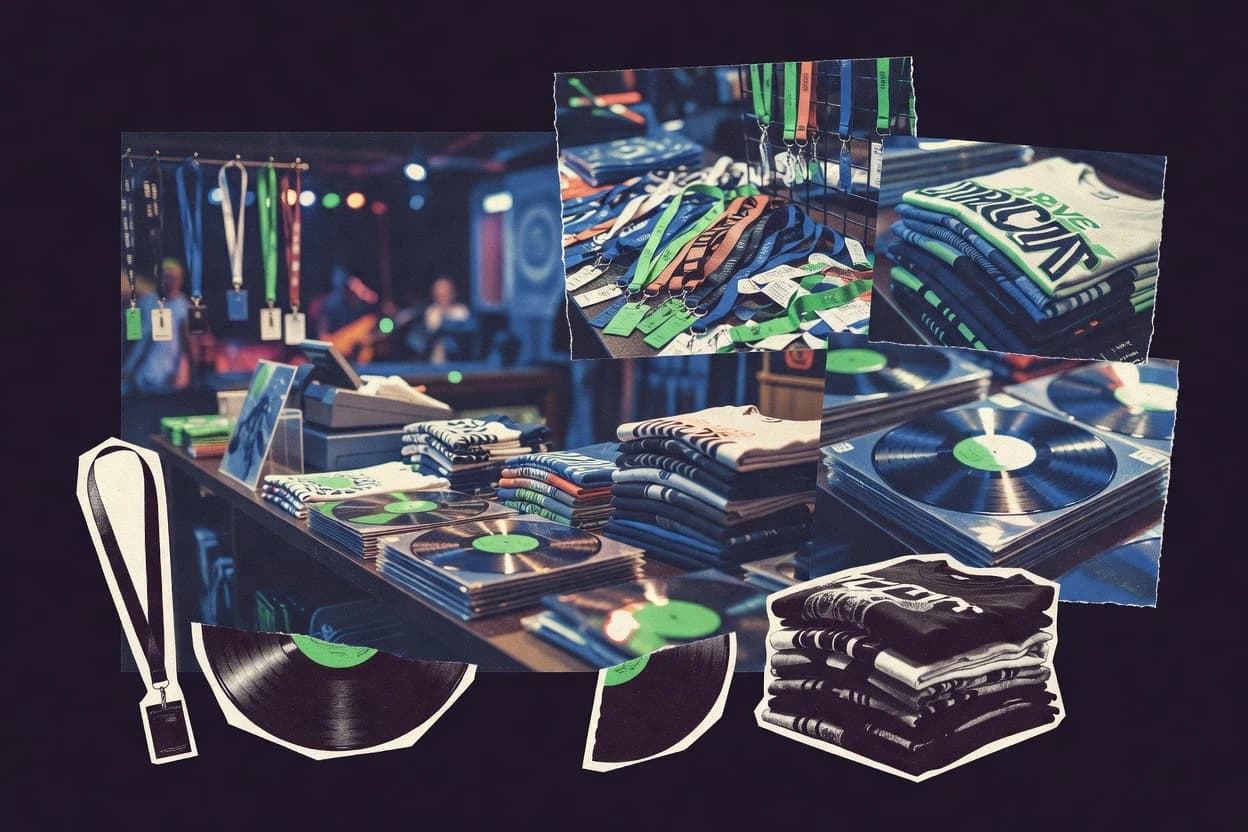

01 Industry overview
The music merchandise industry at a glance
Tracked online music-band merchandise sales reached $277 million in 2025, while the broader global music-merchandise market is forecast to reach $16.3 billion by 2030.
- $277M[1]
- Tracked online sales, 2025
- $16.3B[10]
- Global market forecast, 2030
- 21%[11]
- Concert fans buying merch, 2025
- $10.33[11]
- Average merch spend per attendee, 2025
- Market size
- Tracked online sales across music-band-merchandise retailers totaled $277 million in 2025. MIDiA Research’s broader definition, which includes physical merchandise, digital merchandise and physical music, forecasts the global market at $16.3 billion by 2030.[1][10]
- Forecast & CAGR
- MIDiA Research forecasts the global merchandise market to reach $16.3 billion by 2030, with annual growth slowing to 1.6%. Grips Intelligence expects tracked online music-band-merchandise revenue to grow by 20%–50% in 2026, although this is a platform-tracked estimate rather than a whole-market forecast.[10][1]
- Market share & regions
- The available regional benchmark is from recorded music rather than merchandise: the United States and Canada represented 40.3% of global recorded-music revenue in 2024, while Latin America recorded 22.5% revenue growth. These figures indicate the relative scale and momentum of important music-consumer regions but should not be treated as merchandise market shares.[12]
- Segmentation
- Music merchandise is commonly segmented into apparel, physical music and collectibles, including shirts, hats, vinyl records, CDs, cassettes, posters and other fan items. MIDiA Research also includes digital merchandise such as in-game items in its market definition, while Grips Intelligence tracks apparel, vinyl, posters, CDs and collectibles across online retailers.[10][1]
- Key players & concentration
- Merchbar says its weekly charts track nearly 100,000 music-merchandise items and thousands of artists, indicating a fragmented long tail of artist and retailer offerings. Grips Intelligence’s benchmark covers more than 20 retailers, but neither source provides a reliable industry-wide concentration ratio.[13][1]
- Pricing
- AtVenu reported an average concert merchandise spend of $10.33 per attendee in 2025, up 3% from the prior year. Its benchmark also gives a representative band-tee comparison of approximately $36 per shirt, although product prices vary substantially by artist, garment and sales channel.[11]
- Trends, drivers & challenges
- Demand is being supported by direct-to-fan commerce, touring and renewed interest in physical music. AtVenu reported that 21% of concert fans bought merchandise in 2025, while MIDiA identifies physical, digital and fan-identity products as parts of the market; Grips Intelligence reported that tracked online sales declined in 2025 before forecasting a 20%–50% rebound in 2026.[11][10][1]
- Consumer behavior & competition
- AtVenu found that 21% of fans purchased merchandise at concerts in 2025, versus 20% in 2024, and average merchandise spend per attendee rose 3% to $10.33. Competition spans artist webstores, venue and tour sales, specialist retailers and marketplaces; Merchbar reports tracking nearly 100,000 items across thousands of artists.[11][13]
- Latest news
- The latest available market update from September 2026 reported $277 million in tracked online music-band-merchandise sales for 2025 and forecast 20%–50% growth for 2026. Separately, MIDiA’s latest published market outlook puts the broader global merchandise market at $16.3 billion by 2030.[1][10]
02 Ranking
Top 10 Companies in the Music Merchandise Industry
The leading companies in the music merchandise industry, ranked on market impact, performance, momentum, innovation and brand popularity.
Updated November 20, 2026 · Next review December 20, 2026
Merch Traffic stands out for worldwide coverage across tour, retail and e-commerce because it operates worldwide across tour, retail and e-commerce merchandise, while Mushroom Group focuses on Australasian touring merchandise since it supplies merchandising at scale as one of Australasia’s largest merchandise manufacturers and touring suppliers.
Ranked by Overall score · How we score ↓
Editor's top 3 picks
Where to start, by need.
#1 Overall · Leader in artist merchandise services
Merch Traffic
US
Ranked #1 · 9.6 · Artist merchandise services
Why we picked it: It operates worldwide across tour, retail and e-commerce, including pop-ups and brand collaborations.
Leader in touring and retail supply
Mushroom Group
AU
Ranked #2 · 9.2 · Touring and retail supply
Why we picked it: It focuses on Australasian touring merchandise and artist e-commerce, with scale in local manufacturing and supply.
Leader in brand licensing merchandise
Bravado
US
Ranked #4 · 9.0 · Brand licensing merchandise
Why we picked it: UMG describes it as its global, full-service merchandise business, with revenue growth down 3.7%.
Pick 1 is the #1 company overall. Picks 2 and 3 are the highest-ranked companies in the top 5 that add a new segment.
Full ranking
| # | Company | Overall ↓ | Impact | Performance | Momentum | Innovation | Company snapshot |
|---|---|---|---|---|---|---|---|
| 1 | Merch Traffic Artist merchandise services · US | 9.6 | 9.8 | 9.9 | 9.9 | 9.2 | |
Company snapshot · Merch Traffic · Data as of November 20, 2026 Merch Traffic operates worldwide across tour, retail, e-commerce, pop-ups and brand collaborations.[14]
| |||||||
| 2 | Mushroom Group Touring and retail supply · AU | 9.2 | 8.7 | 9.9 | 9.9 | 9.2 | |
Company snapshot · Mushroom Group · Data as of November 20, 2026 Mushroom says it is one of Australasia's largest merchandise manufacturers and touring suppliers.[15]
| |||||||
| 3 | Ceremony of Roses Artist merchandise services · US | 9.0 | 8.7 | 9.5 | 9.4 | 9.2 | |
Company snapshot · Ceremony of Roses · Data as of November 20, 2026 Ceremony of Roses provides global merchandise sales, production and distribution for major artists.[16]
| |||||||
| 4 | Bravado Brand licensing merchandise · US | 9.0 | 9.9 | 7.8 | 7.9 | 9.9 | |
Company snapshot · Bravado · Data as of November 20, 2026 UMG describes Bravado as its global, full-service merchandise business.[17]
| |||||||
| 5 | Townsend Music Direct-to-fan store platforms · GB | 9.0 | 7.5 | 9.9 | 9.9 | 9.9 | |
Company snapshot · Townsend Music · Data as of November 20, 2026 Townsend says its platform runs more than 1,000 e-commerce artist stores.[18]
| |||||||
| 6 | Global Merchandising Services Global music, celebrity and entertainment merchandising · GB | 8.8 | 8.7 | 8.5 | 9.1 | 9.2 | |
Company snapshot · Global Merchandising Services · Data as of November 20, 2026 Global describes itself as the largest independent company in its merchandising sector.[19]
| |||||||
| 7 | Perryscope Productions Music licensing, merchandise and artist e-commerce · US | 8.8 | 7.5 | 9.5 | 9.9 | 9.2 | |
Company snapshot · Perryscope Productions · Data as of November 20, 2026 Perryscope is an independent full-service licensing and merchandising company for iconic music artists.[20]
| |||||||
| 8 | Absolute Garments Licensed music merchandise design and production · GB | 8.5 | 7.5 | 9.5 | 8.9 | 8.5 | |
Company snapshot · Absolute Garments · Data as of November 20, 2026 Absolute Garments specialises in officially licensed music and entertainment merchandise.[21]
| |||||||
| 9 | Rock Off Trade Licensed music merchandise manufacturing and wholesale · GB | 7.8 | 7.0 | 8.7 | 8.4 | 7.0 | |
Company snapshot · Rock Off Trade · Data as of November 20, 2026
| |||||||
| 10 | Backstage Rock Shop Finnish and European artist merchandise services · FI | 7.4 | 7.0 | 7.0 | 7.0 | 8.5 | |
Company snapshot · Backstage Rock Shop · Data as of November 20, 2026 Backstage Rock Shop operates more than 60 official artist stores and manages complete tour merchandising in Finland.[22]
| |||||||
How we score
- Impact (30%): scale and weight in the market (revenue, market share, employees, market position).
- Performance (20%): recent revenue growth and operating margin; an analyst assessment where a company does not publish them.
- Momentum (20%): growth trajectory and future potential.
- Innovation (15%): R&D intensity and how technologically advanced the company is.
Popularity (brand search demand, 15%) counts toward Overall but is not published as a column. Overall leaves out what is not known.
Scale Scores are shown on a 7–10 scale with one decimal; bars start at 7.0.
Cadence Recalculated when new figures are published; next review December 20, 2026.
Independence. Rankings are editorially independent. Scores, ranks, picks and the verdict follow the method above; no company can pay to change them.
Cite this ranking
APA
Samuel Norberg. (2026, November 20). Top 10 companies in the music merchandise industry. In Music Merchandise Industry Statistics. Gitnux. https://gitnux.org/music-merchandise-industry-statistics/#top-companies
Share of South Korean music merchandise purchasers who purchased each merchandise item in 2024
Photos/Posters/Bromides leads with 53.8%.
03 Trends & forecasts
Top 10 Music Merchandise Industry Trends & Forecasts 2027
What is changing in the music merchandise industry, with the evidence behind each trend and a forecast for 2027.
Forecasts were generated by an AI model from the cited evidence. They are estimates, not guarantees.
01Concert merch demand edges higher
High confidenceAtVenu reported that 21% of concert fans bought merchandise in 2025, up from 20% in 2024, while average merchandise spend per attendee rose 3% to $10.33. Live Nation also reported fan attendance rising 5% to 159 million in 2025.[11][23]
Forecast 2027: In 2027, concert merchandise participation should remain near 21%–22% of attendees, with per-attendee spending rising modestly as touring and attendance remain resilient. Growth will be strongest at stadium tours, festivals and high-fandom events.
02Online merch rebounds sharply
Medium confidenceGrips Intelligence tracked $277 million in online music-band-merchandise sales in 2025, down 20%–50% from the previous year, but forecast 20%–50% growth for 2026. Its benchmark covers more than 20 online retailers and includes apparel, vinyl, posters, CDs and collectibles.[1]
Forecast 2027: The 2026 rebound should carry into 2027, but growth is likely to normalize to roughly 10%–20% as the comparison base strengthens. Artist webstores and specialist retailers should capture most of the incremental online demand.
03Global merchandise growth moderates
High confidenceMIDiA Research forecasts the broader global merchandise market—including physical merchandise, digital merchandise and physical music—to reach $16.3 billion by 2030, with annual growth slowing to 1.6%. This broader definition is materially larger than tracked online band-merchandise sales.[10]
Forecast 2027: The market should expand in 2027 but at a low-single-digit rate, probably around 2%–3%, with mature physical categories offsetting faster growth in digital and fan-identity products. Reported growth will vary significantly by market definition.
04Vinyl remains a premium merch anchor
High confidenceU.S. vinyl revenue reached $1.04 billion in 2025, up 7.9%, while unit sales reached 46.8 million, according to the RIAA. Globally, IFPI reported vinyl revenue growth of 13.7% in 2025 and its 19th consecutive year of growth.[24][25]
Forecast 2027: Vinyl should continue growing in 2027, but likely at a slower mid-single-digit pace as capacity, pricing and collector saturation constrain expansion. Limited editions, colored variants and bundled artist releases will support premium pricing.
05Physical formats diversify beyond vinyl
Medium confidenceMIDiA includes vinyl, CDs and cassettes within the physical-music component of merchandise. UMG’s 2025 annual report confirms that physical products—including vinyl records, CDs and cassette tapes—remain part of its retail and online product portfolio.[10]
Forecast 2027: In 2027, CDs, cassettes and deluxe physical bundles should remain important as lower-cost or novelty alternatives to vinyl. Growth will be concentrated in special editions and fan-club products rather than standard catalog formats.
06Artist-specific products broaden assortments
High confidenceMIDiA reported that the merch-and-live category grew 21.5% in 2025 and highlighted bespoke products such as incense, pajamas and home fragrance. It also noted the proliferation of on-demand merchandise startups serving artists of different sizes.[10]
Forecast 2027: By 2027, merchandise assortments should continue moving beyond shirts and hoodies toward lifestyle, home, beauty and collectible products. These categories will raise average order values but also increase design, licensing and inventory complexity.
07On-demand production reduces inventory risk
Medium confidenceMIDiA identified a proliferation of on-demand merch startups helping artists meet fan demand. This model allows smaller artists to offer broader catalogs without committing to large production runs.[10]
Forecast 2027: In 2027, print-on-demand and made-to-order production should gain share among independent artists and niche fan communities. The trade-off will be higher unit costs and greater pressure to manage fulfillment quality and delivery times.
08Direct-to-fan channels gain leverage
High confidenceUMG describes direct-to-consumer activity, artist websites, fan clubs, touring and physical merchandise as part of its expanded-rights strategy. Merchbar says its platform helps unify artist access to fans and supports merchandise distribution beyond traditional tour and mass-retail formats.[13]
Forecast 2027: In 2027, labels and artists should place greater emphasis on owned customer data, email lists, memberships and artist webstores. Marketplaces will remain useful for discovery, but direct channels should receive more exclusive products and preorder access.
09International fandom supports touring merch
Medium confidenceLive Nation reported that 20% of fans attending its top 50 tours in 2025 were there for international acts. Its global fan study also found that 71% of fans listened to artists outside their native language, while 84% said live music unites across borders.[23]
Forecast 2027: In 2027, international tours and cross-border online sales should increase demand for localized shipping, sizing, currencies and regional designs. Latin American and Asian fan markets are likely to be especially important growth targets, although merchandise share data remains limited.
10Merchandise prices face upward pressure
High confidenceAtVenu reported average concert merchandise spending of $10.33 per attendee in 2025, up 3% year over year, and cited an approximate $36 representative price for a band T-shirt. The end price varies by artist, garment quality and sales channel.[11]
Forecast 2027: In 2027, average ticketed-event merchandise prices should rise by roughly 3%–6%, driven by premium garments, production costs and logistics. Artists will increasingly use lower-priced accessories and bundles to preserve conversion among price-sensitive fans.
04 Statistics
Market Intelligence
Tracked online sales totaled $277 million in 2025 across music-band-merchandise retailers, covering apparel, vinyl, posters, CDs and collectibles.
Market size, volume and shipments in the music merchandise industry
- $277 million was the aggregate online gross merchandise value for music band merchandise across tracked retailers in 2025; the category includes band apparel, vinyl records, posters, CDs and collectible items.[1]
05 Statistics
Production & Operations
Vinyl production capacity reached 443 million discs in 2025, with 90 vinyl-record pressing plants listed worldwide in September 2026.
Installed base and productive capacity in music merchandise
- 443 million discs was the estimated global vinyl-record production capacity for 2025, covering pressing plants serving the recorded-music merchandise supply chain.[2]
- 90 vinyl-record pressing plants with presses on site were listed worldwide in September 2026, indicating the reported installed plant base for this music-merchandise format.[3]
- Around 10 new vinyl-record pressing plants began operating during 2024, expanding the productive asset base serving music merchandise producers worldwide.[2]
06 Statistics
Pricing & Finance
Artist payout ranges vary by fulfillment model, and venue commissions can change outcomes, including a $25 shirt yielding about $13 after payment processing and overhead.
Margins and profitability in the music merchandise industry
- Independent artists retain approximately 59%–74% of retail on bulk screen-printed T-shirts sold direct, after production costs but before other overheads (2026).[4]
- Online merchandisers typically retain about 20% of sales when artists supply finished goods; this rises to 65%–70% when the merchandiser manufactures and ships the merchandise, leaving artists 30%–35% of sales (2024).[5]
- Independent artists retain approximately 51%–59% of retail on comparable print-on-demand T-shirts sold direct, after production costs but before other overheads (2026).[4]
- A $25 merchandise shirt with an $8 unit cost and a 15% venue commission yields about $13 after payment processing and overhead, illustrating the effect of venue deductions on merchandise profitability (2026).[6]
07 Statistics
Regulation & Risk
Counterfeit enforcement is active, including 98 Iron Maiden, AC/DC and Rammstein T-shirts seized in Hamburg in April 2024 and destroyed in June 2024.
Counterfeiting and grey-market supply of music merchandise
- Bootleg Travis Scott merchandise sold for approximately half the price of authorized tour merchandise in the United States and Canada during the artist’s 2023 tour.[7]
- Around £26,000 was generated from counterfeit Beatles and Metallica T-shirt sales over nine months in Weston-super-Mare, United Kingdom, according to a 2026 Trading Standards prosecution.[8]
- 98 counterfeit T-shirts bearing Iron Maiden, AC/DC and Rammstein marks were seized from a China-origin container in Hamburg, Germany, on 18 April 2024 and destroyed on 20 June 2024.[9]
- Hundreds of counterfeit music-artist T-shirts were identified across eBay, Etsy and a seller website in a 2026 North Somerset Trading Standards investigation in the United Kingdom.[8]
Key questions about the music merchandise industry
How large is the online music-band merchandise market?
What growth should operators expect in 2026?
Which companies lead the music merchandise industry?
What technology shifts matter for merchandise operations?
How fragmented is the market structure for music merch offerings?
How do pricing and venue deductions affect per-item profitability?
Cite This Report
This report is designed to be cited. We maintain stable URLs and versioned verification dates. Copy the format appropriate for your publication below.
Samuel Norberg. (2026, November 20). Music Merchandise Industry Statistics. Gitnux. https://gitnux.org/music-merchandise-industry-statistics
Samuel Norberg. "Music Merchandise Industry Statistics." Gitnux, 20 Nov 2026, https://gitnux.org/music-merchandise-industry-statistics.
Samuel Norberg. 2026. "Music Merchandise Industry Statistics." Gitnux. https://gitnux.org/music-merchandise-industry-statistics.
Sources & references
25 sources cited across this report
gripsintelligence.com
futuresource-consulting.com
- thevinylmap.com
- chartlex.com
wipo.int
- openmusicbusiness.com
govinfo.gov
- n-somerset.gov.uk
presseportal.de
midiaresearch.com
atvenu.com
- musicpei.com
merchbar.com
- merchtraffic.com
- mushroomgroup.com
sonymusic.co.uk
assets.ctfassets.net
musicweek.com
- globalmerchservices.com
- perryscope.us
- absolutegarments.com
- backstagerockshop.com
investors.livenationentertainment.com
riaa.com
ifpi.org