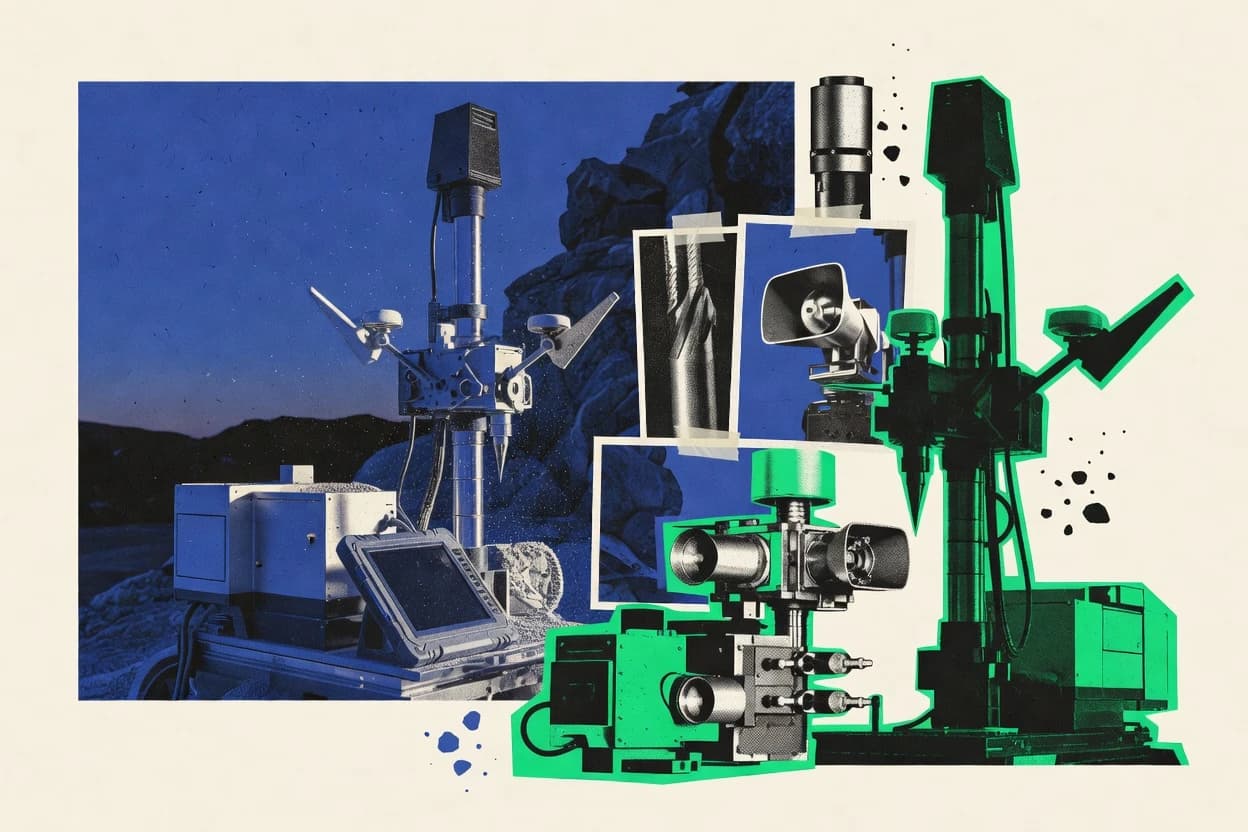

01 Industry overview
The millimeter wave drilling industry at a glance
Millimeter-wave drilling remains a pre-commercial geothermal technology, but investment accelerated in 2026 as Quaise raised $180 million and advanced toward commercial superhot-rock deployment.
- $180M[1]
- Quaise Series B funding, 2026
- 118 m[2]
- Record demonstrated depth, 2025
- 14%[3]
- Nabors ownership of Quaise, 2026
- 400°C[4]
- Target superhot-rock temperature
- Market share & regions
- The technology is concentrated in the United States, where Quaise has demonstrated the system in Texas and is developing Project Obsidian in Oregon. Public sources identify no reliable regional market-share percentages for millimeter-wave drilling, which remains pre-commercial.[2][3]
- Segmentation
- The principal commercial pathway is hybrid drilling: conventional rotary equipment is used through upper formations, while gyrotron-powered millimeter-wave equipment targets deeper, hotter hard rock. The stated application is superhot geothermal development, rather than an established oil-and-gas drilling market.[3][5]
- Key players & concentration
- Quaise is the only company identified in the reviewed sources as commercializing gyrotron-based millimeter-wave drilling, while Nabors is its principal drilling-rig and strategic investment partner. Nabors’ 2026 investment made it Quaise’s largest shareholder with 14% fully diluted ownership, indicating high concentration around one technology developer and one major drilling contractor.[3][5]
- Trends, drivers & challenges
- The main driver is the potential to reach superhot rock at approximately 400°C, where conventional drill bits face severe wear and temperature limitations. The principal challenges are scaling from a 118-meter field demonstration to commercial well depths, integrating the waveguide and gyrotron with drilling rigs, and proving reliability and economics in geothermal wells.[4][2][6]
- M&A
- No acquisition was identified in the reviewed sources. The most significant transaction was Nabors’ $35 million strategic equity investment in August 2026, which increased its fully diluted ownership of Quaise to 14% and included a framework for exclusive drilling services supporting Quaise geothermal projects.[3]
- Latest news
- The latest major development was Quaise’s September 2026 announcement, reported by MIT, that it had raised $180 million in Series B financing and brought total disclosed funding to $280 million. The financing is intended to advance Project Obsidian, a commercial superhot geothermal plant in Oregon, and its millimeter-wave drilling system.[1][3]
02 Trends & forecasts
Top 10 Millimeter Wave Drilling Industry Trends & Forecasts 2027
What is changing in the millimeter wave drilling industry, with the evidence behind each trend and a forecast for 2027.
Forecasts were generated by an AI model from the cited evidence. They are estimates, not guarantees.
01Series B funding accelerates commercialization
High confidenceQuaise raised $180 million in Series B financing in September 2026, bringing disclosed total funding to $280 million. The capital is earmarked for Project Obsidian and continued millimeter-wave drilling development.[7]
Forecast 2027: Funding momentum should remain strong in 2027, but additional capital is likely to become milestone-based as investors demand evidence of kilometer-scale drilling, well completion and power production. Confidence is high because the financing has already moved the technology beyond laboratory-stage funding.
02Strategic drilling-contractor alignment deepens
High confidenceNabors invested $35 million in Quaise in August 2026, becoming its largest shareholder with 14% fully diluted ownership. The agreement also established an exclusivity framework for drilling services on Quaise geothermal projects.[3]
Forecast 2027: In 2027, the industry is likely to rely increasingly on partnerships between technology developers and established drilling contractors rather than standalone millimeter-wave equipment companies. This should accelerate rig integration while reinforcing Quaise-Nabors concentration.
03Hybrid drilling becomes the default pathway
High confidenceQuaise and Nabors demonstrated a full-scale hybrid rig in 2025 that combined conventional rotary drilling with millimeter-wave equipment. The model uses conventional drilling through upper formations before applying electromagnetic rock ablation in deeper, hotter sections.[2][6]
Forecast 2027: By 2027, commercial demonstrations should continue to use hybrid systems rather than fully replacing rotary drilling. The main development priority will be reducing switching time, improving waveguide handling and integrating controls with existing rig systems.
04Demonstrated depth moves toward kilometer scale
Medium confidenceQuaise reported drilling 118 meters in granite in 2025 and said its field team was preparing to reach one kilometer in 2026. The 2025 milestone was achieved after the system moved from laboratory work into a quarry field test.[2]
Forecast 2027: The defining 2027 benchmark will be repeatable kilometer-scale drilling, not another short demonstration. If Quaise reaches or approaches that level, the technology will move closer to geothermal-well validation; otherwise, commercial timelines will likely slip.
05Higher-power gyrotrons become essential
Medium confidenceQuaise’s drilling platform transmits high-frequency electromagnetic energy downhole through a waveguide, while its development roadmap has emphasized progression from laboratory systems to field-scale power. The company’s demonstrations have already moved beyond laboratory testing into full-scale rig integration.[2][3]
Forecast 2027: In 2027, procurement and field qualification of higher-power, continuously operated gyrotrons should become a central supply constraint. Progress will depend on improving power availability, duty cycle, cooling and reliability rather than only increasing beam power.
06Project Obsidian anchors early demand
High confidenceQuaise is developing Project Obsidian near Newberry Volcano in Oregon as a commercial superhot geothermal plant. Nabors said the first phase is planned at 50 megawatts, with later phases targeting up to 1 gigawatt of additional capacity.[7][3]
Forecast 2027: Project Obsidian should remain the primary demand signal for millimeter-wave drilling in 2027. Drilling-system orders, site work and well-construction contracts are likely to be tied closely to its schedule rather than to a broad commercial market.
07Federal support expands the addressable market
High confidenceDOE announced a $171.5 million funding opportunity in February 2026 for next-generation geothermal field tests and exploration drilling. In November 2026, ARPA-E selected eight projects for award negotiations under a superhot-geothermal program worth up to $30 million.[8][9]
Forecast 2027: Federal programs should continue to support adjacent technologies in 2027, including high-temperature wells, materials, monitoring and heat extraction. This will enlarge the ecosystem around millimeter-wave drilling even if direct procurement of the drilling system remains limited.
08Superhot resources strengthen the demand case
Medium confidenceARPA-E defines superhot geothermal resources as temperatures above 375°C and pressures above 22 megapascals, while its November 2026 program said individual wells could potentially deliver more than current geothermal systems. Quaise targets rock temperatures of approximately 400°C for superhot geothermal development.[9]
Forecast 2027: In 2027, demand discussions should shift from generic geothermal expansion toward the productivity and baseload value of superhot wells. This will increase interest in millimeter-wave drilling, but only where the resource temperature premium offsets the technology’s higher development risk.
09U.S. regional concentration persists
High confidencePublic demonstrations and commercial development are concentrated in the United States: Quaise reported its 118-meter test in central Texas, while Project Obsidian is being developed in Oregon. USGS estimated 135 gigawatts of potential EGS capacity in the Great Basin, subject to successful commercialization of emerging technologies.[2][10]
Forecast 2027: The United States should remain the center of millimeter-wave drilling activity in 2027, with Texas supporting technology testing and western states supporting geothermal deployment. International expansion is likely to remain exploratory until a commercial U.S. reference project is operating.
10High-temperature materials become a bottleneck
High confidenceDOE’s SUPERHOT program specifically targets robust wells lasting at least 15 years and identifies new materials, well designs and validation facilities as core needs. Proposed projects include FeCrAl alloys, advanced cements, ceramic liners and composite pipe systems for extreme geothermal conditions.[11][9]
Forecast 2027: In 2027, millimeter-wave drilling suppliers will increasingly be evaluated together with casing, cement, liner, sensor and completion technologies. Commercial progress will depend on proving that the complete well system survives superhot conditions, not merely that the beam can remove rock.
Cite This Report
This report is designed to be cited. We maintain stable URLs and versioned verification dates. Copy the format appropriate for your publication below.
Samuel Norberg. (2026, November 20). Millimeter Wave Drilling Industry Statistics. Gitnux. https://gitnux.org/millimeter-wave-drilling-industry-statistics
Samuel Norberg. "Millimeter Wave Drilling Industry Statistics." Gitnux, 20 Nov 2026, https://gitnux.org/millimeter-wave-drilling-industry-statistics.
Samuel Norberg. 2026. "Millimeter Wave Drilling Industry Statistics." Gitnux. https://gitnux.org/millimeter-wave-drilling-industry-statistics.
Sources & references
11 sources cited across this report