
01 Industry overview
The digital twin food industry at a glance
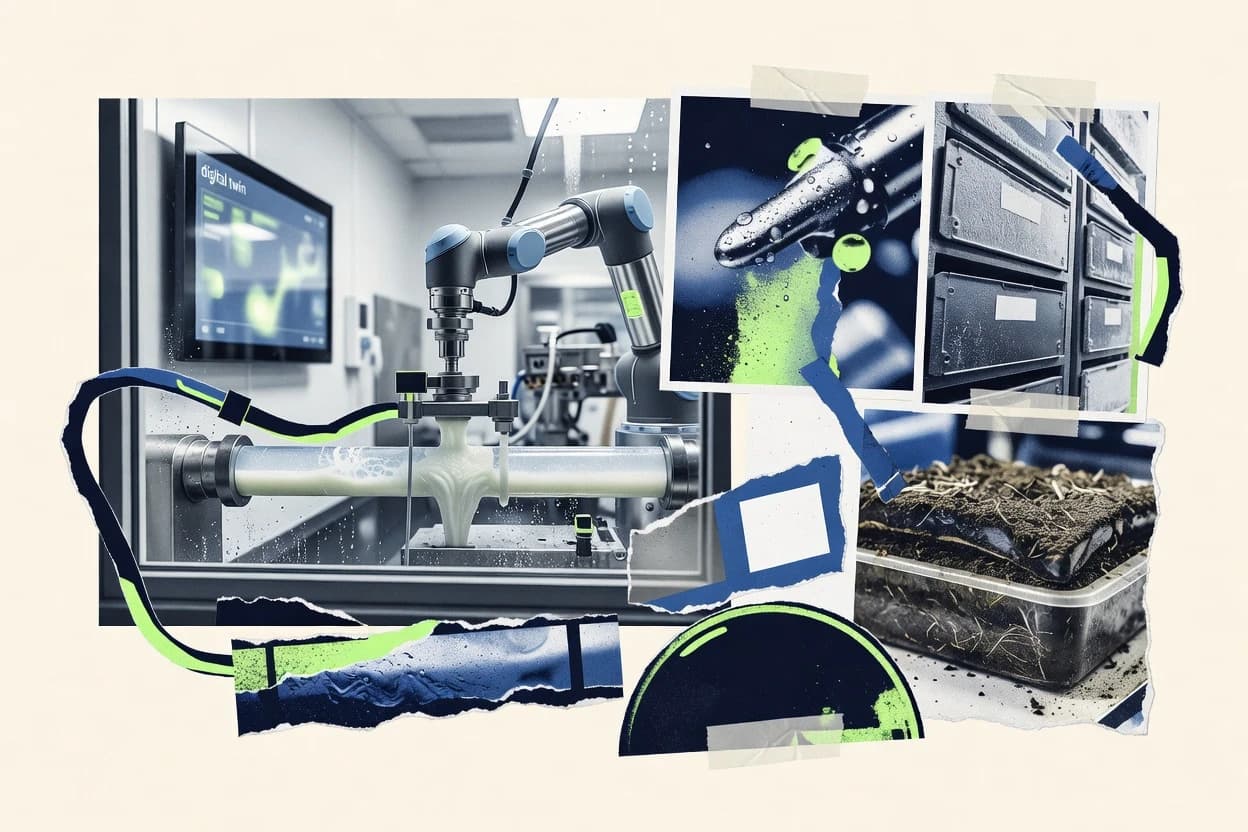
Food digital twins remain an early-stage manufacturing technology: Siemens reported a 10% capacity increase at a Pringles plant in 2026 without new machinery, alongside 13% lower waste and 7% lower energy use.
- 10%[2]
- Pringles capacity increase, 2026
- 9%[3]
- Food firms using digital twins, 2025
- 21%[3]
- Planning adoption within 12 months, 2025
- $1.1M[4]
- Annual savings in food plant case
- Segmentation
- Food-industry digital-twin applications span production scheduling, process simulation, recipe and product modeling, quality inspection, energy management, predictive maintenance, logistics and supply-chain planning. A 2025 food-manufacturing survey found that 9% of respondents were already using digital-twin technology, while 21% planned to implement it within 12 months.[3]
- Key players & concentration
- The market is supplied by industrial-software and automation companies rather than a clearly measurable group of food-specific digital-twin vendors. Named deployments include Siemens with Kellanova’s Pringles operation, IES with Morrisons’ Winsford facility, and CreateASoft with a food and beverage manufacturing plant; no reliable concentration ratio was identified.[5][6][4]
- Trends, drivers & challenges
- Current deployments emphasize higher throughput, lower waste, energy efficiency and faster operational decisions. Siemens reported 10% higher capacity, 13% lower waste and 7% lower energy use at a Pringles plant in 2026, while a separate food-manufacturing case reported $1.1 million in sustained annual savings and a 6.3-month payback period; adoption remains constrained because 53% of surveyed food companies said they did not plan to use digital twins.[2][4][3]
- Consumer behavior & competition
- Direct consumer adoption data for food digital twins is not reliably reported because the technology is primarily used behind the factory, supply-chain and food-safety interfaces. Competition is therefore centered on operational outcomes: Siemens’ Pringles deployment used a digital twin of dough and production processes, while an IEEE 2025 case used a twin to optimize production configuration, workforce allocation and order-deadline fulfillment.[5][7]
- M&A
- The most relevant recent food-sector transaction was Mars’ acquisition of Kellanova, completed on December 11, 2025. Mars said the combined snacking business was expected to generate around $36 billion in annual revenue, operate 80 production facilities and serve more than 145 markets; the transaction is relevant because Kellanova’s Pringles business is a prominent digital-twin deployment.[8][9]
- Regulation
- Food digital twins are developing within existing food-safety, labeling, data-governance and AI rules rather than under a dedicated digital-twin regime. A 2026 legal analysis found that EU food law, including Regulation (EC) No. 178/2002 and the EU AI Act, does not currently prevent applications such as AI-supported shelf-life assessment, but emphasized the need for clear responsibility and consumer information.[10]
- Latest news
- In November 2026, Siemens highlighted the Pringles plant in Kutno, Poland, where a digital twin covering dough, ingredients, packaging and production lines was credited with a 10% capacity increase, 13% reduction in scrap and 7% lower energy consumption without new machinery.[2]
02 Ranking
Top 10 Companies in the Digital Twin Food Industry
The leading companies in the digital twin food industry, ranked on market impact, performance, momentum, innovation and brand popularity.
Updated November 21, 2026 · Next review December 21, 2026
Microsoft stands out for Cloud and IoT industrial digital twins because it is listed among major digital-twin models providers serving food manufacturing, while Oracle focuses on cloud data and supply-chain digital twins since it is listed among major digital-twin models providers for food manufacturing.
Ranked by Overall score · How we score ↓
Editor's top 3 picks
Where to start, by need.
#1 Overall · Leader in digital twin platforms
Microsoft
US
Ranked #1 · 9.8 · Digital twin platforms
Why we picked it: It serves food manufacturing via Cloud, IoT and industrial digital twins, with R&D at 12% of revenue.
#2 overall
Oracle
US
Ranked #2 · 9.5 · Digital twin platforms
Why we picked it: It focuses on cloud data and supply-chain digital twins for food manufacturing, with 17% revenue growth.
Leader in industrial equipment twins
Schneider Electric
FR
Ranked #3 · 9.1 · Industrial equipment twins
Why we picked it: Its EcoStruxure Machine digital twins cover food and beverage equipment used in factory operations.
Pick 1 is the #1 company overall. Pick 2 is the highest-ranked company in the top 5 that adds a new segment; no further segment places in the top 5, so pick 3 follows rank.
Full ranking
| # | Company | Overall ↓ | Impact | Performance | Momentum | Innovation | Company snapshot |
|---|---|---|---|---|---|---|---|
| 1 | Microsoft Digital twin platforms · US | 9.8 | 9.9 | 9.8 | 9.8 | 9.4 | |
Company snapshot · Microsoft · Data as of November 21, 2026 Microsoft is listed among major digital-twin models providers serving food manufacturing.[11]
| |||||||
| 2 | Oracle Digital twin platforms · US | 9.5 | 9.1 | 9.9 | 9.9 | 9.2 | |
Company snapshot · Oracle · Data as of November 21, 2026 Oracle is listed among major digital-twin models providers for food manufacturing.[11]
| |||||||
| 3 | Schneider Electric Industrial equipment twins · FR | 9.1 | 9.3 | 8.5 | 9.9 | 8.5 | |
Company snapshot · Schneider Electric · Data as of November 21, 2026 EcoStruxure Machine digital twins are used for food and beverage production equipment.[12]
| |||||||
| 4 | SAP Digital twin platforms · DE | 9.1 | 9.0 | 8.9 | 9.3 | 9.6 | |
Company snapshot · SAP · Data as of November 21, 2026 SAP is listed among leading digital-twin models providers for food manufacturing.[11]
| |||||||
| 5 | Siemens Digital twin platforms · DE | 9.0 | 9.6 | 7.6 | 9.1 | 8.9 | |
Company snapshot · Siemens · Data as of November 21, 2026 Siemens offers digital twins for recipes, production and traceability in food and beverage.[13]
| |||||||
| 6 | Bentley Systems Infrastructure and process digital twins · US | 8.6 | 7.0 | 9.0 | 9.0 | 9.6 | |
Company snapshot · Bentley Systems · Data as of November 21, 2026 Bentley Systems is listed among digital-twin models providers for food manufacturing.[11]
| |||||||
| 7 | ABB Industrial automation and digital twins · CH | 8.5 | 8.9 | 8.5 | 9.4 | 7.9 | |
Company snapshot · ABB · Data as of November 21, 2026 ABB is identified as a major digital-twin provider for food manufacturing models.[11]
| |||||||
| 8 | Krones Beverage and food production-line systems · DE | 8.5 | 8.4 | 7.6 | 8.8 | 9.3 | |
Company snapshot · Krones · Data as of November 21, 2026 Krones is included among digital-twin models providers serving food manufacturing.[11]
| |||||||
| 9 | Dassault Systèmes Virtual twins for food products and supply chains · FR | 8.4 | 8.5 | 8.3 | 8.1 | 9.9 | |
Company snapshot · Dassault Systèmes · Data as of November 21, 2026 DELMIA models food production, recipes and supply chains with virtual twin technology.[14]
| |||||||
| 10 | PepsiCo Food and beverage operator using digital twins · US | 7.3 | 7.0 | 7.5 | 7.0 | 7.0 | |
Company snapshot · PepsiCo · Data as of November 21, 2026 PepsiCo launched a multi-year collaboration with Siemens and NVIDIA for plant digital twins.[15]
| |||||||
How we score
- Impact (30%): scale and weight in the market (revenue, market share, employees, market position).
- Performance (20%): recent revenue growth and operating margin; an analyst assessment where a company does not publish them.
- Momentum (20%): growth trajectory and future potential.
- Innovation (15%): R&D intensity and how technologically advanced the company is.
Popularity (brand search demand, 15%) counts toward Overall but is not published as a column. Overall leaves out what is not known.
Scale Scores are shown on a 7–10 scale with one decimal; bars start at 7.0.
Cadence Recalculated when new figures are published; next review December 21, 2026.
Independence. Rankings are editorially independent. Scores, ranks, picks and the verdict follow the method above; no company can pay to change them.
Cite this ranking
APA
Samuel Norberg. (2026, November 21). Top 10 companies in the digital twin food industry. In Digital Twin Food Industry Statistics. Gitnux. https://gitnux.org/digital-twin-food-industry-statistics/#top-companies
Revenue of the largest digital twin food companies
Microsoft leads with $281.7B in annual revenue (group level, converted to USD).
03 Trends & forecasts
Top 10 Digital Twin Food Industry Trends & Forecasts 2027
What is changing in the digital twin food industry, with the evidence behind each trend and a forecast for 2027.
Forecasts were generated by an AI model from the cited evidence. They are estimates, not guarantees.
01Digital-twin adoption moves beyond pilots
High confidenceFood Industry Executive’s 2025 survey found that 9% of food manufacturers were already using digital-twin technology and 21% planned implementation within 12 months, while 53% had no plans to use it. This indicates a large but still cautious conversion pipeline.[3]
Forecast 2027: By 2027, adoption should rise into the mid-teens as early deployments demonstrate measurable capacity, waste and energy benefits. However, most smaller and less automated plants will remain outside the market.
02Cloud MES becomes the data backbone
High confidenceIn the 2025 food-manufacturing survey, 18% of respondents were already using cloud-based manufacturing execution systems, while 51% planned implementation within 12 months. Digital twins increasingly depend on MES data for production status, recipes, labor and quality records.[3]
Forecast 2027: By 2027, cloud MES will be a common prerequisite for new food digital-twin projects, particularly in multi-site manufacturers. Twin vendors will increasingly sell connectors and analytics on top of MES platforms rather than standalone models.
03Warehouse twins expand beyond production
High confidenceThe 2025 survey showed 17% of food manufacturers already using automated warehouse-management systems and 51% planning implementation within 12 months. This creates a growing source of inventory, storage, picking and shipment data for supply-chain twins.[3]
Forecast 2027: By 2027, more deployments will connect plant twins with refrigerated warehousing and distribution models. The strongest use cases will focus on inventory allocation, cold-chain risk and order fulfillment rather than factory simulation alone.
04Recipe twins improve formulation control
High confidenceDigital recipe-management systems were already used by 31% of respondents in 2025, with another 33% planning adoption within 12 months. Siemens and Kellanova also used a digital twin of Pringles dough to model ingredient variability and production behavior.[3][16]
Forecast 2027: By 2027, recipe and process twins should become more closely linked, allowing manufacturers to test ingredient substitutions, supplier variability and reformulations before changing the line. Adoption will be strongest in baked goods, snacks, beverages and other high-volume products.
05Sensor coverage accelerates twin accuracy
High confidenceIoT sensors and equipment monitoring were used by 26% of surveyed food manufacturers in 2025, while 37% planned adoption within 12 months. The Pringles deployment used process data to predict how variations in ingredients affected dough behavior.[3][17]
Forecast 2027: By 2027, sensor retrofits and edge data collection will be a major enabler of food digital twins, especially where plants lack modern equipment. Better data quality should improve model reliability, but poorly calibrated sensors will remain a material implementation risk.
06Energy twins gain commercial priority
High confidenceSmart energy-management systems were used by 18% of respondents in 2025, with 44% planning adoption within 12 months. Siemens reported 7% lower energy use at the Pringles operation after combining digital-twin and AI methods.[3][16]
Forecast 2027: By 2027, energy optimization will be among the most fundable food-twin applications because it can produce measurable operating-cost and emissions benefits. Models will increasingly schedule high-load processes around tariffs, production demand and cleaning cycles.
07Computer vision links quality to process twins
Medium confidenceAutomated quality-inspection and computer-vision systems were already used by 26% of food manufacturers surveyed in 2025, with 35% planning adoption within 12 months. Siemens identifies AI-powered visual quality inspection as a food-manufacturing use case alongside digital twins.[3]
Forecast 2027: By 2027, quality-inspection data will increasingly feed back into process twins for root-cause analysis and real-time parameter adjustment. This should reduce reliance on end-of-line inspection, although validation requirements will limit fully autonomous decisions.
08AI turns twins into operating systems
High confidenceAI and machine learning were used by 22% of surveyed food manufacturers in 2025, while 39% planned adoption within 12 months. CreateASoft reported a food-plant twin generating scheduling recommendations every 15 minutes and delivering $1.1 million in sustained annual savings.[3][4]
Forecast 2027: By 2027, the market will shift from descriptive visualization toward AI-assisted recommendations for scheduling, allocation, cleaning and process control. Vendors that can connect recommendations directly to MES, SCADA and ERP systems should capture more value than dashboard-only providers.
09Predictive maintenance joins twin deployments
High confidencePredictive-maintenance systems were used by 18% of respondents in 2025, with 42% planning implementation within 12 months. Siemens described predictive maintenance as one of the applications developed around the Pringles digital-transformation program.[3][18]
Forecast 2027: By 2027, predictive maintenance will commonly be bundled with production and energy twins rather than purchased separately. The clearest returns will come from bottleneck assets where unplanned downtime has a direct effect on throughput and waste.
10Process simulation supports faster decisions
High confidenceProcess simulation and modeling were used by 9% of food manufacturers in 2025, while 36% planned adoption within 12 months. A CreateASoft food-plant case moved from offline simulation to a connected real-time twin in 12 weeks and reported a 10.2% efficiency improvement.[3][4]
Forecast 2027: By 2027, simulation-led projects should remain the main entry point because they allow plants to test value before connecting live control systems. More projects will progress from offline what-if analysis to closed-loop recommendations as confidence and data maturity improve.
04 Statistics
Market Intelligence
This section provides a single quantified benchmark: USD 185 million in the 2025 North American restaurant digital twin software market.
Market size and revenue in the digital twin food industry
- USD 185 million was the 2025 North American restaurant digital twin software market, covering commercial products, platforms, services and operating models used to manage restaurant activity; bundled scope includes technology infrastructure and customer-facing workflows.[1]
Key questions about the digital twin food industry
What is the market size for digital twin software tied to restaurants in North America?
How fast are food firms planning to adopt digital twins?
Which companies lead the digital twin food industry?
What technology shifts are most evident in food digital twin deployments?
How is the digital twin food market structured by provider type?
What outcomes have been reported from real food plant cases?
Cite This Report
This report is designed to be cited. We maintain stable URLs and versioned verification dates. Copy the format appropriate for your publication below.
Samuel Norberg. (2026, November 21). Digital Twin Food Industry Statistics. Gitnux. https://gitnux.org/digital-twin-food-industry-statistics
Samuel Norberg. "Digital Twin Food Industry Statistics." Gitnux, 21 Nov 2026, https://gitnux.org/digital-twin-food-industry-statistics.
Samuel Norberg. 2026. "Digital Twin Food Industry Statistics." Gitnux. https://gitnux.org/digital-twin-food-industry-statistics.
Sources & references
18 sources cited across this report