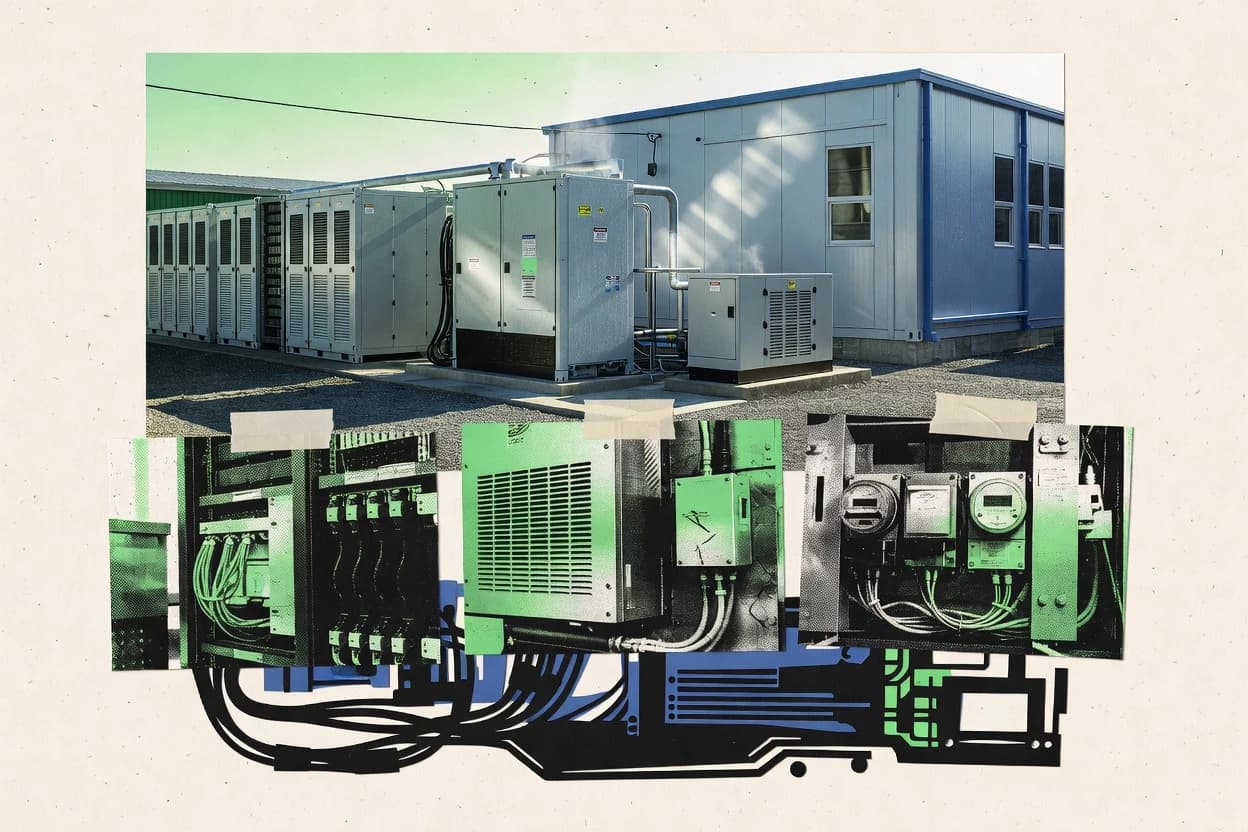

01 Industry overview
The data center microgrid industry at a glance
The global data center microgrid market is projected at $4.60 billion in 2025 and is expanding as AI workloads, grid constraints and resilience requirements drive investment in onsite generation, storage and controls.
- $4.60B[4]
- Global market size, 2025
- 15.0%[4]
- Forecast CAGR, 2026–2032
- 45.19%[9]
- North America share, 2026
- 38.94%[9]
- Hyperscale share, 2026
- Market size
- MarketsandMarkets projects the global data center microgrid market at $4.60 billion in 2025. Its forecast covers power-generation systems, energy storage, switchgear and distribution infrastructure, with grid connectivity and data-center type included as additional dimensions.[4]
- Forecast & CAGR
- The market is projected to reach $12.26 billion by 2032 from $4.60 billion in 2025, representing a 15.0% CAGR during the forecast period. North America is forecast to grow at 14.7% annually, Europe at 13.6% and Asia-Pacific at 16.8%.[4]
- Market share & regions
- North America accounted for 45.19% of the broader data-center energy-storage and microgrids market in 2026, the largest regional share. In the narrower data center microgrid market, MarketsandMarkets estimates 2025 revenues of $1.82 billion in North America, $1.31 billion in Asia-Pacific, $1.04 billion in Europe and $0.43 billion in the rest of the world.[9][4]
- Segmentation
- The market is segmented by component, including power-generation systems, energy-storage systems, switchgear and distribution infrastructure; by power source, including natural gas, solar PV and fuel cells; and by data-center type, including hyperscale, colocation and enterprise facilities. In the broader adjacent market, grid-connected microgrids represented 59.97% of 2026 revenue and lithium-ion batteries represented 62.32%.[4][9]
- Key players & concentration
- Public market pages identify major participants including Vertiv, Generac, Bloom Energy, Schneider Electric, Siemens, Eaton and Caterpillar, but do not provide a reliable CR4 or HHI concentration figure. Scale Microgrids reported 250 MW of operating and in-construction assets and a 2.5 GW near-term pipeline, illustrating the presence of specialized developers alongside large equipment suppliers.[6][9]
- Trends, drivers & challenges
- Long grid-connection timelines, AI-related load variability, power-resilience requirements and renewable integration are driving adoption. Mordor Intelligence identifies power resilience as a driver with a stated +5.2% impact on forecast CAGR and AI-related load variability at +4.8%; key challenges include grid constraints, interconnection delays, emissions concerns and the complexity of integrating generation, storage and controls.[9][4]
- Consumer behavior & competition
- Data-center operators are increasingly buying integrated solutions that combine onsite generation, battery storage, electrical equipment and operating controls rather than standalone backup assets. Cloud service providers represented 45.01% of the broader market’s 2026 revenue, while hyperscale facilities represented 38.94%, indicating that competition is concentrated around large, power-intensive customers.[9]
- M&A
- M&A is expanding from generation and storage into controls, engineering and grid interconnection. Vertiv acquired UtilityInnovation in 2026 to add microgrid controls, onsite-generation and energy-storage orchestration capabilities; Generac acquired Ageto in August 2024, and Willdan acquired APG in March 2025, adding microgrid, data-center electrical-engineering and construction-management capabilities.[6][12][13]
- Regulation
- Regulation is increasingly addressing local control, grid independence, emissions, water use and ratepayer impacts. West Virginia’s Power Generation and Consumption Act, signed in April 2025, removed local authority over data centers and microgrids while allocating 30% of project tax revenue to the host county and 5% across the state’s other counties.[14]
- Latest news
- In 2026, Vertiv’s acquisition of UtilityInnovation expanded its offering upstream toward utility interconnection, onsite generation, energy storage orchestration and behind-the-meter power architecture. The transaction reflects the industry’s shift toward microgrids as a way to accelerate data-center power availability amid grid constraints.[6]
02 Ranking
Top 10 Companies in the Data Center Microgrid Industry
The leading companies in the data center microgrid industry, ranked on market impact, performance, momentum, innovation and brand popularity.
Updated November 18, 2026 · Next review December 18, 2026
Eaton stands out for power management and microgrid systems because it identifies data centers and AI as major growth markets for its power-management portfolio, while Schneider Electric is the pick for EcoStruxure microgrid systems since it supplies data-center power infrastructure with an 18.7% operating margin.
Ranked by Overall score · How we score ↓
Editor's top 3 picks
Where to start, by need.
#1 Overall · Leader in microgrid controls & switchgear
Eaton
IE
Ranked #1 · 9.2 · Microgrid controls & switchgear
Why we picked it: Eaton ties its power-management portfolio to data centers and AI as major growth markets.
Leader in distributed generation equipment
INNIO
AT
Ranked #4 · 9.0 · Distributed generation equipment
Why we picked it: INNIO is identified among suppliers of distributed-generation equipment for data-center microgrids.
Leader in microgrid architectures & power systems
GE Vernova
US
Ranked #5 · 8.8 · Microgrid architectures & power systems
Why we picked it: GE Vernova offers islanded and grid-connected microgrid architectures for data centers.
Pick 1 is the #1 company overall. Picks 2 and 3 are the highest-ranked companies in the top 5 that add a new segment.
Full ranking
| # | Company | Overall ↓ | Impact | Performance | Momentum | Innovation | Company snapshot |
|---|---|---|---|---|---|---|---|
| 1 | Eaton Microgrid controls & switchgear · IE | 9.2 | 9.3 | 8.2 | 8.7 | 9.9 | |
Company snapshot · Eaton · Data as of November 18, 2026 Eaton identifies data centers and AI as major growth markets for its power-management portfolio.[15]
| |||||||
| 2 | Schneider Electric Microgrid controls & switchgear · FR | 9.1 | 9.7 | 8.3 | 9.1 | 8.3 | |
Company snapshot · Schneider Electric · Data as of November 18, 2026 Schneider Electric supplies EcoStruxure microgrid systems and data-center power infrastructure.[1]
| |||||||
| 3 | Siemens Microgrid controls & switchgear · DE | 9.0 | 9.9 | 7.4 | 8.3 | 9.1 | |
Company snapshot · Siemens · Data as of November 18, 2026 Siemens offers a Microgrid Integrated Switchboard designed for data centers.[16]
| |||||||
| 4 | INNIO Distributed generation equipment · AT | 9.0 | 7.6 | 9.9 | 9.9 | 9.9 | |
Company snapshot · INNIO · Data as of November 18, 2026 INNIO is identified among suppliers of distributed-generation equipment for data-center microgrids.[17]
| |||||||
| 5 | GE Vernova Microgrid architectures & power systems · US | 8.8 | 8.7 | 7.3 | 9.1 | 9.9 | |
Company snapshot · GE Vernova · Data as of November 18, 2026 GE Vernova offers islanded and grid-connected microgrid architectures for data centers.[18]
| |||||||
| 6 | Scale Microgrids Owned and operated data-center energy centers · US | 8.6 | 7.0 | 9.4 | 9.4 | 9.9 | |
Company snapshot · Scale Microgrids · Data as of November 18, 2026 Scale designs, builds, owns and operates multi-asset microgrids for hyperscale data centers.[19]
| |||||||
| 7 | PowerSecure Data-center microgrid development and operations · US | 8.6 | 8.2 | 8.9 | 8.7 | 8.9 | |
Company snapshot · PowerSecure · Data as of November 18, 2026 PowerSecure delivers permanent and temporary microgrid power solutions for data-center developers.[20]
| |||||||
| 8 | AVK-SEG Prime power and microgrids for data centers · GB | 8.5 | 7.3 | 8.9 | 9.6 | 8.9 | |
Company snapshot · AVK-SEG · Data as of November 18, 2026 AVK positions its prime-power and microgrid solutions specifically for the data-centre industry.[21]
| |||||||
| 9 | Caterpillar Gas generation and microgrid power systems · US | 8.1 | 9.2 | 7.7 | 7.3 | 7.0 | |
Company snapshot · Caterpillar · Data as of November 18, 2026 Caterpillar is supplying fast-response gas generation and battery systems for hyperscale AI microgrids.[22]
| |||||||
| 10 | Cummins Generator sets and microgrid integration · US | 7.8 | 8.7 | 7.0 | 7.0 | 7.3 | |
Company snapshot · Cummins · Data as of November 18, 2026 Cummins supplies generator sets and integrated microgrid controls for HPC data centers.[23]
| |||||||
How we score
- Impact (30%): scale and weight in the market (revenue, market share, employees, market position).
- Performance (20%): recent revenue growth and operating margin; an analyst assessment where a company does not publish them.
- Momentum (20%): growth trajectory and future potential.
- Innovation (15%): R&D intensity and how technologically advanced the company is.
Popularity (brand search demand, 15%) counts toward Overall but is not published as a column. Overall leaves out what is not known.
Scale Scores are shown on a 7–10 scale with one decimal; bars start at 7.0.
Cadence Recalculated when new figures are published; next review December 18, 2026.
Independence. Rankings are editorially independent. Scores, ranks, picks and the verdict follow the method above; no company can pay to change them.
Cite this ranking
APA
Samuel Norberg. (2026, November 19). Top 10 companies in the data center microgrid industry. In Data Center Microgrid Industry Statistics. Gitnux. https://gitnux.org/data-center-microgrid-industry-statistics/#top-companies
Data center microgrid market value by country
United States leads with $453.6M.
03 Trends & forecasts
Top 10 Data Center Microgrid Industry Trends & Forecasts 2027
What is changing in the data center microgrid industry, with the evidence behind each trend and a forecast for 2027.
Forecasts were generated by an AI model from the cited evidence. They are estimates, not guarantees.
01AI workloads accelerate power demand
High confidenceU.S. data-center electricity use reached 176 TWh in 2023 and is estimated at 325–580 TWh by 2028. AI workloads already represent an estimated 15%–25% of data-center electricity consumption and are rising rapidly.[24][25]
Forecast 2027: In 2027, AI campuses will remain the strongest source of new microgrid demand, particularly for behind-the-meter generation, storage and power-quality systems. Projects designed around AI load profiles will increasingly specify flexible capacity rather than fixed backup-only assets.
02Grid delays push onsite generation
High confidenceThe Department of Energy identifies microgrids as a way to provide additional capacity when transmission upgrades cannot meet large-load schedules. McKinsey reports that 65% of surveyed power-sector leaders expect data-center operators to deploy some form of onsite power because of uptime, resilience and speed-to-market requirements.[24][26]
Forecast 2027: By 2027, onsite gas engines, turbines, fuel cells and hybrid systems will be used more often as bridging capacity while utility interconnections are completed. Microgrid projects that can operate in parallel with the grid and later reduce onsite generation will gain preference.
03Behind-the-meter systems scale rapidly
High confidenceVertiv’s October 2026 acquisition of UtilityInnovation Group added microgrid controls, onsite-generation orchestration, energy-storage orchestration and behind-the-meter power architecture. The transaction was valued at approximately $1.45 billion upfront, indicating that BTM power infrastructure has become strategically important to major data-center suppliers.[27]
Forecast 2027: In 2027, BTM microgrids will move from niche resilience projects toward standard infrastructure for large AI campuses. Vendors will increasingly sell coordinated grid-interconnect, generation, storage and controls packages rather than isolated equipment.
04Battery storage deployment keeps rising
High confidenceU.S. battery-energy-storage deployments reached 9.7 GWh in the first quarter of 2026, up 32% year over year. In the first half of 2026, just under 31 GWh entered operation across utility-scale and behind-the-meter markets, up 23% year over year.[28]
Forecast 2027: In 2027, batteries will be deployed more frequently for peak shaving, ride-through, black start support and renewable shifting at data centers. The fastest growth will be in systems that combine high-power UPS capability inside the facility with larger-duration BESS outside it.
05Long-duration storage enters data centers
Medium confidenceSEIA and Benchmark report that Google announced plans for a 30 GWh iron-air system and that Meta reserved up to 100 GWh of capacity using reversible solid-oxide fuel-cell technology. These systems target multiday renewable-energy shortfalls rather than only short-duration UPS needs.[28]
Forecast 2027: By 2027, long-duration storage will remain limited to flagship hyperscale projects but will become a more visible procurement category. Demonstration contracts and offtake agreements will favor iron-air, flow, solid-oxide and other non-lithium technologies where 24/7 carbon-free operation is a priority.
06Lithium-ion remains the default chemistry
High confidenceLithium-ion systems continue to dominate stationary storage deployments, while SEIA expects LFP to retain a similar market share through 2030. Alternative chemistries are expected to reach larger scale toward the end of the decade, partly because data centers are beginning to sign long-duration-storage offtake agreements.[28]
Forecast 2027: In 2027, LFP lithium-ion batteries will remain the main technology for short-duration data-center microgrid storage because of supply-chain maturity, bankability and established safety systems. Non-lithium systems will grow mainly through pilots and contracted hyperscale deployments.
07Storage prices continue to decline
High confidenceSEIA reports that average utility-scale storage prices declined 55% from 2022 levels. The same source reports 48.3 GWh of U.S. storage additions during the first nine months of 2026, up 20% year over year.[28]
Forecast 2027: In 2027, falling battery-system costs will improve the business case for pairing storage with onsite generation and solar PV. Savings will be partly offset by transformer, switchgear, interconnection and construction-cost inflation, so total installed project cost will not fall as quickly as cell prices.
08Renewables gain share in microgrids
High confidenceThe IEA projects renewable generation for data centers to grow at an average annual rate of 22% from 2024 to 2030 and to meet nearly half of the growth in data-center electricity demand. DOE also identifies renewable generation and storage as core microgrid options for large electric loads.[29][24]
Forecast 2027: In 2027, solar-plus-storage will expand within data-center microgrids, especially where renewable procurement, emissions limits or utility tariffs improve project economics. Renewable assets will generally be paired with firm generation or grid supply because solar alone cannot meet continuous uptime requirements.
09Gas remains the near-term firming source
Medium confidenceMcKinsey’s 2025 survey found that data-center operators are turning to onsite power, including gas engines and turbines, fuel cells and battery storage, with gas expected to be the primary source in the near term. A 2025 study of 403 U.S. hyperscale facilities estimated that approximately 54% of attributed electricity generation came from fossil fuels.[26][30]
Forecast 2027: In 2027, natural-gas generation will remain the leading firming option for fast-built U.S. data-center microgrids, although projects will increasingly include emissions controls, renewable offsets, battery support and future fuel-flexibility provisions. Regulatory scrutiny will limit the most emissions-intensive configurations.
10Controls become a strategic layer
High confidenceGenerac acquired Ageto in August 2024 to add microgrid controls that integrate and optimize conventional resources, renewables and EV chargers. Vertiv’s 2026 UtilityInnovation acquisition similarly added advanced power controls and energy-storage orchestration to its data-center portfolio.[31][27]
Forecast 2027: In 2027, controls software will become a differentiating component of data-center microgrids rather than an ancillary feature. Buyers will place greater value on predictive dispatch, load forecasting, islanding, power-quality management and coordination with utility tariffs and demand-response programs.
04 Statistics
Market Intelligence
We quantify both value layers and infrastructure scope: $4.60B in 2025 for generation, storage, switchgear and distribution, plus $648.05M for the microgrid integration and operations layer.
Market size, volume and shipments in the data center microgrid industry
- USD 648.05 million was the global 2025 market size for the data center microgrid layer, covering controllers, switchgear, integration and operations rather than the generators and batteries themselves.[1]
- USD 5.80 billion was the global 2025 data center microgrid market size, segmented by component, power source, grid type, application, end user and region.[2]
- Approximately 12 GW of global data center microgrid output was reported for 2025; this is a physical-capacity measure, not a monetary market-size measure.[3]
- USD 4.60 billion was the global 2025 data center microgrid market size, covering power-generation systems, energy-storage systems, switchgear and distribution infrastructure.[4]
- USD 4.12 billion was the global 2025 data center microgrid market size, defined as localized energy networks integrating renewable generation, storage and backup generation for data centers.[5]
Forecast growth and shipments in the data center microgrid industry
- The global data center microgrid market is projected to reach USD 8.73 billion by 2034 from USD 4.45 billion in 2026, implying approximately 8.0% CAGR; the category includes renewable generation, storage and backup generation.[5]
- The global data center microgrid market is projected to reach USD 35.32 billion by 2035 from USD 5.80 billion in 2025, implying 19.8% CAGR across components, power sources, grid types, applications, end users and regions.[2]
- The global data center microgrid market is projected to reach USD 12.26 billion by 2032 from USD 4.60 billion in 2025, implying 15.0% CAGR; the category covers generation, storage, switchgear and distribution infrastructure.[4]
05 Statistics
Production & Operations
Reported operating projects show the range of installed capacities, from 600 kW continuous fuel-cell microgrids to 15.5 MW fuel-cell generation at a 2022 operational project.
Installed base and productive capacity in data center microgrid
- 10.99 MW of installed generation capacity and 14 million kWh of annual generation capacity were reported for Tencent’s renewable-powered data-center microgrid in Tianjin, China.[6]
- 600 kW of generation capacity was installed at a 2021 operational data-center microgrid in Ashburn, Virginia; the source classifies it as a continuous, grid-connected fuel-cell microgrid.[7]
- 500 kW of solar photovoltaic capacity was installed and operational in a data-center microgrid serving a public-utility office and clean-energy technology center in Arlington, Washington.[8]
- 15.5 MW of generation capacity was installed at the Middletown Data Center Microgrid in Virginia, a 2022 operational project; the source classifies it as a continuous, grid-connected fuel-cell microgrid.[7]
06 Statistics
Customers & Channel
Customer concentration is visible in value shares, including 45.01% of 2026 broader revenue from cloud service providers and 38.94% from hyperscale facilities.
Demand by end use for data center microgrid
- 54% of global data center microgrid market value was attributed to hyperscale data centers in 2025; the source defines the category as microgrid systems serving data centers.[2]
- 41% of global data center microgrid market value was attributed to backup power and resiliency applications in 2025; the source defines the category as microgrid systems serving data centers.[2]
- 45.01% of global data center energy-storage-and-microgrids market revenue came from cloud service providers in 2026; this broader category includes energy storage and microgrids used by data centers.[9]
07 Statistics
Regulation & Risk
Permitting thresholds and exemptions shape project cadence, including West Virginia’s 300 MW generation threshold and California’s 50 MW and 100 MW thermal-generation certification cutoffs.
Regulations and compliance for data center microgrid
- 300 MW is the generation threshold at which West Virginia microgrid-district applicants are exempt from the 120-day utility-negotiation requirement under H.B. 2014; effective 2025.[10]
- 2,250 acres is the maximum nearly contiguous area for a West Virginia certified microgrid district serving high-impact data centers under H.B. 2014, as summarized by the Department of Commerce; effective 2025.[10]
- 50 MW or larger is the California Energy Commission’s threshold for exclusive certification authority over thermal generating facilities associated with data centers; applicable under California permitting rules.[11]
- 100 MW is the California threshold above which thermal generation associated with a data center must use the Application for Certification or Opt-In process rather than the Small Power Plant Exemption; applicable under California permitting rules.[11]
Key questions about the data center microgrid industry
What is the current market size for data center microgrids?
How fast is the data center microgrid market growing through 2032?
Which companies lead the data center microgrid industry?
What technology shift is most visible in the industry’s adoption profile?
How is the market structured by customer type and application?
What regulation-related thresholds can affect microgrid development timelines and permitting?
Cite This Report
This report is designed to be cited. We maintain stable URLs and versioned verification dates. Copy the format appropriate for your publication below.
Samuel Norberg. (2026, November 19). Data Center Microgrid Industry Statistics. Gitnux. https://gitnux.org/data-center-microgrid-industry-statistics
Samuel Norberg. "Data Center Microgrid Industry Statistics." Gitnux, 19 Nov 2026, https://gitnux.org/data-center-microgrid-industry-statistics.
Samuel Norberg. 2026. "Data Center Microgrid Industry Statistics." Gitnux. https://gitnux.org/data-center-microgrid-industry-statistics.
Sources & references
31 sources cited across this report
dcmarketinsights.com
snsinsider.com
pdf.marketpublishers.com
marketsandmarkets.com
- intelmarketresearch.com
datacenterdynamics.com
cesp.gmu.edu
burnsmcdo.com
mordorintelligence.com
westvirginia.gov
energy.ca.gov
investors.generac.com
ir.willdangroup.com
apnews.com
eaton.com
siemens.com
energyresourcesinsights.com
gevernova.com
scalemicrogrids.com
powersecure.info
avk-seg.com
caterpillar.com
investor.cummins.com
energy.gov
powering-intelligence.epri.com
mckinsey.com
vertiv.com
seia.org
iea.org
arxiv.org