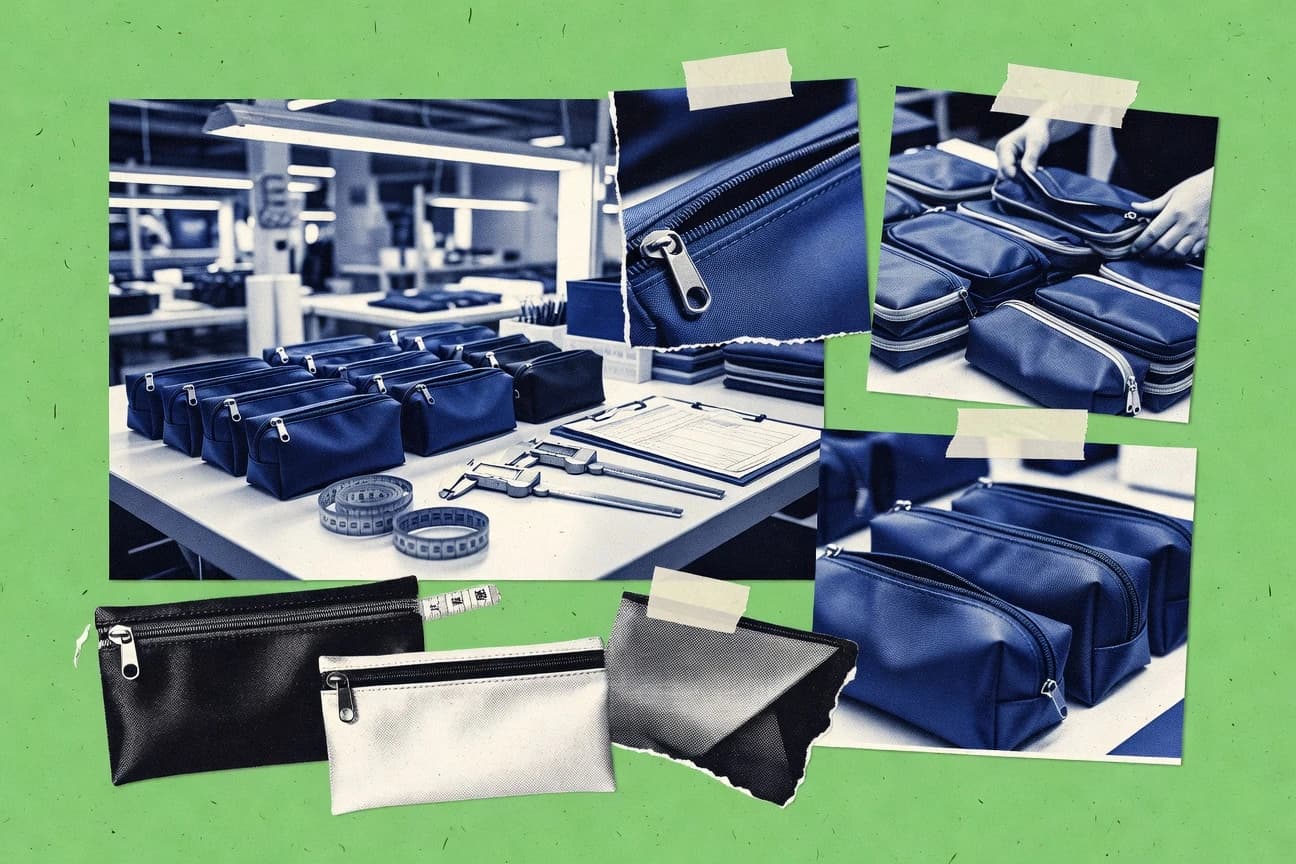

01 Industry overview
The cosmetic bag industry at a glance
The global makeup-bag market was valued at $3.65 billion in 2025 and is forecast to grow as travel recovery, beauty consumption and demand for organized, portable storage support new product development.
- $3.65B[11]
- Global market size, 2025
- 6.7%[11]
- Forecast CAGR, 2025–2033
- 36%[11]
- Asia-Pacific share, 2025
- 29%[12]
- Planned 2025 travel-bag purchases
- Market size
- The global makeup-bag market was valued at $3.65 billion in 2025. A narrower cosmetic-bags-and-cases definition from The Insight Partners measured the market at $232.55 million in 2025, highlighting the effect of category scope.[11][1]
- Forecast & CAGR
- The broader makeup-bags market is projected to reach $6.13 billion by 2033, implying a 6.7% CAGR from 2025 to 2033. The narrower cosmetic-bags-and-cases segment is forecast to reach $347.9 million by 2034 at a 5.16% CAGR from 2026 to 2034.[11][1]
- Market share & regions
- Asia-Pacific accounted for approximately 36% of global makeup-bag revenue in 2025, followed by North America at roughly 28.5% and Europe at about 21%. Asia-Pacific was also identified as the fastest-growing region, with a forecast CAGR of 7.4%.[11]
- Segmentation
- The market is segmented by product scope and use, including makeup bags, cosmetic cases, vanity pouches and toiletry cases, with applications spanning personal, travel and professional use. Common material categories include PVC, nylon, fabric, plastic and leather, while distribution includes online retail, specialty stores and supermarkets or hypermarkets.[11][1]
- Key players & concentration
- Publicly available market pages identify a fragmented competitive field spanning branded beauty, luggage and accessories companies, but do not provide a reliable concentration ratio such as CR4 or HHI. The available reports instead compare leading players and analyze competition by material, channel, region and end use.[11][1]
- Trends, drivers & challenges
- Demand is being supported by travel normalization, interest in organized beauty storage, portable and modular designs, and growth in gender-neutral and men’s grooming products. Sustainability, material selection and competition across online marketplaces remain important product and sourcing challenges.[12][13]
- Consumer behavior & competition
- In a 2025 travel-goods survey, 29% of consumers said they planned to buy toiletry or cosmetics bags, making them the most-purchased travel-accessory category listed. Competition is increasingly shaped by e-commerce, social discovery, customization, travel functionality and premium design.[12][11]
- Regulation
- Cosmetic bags themselves are generally regulated as consumer goods, textiles, plastics or travel accessories rather than as cosmetic products. In the European Union, Regulation (EC) No. 1223/2009 applies to finished cosmetic products placed on the market, not ordinarily to the bags used to store them.[14]
02 Ranking
Top 10 Companies in the Cosmetic Bag Industry
The leading companies in the cosmetic bag industry, ranked on market impact, performance, momentum, innovation and brand popularity.
Updated November 17, 2026 · Next review December 17, 2026
BÉIS stands out for travel and cosmetic bags because it targets the United States travel accessory market, while Tapestry focuses on cosmetic cases and pouches since operating margin reached 5.5% alongside 14% revenue growth in 2025.
Ranked by Overall score · How we score ↓
Editor's top 3 picks
Where to start, by need.
#1 Overall · Leader in travel cosmetic bags
BÉIS
US
Ranked #1 · 9.4 · Travel cosmetic bags
Why we picked it: It focuses on travel and cosmetic bags and covers the United States segment.
#2 overall
Tapestry
US
Ranked #2 · 9.2 · Travel cosmetic bags
Why we picked it: It operates Coach and Kate Spade, which include cosmetic cases and pouches.
#3 overall
Baggallini
US
Ranked #3 · 9.0 · Travel cosmetic bags
Why we picked it: It specializes in travel accessories and cosmetic bags in the United States.
Pick 1 is the #1 company overall. No other segment places in the top 5, so picks 2 and 3 follow rank.
Full ranking
| # | Company | Overall ↓ | Impact | Performance | Momentum | Innovation | Company snapshot |
|---|---|---|---|---|---|---|---|
| 1 | BÉIS Travel cosmetic bags · US | 9.4 | 8.5 | 9.9 | 9.9 | 9.9 | |
Company snapshot · BÉIS · Data as of November 17, 2026
| |||||||
| 2 | Tapestry Travel cosmetic bags · US | 9.2 | 9.9 | 8.0 | 9.6 | 8.9 | |
Company snapshot · Tapestry · Data as of November 17, 2026 Tapestry operates Coach and Kate Spade, global accessories brands with cosmetic cases and pouches.[15]
| |||||||
| 3 | Baggallini Travel cosmetic bags · US | 9.0 | 8.5 | 9.9 | 9.4 | 8.0 | |
Company snapshot · Baggallini · Data as of November 17, 2026
| |||||||
| 4 | Lush Travel cosmetic bags · GB | 8.8 | 8.5 | 8.5 | 8.7 | 9.9 | |
Company snapshot · Lush · Data as of November 17, 2026
| |||||||
| 5 | Longchamp Travel cosmetic bags · FR | 8.7 | 8.5 | 8.6 | 9.1 | 8.9 | |
Company snapshot · Longchamp · Data as of November 17, 2026 Longchamp is a global luxury leather-goods house whose product range includes small bags and cosmetic pouches.[16]
| |||||||
| 6 | Xiamen Tiumsen Cosmetics OEM and ODM sewn cosmetic bags · CN | 7.9 | 7.0 | 8.7 | 8.5 | 8.0 | |
Company snapshot · Xiamen Tiumsen Cosmetics · Data as of November 17, 2026 Xiamen Tiumsen reports OEM, ODM and OBM production of cosmetic and toiletry bags.[17]
| |||||||
| 7 | Lay-n-Go Cosmetic bags and drawstring organizers · US | 7.8 | 7.3 | 8.2 | 8.0 | 8.0 | |
Company snapshot · Lay-n-Go · Data as of November 17, 2026 Lay-n-Go sells patented cosmetic bags designed to open flat and cinch closed.[18]
| |||||||
| 8 | Bobbi Brown Cosmetic bags and cases, global · US | 7.7 | 8.5 | 7.0 | 7.0 | 8.0 | |
Company snapshot · Bobbi Brown · Data as of November 17, 2026
| |||||||
| 9 | Timmy Bags OEM and private-label cosmetic bags · CN | 7.6 | 7.3 | 8.2 | 8.0 | 7.0 | |
Company snapshot · Timmy Bags · Data as of November 17, 2026 Timmy Bags is a Shenzhen OEM and private-label manufacturer of custom cosmetic bags.[19]
| |||||||
| 10 | Dongguan Changrong Handbag OEM and ODM cosmetic bag manufacturing · CN | 7.6 | 7.3 | 8.2 | 8.0 | 7.0 | |
Company snapshot · Dongguan Changrong Handbag · Data as of November 17, 2026 Dongguan Changrong Handbag manufactures custom cosmetic bags for beauty and skincare brands.[20]
| |||||||
How we score
- Impact (30%): scale and weight in the market (revenue, market share, employees, market position).
- Performance (20%): recent revenue growth and operating margin; an analyst assessment where a company does not publish them.
- Momentum (20%): growth trajectory and future potential.
- Innovation (15%): R&D intensity and how technologically advanced the company is.
Popularity (brand search demand, 15%) counts toward Overall but is not published as a column. Overall leaves out what is not known.
Scale Scores are shown on a 7–10 scale with one decimal; bars start at 7.0.
Cadence Recalculated when new figures are published; next review December 17, 2026.
Independence. Rankings are editorially independent. Scores, ranks, picks and the verdict follow the method above; no company can pay to change them.
Cite this ranking
APA
James Okoro. (2026, February 13). Top 10 companies in the cosmetic bag industry. In Cosmetic Bag Industry Statistics. Gitnux. https://gitnux.org/cosmetic-bag-industry-statistics/#top-companies
North America cosmetic bags segment market size
North America cosmetic bags segment market size grew from $248.3M in 2020 to $284.5M in 2023.
03 Trends & forecasts
Top 10 Cosmetic Bag Industry Trends & Forecasts 2027
What is changing in the cosmetic bag industry, with the evidence behind each trend and a forecast for 2027.
Forecasts were generated by an AI model from the cited evidence. They are estimates, not guarantees.
01Global market expands steadily
High confidenceThe broader global makeup-bag market was valued at $3.65 billion in 2025 and is forecast to reach $6.13 billion by 2033, representing a 6.7% CAGR. A narrower cosmetic-bags-and-cases definition measured $232.55 million in 2025 and forecasts a 5.16% CAGR through 2034.[1]
Forecast 2027: In 2027, industry revenue should continue rising at a mid-single-digit rate, supported by beauty consumption, travel demand and replacement purchases. Broader market definitions will continue to report materially larger values than narrowly defined cosmetic-case segments.
02Travel-led demand remains resilient
High confidenceInternational tourist arrivals reached an estimated 1.52 billion in 2025, up 4% year over year, while 29% of surveyed shoppers planned to buy toiletry or cosmetics bags in 2025. Travel recovery therefore continues to support a major use case for cosmetic bags.[21][12]
Forecast 2027: In 2027, travel-specific cosmetic bags should remain one of the strongest demand pockets, although growth will moderate from the post-pandemic rebound. Compact, leak-resistant and airline-friendly formats are likely to outperform purely decorative pouches.
03Asia-Pacific leads market growth
High confidenceAsia-Pacific represented approximately 36% of global makeup-bag revenue in 2025 and was identified as the fastest-growing region, with a projected 7.4% CAGR. In the wider beauty sector, Asia-Pacific beauty sales grew 14.3% in 2025, led by China and digital commerce.[1][22]
Forecast 2027: Asia-Pacific should remain the primary regional growth engine in 2027. Localized designs, K-beauty and C-beauty associations, mobile-first selling and premium gifting should support above-global-average growth.
04Beauty routines increase storage needs
High confidenceGlobal beauty sales rose 10% in 2025, according to NielsenIQ, while the market is expanding into wellness, skincare and broader personal-care routines. More products and more specialized routines increase demand for compartmentalized cosmetic storage.[22]
Forecast 2027: By 2027, multi-compartment organizers should gain share over single-pocket pouches. Products designed around skincare, haircare, fragrance and wellness categories will broaden the market beyond traditional color cosmetics.
05Digital beauty discovery accelerates sales
High confidenceE-commerce accounted for 28% of global beauty sales by channel, the largest share identified by McKinsey. The same analysis estimated that U.S. social-commerce sales across consumer categories would reach $100 billion by 2026.[23]
Forecast 2027: In 2027, cosmetic-bag brands should rely increasingly on marketplace search, creator content, shoppable video and social-commerce launches. Products with strong visual demonstrations—such as clear, modular or transformable organizers—should benefit most.
06Social commerce favors rapid product cycles
Medium confidenceEuromonitor reported that TikTok-driven beauty product sales through social media rose 22% in 2024. TikTok Shop also generated about $1 billion in U.S. beauty sales in 2024, according to reporting citing Euromonitor.[24]
Forecast 2027: In 2027, limited editions, creator collaborations and trend-responsive colorways should shorten cosmetic-bag product cycles. Competition will shift toward speed of design, content creation and replenishment rather than only long-term brand heritage.
07Sustainability shifts material choices
High confidenceThe EU Ecodesign for Sustainable Products Regulation covers almost all goods placed on the EU market and introduces a framework for sustainability information, including digital product passports. In a 2025 global circularity survey, 47.0% of respondents associated circular products with durability and 37.8% with lower-impact materials.[25][26]
Forecast 2027: In 2027, recycled synthetics, lower-impact coatings, durable construction and material traceability should become more prominent in product development. Compliance pressure will be strongest for brands selling into Europe, even where cosmetic bags are not directly subject to product-specific requirements.
08Durability competes with low prices
Medium confidenceDurability was the most frequently selected characteristic of circular products in the 2025 global circularity survey, cited by 47.0% of respondents, ahead of lower-impact materials at 37.8%. This indicates that sustainability claims increasingly depend on product longevity rather than material substitution alone.[26]
Forecast 2027: In 2027, brands should emphasize washable linings, stronger zippers, repairability and longer usable life alongside recycled content. Premium products may justify higher prices when durability is visible and supported by credible product information.
09Personalization expands premium demand
Medium confidenceMarket analysis identifies personalized makeup cases, eco-friendly bags and travel-friendly organizers as key opportunity areas influencing the cosmetic-bags-and-cases market. Customization also fits social-commerce merchandising, where limited designs can be promoted through creator and community channels.[1]
Forecast 2027: In 2027, monogramming, color selection, modular inserts and small-batch collaborations should support premium pricing. Personalization will remain a niche by volume but an important tool for gifting, loyalty and direct-to-consumer differentiation.
10Modular organization gains share
High confidenceTravel shoppers show strong demand for organization: 27% planned to buy clothes-packing organizers in 2025, while 29% planned to buy toiletry or cosmetics bags. The adjacent demand suggests that consumers value systems that make limited luggage space easier to manage.[12]
Forecast 2027: By 2027, detachable pouches, adjustable dividers, stackable cases and coordinated travel systems should outperform basic unstructured bags. Modular features will be especially valuable in mid-market and premium travel collections.
04 Statistics
Market Intelligence
This section shows scope-driven differences: the $3.65B 2025 global makeup-bag value contrasts with $232.55M for cosmetic bags and cases, and it reports both 2033 and 2034 forecasts.
Market size, volume and shipments in the cosmetic bag industry
Forecast growth and shipments in the cosmetic bag industry
- The global cosmetic bag market is projected to grow from US$3.86 billion in 2025 to US$8.22 billion in 2034, a 2025–2034 CAGR of 8.77%.[2]
- The global cosmetics bags and cases market is forecast to increase from US$2.5 billion in 2024 to US$4.2 billion in 2033, at approximately 6.1% CAGR during 2025–2033.[3]
- The global cosmetic bags and cases market is projected to rise from US$232.55 million in 2025 to US$347.9 million in 2034, at a 2026–2034 CAGR of 5.16%.[1]
05 Statistics
Customers & Channel
Channel math is split between offline and online in 2025 and tied to U.S. retailer and e-commerce shares in 2026, with 48% projected for online versus 55% for offline.
Distribution channels for cosmetic bag
- 35–40% of United States makeup bags and organizers dollar sales are estimated to come from mass retailers such as Walmart, Target and club stores in 2026.[4]
- 3 distribution channels are covered in the global cosmetic bags and cases market: supermarkets and hypermarkets, specialty stores, and online retail.[1]
- 30–35% of United States makeup bags and organizers sales are estimated to come through e-commerce, including Amazon, brand websites and social commerce, in 2026.[4]
- 4 route-to-market formats are described for makeup bags and organizers: mass retail, premium retail, direct-to-consumer and specialty beauty retail.[4]
- 48% of global cosmetics bags and cases sales are projected to come through online channels in 2025, versus 55% through offline channels; the publisher reports these as separate channel estimates.[5]
06 Statistics
Pricing & Finance
The pricing inputs focus on FOB Shenzhen and OEM cost breakdowns, including $1.20–$7.50 per unit and material plus labor accounting for 30–50% of total OEM cost in 2026.
Prices and price indices for cosmetic bag
- $1.20–$7.50 per unit is the reported FOB Shenzhen price range for custom cosmetic bags, varying by material and construction complexity, in 2026.[6]
- $4.80–$7.20 per unit is the typical price for a 1,000-piece, 20 × 14 × 6 cm PU cosmetic-bag run supplied FOB Shenzhen in 2026.[7]
- $3.00–$12.00 per unit is the reported custom cosmetic-bag price range, with PU leather bags listed at $3.00–$12.00, in 2026.[8]
Input costs in the cosmetic bag industry
- 30–50% of total OEM cost is attributed to material selection and associated labor-skill requirements for custom cosmetic bags in 2026.[8]
- 22–30% of a typical 500-piece mid-specification cosmetic-bag order is direct labor cost, according to a supplier cost breakdown.[9]
- 20–30% can be added to a cosmetic-bag invoice by mold costs, printing-plate fees and packaging charges, according to a 2026 manufacturing guide.[6]
07 Statistics
Trade & Footprint
U.S. duty rates in 2025 are specified by HTSUS lines, including 20% for HS 42029245 and 17.6% for HS 42029290 and HS 42029230.
Tariffs and trade policy for cosmetic bag
- The US 2025 HTSUS sets a 20% general duty for HS 42029245 travel, sports and similar bags with plastic-sheeting outer surfaces, a category containing some cosmetic bags.[10]
- The US 2025 HTSUS sets a 17.6% general duty for HS 42029290 other bags, cases and similar containers with plastic-sheeting or textile outer surfaces, excluding cotton.[10]
- The US 2025 HTSUS sets a 17.6% general duty for HS 42029230 travel, sports and similar bags with textile outer surfaces, a category containing some cosmetic bags.[10]
Key questions about the Cosmetic Bag Industry
What is the cosmetic bag market size in 2025?
How fast is the market expected to grow?
Which companies lead the cosmetic bag industry?
What technology or product shifts are changing demand?
How is the market structured by channels and retailers?
What duty rates apply for relevant bag categories into the U.S.?
Cite This Report
This report is designed to be cited. We maintain stable URLs and versioned verification dates. Copy the format appropriate for your publication below.
James Okoro. (2026, February 13). Cosmetic Bag Industry Statistics. Gitnux. https://gitnux.org/cosmetic-bag-industry-statistics
James Okoro. "Cosmetic Bag Industry Statistics." Gitnux, 13 Feb 2026, https://gitnux.org/cosmetic-bag-industry-statistics.
James Okoro. 2026. "Cosmetic Bag Industry Statistics." Gitnux. https://gitnux.org/cosmetic-bag-industry-statistics.
Sources & references
26 sources cited across this report
theinsightpartners.com
globalgrowthinsights.com
markettrendsanalysis.com
indexbox.io
6wresearch.com
merriscustombags.com
gzdreamway.com
soltonleather.com
- custombagsforkickstarter.com
learning.usitc.gov
datainsightsmarket.com
homepagenews.com
deepmarketinsights.com
single-market-economy.ec.europa.eu
investors.tapestry.com
longchamp.com
cosmoprof-asia.com
layngo.com
timmybags.com
crcosmeticbags.com
untourism.int
nielseniq.com
mckinsey.com
apnews.com
sheingroup.com