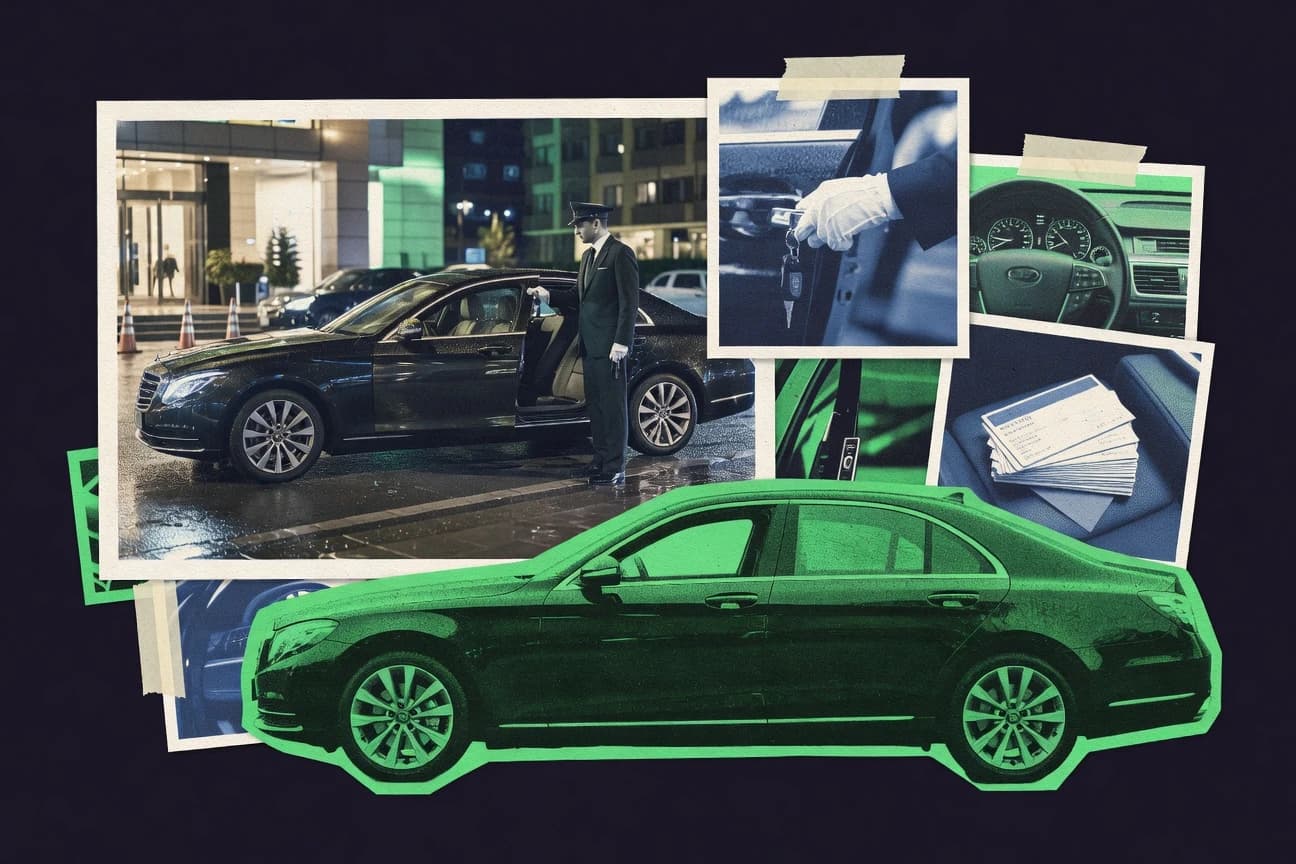

01 Industry overview
The chauffeur industry at a glance
The chauffeur and limousine sector is expanding through premium travel and digital booking, with the global limousine-service market forecast to grow by $4.37 billion from 2025 to 2030 at an 8.1% CAGR.
- $6.8B[14]
- U.S. limousine sales, 2025
- 8.1%[14]
- Global limousine CAGR, 2025–2030
- 251,500[11]
- U.S. shuttle chauffeurs, 2025
- $37,290[11]
- Median chauffeur wage, 2025
- Market size
- The U.S. limousine-service industry generated $6.8 billion in sales in 2025. Globally, the broader taxi and limousine-services market was estimated at $122.77 billion in 2025, although that total includes taxis and other passenger-car services beyond chauffeur operations.[14]
- Forecast & CAGR
- The global limousine-service market is forecast to expand by $4.37 billion between 2025 and 2030, representing an 8.1% CAGR. A separate 2026 market estimate puts the global taxi and limousine-services market at $132.29 billion in 2026, up 7.8% from 2025.[14]
- Market share & regions
- Asia-Pacific was the largest regional market for taxi and limousine services in 2025, followed by Western Europe. The available sources do not disclose a directly comparable percentage share for chauffeur-only services.[14]
- Segmentation
- The broader taxi and limousine market is segmented by service type, including online taxi services, telephonic and offline taxi services, and limousine services; by vehicle type, including cars and motorcycles; and by payment mode and ride type. Chauffeur services generally occupy the premium, reserved-journey portion of the limousine segment.[14]
- Key players & concentration
- The global limousine-service competitive set includes Addison Lee, Blacklane, Carey International, Dav El/BostonCoach, Drivania, EmpireCLS, Europcar Mobility Group, Gett, SIXT, Uber and Wheely, among others. The market remains fragmented, with the cited industry analysis covering about 25 vendors rather than identifying a dominant single provider.[14][15]
- Trends, drivers & challenges
- Growth is being supported by digital booking, data-driven personalization, premium corporate and tourism travel, and demand for flexible on-demand mobility. Key challenges include pricing pressure, operating-cost inflation, driver classification disputes, and the need to adapt fleets to electric and hybrid vehicles.[14][16]
- Consumer behavior & competition
- Demand spans corporate travel, airport transfers, tourism, weddings, events and executive travel, with competition extending beyond chauffeur firms to ride-hailing, taxis, rental cars and shuttles. In the United States, employment for shuttle drivers and chauffeurs is projected to rise 7% from 251,500 jobs in 2025 to 269,400 in 2035, indicating continued demand for reserved and specialized transportation.[14][11]
- M&A
- Uber announced an agreement in 2026 to acquire Blacklane, a Berlin-based global chauffeur provider, subject to customary regulatory approvals and other closing conditions. Uber stated that the transaction would support its expansion into chauffeur services through Uber Elite; its filing said the acquisition was expected to close by the end of 2026.[17][16]
- Regulation
- Regulatory exposure is concentrated in licensing, passenger-safety requirements, labor classification and merger review. Uber's 2026 filing disclosed ongoing claims and investigations in multiple jurisdictions over whether drivers should be treated as employees, workers or independent contractors, while the Blacklane transaction remained subject to regulatory approval.[16][17]
- Latest news
- The most significant recent development is Uber's 2026 agreement to acquire Blacklane, a global chauffeur-services provider. The transaction links a major ride-hailing platform with an established premium chauffeur network and illustrates the sector's increasing consolidation and platform integration.[17][16]
02 Ranking
Top 10 Companies in the Chauffeur Industry
The leading companies in the chauffeur industry, ranked on market impact, performance, momentum, innovation and brand popularity.
Updated November 16, 2026 · Next review December 16, 2026
Uber Technologies stands out for expanding chauffeur services because it agreed in 2026 to acquire Blacklane, a Berlin-based global chauffeur provider, while Addison Lee focuses on premium private hire since it serves over 10 million passengers yearly.
Ranked by Overall score · How we score ↓
Editor's top 3 picks
Where to start, by need.
#1 Overall · Leader in chauffeured transportation
Uber Technologies
US
Ranked #1 · 9.8 · Chauffeured transportation
Why we picked it: Uber’s chauffeur expansion is tied to its 2026 Blacklane acquisition agreement for global premium network integration.
#2 overall
Addison Lee
GB
Ranked #2 · 9.0 · Chauffeured transportation
Why we picked it: Addison Lee runs premium passenger, executive-car and chauffeur services at a reported scale of over 10 million yearly passengers.
#3 overall
Carey International
US
Ranked #3 · 8.8 · Chauffeured transportation
Why we picked it: Carey spans corporate chauffeured transportation across more than 1,000 cities and over 70 countries.
Pick 1 is the #1 company overall. No other segment places in the top 5, so picks 2 and 3 follow rank.
Full ranking
| # | Company | Overall ↓ | Impact | Performance | Momentum | Innovation | Company snapshot |
|---|---|---|---|---|---|---|---|
| 1 | Uber Technologies Chauffeured transportation · US | 9.8 | 9.9 | 9.3 | 9.9 | 9.9 | |
Company snapshot · Uber Technologies · Data as of November 16, 2026 Uber acquired 100% of Blacklane, a global chauffeur service provider, on August 13, 2026.[16]
| |||||||
| 2 | Addison Lee Chauffeured transportation · GB | 9.0 | 8.1 | 9.5 | 9.8 | 9.8 | |
Company snapshot · Addison Lee · Data as of November 16, 2026 Addison Lee operates premium passenger, executive-car and chauffeur services and serves over 10 million passengers yearly.[18]
| |||||||
| 3 | Carey International Chauffeured transportation · US | 8.8 | 9.9 | 8.4 | 8.5 | 7.9 | |
Company snapshot · Carey International · Data as of November 16, 2026 Carey provides chauffeured transportation in more than 1,000 cities across over 70 countries.[19]
| |||||||
| 4 | Nihon Kotsu Chauffeured transportation · JP | 8.8 | 8.4 | 9.1 | 8.5 | 9.8 | |
Company snapshot · Nihon Kotsu · Data as of November 16, 2026 Nihon Kotsu operates more than 2,000 chauffeur vehicles and employs over 18,000 people.[20]
| |||||||
| 5 | Carzonrent Chauffeured transportation · IN | 8.6 | 8.4 | 9.9 | 8.3 | 7.9 | |
Company snapshot · Carzonrent · Data as of November 16, 2026 Carzonrent offers chauffeur-driven corporate travel, airport transfers and executive travel across India.[21]
| |||||||
| 6 | Wheely Luxury on-demand and scheduled chauffeur services · GB | 8.6 | 7.0 | 9.6 | 9.3 | 9.8 | |
Company snapshot · Wheely · Data as of November 16, 2026 Wheely offers scheduled and on-demand chauffeur bookings in London, New York, Paris and Dubai.[22]
| |||||||
| 7 | Dav El | BostonCoach Executive chauffeur and corporate ground transportation · US | 8.6 | 9.9 | 8.4 | 8.0 | 7.0 | |
Company snapshot · Dav El | BostonCoach · Data as of November 16, 2026 Dav El | BostonCoach operates in over 550 markets with more than 25,000 vehicles.[23]
| |||||||
| 8 | EmpireCLS Luxury chauffeured transportation and VIP travel · US | 8.1 | 8.4 | 8.4 | 8.0 | 7.0 | |
Company snapshot · EmpireCLS · Data as of November 16, 2026 EmpireCLS owns 500 vehicles, employs over 400 chauffeurs and serves over 1,000 cities globally.[24]
| |||||||
| 9 | Lyft Global chauffeur network via TBR and Alcove · US | 8.1 | 8.4 | 7.2 | 8.1 | 8.4 | |
Company snapshot · Lyft · Data as of November 16, 2026 Lyft acquired TBR Global Chauffeuring and is transitioning it into its global Alcove chauffeur brand.[25]
| |||||||
| 10 | GroundLink Global corporate black-car and chauffeur services · US | 7.2 | 7.0 | 7.0 | 7.0 | 7.0 | |
Company snapshot · GroundLink · Data as of November 16, 2026 GroundLink is identified as a major participant in the global luxury chauffeur-services market.[26]
| |||||||
How we score
- Impact (30%): scale and weight in the market (revenue, market share, employees, market position).
- Performance (20%): recent revenue growth and operating margin; an analyst assessment where a company does not publish them.
- Momentum (20%): growth trajectory and future potential.
- Innovation (15%): R&D intensity and how technologically advanced the company is.
Popularity (brand search demand, 15%) counts toward Overall but is not published as a column. Overall leaves out what is not known.
Scale Scores are shown on a 7–10 scale with one decimal; bars start at 7.0.
Cadence Recalculated when new figures are published; next review December 16, 2026.
Independence. Rankings are editorially independent. Scores, ranks, picks and the verdict follow the method above; no company can pay to change them.
Cite this ranking
APA
Henrik Dahl. (2026, February 13). Top 10 companies in the chauffeur industry. In Chauffeur Industry Statistics. Gitnux. https://gitnux.org/chauffeur-industry-statistics/#top-companies
U.S. limousine services revenue
U.S. limousine services revenue grew from $4.5B in 2019 to $4.8B in 2022.
03 Trends & forecasts
Top 10 Chauffeur Industry Trends & Forecasts 2027
What is changing in the chauffeur industry, with the evidence behind each trend and a forecast for 2027.
Forecasts were generated by an AI model from the cited evidence. They are estimates, not guarantees.
01Premium travel demand keeps rising
High confidenceU.S. inflation-adjusted total travel spending reached $1.36 trillion in 2025 and is forecast at $1.38 trillion in 2027. Business travel spending is forecast to increase from $316.3 billion in 2026 to $325.2 billion in 2027, supporting corporate and executive chauffeur demand.[27]
Forecast 2027: In 2027, chauffeur operators should see moderate growth in corporate transfers, meetings, events and premium leisure travel. Growth will likely be strongest in major business and tourism gateways rather than evenly across all markets.
02Airport transfers remain the core use case
High confidenceGlobal air travel reached 9.8 billion passengers in 2025, according to Airports Council International. Airport transfers are a central chauffeur application because they combine advance booking, luggage handling and reliability requirements.[28]
Forecast 2027: Airport-transfer volumes should expand in 2027 as passenger traffic grows, although operators will face congestion and curb-access constraints at the busiest airports. Pre-booked meet-and-greet and flight-monitoring services should gain share.
03International visitor demand rebounds
High confidenceThe U.S. National Travel and Tourism Office forecasts international visitors to the United States to rise 5.2% to 74.1 million in 2027. International visitors are disproportionately relevant to chauffeur services because they rely on pre-arranged airport, hotel and multi-stop transportation.[29]
Forecast 2027: International-arrival chauffeur bookings should grow faster than general domestic point-to-point demand in 2027. Multilingual booking, fixed airport pricing and hotel partnerships will become more important competitive tools.
04Digital booking becomes the default
High confidenceBlacklane operates through an app and web booking platform and connects travelers with independent chauffeur services in more than 500 cities across over 60 countries. This illustrates the industry’s shift from telephone and hotel-desk reservations toward centralized digital distribution.[17]
Forecast 2027: By 2027, most scalable operators will need mobile booking, instant confirmation, digital receipts, live trip status and automated dispatch. Smaller firms without API or marketplace connectivity will increasingly depend on aggregators and affiliate networks.
05Marketplace consolidation accelerates
High confidenceUber announced an agreement on March 30, 2026, to acquire Blacklane, which operates in more than 500 cities and over 60 countries. The transaction links a global ride-hailing platform with an established premium chauffeur network and remains subject to closing conditions and regulatory approval.[17]
Forecast 2027: In 2027, platform acquisitions and commercial partnerships should increase as mobility companies seek premium inventory and global coverage. Independent chauffeur companies will face stronger pressure to join networks, differentiate locally or specialize in corporate accounts.
06Chauffeur employment expands gradually
High confidenceThe U.S. Bureau of Labor Statistics reports 251,500 shuttle-driver and chauffeur jobs in 2025 and projects 269,400 in 2035, a 7% increase. It attributes demand partly to special events, tours, business travel, luxury travel and transportation for older adults and people with disabilities.[11]
Forecast 2027: Employment should rise modestly through 2027, but labor availability will remain a constraint in high-demand cities and peak event periods. Operators will increasingly use structured scheduling, driver pools and contractor networks to protect service coverage.
07Driver pay remains a recruitment pressure
High confidenceThe median annual wage for U.S. shuttle drivers and chauffeurs was $37,290 in May 2025, while the median wage in taxi and limousine services was $43,230. The difference indicates that compensation varies substantially by employer and service mix.[11]
Forecast 2027: In 2027, premium operators will likely raise effective compensation through higher base pay, guaranteed minimums, bonuses and better utilization rather than relying only on fare increases. Recruitment difficulty will be greatest for night, airport and event work.
08Operating costs keep pricing firm
Medium confidenceThe chauffeur labor market combines structured, client-dependent schedules with median pay of $37,290 for shuttle drivers and chauffeurs and $43,230 in taxi and limousine services. Vehicles, insurance, maintenance, fuel and paid driver time therefore remain significant cost components even when vehicles are not carrying passengers.[11]
Forecast 2027: In 2027, published chauffeur prices should remain firm, with more operators using peak-period surcharges, minimum booking durations and cancellation fees. Discounting will be concentrated in lightly utilized routes and highly competitive airport corridors.
09Electric fleets expand from policy pressure
Medium confidenceThe U.S. Department of Transportation’s electric-fleet toolkit notes that New York City’s Taxi and Limousine Commission reopened electric-vehicle license applications in 2023 and that new licenses were directed toward wheelchair-accessible or zero-emission vehicles. The policy direction is relevant to chauffeur fleets operating in regulated urban markets.[30]
Forecast 2027: By 2027, electric and hybrid vehicles should represent a larger share of new premium-fleet purchases, especially for urban airport and hotel work. Adoption will remain uneven because charging access, vehicle range, acquisition cost and passenger luggage capacity vary by market.
10Fleet electrification raises capital needs
Medium confidenceThe DOT toolkit identifies zero-emission vehicles and charging infrastructure as fleet-transition priorities, while chauffeur services typically require high vehicle availability and predictable passenger service. This makes charging downtime and infrastructure investment more material than for occasional private-car use.[30]
Forecast 2027: In 2027, larger operators should favor depot charging, mixed fleets and route-level vehicle allocation rather than rapid full-fleet replacement. Capital requirements will encourage partnerships with hotels, airports, charging providers and vehicle lessors.
04 Statistics
Technology & AI
Operators report broad use of dispatch platforms, with 96% using dedicated dispatch in 2026. Fleet sensing shows up via telematics or cameras (65% in 2025) and exterior-facing cameras (76% in 2025).
Tools, systems and equipment in the chauffeur industry
- 65% of surveyed U.S. limousine operators used telematics or cameras in their fleets in 2025; the survey covered 48 operators.[1]
- 96% of surveyed taxi, limo, chauffeur and ride-hailing operators used a dedicated dispatch platform in 2026; the survey covered 517 operators across five regions.[2]
- 76% of surveyed U.S. limousine operators used exterior-facing cameras in 2025; the survey covered 48 operators.[1]
05 Statistics
Market Intelligence
Market sizing puts chauffeur services at $26.50 billion in 2025, with airport transfers, hourly hire, point-to-point travel, and events included in the category definition. Buyer contracting spreads across multiple providers, with 17% using three to five providers in 2026.
Market size and service revenue in the chauffeur industry
- $26.50 billion was the estimated global chauffeur-services market in 2025; the study defines the category as chauffeur-provided passenger transportation and reports airport transfers, hourly hire, point-to-point travel, and events as service types.[3]
- $4.767 billion in total revenue was generated by U.S. employer establishments classified as Limousine Service (NAICS 48532) in 2022; the category covers prearranged luxury-sedan and limousine passenger transportation with drivers.[4]
Growth forecasts for the chauffeur industry
- The global chauffeur-car market is projected to grow from $65.00 billion in 2025 to $104.38 billion in 2032, representing a 7.0% CAGR; the study segments the category by luxury sedans, SUVs, and applications.[5]
- The global chauffeur-services market is projected to reach $45.54 billion by 2034 from $26.50 billion in 2025, implying a 6.2% CAGR; the study covers airport transfers, hourly hire, point-to-point travel, and event chauffeur services.[3]
- Asia-Pacific chauffeur-services revenue is forecast to grow at 7.6% annually from 2026 to 2034, according to a global market study covering chauffeur-provided airport, corporate, hourly, point-to-point, and event transportation.[3]
Demand shifts in the chauffeur industry
- In 2026, 17% of corporate buyers with chauffeured contracts used three to five providers, up from 11% in 2025, while 11% used more than five, up from 7%.[6]
- 67% of surveyed U.S. and Canadian corporate travel managers used limousine companies exclusively for airport executive transfers, while 86% used chauffeured sedans or SUVs for airport and other destinations.[7]
- 59% of surveyed corporate travel buyers had active chauffeur contracts in 2025, up from 57% in 2024, indicating a two-point increase in contracted chauffeured-transport demand.[6]
Regional breakdown of the chauffeur industry
- Europe accounted for 26.07% of the global chauffeur-car market in 2025, with estimated regional revenue of $16.94 billion.[5]
- Asia-Pacific represented 24.0% of global chauffeur-services revenue in 2025 in the study’s regional breakdown covering North America, Europe, Asia-Pacific, Latin America, and Middle East and Africa.[3]
- North America represented 33.0% of global chauffeur-services revenue in 2025, the largest regional share in the study’s geography split.[3]
- North America accounted for 38.75% of the global chauffeur-car market in 2025, with estimated regional revenue of $25.18 billion.[5]
06 Statistics
Operating Benchmarks
Service quality appears in buyer ratings, with 4.10 out of 5 in 2025 for drivers and company employees and 4.02 out of 5 in 2026 for service consistency across affiliates.
Operating metrics used in the chauffeur industry
- 4.10 out of 5 was the 2025 average buyer rating for drivers and company employees among chauffeured-service providers.[6]
- 49.45% of responding limousine operators reported that airport transfers accounted for more than half of their annual business in the National Limousine Association survey.[8]
- 4.02 out of 5 was the 2026 average buyer rating for service consistency across affiliates among chauffeured-car providers.[6]
07 Statistics
Delivery & Operations
New York City capacity shows licensing across bases and vehicle types, including 791 licensed for-hire vehicle bases dispatching chauffeur-driven trips at end of 2025.
Delivery capacity and installed base in the chauffeur industry
- 791 licensed for-hire vehicle bases dispatched chauffeur-driven trips in New York City at the end of 2025.[9]
- 81 licensed luxury-limousine bases operated in New York City at the end of 2025.[9]
- 485 licensed black-car bases operated in New York City at the end of 2025.[9]
- Approximately 103,700 licensed for-hire vehicles operated through pre-arrangement in New York City at the end of 2025, covering livery vehicles, black cars and luxury limousines.[9]
- More than 13,500 wheelchair-accessible vehicles were performing accessible trips across New York City’s taxi and for-hire vehicle fleets at the end of 2025.[10]
08 Statistics
People & Workforce
Workforce demand remains visible in projection and wage benchmarks, with median annual wages for U.S. shuttle drivers and chauffeurs at $37,290 in May 2025.
Employment and hiring in the chauffeur industry
- About 55,900 job openings for U.S. taxi drivers, shuttle drivers and chauffeurs are projected annually on average from 2025 through 2035.[11]
- Employment of U.S. shuttle drivers and chauffeurs is projected to increase 7% from 251,500 in 2025 to 269,400 in 2035.[11]
- 251,500 shuttle drivers and chauffeurs were employed in the United States in 2025, according to the Bureau of Labor Statistics.[11]
Pay and labour costs in the chauffeur industry
09 Statistics
Risk & Compliance
Compliance exposure centers on insurance and operating authority, with California charter-party minimum liability coverage ranging from $750,000 to $5 million depending on passenger count.
Regulation and licensing in the chauffeur industry
- $1.5 million is the minimum liability-insurance coverage for California charter-party passenger carriers carrying 8–15 passengers, under CPUC General Order 115; the requirement is currently in force.[12]
- Three years is the renewal interval for most California charter-party carrier certificates and permits, with a $100 renewal fee, according to current CPUC licensing rules.[12]
- $750,000 is the minimum liability-insurance coverage for California charter-party passenger carriers carrying 7 or fewer passengers, under CPUC General Order 115; the requirement is currently in force.[12]
- $5 million is the minimum liability-insurance coverage for California charter-party passenger carriers carrying 16 or more passengers, under CPUC General Order 115; the requirement is currently in force.[12]
- Interstate for-hire passenger carriers generally require federal operating authority before beginning operations, unless an exemption such as a commercial-zone exception applies under 49 U.S.C. and FMCSA rules.[13]
Key questions about the Chauffeur Industry
What is the size of the chauffeur-services market?
How fast is the chauffeur-services market expected to grow?
Which companies lead the chauffeur industry?
What technology shifts matter for chauffeur operators?
How concentrated is the chauffeur-services competitive set?
How do corporate buyers allocate chauffeur-contracts across providers?
Cite This Report
This report is designed to be cited. We maintain stable URLs and versioned verification dates. Copy the format appropriate for your publication below.
Henrik Dahl. (2026, February 13). Chauffeur Industry Statistics. Gitnux. https://gitnux.org/chauffeur-industry-statistics
Henrik Dahl. "Chauffeur Industry Statistics." Gitnux, 13 Feb 2026, https://gitnux.org/chauffeur-industry-statistics.
Henrik Dahl. 2026. "Chauffeur Industry Statistics." Gitnux. https://gitnux.org/chauffeur-industry-statistics.
Sources & references
30 sources cited across this report
limo.org
- taxi-webdesign.com
growthmarketreports.com
fred.stlouisfed.org
pmarketresearch.com
businesstravelnews.com
- chauffeurdriven.com
- utrc2.org
nyc.gov
bls.gov
cpuc.ca.gov
fmcsa.dot.gov
researchandmarkets.com
nsearchives.nseindia.com
sec.gov
investor.uber.com
addisonlee.com
carey.com
techradar.com
carzonrent.com
wheely.com
davelbostoncoach.com
websterbank.com
- tbrglobal.com
htfmarketintelligence.com
ustravel.org
aci.aero
trade.gov
transportation.gov