
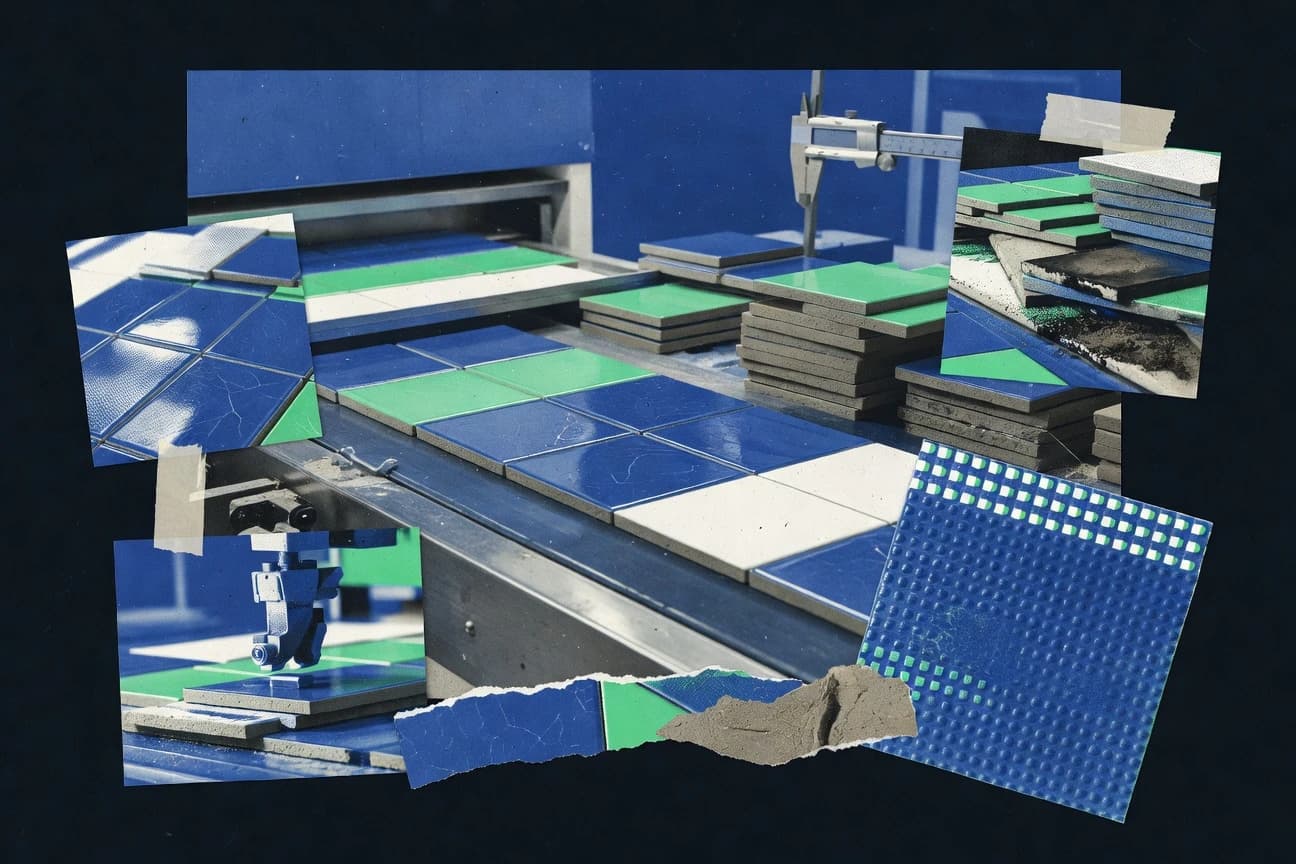

From kiln fuel and CO2 math to pricing pressure and automation gains, the ceramics tile industry is moving fast, with large format launches still dominating European trade fair spotlights in 2024 and a 12.6% CAGR expected for the ceramic tiles market from 2024 to 2032. China alone produced about 8.3 billion square meters of ceramic tiles in 2021, yet energy and emissions continue to hinge on details like kiln fuel mix and heat recovery. The figures beneath these headline trends raise practical questions about how manufacturing choices ripple through cost, emissions, and even the recycled materials that end up on the showroom floor.
Key Takeaways
- 12.6% CAGR expected for the ceramic tiles market from 2024 to 2032
- China produced about 8.3 billion square meters of ceramic tiles in 2021
- The global ceramic tiles industry used an estimated 62 TWh of energy in 2022
- 65% of EU ceramic tile energy consumption is attributed to kilns (firing) according to industry energy-use breakdown studies
- Natural gas accounts for about 60% of kiln fuel use in European ceramic tile manufacturing (by energy input)
- Electricity is typically 10%–20% of total energy use for ceramic tile manufacturing processes (by studies of EU plants)
- EU ETS covers about 35% of EU greenhouse gas emissions (including energy-intensive industry)
- Recycled content targets: some leading EU tiles brands advertise use of recycled glass/overburden minerals up to 30% in formulations
- VOC emissions: low-emission printing/glazing inks can reduce VOCs by up to 90% versus solvent-based systems in published environmental studies
- The global floor tiles market (ceramic and similar) was valued at $40.7 billion in 2023
- In 2024, large format tiles (600x600mm and above) accounted for about 45% of showcased new tile product launches at major European trade fairs
- Wet-area (bathroom/kitchen) renovation spending in the US was $27.2 billion in 2023
- UPM of ceramic tile prices in Europe increased by ~10% in 2022 due to input costs (energy, clay, packaging) per trade-press reporting
- In 2023, US ceramic tile retail price indices rose by 4.1% year-over-year (CPI category data)
- The Producer Price Index for ceramic tile manufacturing in the Euro area increased by 8.0% in 2022 versus 2021 (Eurostat PPI)
With steady 12.6% CAGR growth, ceramic tiles production is set to expand while cutting kiln emissions.
Related reading
01 · Category
Market Size2 stats
01
12.6% CAGR expected for the ceramic tiles market from 2024 to 2032
02
China produced about 8.3 billion square meters of ceramic tiles in 2021
Interpretation
Market Size Interpretation
With the ceramic tiles market projected to grow at a 12.6% CAGR from 2024 to 2032 and China producing about 8.3 billion square meters in 2021, the Market Size outlook points to strong expansion momentum alongside huge existing production scale.
02 · Category
Capacity & Production1 stats
01
The global ceramic tiles industry used an estimated 62 TWh of energy in 2022
Interpretation
Capacity & Production Interpretation
In the capacity and production category, the global ceramic tiles industry’s estimated 62 TWh of energy use in 2022 underscores how energy demand remains a key driver of how much tile manufacturing capacity the sector can sustain.
03 · Category
Cost & Energy7 stats
01
65% of EU ceramic tile energy consumption is attributed to kilns (firing) according to industry energy-use breakdown studies
02
Natural gas accounts for about 60% of kiln fuel use in European ceramic tile manufacturing (by energy input)
03
Electricity is typically 10%–20% of total energy use for ceramic tile manufacturing processes (by studies of EU plants)
04
In a case study, replacing natural gas with biogas reduced kiln CO2 emissions by 80%
05
A 2021 study found that optimized kiln scheduling reduced ceramic firing energy consumption by 6%–10%
06
Using waste heat recovery in tile kilns can achieve energy savings of up to 20% in published engineering studies
07
In published life-cycle assessments, manufacturing of ceramic tiles can produce around 0.5–1.5 tCO2e per tonne depending on energy and mix
Interpretation
Cost & Energy Interpretation
From a cost and energy angle, the kiln remains the dominant expense driver since 65% of EU ceramic tile energy use comes from firing and natural gas supplies about 60% of kiln fuel, but practical efficiency moves like biogas switching cutting CO2 by 80%, kiln scheduling cutting energy 6% to 10%, and waste heat recovery delivering up to 20% savings show that substantial cost relief is achievable.
04 · Category
Sustainability & Emissions6 stats
01
EU ETS covers about 35% of EU greenhouse gas emissions (including energy-intensive industry)
02
Recycled content targets: some leading EU tiles brands advertise use of recycled glass/overburden minerals up to 30% in formulations
03
VOC emissions: low-emission printing/glazing inks can reduce VOCs by up to 90% versus solvent-based systems in published environmental studies
04
A 2019 peer-reviewed LCA reported that clinkerless binders can reduce embodied CO2 in ceramic-related construction products by 20%–40% (context: cementitious components)
05
In a study of sustainable tile manufacturing, using alternative fuels reduced kiln GHG emissions by 15%–25%
06
In the EU, the Circular Economy Action Plan aims to increase circular material use to 25% by 2030, impacting mineral-based manufacturing including ceramics
Interpretation
Sustainability & Emissions Interpretation
For the Sustainability and Emissions angle, the data point to real decarbonization leverage in ceramics, from alternative fuels cutting kiln GHG emissions by 15% to 25% and clinkerless binders lowering embodied CO2 by 20% to 40% to EU policy and recycled-content targets pushing circular, lower-emission production toward 25% circular material use by 2030.
05 · Category
Demand & End Markets5 stats
01
The global floor tiles market (ceramic and similar) was valued at $40.7 billion in 2023
02
In 2024, large format tiles (600x600mm and above) accounted for about 45% of showcased new tile product launches at major European trade fairs
03
Wet-area (bathroom/kitchen) renovation spending in the US was $27.2 billion in 2023
04
Saudi Arabia construction spending reached about $56 billion in 2023, boosting imported building finishes including tiles
05
UAE construction output reached AED 107.0 billion in 2023 (driving renovation and finishing markets)
Interpretation
Demand & End Markets Interpretation
Demand for ceramic tiles is being pulled by renovation and construction activity, with the US wet-area spend at $27.2 billion in 2023 and major Saudi and UAE building programs reaching $56 billion and AED 107.0 billion respectively, while in Europe large format tiles of 600x600mm and above made up about 45% of new product launches in 2024.
06 · Category
Trade & Pricing4 stats
01
UPM of ceramic tile prices in Europe increased by ~10% in 2022 due to input costs (energy, clay, packaging) per trade-press reporting
02
In 2023, US ceramic tile retail price indices rose by 4.1% year-over-year (CPI category data)
03
The Producer Price Index for ceramic tile manufacturing in the Euro area increased by 8.0% in 2022 versus 2021 (Eurostat PPI)
04
Freight and logistics cost pressures were elevated in 2021–2022; the World Bank reports the global container freight index peaked multiple times during that period, affecting tile shipping costs
Interpretation
Trade & Pricing Interpretation
Trade and pricing pressures are clearly building across key markets, with European ceramic tile prices rising about 10% in 2022 and the Euro area producer prices jumping 8.0%, while the US retail price index climbed 4.1% in 2023 as elevated 2021 to 2022 freight and logistics costs kept shipping expenses in the mix.
More related reading
07 · Category
Adoption & Technology8 stats
01
Ceramic tile thickness reductions (e.g., via advanced pressing and drying) of 10%–20% reduce material use while maintaining performance in published manufacturing R&D
02
Automation reduces scrap rates in ceramic tile lines; published studies show 20%–40% scrap reduction after process control upgrades
03
Predictive maintenance deployments in ceramics manufacturing can cut unplanned downtime by 25%–50% (peer-reviewed operational research)
04
Machine vision inspection systems can detect defects with 95%+ accuracy in printed ceramic tile quality control studies
05
Drying innovations that use microwave/infrared pre-treatment can reduce drying time by up to 30% in lab-to-pilot studies
06
Slip-casting and pressing process optimization reduces water use; industrial studies report 25% lower water consumption using closed-loop slurry systems
07
Thermal imaging-based kiln monitoring improves energy efficiency; studies report 3%–8% kiln fuel savings
08
Roller kiln improvements (insulation + optimized airflow) can reduce heat losses by about 10%–15% in engineering analyses
Interpretation
Adoption & Technology Interpretation
Adoption of proven manufacturing technologies is delivering measurable gains across ceramic tile production, from 10% to 20% thickness and material reduction to 25% to 50% less unplanned downtime and 3% to 8% kiln fuel savings, showing how technology upgrades are directly translating into lower waste and energy use in the industry.
08 · Category
Market Demand4 stats
01
2.3% of EU GDP (or 1.7% of total employment in the EU in 2021) is attributed to the construction sector, underpinning long-run demand for building finishes
02
Over 1.1 million construction-related permits/starts were processed in Spain in 2022 according to Spain’s Ministry of Transport, Mobility and Urban Agenda publication on building permits/statistics, reflecting renovation and new-build activity supporting tile demand
03
In 2023, the US construction spending totalled about $2.2 trillion (annual), providing a quantified macro demand backdrop for flooring and wall finishing materials including ceramic tiles
04
In Europe, building permits are a leading indicator: Eurostat data show that EU building permits for residential buildings in 2023 were above the 2022 level, supporting multi-year renovation/new-build demand for wall and floor finishes including tiles
Interpretation
Market Demand Interpretation
Market demand for ceramic tiles is being supported by construction activity across major regions, with Spain processing over 1.1 million construction permits or starts in 2022 and US construction spending reaching about $2.2 trillion in 2023, while Eurostat shows EU residential building permits in 2023 were above 2022 levels for sustained renovation and new build finishing demand.
09 · Category
Policy & Regulation3 stats
01
The EU Sustainable Products Initiative requires eco-design for sustainable products, covering relevant material footprints and processes; as of the political agreement, a first set of product categories is expected to be covered starting in 2026 (timeline with quantified milestones affecting ceramic tiles)
02
In 2023, the EU’s REACH/CLP regulatory activity continued to target SVHC chemicals; the European Chemicals Agency reports that 233 substances were identified as SVHC by May 2024, affecting chemical usage choices in glazes/finishes for tiles
03
In 2024, ECHA reported 54 harmonised classifications/labels are relevant for substances that may be used in ceramic formulations, reflecting quantified regulatory scrutiny of hazardous chemicals in tile materials
Interpretation
Policy & Regulation Interpretation
For Policy and Regulation, the EU is tightening ceramics tile rules at multiple chemical and product levels, with 233 SVHC substances identified by May 2024 and 54 harmonised classifications applying to potential ceramic formulation substances, while the Sustainable Products Initiative is set to start covering initial product categories in 2026.
10 · Category
Energy Use4 stats
01
Natural gas is still the dominant fuel in EU industrial combustion; in the EU IEA-like compilation from Ember’s electricity system dataset, gas accounted for 40% of EU electricity generation in 2023 (a proxy for upstream emissions and electricity decarbonisation effects on tile electrification options)
02
In the EU, electricity carbon intensity averaged 200–300 gCO2/kWh during multiple periods in 2023 depending on country/region in Ember’s dataset and charts, affecting embodied emissions when tiles use electrically-driven processes
03
The IEA’s World Energy Outlook 2023 reports that industry accounts for 28% of global final energy consumption (context for energy-intensive ceramic tile processes relative to the whole industrial sector)
04
A 2018 peer-reviewed study in the Journal of Cleaner Production reports that kiln firing energy intensity in ceramic tile manufacturing commonly lies in the range of about 2.0–4.0 GJ per tonne of tiles (depending on product type and plant efficiency)
Interpretation
Energy Use Interpretation
Energy use remains a central lever for decarbonizing ceramic tile production because, with natural gas still responsible for 40% of EU electricity generation in 2023 and kiln firing typically consuming about 2.0 to 4.0 GJ per tonne, the carbon footprint of both fuel choices and tile-linked electrification is tightly tied to grid carbon intensity that averaged 200 to 300 gCO2 per kWh across EU regions in 2023.
11 · Category
Trade & Supply4 stats
01
In 2023, the global ceramics and refractory products trade value exceeded $100 billion (as reported in UN Comtrade-derived summaries by the UN Statistics Division) indicating large cross-border tile and related ceramic product flows
02
Global production concentration is high: China accounts for the majority share of world ceramic tile exports; China’s share of HS 6908/6907 trade is reported at roughly 40%+ in WTO World Trade Statistical Review 2024 tables for ceramic products
03
In 2022, India’s ceramic tile production exceeded 1.0 billion square meters (as reported in the International Trade Centre’s market analysis notes summarizing national industry associations for HS 6907/6908)
04
In 2023, EU import reliance for ceramic tiles remained significant; Eurostat’s COMEXT trade statistics show non-EU imports for HS 6907/6908 were in the hundreds of millions of euros annually (indicating continued supply-side pressure on EU manufacturers)
Interpretation
Trade & Supply Interpretation
In the Trade and Supply landscape, global cross border flows in 2023 topped $100 billion for ceramics and refractory products, with China holding roughly a 40 percent plus share of HS 6908 and 6907 trade, while the EU still relies on substantial non EU imports worth hundreds of millions of euros each year.
12 · Category
Cost & Footprint3 stats
01
A 2021 meta-analysis in environmental engineering literature reports that industrial waste heat recovery typically delivers 10%–30% energy savings for high-temperature process plants, which includes kiln-type thermal processes used in tiles
02
A 2020 peer-reviewed review on calcination and ceramic manufacturing emissions states that kiln-related steps contribute the dominant share of lifecycle greenhouse gas emissions in ceramic tile systems (often estimated at >50% of total LCA impacts depending on fuel and electricity mix)
03
A 2022 journal article measuring industrial tile kiln off-gas indicates typical total particulate matter levels of several mg/Nm3 depending on abatement (electrostatic precipitation/scrubbers), showing quantified air-pollution control needs
Interpretation
Cost & Footprint Interpretation
For the Ceramics Tile Industry under Cost and Footprint, kiln-related operations dominate lifecycle greenhouse impacts and can consume energy where waste heat recovery typically cuts energy use by only 10% to 30%, while off gas abatement is still needed because particulate levels can remain several mg per Nm3 depending on control technology.
Reference
Cite This Report
This report is designed to be cited. We maintain stable URLs and versioned verification dates. Copy the format appropriate for your publication below.
APA
Samuel Norberg. (2026, February 13). Ceramics Tile Industry Statistics. Gitnux. https://gitnux.org/ceramics-tile-industry-statistics
MLA
Samuel Norberg. "Ceramics Tile Industry Statistics." Gitnux, 13 Feb 2026, https://gitnux.org/ceramics-tile-industry-statistics.
Chicago
Samuel Norberg. 2026. "Ceramics Tile Industry Statistics." Gitnux. https://gitnux.org/ceramics-tile-industry-statistics.
Sources & references
51 datasets cited across this report · attribution is report-level
+25 additional datasets cited (not shown individually)