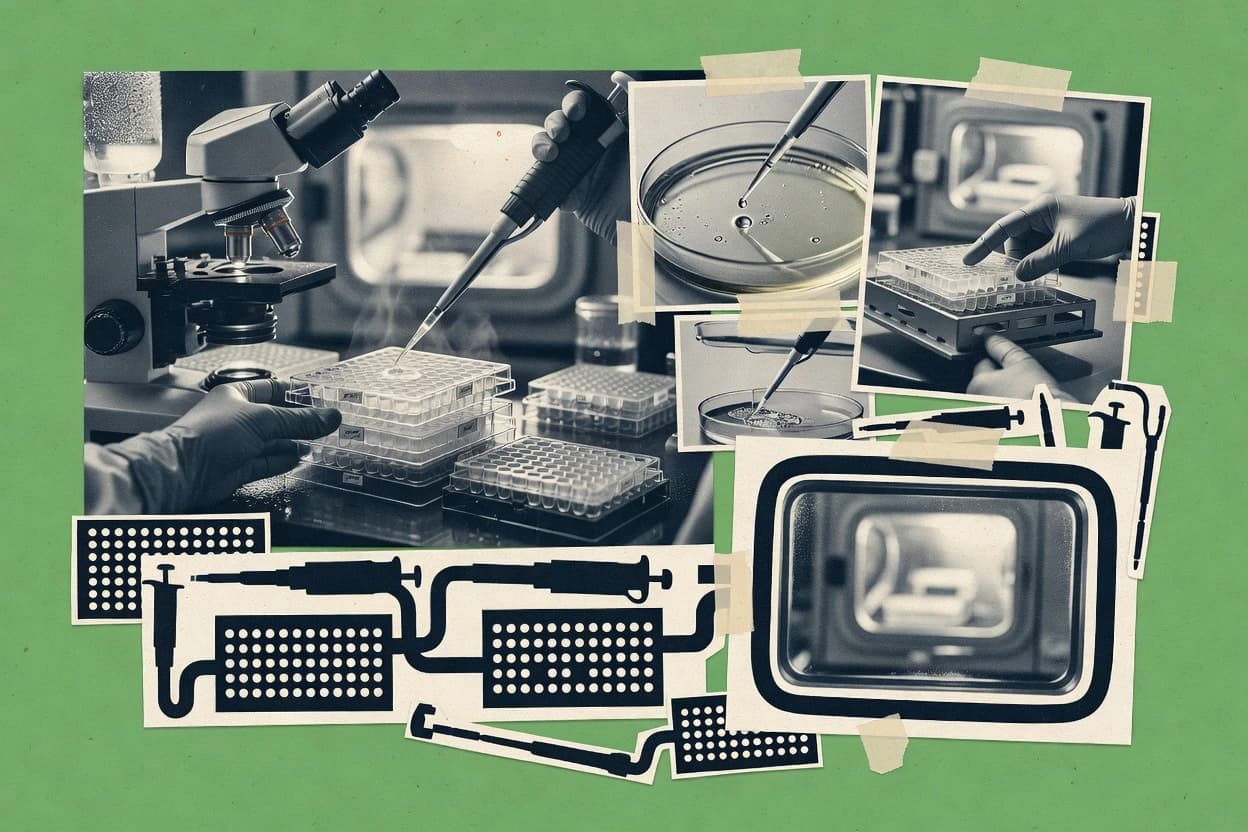

01 Industry overview
The cell culture industry at a glance
The global cell culture market is estimated at $21.0 billion in 2026, with demand driven by biopharmaceutical manufacturing, cell and gene therapy, and cell-based drug research.
- $21.0B[3]
- Global market size, 2026
- 12.9%[3]
- Forecast CAGR, 2026–2033
- 36.05%[3]
- North America share, 2025
- $3.96B[9]
- Cell culture media market, 2030
- Market size
- Grand View Research estimates the global cell culture market at $19.1 billion in 2025 and $21.0 billion in 2026. A separate estimate from Mordor Intelligence values the 2025 market at $29.34 billion, reflecting differences in market definitions and coverage.[3][1]
- Forecast & CAGR
- Grand View Research forecasts growth from $21.0 billion in 2026 to $49.3 billion in 2033, representing a 12.9% CAGR. MarketsandMarkets projects a lower 11.2% CAGR from 2025 to 2030, reaching $50.69 billion.[3][10]
- Market share & regions
- North America accounted for 36.05% of the global cell culture market in 2025 according to Grand View Research. In the narrower cell culture media and cell lines segment, North America held 43.15% in 2025.[3]
- Segmentation
- The market is commonly segmented by product into consumables and instruments, and by application into biopharmaceutical production, drug development, tissue engineering, cell and gene therapy, and toxicity testing. Other published classifications segment by cell type, including primary cultures, secondary cultures, and established cell lines, and by media type, including natural and artificial media.[3][2]
- Key players & concentration
- Major suppliers include Thermo Fisher Scientific, Merck, Danaher, Sartorius, and Becton Dickinson, but reliable public data identifying a single combined market-share percentage for the overall cell culture industry was not found. The market is fragmented across media, reagents, instruments, cell lines, and services.[3][2]
- Pricing
- Public catalog prices illustrate the wide range of cell culture input costs: Thermo Fisher lists 10 liters of CD 293 AGT medium at $1,234, 100 liters of OptiPRO medium at $7,580, and 10 kilograms of CD BHK-21 production medium at $3,185. Prices vary by formulation, volume, grade, and customization.[11]
- Trends, drivers & challenges
- Growth is being supported by biopharmaceutical production, personalized medicine, cell and gene therapy, and increasing use of cell-based assays in drug discovery. Key challenges include serum and raw-material variability, complex culture conditions, contamination control, scalability, and the high cost of manufacturing-grade inputs.[3][11]
- Consumer behavior & competition
- End-user demand is concentrated among pharmaceutical and biotechnology companies, academic and research institutes, hospitals, diagnostic laboratories, and cell banks. Competition is increasingly based on reproducibility, defined and serum-free formulations, automation, supply reliability, and compatibility with cell and gene therapy manufacturing rather than on price alone.[2][11]
- M&A
- Cell culture suppliers compete within a broader life-sciences M&A environment: Deloitte reported $120 billion in life-sciences deals in 2025, with oncology accounting for 30% of deal value, including interest in immune-cell therapies. Publicly documented figures isolating M&A activity for the cell culture industry itself were not found.[12]
- Regulation
- In May 2026, the U.S. FDA issued guidance describing CMC flexibilities for human cellular and gene therapy products developed for biologics license applications under 21 CFR Part 601. In November 2026, FDA issued final potency-assurance guidance covering cell and gene therapy products from early development through post-approval monitoring.[13]
- Latest news
- The latest major regulatory development identified was FDA's November 2, 2026 final guidance on potency assurance for cellular and gene therapy products. The guidance recommends a risk-based strategy covering raw-material variability, manufacturing tests, batch potency, short shelf-life products, viral vectors, and patient-specific therapies.[13]
02 Ranking
Top 10 Companies in the Cell Culture Industry
The leading companies in the cell culture industry, ranked on market impact, performance, momentum, innovation and brand popularity.
Updated November 21, 2026 · Next review December 21, 2026
Lonza stands out for mammalian cell culture development and manufacturing because it provides mammalian cell culture development, manufacturing and media technologies, while Corning focuses on cell culture consumables since it supplies cell culture vessels, surfaces and laboratory tools worldwide.
Ranked by Overall score · How we score ↓
Editor's top 3 picks
Where to start, by need.
#1 Overall · Leader in mammalian cell culture CDMO
Lonza
CH
Ranked #1 · 9.3 · Mammalian cell culture CDMO
Why we picked it: It provides development and manufacturing services tied to mammalian cell culture and media technologies, alongside an an 19% operating margin.
Leader in cell culture consumables
Corning
US
Ranked #2 · 9.3 · Cell culture consumables
Why we picked it: Its consumables focus includes cell culture vessels and surfaces, supported by an an 14.6% operating margin.
Leader in cell culture media & instruments
Thermo Fisher Scientific
US
Ranked #3 · 9.0 · Cell culture media & instruments
Why we picked it: It spans media, sera, vessels, reagents, and instruments, with an 17.4% operating margin.
Pick 1 is the #1 company overall. Picks 2 and 3 are the highest-ranked companies in the top 5 that add a new segment.
Full ranking
| # | Company | Overall ↓ | Impact | Performance | Momentum | Innovation | Company snapshot |
|---|---|---|---|---|---|---|---|
| 1 | Lonza Mammalian cell culture CDMO · CH | 9.3 | 9.3 | 9.7 | 9.8 | 7.6 | |
Company snapshot · Lonza · Data as of November 21, 2026 Lonza provides mammalian cell culture development, manufacturing and media technologies.[14]
| |||||||
| 2 | Corning Cell culture consumables · US | 9.3 | 9.6 | 9.4 | 9.8 | 8.5 | |
Company snapshot · Corning · Data as of November 21, 2026 Corning Life Sciences supplies cell culture vessels, surfaces and laboratory tools worldwide.[15]
| |||||||
| 3 | Thermo Fisher Scientific Cell culture media & instruments · US | 9.0 | 9.9 | 8.5 | 8.8 | 7.4 | |
Company snapshot · Thermo Fisher Scientific · Data as of November 21, 2026 A leading supplier of cell culture media, sera, vessels, reagents and instruments.[3]
| |||||||
| 4 | Sartorius Cell cultivation systems · DE | 9.0 | 9.1 | 8.5 | 9.2 | 8.5 | |
Company snapshot · Sartorius · Data as of November 21, 2026 Sartorius holds leading positions in cell cultivation and supplies media, bioreactors and related systems.[16]
| |||||||
| 5 | STEMCELL Technologies Primary cells & specialty media · CA | 8.9 | 8.2 | 9.9 | 9.4 | 9.0 | |
Company snapshot · STEMCELL Technologies · Data as of November 21, 2026 STEMCELL develops and manufactures cell culture media, primary cells and culture reagents.[17]
| |||||||
| 6 | FUJIFILM Holdings Cell culture biomanufacturing and bioprocessing · JP | 8.7 | 8.2 | 8.0 | 9.9 | 9.6 | |
Company snapshot · FUJIFILM Holdings · Data as of November 21, 2026 FUJIFILM Biotechnologies operates large-scale mammalian cell culture manufacturing sites.[6]
| |||||||
| 7 | PromoCell Primary cells and customized cell culture media · DE | 8.3 | 7.3 | 9.1 | 8.9 | 8.3 | |
Company snapshot · PromoCell · Data as of November 21, 2026 PromoCell provides primary human cells, customized media and cell culture support products.[18]
| |||||||
| 8 | Bio-Rad Laboratories Cell culture reagents and bioprocess analytics · US | 8.0 | 8.2 | 7.4 | 7.3 | 8.8 | |
Company snapshot · Bio-Rad Laboratories · Data as of November 21, 2026 Bio-Rad offers cell culture reagents, media and analytical tools for biopharma and research.[19]
| |||||||
| 9 | HiMedia Laboratories Cell culture media and microbiology reagents · IN | 7.7 | 7.0 | 8.6 | 7.9 | 7.0 | |
Company snapshot · HiMedia Laboratories · Data as of November 21, 2026 HiMedia manufactures cell culture media and related reagents for research and bioprocess applications.[19]
| |||||||
| 10 | Eppendorf Cell culture equipment, vessels and consumables · DE | 7.7 | 8.2 | 7.0 | 7.0 | 7.7 | |
Company snapshot · Eppendorf · Data as of November 21, 2026 Eppendorf manufactures cell culture consumables and equipment for research laboratories.[20]
| |||||||
How we score
- Impact (30%): scale and weight in the market (revenue, market share, employees, market position).
- Performance (20%): recent revenue growth and operating margin; an analyst assessment where a company does not publish them.
- Momentum (20%): growth trajectory and future potential.
- Innovation (15%): R&D intensity and how technologically advanced the company is.
Popularity (brand search demand, 15%) counts toward Overall but is not published as a column. Overall leaves out what is not known.
Scale Scores are shown on a 7–10 scale with one decimal; bars start at 7.0.
Cadence Recalculated when new figures are published; next review December 21, 2026.
Independence. Rankings are editorially independent. Scores, ranks, picks and the verdict follow the method above; no company can pay to change them.
Cite this ranking
APA
Samuel Norberg. (2026, November 21). Top 10 companies in the cell culture industry. In Cell Culture Industry Statistics. Gitnux. https://gitnux.org/cell-culture-industry-statistics/#top-companies
03 Trends & forecasts
Top 10 Cell Culture Industry Trends & Forecasts 2027
What is changing in the cell culture industry, with the evidence behind each trend and a forecast for 2027.
Forecasts were generated by an AI model from the cited evidence. They are estimates, not guarantees.
01Biopharma demand keeps expanding
High confidenceThe global cell culture market is estimated at $21.0 billion in 2026, up from $19.1 billion in 2025, with biopharmaceutical production identified as a core demand driver. Grand View Research forecasts the market to reach $49.3 billion by 2033, equivalent to a 12.9% CAGR from 2026 to 2033.[3]
Forecast 2027: In 2027, biopharmaceutical manufacturing should remain the largest demand pool, supporting approximately 12%–13% year-on-year market growth. Demand will be strongest for production media, cell lines, bioreactors and process-development services.
02Serum-free media gains share
High confidenceThermo Fisher describes serum-free media as improving consistency and productivity while simplifying purification and downstream processing. Its catalog lists manufacturing-oriented serum-free products such as CD CHO AGT medium at $1,180 for 10 liters and CD OptiCHO medium at $153 for 1 liter.[11]
Forecast 2027: In 2027, serum-free and chemically defined formulations should continue replacing serum-containing media in regulated manufacturing and advanced research. Adoption will be fastest where lot consistency, contamination risk and regulatory traceability outweigh the lower upfront cost of conventional media.
03Cell culture media outpaces core equipment
High confidenceGrand View Research estimates the global cell culture media market at $4.8 billion in 2025 and $5.3 billion in 2026, with a forecast of $12.8 billion by 2033 and a 13.5% CAGR. Media demand is therefore growing at least as quickly as, and in some estimates faster than, the broader cell culture market.[3]
Forecast 2027: The media segment should reach roughly $5.9 billion in 2027 if its published 2026–2033 growth trajectory holds. Specialty media for CHO, stem-cell, immune-cell and viral-vector production will account for a growing share of spending.
04Animal-origin-free inputs become standard
Medium confidenceCell and gene therapy manufacturing literature increasingly emphasizes animal-origin-free media to improve reproducibility, reduce contamination concerns and meet regulatory expectations. Thermo Fisher’s cell-therapy materials describe fully defined, serum-free and animal-origin-free formulations for clinical manufacturing.[21][11]
Forecast 2027: By 2027, animal-origin-free specifications should be increasingly requested during technology transfer and supplier qualification, particularly for autologous and allogeneic cell therapies. Suppliers offering documented raw-material traceability and consistent lots should gain share.
05Personalized therapies increase process complexity
High confidenceThe FDA’s November 2026 potency-assurance guidance specifically addresses short shelf-life products and patient-specific therapies. It recommends controls covering manufacturing-process design, material control, in-process testing and potency lot-release assays.[13]
Forecast 2027: In 2027, demand will shift toward closed, rapid and highly standardized workflows that reduce the time between cell collection, expansion, release testing and administration. This should favor ready-to-use media, automated sampling and integrated quality-control platforms.
06Potency testing moves upstream
High confidenceFDA’s final 2026 guidance replaces the former single-minded focus on potency testing with a broader potency-assurance strategy spanning process design, process controls, material controls, in-process testing and lot-release assays. The guidance applies across the product lifecycle from development through post-approval monitoring.[13]
Forecast 2027: In 2027, potency-related requirements should increase demand for functional cell-based assays, standardized reference materials and validated in-process measurements. Suppliers that can connect culture conditions to product potency will have an advantage over providers selling isolated reagents.
07Automation reduces manual handling
Medium confidenceFDA’s potency framework places greater emphasis on manufacturing-process control and in-process testing, while cell-therapy production commonly involves short shelf lives and patient-specific batches. These requirements create a strong operational incentive to reduce manual interventions and improve process repeatability.[13]
Forecast 2027: During 2027, automated cell counters, closed expansion systems, robotic liquid handling and software-connected monitoring should see faster adoption in commercial and late-stage clinical facilities. Automation will be justified mainly by reproducibility, labor availability and contamination control rather than by labor savings alone.
08Closed systems gain manufacturing share
Medium confidenceThe FDA identifies raw-material variability, manufacturing controls and short shelf-life products as central potency-assurance considerations for cell and gene therapies. Closed processing directly addresses several of these risks by limiting open manipulations and environmental exposure.[13]
Forecast 2027: In 2027, closed or functionally closed culture systems should become the default target for new commercial cell-therapy processes. Open systems will remain important in research and early development, but their use will increasingly require stronger contamination-control justification.
09Cell culture supply chains diversify
Medium confidenceThe U.S. bioscience economy report identifies growing demand for advanced production systems, contract development and manufacturing organizations, and domestic and diversified production capacity. Thermo Fisher also describes investment in a new manufacturing facility that increased capacity 2.5-fold for a customer requiring supply for up to 50,000 patients annually.[22][11]
Forecast 2027: In 2027, manufacturers should continue dual-sourcing critical media, supplements and single-use components, with more regional production and safety stock. Supplier qualification and continuity assurances will become stronger competitive differentiators.
10Asia-Pacific expands fastest
Medium confidenceMarket research identifies North America as the largest regional market while Asia-Pacific is the fastest-growing region for cell culture media. The broader cell culture market also assigns North America a 36.05% share in 2025, indicating substantial room for faster growth in other regions.[2][3]
Forecast 2027: In 2027, Asia-Pacific should deliver faster percentage growth than North America, supported by biopharmaceutical investment, local manufacturing capacity and expanding research activity. North America will remain the largest regional revenue base but should lose some relative share.
04 Statistics
Market Intelligence
Market-intelligence figures show both definitional variation and a 2026-to-2033 growth path from $21.0 billion to $49.3 billion at a 12.9% CAGR.
Market size, volume and shipments in the cell culture industry
- USD 29.34 billion was the global cell culture market size in 2025, measured across product, cell type, technology, application, end-user and geography segments.[1]
- USD 31.25 billion was the global cell culture market size in 2025, covering primary and secondary cultures, cell lines, media and applications including biopharmaceuticals, according to The Business Research Company.[2]
- USD 19.1 billion was the global cell culture market size in 2025, covering consumables and instruments across biopharmaceutical production, drug development, tissue engineering, cell and gene therapy, and toxicity testing.[3]
Forecast growth and shipments in the cell culture industry
- The global cell culture market is forecast to reach USD 46.73 billion in 2030 from USD 33.81 billion in 2026, implying an 8.4% CAGR; the report was published for the 2026–2030 forecast period.[2]
- The global cell culture market is projected to reach USD 49.3 billion in 2033 from USD 21.0 billion in 2026, at a 12.9% CAGR; the forecast was published in 2026.[3]
- The global cell culture market is projected to reach USD 58.42 billion in 2031 from USD 33.07 billion in 2026, at a 12.1% CAGR; the forecast was published in June 2026.[4]
Regional split of the cell culture industry
- North America accounted for 36.05% of global cell culture market revenue in 2025, the largest regional share in Grand View Research’s geography-defined market model.[3]
- In 2025, North America represented 39.8%, Europe 27.4%, Asia-Pacific 24.6%, and LAMEA 8.2% of global cell culture market revenue.[5]
- North America held 35.59% of global cell culture market revenue in 2025, while Asia-Pacific is forecast to grow at 9.27% annually from 2026 to 2031.[1]
05 Statistics
Strategy & Growth
Strategy and growth highlights scale expansion: Fujifilm Diosynth Biotechnologies planned 8 × 20,000-litre mammalian cell-culture bioreactors in 2028.
Capacity expansion in the cell culture industry
- $1.2 billion was announced in 2024 for an additional 8 × 20,000-litre mammalian cell-culture bioreactors at Fujifilm Diosynth Biotechnologies’ Holly Springs, North Carolina, site, planned for 2028.[6]
- The first phase opened in 2025 with 8 × 20,000-litre mammalian cell-culture bioreactors; the planned second phase increases the site to 16 bioreactors.[6]
- The Holly Springs expansion includes approximately 400,000 square feet of additional manufacturing space and 8 × 20,000-litre cell-culture bioreactors, with completion planned by 2028.[7]
06 Statistics
Trade & Footprint
Trade and footprint focuses attention on cross-border flows: in 2024, U.S. exports under HS 3002.51 reached $768.7 million and 303,098 kg.
Imports and exports of cell culture
- U.S. imports of cell cultures, whether or not modified, under HS 3002.51 were $33.4 million and 4,025 kg in 2024.[8]
- U.S. exports of cell cultures, whether or not modified, under HS 3002.51 were $768.7 million and 303,098 kg in 2024.[8]
- U.S. re-exports of cell cultures, whether or not modified, under HS 3002.51 were $9.4 million and 6,625 kg in 2024.[8]
Key questions about the cell culture industry
How large is the global cell culture market in 2026?
What growth rate is expected for the market after 2026?
Which companies lead the cell culture industry?
Which technology shifts matter most for cell culture purchasing?
How is the cell culture industry structured in public data?
What do U.S. trade flows show for cell cultures in 2024?
Cite This Report
This report is designed to be cited. We maintain stable URLs and versioned verification dates. Copy the format appropriate for your publication below.
Samuel Norberg. (2026, November 21). Cell Culture Industry Statistics. Gitnux. https://gitnux.org/cell-culture-industry-statistics
Samuel Norberg. "Cell Culture Industry Statistics." Gitnux, 21 Nov 2026, https://gitnux.org/cell-culture-industry-statistics.
Samuel Norberg. 2026. "Cell Culture Industry Statistics." Gitnux. https://gitnux.org/cell-culture-industry-statistics.
Sources & references
22 sources cited across this report
mordorintelligence.com
thebusinessresearchcompany.com
grandviewresearch.com
marketsandmarkets.com
- cervicornconsulting.com
fujifilm.com
s205.q4cdn.com
data.un.org
www1.hkexnews.hk
prnewswire.com
thermofisher.com
deloitte.com
fda.gov
lonza.com
corning.com
sartorius.com
stemcell.com
- promocell.com
globenewswire.com
eppendorf.com
bio.org