
GITNUXSOFTWARE ADVICE
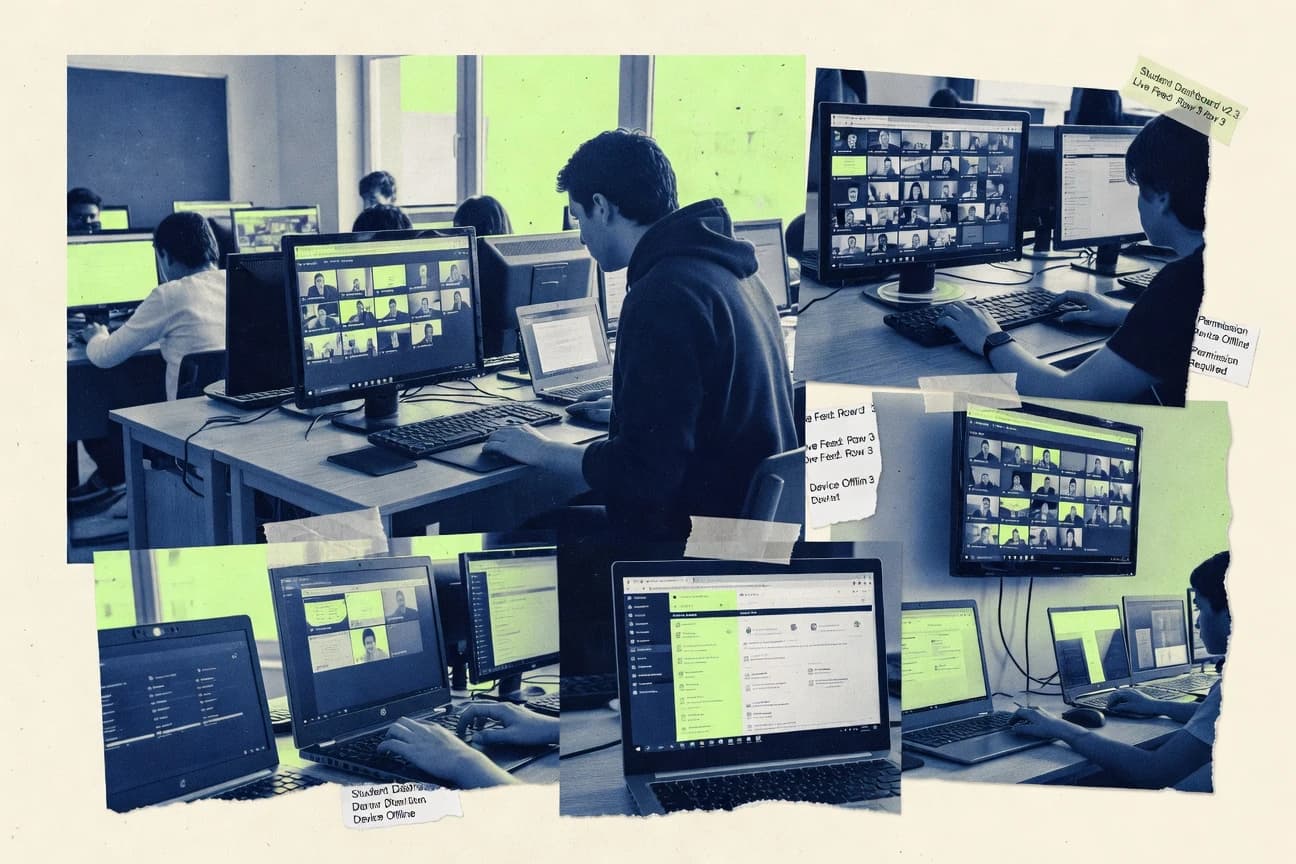
Education LearningTop 10 Best Student Computer Monitoring Software of 2026
Ranked top 10 student computer monitoring software for schools, comparing Lightspeed Classroom Management, GoGuardian, and LanSchool features and tradeoffs.

How we ranked these tools
Core product claims cross-referenced against official documentation, changelogs, and independent technical reviews.
Analyzed video reviews and hundreds of written evaluations to capture real-world user experiences with each tool.
AI persona simulations modeled how different user types would experience each tool across common use cases and workflows.
Final rankings reviewed and approved by our editorial team with authority to override AI-generated scores based on domain expertise.
Score: Features 40% · Ease 30% · Value 30%
Gitnux may earn a commission through links on this page — this does not influence rankings. Editorial policy
LanSchool is the best fit if your school wants instructor-led, predictable live monitoring across managed endpoints, whereas Lightspeed Classroom Management suits teams that need consistent restriction controls and classroom orchestration with teacher-led monitoring.
Editor’s top 3 picks
Three quick recommendations before you dive into the full comparison below — each one leads on a different dimension.
LanSchool
Live teacher controls for viewing and directing student screens during active instruction sessions.
Built for fits when schools need instructor-led live monitoring with predictable policy rollout across managed endpoints..
Lightspeed Classroom Management
Editor pickTeacher console session controls that combine live visibility with quick restriction actions during instruction.
Built for fits when schools want teacher-led monitoring and consistent restriction controls across managed device groups..
NetSupport School
Editor pickAssessment-mode lockdown that restricts student actions during tests while teachers maintain session control.
Built for fits when schools need teacher-led monitoring with assessment lockdown and room-scoped policies..
Comparison Table
LanSchool
SMBClassroom monitoring software for viewing and controlling student screens.
Live teacher controls for viewing and directing student screens during active instruction sessions.
LanSchool supports teacher-managed session workflows where instructors can view student activity, intervene during off-task moments, and keep multiple students under the same classroom ruleset. The product also fits environments that need repeatable device enrollment and policy rollout, since monitoring depends on installed client agents that must match the school’s deployment model.
A key tradeoff is that agent-based monitoring adds endpoint management overhead compared with agentless approaches. LanSchool works best in labs and 1:1 device programs where device imaging, software deployment tooling, and consistent student logins are already in place.
- +Teacher console supports real-time student screen visibility during lessons
- +Session controls enable instructor interventions without interrupting the class flow
- +Centralized configuration helps keep classroom rules consistent across rooms
- +Designed for managed endpoint deployments rather than ad hoc monitoring
- –Agent-based monitoring requires reliable endpoint deployment and maintenance
- –Some advanced governance workflows take time to standardize across sites
K-12 classroom teachers
During lessons, spot off-task screens fast
Faster redirection during class
Technology coordinators
Standardize monitoring across device fleets
Consistent monitoring coverage
Show 1 more scenario
Instructional coaches
Observe and guide classroom practice
Actionable instructional feedback
Coaches use session visibility to understand whether students follow guided learning tasks.
Best for: Fits when schools need instructor-led live monitoring with predictable policy rollout across managed endpoints.
Lightspeed Classroom Management
vertical specialistStudent monitoring and classroom orchestration software for schools.
Teacher console session controls that combine live visibility with quick restriction actions during instruction.
Lightspeed Classroom Management targets schools that need teacher dashboards for live monitoring, plus administrative governance for consistent acceptable use rules. The core classroom workflow covers activity visibility, student alerts for likely off-task behavior, and lockdown modes for tests. The admin side supports centralized device grouping and policy assignment so teachers do not manage per-device settings during instruction.
A tradeoff appears in how tightly classroom workflows are organized around teacher console actions rather than open-ended automation. Schools that need deep custom integrations or complex roster transformation often find the automation surface limited compared with products that expose broader REST API coverage. A common usage situation fits teachers running frequent in-class assessments who want quick access to restriction controls without switching tools.
- +Teacher console supports live monitoring and session controls in one workflow
- +Centralized policy assignment reduces per-class configuration drift
- +Off-task alerts support faster intervention than end-of-class review
- +Assessment-focused restriction controls fit proctored classroom testing routines
- –Automation and integration depth are more limited than roster-centric monitoring stacks
- –Fine-grained customization can require admin intervention instead of teacher self-service
- –Alert quality depends on device and classroom policy tuning at rollout
K-12 instructional leadership
Standardize acceptable use across labs
Fewer policy exceptions during class
Teachers running tests
Lock down during assessments
Stronger test integrity enforcement
Show 1 more scenario
School IT teams
Roll out monitoring to device carts
Faster lab readiness cycles
IT configures monitoring policy once and assigns it across scheduled device groups for classes.
Best for: Fits when schools want teacher-led monitoring and consistent restriction controls across managed device groups.
NetSupport School
SMBClassroom instruction and monitoring suite for student devices.
Assessment-mode lockdown that restricts student actions during tests while teachers maintain session control.
NetSupport School is built for teacher-led instruction with a fast workflow from roster selection to live monitoring and targeted interventions. The admin console supports group-based organization for managing rooms and devices, and it includes configuration controls for what teachers can see and do during a session. Classroom sessions can run in a guided mode where the teacher directs attention using broadcast viewing and off-task alerts.
A key tradeoff is reliance on deployment and ongoing endpoint agent health for consistent monitoring coverage. It fits labs that run scheduled classes with predictable device sets, where the school can standardize agent installs and configuration before the term begins.
- +Teacher console supports live student visibility and targeted classroom interventions
- +Assessment-mode lockdown includes guided control during tests and quizzes
- +Group-based administration simplifies rolling out classroom policies by room
- +Interactive student actions support messaging and teacher-directed tasks
- –Monitoring depends on agent deployment and endpoint availability
- –API automation surface is limited for roster sync workflows
- –Advanced governance settings require careful policy design across groups
- –Large device counts can increase console responsiveness lag during peak sessions
Secondary school teachers
Monitor during daily instruction
Fewer disruptions in class
IT administrators
Standardize lab policies by room
Lower per-room setup time
Show 2 more scenarios
Assessment coordinators
Lock down devices for quizzes
Improved test integrity
Tests run with guided restrictions while teachers retain session oversight and messaging.
School operations teams
Manage recurring scheduled labs
More reliable start-of-class control
Device sets are managed around class schedules to keep monitoring ready at start time.
Best for: Fits when schools need teacher-led monitoring with assessment lockdown and room-scoped policies.
GoGuardian
vertical specialistK-12 classroom management and student device monitoring platform.
Teacher-triggered supervision actions that pair real-time alerts with classroom enforcement on managed student endpoints.
GoGuardian is a student computer monitoring solution built around classroom teacher controls plus a student endpoint agent that can apply content filtering and supervision actions. Core capabilities include teacher dashboards, off-task alerts, web and app activity visibility, and configurable classroom modes that limit student deviation during instruction or assessments.
Administration also covers device onboarding and policy configuration through a centralized console, with audit-relevant reporting for what students viewed and what actions teachers took. GoGuardian’s strongest fit is schools that want tight teacher-to-device orchestration with enforcement behaviors that go beyond passive visibility.
- +Teacher dashboard supports live supervision with actionable student alerts
- +Agent-based enforcement can block or restrict behaviors on student devices
- +Web and app activity reporting supports classroom accountability workflows
- +Assessment mode style lockdown helps preserve test integrity during checks
- –More effective results require consistent agent deployment across enrolled devices
- –Advanced automation and integration depends on available roster and API workflows
Best for: Fits when school teams need teacher-led monitoring with enforcement behaviors on student endpoints.
Securly
vertical specialistStudent safety and device monitoring platform for K-12 education.
Incident-style alerting that surfaces off-task behavior patterns tied to device activity, then routes context to teacher review views.
Securly manages school device monitoring from a teacher-facing console with student-level activity visibility. The product focuses on web and app controls, incident-style alerts for off-task behavior, and reporting for classroom and network context.
It also supports deployment patterns commonly used in K-12 environments, including agent-based monitoring and policy-driven configuration workflows. Securly’s governance hinges on configurable oversight settings that map to classroom needs rather than one-size enforcement.
- +Teacher dashboards provide actionable activity views during class time.
- +Policy-driven web and app control supports consistent acceptable-use enforcement.
- +Alerting highlights likely off-task behavior for quick intervention.
- +Reporting supports parent-facing summaries and internal review workflows.
- –Guardrails depend on careful configuration to avoid alert noise.
- –Some classroom automation workflows require more admin setup than peers.
Best for: Fits when schools need teacher-visible activity alerts plus policy-based content controls for student devices.
Vision for Chromebooks
SMBClassroom monitoring tool for viewing student Chromebook screens.
ChromeOS-focused monitoring and classroom control tied to device activity, not generic cross-OS management.
Vision for Chromebooks from netop.com is a student computer monitoring tool built specifically around ChromeOS class deployments. It focuses on teacher visibility into classroom activity and on-device enforcement options that fit typical school workflows for off-task detection and classroom interventions.
The console design emphasizes managing multiple student endpoints and keeping policies consistent across devices in a single school network. Administrators get monitoring and reporting that align with day-to-day governance needs for classroom oversight rather than enterprise-wide device management.
- +ChromeOS-first deployment reduces friction for Chromebook-centered classrooms
- +Teacher-facing monitoring supports quick intervention during in-class tasks
- +Policy handling is oriented toward keeping classroom rules consistent across devices
- +Reporting supports routine oversight without requiring separate analytics tools
- –Works best for Chromebook fleets and is less applicable for mixed device environments
- –Integration and automation surface is limited compared with tools that offer deeper API-based workflows
Best for: Fits when Chromebook classrooms need teacher monitoring and intervention with straightforward administrative setup.
Bark for Schools
vertical specialistStudent safety and activity monitoring platform for school accounts.
Bark’s incident detection and safety alert workflows prioritize harmful-content signals over classroom device control.
Bark for Schools centers student safety monitoring with a purpose-built workflow that targets harmful language and risky online behavior rather than only class-time device control. The product focuses on centralized policies, student privacy controls, and actionable alerts for staff, with reports that support documentation needs.
Core capabilities include monitoring of student communications and device-related signals configured for school use, plus administrator settings that govern what gets flagged and who can view results. The platform’s value depends on whether the school wants safety triage automation to complement or replace classroom monitoring patterns.
- +Safety-focused monitoring targets harmful language and risky behavior signals
- +Centralized alerting gives staff a single triage stream for incidents
- +School-specific policy controls reduce over-collection risk
- +Reporting supports documentation workflows for follow-up actions
- –Less focused on live classroom orchestration than device-control centric tools
- –Alert volume can require staff training for consistent triage
- –Browser lockdown and exam integrity features are not the primary workflow
- –Automation depth is narrower than platforms built around classroom management
Best for: Fits when schools need language and behavior risk triage that complements classroom monitoring.
Senso
SMBSenso monitors student device activity and provides classroom controls, safeguarding alerts, and administrative reporting.
API-driven roster sync combined with admin-scoped monitoring actions supports repeatable classroom setup at scale.
Senso focuses on agent-based student device monitoring with a cloud console for visibility and classroom control. The core workflow includes live status views for connected endpoints, off-task alerting, and evidence-oriented recording for teacher review.
Senso also targets integration depth through an API for roster sync and automation hooks that support school IT operations and lab provisioning. Admin governance centers on role-based access and audit-friendly activity trails tied to configuration changes and monitoring actions.
- +Agent-based monitoring gives steadier device-level signals than agentless approaches
- +API supports roster synchronization and automation across school administration tools
- +Role-scoped controls help separate teacher visibility from admin configuration
- +Teacher review tools map monitoring events to actionable classroom moments
- –Endpoint rollout needs disciplined device grouping and initial configuration
- –Alert noise control takes tuning to avoid frequent off-task prompts
Best for: Fits when schools need agent-driven monitoring plus API-based automation for device and roster workflows.
Respondus LockDown Browser
vertical specialistRespondus LockDown Browser restricts student computers during online assessments and blocks unauthorized applications and navigation.
Assessment-time app switching and navigation blocking that is enforced by the dedicated LockDown Browser process.
Respondus LockDown Browser launches as an exam browser that blocks students from switching apps, navigating away, or using external tools during assessments. It integrates with common learning and testing workflows by locking down the device at test start and restoring normal access at test end.
Schools use it for test integrity enforcement when proctoring needs focus on device-level behavior rather than continuous live review. LockDown Browser also supports assessment modes like monitor-plus-lockdown workflows when paired with Respondus monitoring products.
- +Device-level exam lockdown prevents app switching and navigation changes
- +Works as an exam browser workflow with start and restore control points
- +Integrates with school assessment setups through supported LMS delivery patterns
- +Clear student experience because the lockdown behavior is localized to test time
- –Primarily covers browser and device lockdown, not full classroom orchestration
- –Lockdown behavior depends on correct installation and update management across labs
- –Limited live monitoring capabilities compared with dedicated classroom monitoring suites
- –Admin control depth can feel narrower than tools offering broader monitoring surfaces
Best for: Fits when schools need test integrity enforcement through exam browser lockdown rather than full classroom monitoring.
Veyon
SMBVeyon is open-source classroom management software for viewing, controlling, locking, and broadcasting student computers.
Teacher-side remote control workflows that combine live viewing with endpoint actions under one classroom session.
Veyon is a student computer monitoring tool built for teacher-led classroom management with a client-agent model and a teacher console. It supports live screen viewing, remote control, and file or application launch patterns that fit in-lab instruction workflows.
The software also includes logging and exam-style restrictions, plus configuration options for visibility limits and student privacy boundaries. Compared with browser-first tools, Veyon targets managed endpoints where agents and policies can be controlled centrally.
- +Live screen viewing and teacher remote control for direct classroom intervention
- +Endpoint-focused architecture supports offline or LAN-first deployments
- +Exam-style lockdown workflows with assessment mode restrictions
- +Activity logging supports classroom audit trails and troubleshooting
- –Agent deployment and policy rollout require endpoint administration discipline
- –Limited built-in browser lockdown compared with exam browser products
- –Integration depth for cloud identity and device orchestration is narrower than top-tier tools
- –Large deployments can feel heavier to manage than cloud console systems
Best for: Fits when schools want on-prem monitoring and teacher control across lab PCs with managed endpoints.
Conclusion
After evaluating 10 education learning, LanSchool stands out as our overall top pick — it scored highest across our combined criteria of features, ease of use, and value, which is why it sits at #1 in the rankings above.
Use the comparison table and detailed reviews above to validate the fit against your own requirements before committing to a tool.
How to Choose the Right student computer monitoring software
Student computer monitoring software helps schools coordinate teacher-led oversight, enforce acceptable-use boundaries, and keep classroom interventions consistent across lab PCs, Chromebook fleets, or mixed device deployments.
This guide covers the top ranked options from the working set, including LanSchool, Lightspeed Classroom Management, GoGuardian, and the remaining tools in the student computer monitoring software shortlist.
Student computer monitoring software for classroom oversight, supervision, and policy enforcement
Student computer monitoring software combines teacher consoles with endpoint controls to support live monitoring, session-based enforcement, and incident-style alerts tied to student device activity.
LanSchool emphasizes instructor-led live visibility through session controls during active instruction, while GoGuardian pairs real-time alerts with teacher-triggered enforcement actions on managed student endpoints.
Many deployments also rely on agent-based endpoint installation for reliable signals, and schools typically standardize device grouping and policy rollout so teacher actions apply predictably across classrooms and device carts.
Other products shift emphasis toward assessment-time lockdown workflows or API-driven roster synchronization, which changes how administrators provision classes and how much automation they can apply across school systems.
Core capabilities to compare across student computer monitoring tools
Student computer monitoring software succeeds when teacher workflows match the enforcement model on student endpoints, so classes stay consistent during live instruction and during assessment periods. The strongest tools also reduce admin overhead with repeatable provisioning, predictable policy rollouts, and automation options that align with the school’s device grouping and roster processes.
Teacher session controls for live supervision
LanSchool provides live teacher controls that let instructors view and direct student screens during active instruction sessions without switching to separate admin workflows. Lightspeed Classroom Management also bundles live visibility with quick restriction actions in a teacher console tied to managed device groups.
Assessment-mode lockdown and test integrity enforcement
NetSupport School includes assessment-mode lockdown that restricts student actions during tests while teachers maintain session control. Respondus LockDown Browser enforces app switching and navigation blocking through the dedicated LockDown Browser process for exam browser lockdown workflows.
Teacher-triggered enforcement tied to alerting
GoGuardian pairs real-time alerts with teacher-triggered supervision actions that can block or restrict behaviors on managed student endpoints. Securly routes incident-style alerting to teacher review views and pairs the visibility layer with policy-driven web and app control for acceptable-use enforcement.
Automation and roster synchronization surfaces for admin workflows
Senso emphasizes API-driven roster sync so schools can automate classroom setup and repeatable monitoring actions at scale. Lightspeed Classroom Management centers on centralized policy assignment for fewer class-by-class configuration changes, but its automation and integration depth is more limited than roster-centric stacks.
Device-platform fit for Chromebook-first classrooms
Vision for Chromebooks focuses on ChromeOS-first monitoring and classroom control tied to device activity. LanSchool can fit broader managed endpoint environments, but its strongest fit comes from instructor-led live monitoring with session controls that depend on reliable endpoint deployment.
Safety-focused incident detection for harmful language and risky behavior
Bark for Schools prioritizes harmful-content signals and safety alert workflows that route to centralized staff triage. GoGuardian concentrates on live classroom supervision and enforcement behaviors on student devices rather than language-risk triage as its primary workflow.
Choose by workflow: live classroom orchestration versus assessment lockdown versus automation-first deployment
Start by identifying the dominant enforcement moment in the school day because each tool’s teacher console and endpoint controls reflect that primary workflow. LanSchool and Lightspeed Classroom Management center on instructor-led live supervision, NetSupport School centers on assessment-mode lockdown alongside teacher control, and Respondus LockDown Browser centers on exam browser lockdown through a dedicated process.
Pick the enforcement phase the school needs most
If daily instruction requires teachers to intervene in real time, choose LanSchool or Lightspeed Classroom Management because their teacher consoles combine live visibility with session controls and restriction actions. If test periods require limiting student actions while keeping teachers in control, choose NetSupport School or Respondus LockDown Browser because both focus on assessment-time lockdown, with one using teacher-guided assessment-mode control and the other using the LockDown Browser process.
Match the product to the school’s endpoint deployment reality
If the school can standardize agent-based endpoint deployment across device groups, tools like LanSchool, GoGuardian, and NetSupport School align with agent-based monitoring signals. If endpoint administration capacity is constrained, prioritize tools whose operational model fits existing lab workflows, because Vision for Chromebooks is built for ChromeOS-centered classroom environments and Veyon is designed for on-prem lab PC control.
Decide whether roster setup needs API-driven automation
If class creation and roster synchronization must run with minimal manual admin work, evaluate Senso because it emphasizes API-driven roster sync for repeatable setup at scale. If roster changes are handled through teacher workflows and centralized policy assignment, evaluate Lightspeed Classroom Management because it reduces per-class configuration drift even though its automation and integration depth is more limited than roster-centric options.
Validate teacher control surfaces for the actual classroom behavior patterns
If the school wants alerts that quickly convert into teacher actions on student endpoints, evaluate GoGuardian because supervision actions are teacher-triggered and enforced on managed devices. If the school needs incident-style activity views that pair with policy-driven web and app control, evaluate Securly because teacher review views connect directly to content control.
Filter by classroom device mix and lab architecture
If the environment is Chromebook-centered, choose Vision for Chromebooks because it is ChromeOS-first and reduces friction for Chromebook fleets. If the school relies on on-prem lab PCs and wants teacher remote control workflows that operate under an offline or LAN-first architecture, evaluate Veyon because its endpoint-focused design fits that lab model.
Add a safety triage workflow only when it matches operational needs
If the school’s highest priority is harmful language and risky behavior triage with centralized staff alerting, evaluate Bark for Schools because safety workflows are its primary focus. If live supervision and enforcement behaviors are the core requirement, tools like LanSchool and GoGuardian provide classroom orchestration that is not centered on language-risk detection.
Who student computer monitoring software is for and which tools map to those needs
Student computer monitoring software supports roles that manage classroom device behavior and enforce acceptable-use boundaries through teacher-visible controls and endpoint actions. The best match depends on whether the organization needs live supervision, assessment lockdown, or admin automation for classroom setup and roster updates.
K-12 or district IT teams responsible for consistent policy rollout across many classes
Lightspeed Classroom Management fits when centralized policy assignment needs to reduce per-class configuration drift across managed device groups. Senso fits when districts require API-driven roster sync to automate classroom setup and monitoring actions across school systems.
Instruction leaders and teachers running daily supervised instruction with real-time interventions
LanSchool fits when live teacher controls must support viewing and directing student screens during active instruction sessions. GoGuardian fits when teacher-triggered enforcement actions must pair with actionable student alerts during classroom supervision.
Assessment coordinators and testing administrators focused on test integrity
NetSupport School fits when assessment-mode lockdown must restrict student actions while keeping teacher session control available during tests and quizzes. Respondus LockDown Browser fits when exam browser lockdown must prevent app switching and navigation changes through the dedicated LockDown Browser process.
Chromebook-focused schools that want monitoring aligned to ChromeOS deployment patterns
Vision for Chromebooks fits when Chromebook fleets need ChromeOS-first monitoring and intervention with straightforward administrative setup. Tools that are broader across endpoint types may require more planning when the deployment is entirely Chromebook-centered.
Student safety and welfare teams that track harmful language or risky behavior signals
Bark for Schools fits when workflows must prioritize harmful-content signals and route incidents into centralized triage streams. Classroom-orchestration tools can support monitoring needs, but Bark is designed around safety alerting rather than instruction-focused session controls.
Common procurement and rollout pitfalls
Many deployments fail when the enforcement workflow picked during procurement does not match what teachers can execute during class time or what administrators can provision across devices. Another frequent issue is over-reliance on endpoint deployment without building governance checks for class grouping, alert tuning, and teacher permissions.
Selecting for the monitoring interface but ignoring the endpoint deployment dependency
LanSchool and GoGuardian depend on agent-based monitoring behavior that requires reliable endpoint deployment and maintenance. Standardize device grouping and rollout so teacher controls affect the same managed endpoints across classrooms.
Treating assessment lockdown as a substitute for full classroom orchestration
Respondus LockDown Browser is designed for exam browser lockdown and app switching prevention rather than complete classroom supervision. NetSupport School supports assessment-mode lockdown with teacher session control, which aligns better when both testing and instruction require consistent teacher oversight.
Underestimating alert tuning and governance discipline for incident-heavy models
Securly requires careful configuration to avoid alert noise, and Bark for Schools can generate alert volume that needs consistent triage training. Build an alert ownership workflow before scaling the policy scope across schools.
Assuming roster automation exists without validating the admin integration path
Senso explicitly emphasizes API-driven roster sync, while Lightspeed Classroom Management focuses more on centralized policy assignment than roster-centric automation. If roster change propagation is a priority, prioritize tools with an automation surface aligned to that workflow.
Forcing a mixed-device classroom onto a Chromebook-first deployment strategy
Vision for Chromebooks is best aligned to Chromebook fleets because it is ChromeOS-first and less applicable for mixed device environments. If the device mix is inconsistent, prioritize tools with classroom orchestration across managed endpoint environments or plan separate policies per device cohort.
How We Selected and Ranked These Tools
We evaluated LanSchool, Lightspeed Classroom Management, GoGuardian, and the other shortlist tools by scoring features at 40 percent and ease plus value at 30 percent each. Feature scoring weighted teacher session controls for live monitoring, assessment-time lockdown behaviors, and whether teacher dashboards convert alerts into enforcement actions on student endpoints.
Ease scoring favored operational fit for classroom use, including how quickly teachers can act in their console and how predictable enforcement is during instruction sessions. We weighted LanSchool highest because live teacher controls for viewing and directing student screens during active instruction sessions combine real-time visibility with session controls that reduce friction during daily classroom workflows.
Frequently Asked Questions About student computer monitoring software
How do Lightspeed Classroom Management and GoGuardian differ in teacher controls during instruction?
Which option is better for Chromebook-only monitoring in a school network?
What breaks if a school expects agentless monitoring but selects an agent-based product?
How does LanSchool handle live screen visibility compared with remote control workflows in Veyon?
What should admins check for in security and governance when comparing GoGuardian and Senso?
How do Senso and other classroom tools support roster onboarding and automation with IT systems?
When should a school choose Respondus LockDown Browser instead of classroom monitoring tools?
What tradeoff appears when administrators prioritize acceptable use enforcement over live screen intervention?
How does Bark for Schools differ from classroom monitoring when handling risk detection?
Tools reviewed
Primary sources checked during evaluation.
Referenced in the comparison table and product reviews above.
- Education LearningTop 10 Best Student Monitoring Software of 2026
- Technology Digital MediaTop 10 Best Computer Screen Monitoring Software of 2026
- Education LearningTop 10 Best Classroom Computer Management Software of 2026
- Education LearningTop 10 Best CHR omebook Monitoring Software of 2026
- Employment WorkforceTop 10 Best Workplace Computer Monitoring Software of 2026
Keep exploring
Comparing two specific tools?
Software Alternatives
See head-to-head software comparisons with feature breakdowns, pricing, and our recommendation for each use case.
Explore software alternatives→In this category
Education Learning alternatives
See side-by-side comparisons of education learning tools and pick the right one for your stack.
Compare education learning tools→