
GITNUXSOFTWARE ADVICE
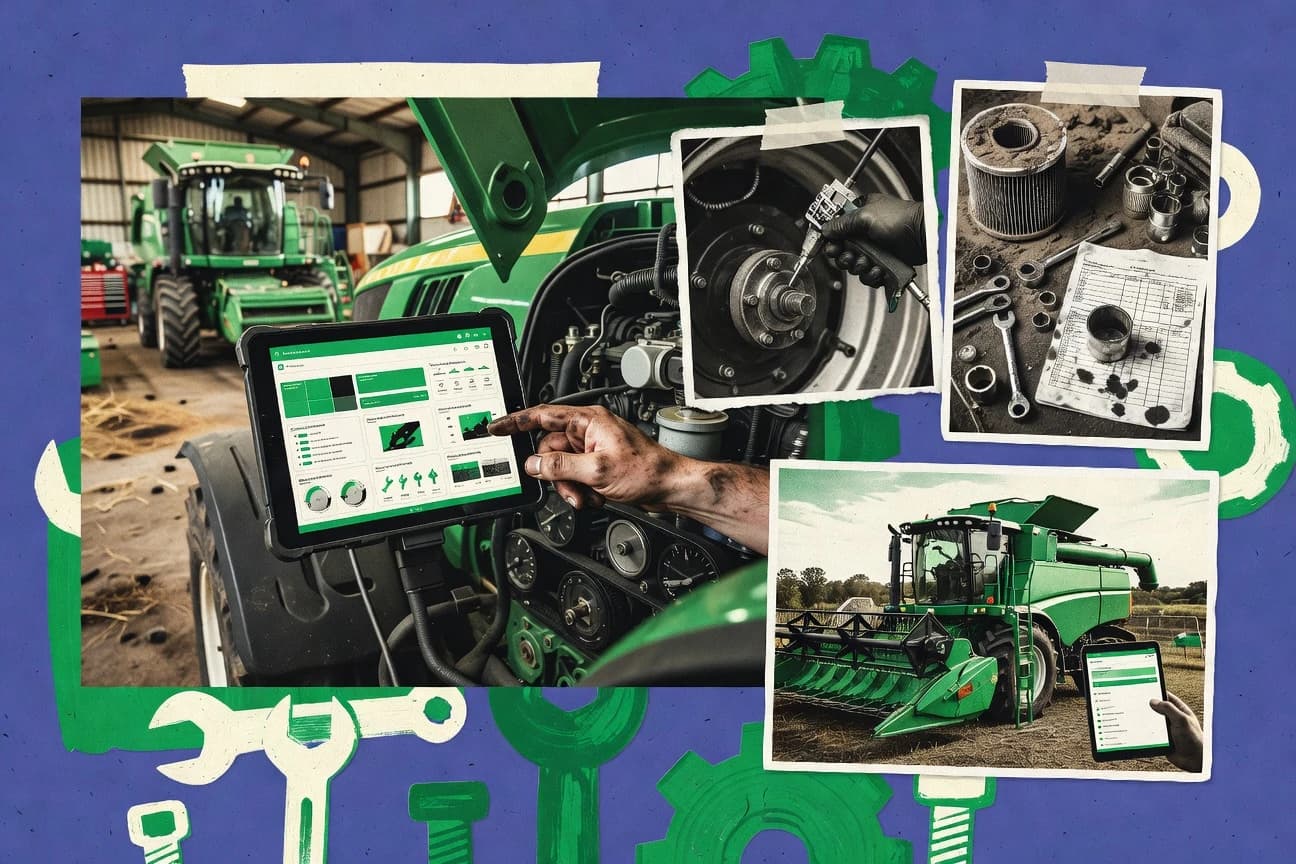
Agriculture FarmingTop 10 Best Farm Equipment Maintenance Software of 2026
Ranked roundup of top farm equipment maintenance software with criteria and tradeoffs for fleet managers, plus notes on Limonet, TractIQ, and Samsara.

How we ranked these tools
Core product claims cross-referenced against official documentation, changelogs, and independent technical reviews.
Analyzed video reviews and hundreds of written evaluations to capture real-world user experiences with each tool.
AI persona simulations modeled how different user types would experience each tool across common use cases and workflows.
Final rankings reviewed and approved by our editorial team with authority to override AI-generated scores based on domain expertise.
Score: Features 40% · Ease 30% · Value 30%
Gitnux may earn a commission through links on this page — this does not influence rankings. Editorial policy
Limonet is the best pick for farm equipment dealers and workshops that want one workspace for machinery records, work orders, and repair documentation, while Samsara fits when you need connected visibility for tractors, implements, trailers, and support vehicles.
Editor’s top 3 picks
Three quick recommendations before you dive into the full comparison below — each one leads on a different dimension.
Limonet
Farm-specific asset records connect machine details, attachments, costs, and maintenance tasks in one workspace.
Built for fits when farms need one workspace for machinery records, maintenance tasks, parts, and repair documentation..
TractIQ
Editor pickAPI-first asset and maintenance activity sync that keeps field updates consistent with external systems.
Built for fits when farm maintenance teams need scheduled work orders, inspection records, and API-based integrations..
Samsara
Editor pickConnected Operations Cloud unifies gateways, asset tags, diagnostics, driver workflows, and maintenance records across powered and unpowered equipment.
Built for fits when farm operators need connected visibility across tractors, implements, trailers, and support vehicles..
Comparison Table
Limonet
vertical specialistFarm machinery maintenance and workshop management software for equipment dealers.
Farm-specific asset records connect machine details, attachments, costs, and maintenance tasks in one workspace.
Each asset can carry identifying details, meter readings, documents, assigned tasks, and past repairs. Managers can connect maintenance activity to specific machines instead of storing records across spreadsheets and paper forms. The structure suits farms that maintain mixed fleets with different service requirements.
The documented feature set emphasizes recordkeeping and maintenance coordination rather than telematics-driven automation. A farm with several tractors and seasonal harvesting equipment can use Limonet to assign upcoming maintenance, record completed repairs, and keep supporting documents with each asset. Teams needing deep API connectivity, advanced fleet telemetry, or extensive governance controls may require additional systems.
- +Farm-specific equipment records organize tractors, combines, implements, and attachments.
- +Maintenance tasks can include due dates, notes, documents, and assigned personnel.
- +Parts inventory connects stock items to maintenance activity.
- +Mobile access supports field updates without returning to the office.
- –Public materials do not detail API endpoints, RBAC, or audit-log controls.
- –Telematics and GPS fleet tracking are not central to the documented workflow.
- –Advanced financial costing and labor analytics receive less emphasis than equipment records.
- –Large organizations may need governance for shared asset naming and data ownership.
Farm fleet managers
Coordinating seasonal machinery maintenance
Fewer missed service tasks
Agricultural technicians
Recording completed equipment repairs
Centralized repair documentation
Show 1 more scenario
Multi-farm operators
Managing distributed equipment records
Clearer fleet visibility
Operations teams maintain consistent records for machines working across multiple farms and storage locations.
Best for: Fits when farms need one workspace for machinery records, maintenance tasks, parts, and repair documentation.
TractIQ
vertical specialistAgricultural equipment telematics and maintenance platform for farm operations.
API-first asset and maintenance activity sync that keeps field updates consistent with external systems.
TractIQ’s core workflow ties together preventive maintenance scheduling, corrective maintenance work orders, and inspection documentation in a single asset activity timeline. The system supports recurring service intervals and helps teams record labor and repair outcomes against each machine. Admin controls cover organization-wide configuration so standards like checklists and service templates stay consistent across users.
A tradeoff appears in the need to map assets and checklist templates before meaningful automation happens. Teams that already standardize part names, service definitions, and equipment hierarchy get faster adoption, especially when mobile forms are used for technician entry.
- +Recurring maintenance scheduling tied to asset service history
- +Work orders capture inspection and repair details in one timeline
- +Maintenance alerts based on planned service intervals
- +API-first integration supports data sync with operational systems
- –Effective automation depends on up front asset and checklist setup
- –Advanced governance settings need deliberate admin configuration
- –Parts fitment depth can require manual discipline for accuracy
- –Reporting exports require consistent field completion from technicians
Maintenance managers
Preventive service scheduling across tractors
Fewer missed services
Field technicians
Mobile maintenance form recordkeeping
Cleaner repair histories
Show 2 more scenarios
Operations leaders
Corrective maintenance workflow triage
Faster maintenance decisions
Create work orders for breakdowns and maintain a shared repair timeline.
Software integrators
Sync maintenance data via API
Less manual reentry
Push asset and maintenance activity updates to upstream systems using API calls.
Best for: Fits when farm maintenance teams need scheduled work orders, inspection records, and API-based integrations.
Samsara
enterpriseConnected operations software with vehicle maintenance, inspections, telematics, and equipment monitoring.
Connected Operations Cloud unifies gateways, asset tags, diagnostics, driver workflows, and maintenance records across powered and unpowered equipment.
Preventive maintenance scheduling can use calendar dates, mileage, or engine-hour thresholds across vehicles and equipment. Maintenance alerts help coordinators identify upcoming service and reported faults before assigning field technicians. Asset gateways and tags extend location visibility to trailers, implements, and other non-powered equipment.
Samsara does not provide a dedicated agricultural parts catalog, crop-season maintenance model, or deep warranty workflow. A grain operation with mixed tractors, trailers, and support vehicles can use Samsara to connect location, diagnostic, and service information while keeping specialized parts records elsewhere. Configuration requires consistent asset naming and maintenance rules across different equipment classes.
- +Engine-hour readings support service intervals for off-road assets.
- +Fault-code visibility links vehicle problems to assigned maintenance tasks.
- +API and webhook options support fleet-system integrations.
- +Asset tags extend tracking to trailers, implements, and non-powered equipment.
- –Farm-specific parts catalogs and warranty workflows require external systems.
- –Maintenance depth depends on compatible diagnostic data from each machine.
- –Broad configuration can require governance across mixed asset classes.
- –Some implements may need separate asset tags instead of native machine data.
Farm fleet managers
Mixed equipment yards
Fewer unlocated assets
Maintenance coordinators
Engine-fault triage
Earlier fault response
Show 1 more scenario
Operations administrators
Cross-system reporting
Connected operational reporting
APIs and webhooks transfer asset, location, and maintenance events into dispatch or enterprise reporting systems.
Best for: Fits when farm operators need connected visibility across tractors, implements, trailers, and support vehicles.
Fleetio
SMBFleet maintenance platform supporting agricultural equipment and machinery tracking.
Maintenance history rollups connect each work order to installed parts and inspection documentation for audit-ready traceability.
Fleetio is a fleet maintenance system that connects work orders to asset and service history with a workflow designed for shop and field execution. It supports preventive maintenance scheduling, repair tracking, inspection records, and document storage so maintenance teams can keep equipment context in one place.
The integration and automation surface focuses on feeding operational data into maintenance workflows, including mobile data capture for technicians. Fleetio also supports parts and vendor workflows so repair execution can reference what was installed and when.
- +Work orders tie to equipment history and stored maintenance documents.
- +Preventive maintenance scheduling supports service intervals tied to usage or dates.
- +Mobile technician capture reduces back-and-forth during field repairs.
- +Parts fitment records support repeatable repairs and traceability.
- –Advanced automation needs careful configuration of assets, schedules, and workflows.
- –Agricultural-specific reporting requires mapping equipment and intervals consistently.
Best for: Fits when farm maintenance teams need work order workflows tied to service history and parts fitment records.
Fiix
enterpriseCMMS software for preventive maintenance, asset histories, parts inventory, and maintenance analytics.
Fiix REST API exposes asset, maintenance, labor, parts, and meter records for custom integrations with farm management and equipment systems.
Fiix manages maintenance requests, recurring service, inspections, assets, and spare parts through a cloud CMMS with mobile access. Configurable asset hierarchies connect sites, tractors, implements, components, documents, labor, and service history. REST API access, webhooks, and integrations support ERP, IoT, and custom applications, while farm-specific telematics, implement compatibility, and seasonal utilization workflows require configuration.
- +Configurable asset hierarchy supports farms, sites, equipment, components, and subcomponents.
- +Meter-based service intervals can trigger recurring maintenance from usage readings.
- +Mobile forms capture photos, labor, parts usage, and technician notes in the field.
- +REST API and webhooks support synchronization with ERP, IoT, and custom applications.
- –No dedicated farm module covers implement compatibility, crop-season planning, or OEM service programs.
- –GPS-based fleet visibility depends on external systems or custom integrations.
- –Farm utilization metrics require custom fields and carefully designed reports.
- –Low-connectivity fields can delay synchronization for mobile technicians.
Best for: Fits when multi-site farm operations need a configurable CMMS with API connectivity and technician mobile access.
eMaint
enterpriseEnterprise CMMS software for preventive maintenance, asset management, inventory, and compliance records.
eMaint's configurable form designer lets administrators tailor fields, approvals, alerts, and escalation paths for each maintenance process.
eMaint fits farm operators managing mixed equipment across multiple locations, with configurable forms and workflows as its distinct strength. The CMMS organizes work orders, recurring service plans, asset records, inventory data, and maintenance histories in one system.
Mobile access supports technician updates, field forms, dashboards, alerts, and role-based permissions. API connectivity and multi-site administration support integration with business systems and centralized governance.
- +Configurable fields and workflows support site-specific approval and escalation rules.
- +Multi-site administration centralizes assets, users, and maintenance records.
- +Mobile access supports technician updates and offline field work.
- +API access supports connections with external business systems.
- –Initial configuration requires administrator time for fields, roles, notifications, and workflows.
- –Farm-specific equipment templates may require manual configuration instead of ready-made agricultural schemas.
- –Interface density can slow adoption for occasional operators.
- –Advanced machine-data workflows may require external integrations.
Best for: Fits when multi-location farm teams need configurable maintenance workflows across mixed equipment.
AGRIVI
vertical specialistFarm management software covering production planning, resource records, and operational monitoring.
Hierarchical equipment maintenance records that link attachments to a parent asset for consistent service history views.
AGRIVI centers maintenance workflows on farm equipment assets and ties work orders to operational service cycles.
The app stores repair histories and inspection records so technicians can review prior issues before starting corrective maintenance.
Equipment hierarchy and recurring routines help organize maintenance across tractors and implements while keeping follow-ups attached to the right asset.
- +Maintenance work orders map cleanly to farm equipment usage cycles
- +Repair history records support faster troubleshooting across service visits
- +Equipment hierarchy keeps tractor, implement, and attachment maintenance separated
- +Inspection and follow-up tasks reduce missed checks during busy seasons
- –Limited evidence of a public API for external fleet and telematics systems
- –Mobile form capture is constrained for highly customized checklist flows
- –Audit reporting and governance controls appear less granular than enterprise CMMS
- –Parts fitment and warranty tracking depth is not suited for complex part genealogy
Best for: Fits when farm operators need equipment maintenance records, work orders, and recurring alerts for mixed machinery fleets.
MaintainX
SMBCloud-based CMMS with a dedicated agriculture vertical for preventive maintenance, work orders, and parts inventory across farm equipment fleets.
Mobile technician intake that turns field observations into actionable work orders with checklist-linked inspection evidence.
MaintainX is farm equipment maintenance software built around work orders, inspection records, and service history tied to assets. It supports preventive maintenance scheduling with checklists, plus corrective maintenance tracking through guided issue intake and technician execution.
MaintainX also connects field workflows to reporting so managers can review maintenance outcomes and maintenance costs by machine and time window. Admins can configure maintenance templates and governance around what technicians can do in the field, which matters for mixed teams running tractor and implement fleets.
- +Work orders capture checklist results and repair notes in one maintenance record
- +Inspection templates help standardize pre-season and post-season checks across fleets
- +Service history stays tied to each asset for faster troubleshooting and scheduling
- +Mobile forms support technician defect reporting during on-site repairs
- –Parts inventory depth is limited versus full ERP-grade spare parts workflows
- –Maintenance approval and role controls require deliberate setup discipline
- –Complex asset hierarchies can require extra configuration work
- –Offline field behavior depends on configuration and device conditions
Best for: Fits when farm operators need guided maintenance workflows across tractors, combines, and implements with consistent field data capture.
xFarm
vertical specialistAgricultural machinery management app with maintenance records, spare part wear tracking, cost control, and telematics from 50+ OEM brands.
Mobile maintenance checklists collect inspection findings and tie them to the same work order record.
xFarm schedules equipment maintenance and manages work orders for farm machinery across assets and service history. It records inspection results and repair outcomes in a centralized maintenance log and connects tasks to defined service intervals.
xFarm also tracks usage inputs such as engine hours and odometer readings to trigger upcoming service actions. The software supports technician-facing field workflows through mobile capture and structured maintenance checklists.
- +Work orders link directly to recorded service history per asset
- +Maintenance alerts are driven by engine hours and odometer inputs
- +Inspection checklists standardize what gets captured each visit
- +Mobile forms support technician updates from the field
- –Asset hierarchy setup is required to keep fleet reporting consistent
- –Parts inventory and fitment tracking cover common needs but not every edge case
- –Export formats for service history can be limited for custom reporting
- –External integration options depend on configuration rather than open connectors
Best for: Fits when farm teams need checklist-driven maintenance with hour or odometer-based scheduling.
IntelliServe
enterpriseEnterprise asset platform for agricultural machinery fleets with seasonal PM scheduling, field-to-workshop dispatch, and mobile fault logging.
Operator and technician mobile form capture that writes directly into a per-asset repair history used by recurring maintenance scheduling.
IntelliServe is a farm equipment maintenance system focused on tying work orders to tracked assets across the repair and scheduling lifecycle. Core capabilities include inspection checklists, maintenance alerts, and repair history capture that supports recurring service intervals.
The workflow is centered on operator and technician entries so that defects, actions, and outcomes stay connected to specific equipment. Extensibility shows up through configurable forms and integration-friendly records intended for operational coordination.
- +Clear work order flow from checklist to repair history
- +Maintenance alerts keep service intervals from being missed
- +Configurable mobile forms support field-level defect reporting
- +Asset-linked records reduce rework during repeat repairs
- –Limited visibility into multi-location fleets without extra setup
- –Parts inventory and fitment records appear less central than work orders
- –Automation options feel narrow beyond checklist-driven scheduling
- –API and integration details are less documented than category leaders
Best for: Fits when small agricultural teams need asset-linked work orders with checklist-based maintenance logging.
Conclusion
After evaluating 10 agriculture farming, Limonet stands out as our overall top pick — it scored highest across our combined criteria of features, ease of use, and value, which is why it sits at #1 in the rankings above.
Use the comparison table and detailed reviews above to validate the fit against your own requirements before committing to a tool.
How to Choose the Right farm equipment maintenance software
Farm equipment maintenance software keeps inspection records, corrective repairs, and preventive maintenance scheduling tied to the same asset history across tractors, combines, implements, and attachments. This guide covers Limonet, TractIQ, and nine other platforms built for farm workflows that track service intervals, work orders, and maintenance documentation.
Several tools focus on farm-specific asset records and document trails. Limonet connects machine details, attachments, costs, and maintenance tasks in one workspace. TractIQ emphasizes an API-first approach that syncs asset and maintenance activity with external systems.
Farm equipment maintenance software for work orders, inspections, and usage-based service intervals
Farm equipment maintenance software manages work orders, maintenance checklists, and repair histories while triggering preventive maintenance from service intervals tied to usage. Systems typically store inspection evidence, link repairs to the same asset record, and keep recurring schedules current as engine hours or odometer values change.
Limonet builds farm-focused asset records that connect machine details, attachments, costs, and maintenance tasks in one place. TractIQ supports scheduled work orders and inspection record timelines through API-first synchronization that keeps field updates consistent with external systems.
Work-order workflow, asset hierarchy, and usage-based maintenance controls
Farm equipment maintenance software succeeds when work orders, inspection evidence, and repair history stay tied to the same asset record across tractors, combines, implements, and attachments. That linkage determines whether preventive maintenance scheduling remains accurate after a corrective repair changes the equipment condition.
The strongest tools also control how tasks are generated from service intervals and how field inputs become audit-traceable maintenance records. The cards below show which products centralize farm asset documentation and which products expose automation and integrations through an API.
Farm-focused asset records with attachments and maintenance linkage
Limonet connects machine details, attachments, and maintenance tasks in one workspace so costs and repair documentation stay anchored to the same farm asset record. AGRIVI also structures maintenance records hierarchically and links attachments to a parent asset for consistent service history views.
API surface for asset and maintenance activity synchronization
TractIQ uses an API-first approach to keep scheduled work orders, inspection records, and field updates consistent with external systems. Fiix exposes a REST API that covers asset, maintenance, labor, parts, and meter records for custom integrations.
Preventive maintenance scheduling driven by usage meters or interval rules
Fleetio supports preventive maintenance scheduling with service intervals tied to usage or dates and ties each work order to installed parts and inspection documentation. xFarm drives maintenance alerts from engine hours and odometer inputs so interval timing follows tracked usage.
Maintenance work-order evidence from mobile checklists and forms
MaintainX turns guided field observations into actionable work orders with checklist-linked inspection evidence. IntelliServe writes operator and technician mobile form capture directly into per-asset repair history that recurring maintenance scheduling uses.
Governance controls for approvals, roles, notifications, and escalation
eMaint provides a configurable form designer that administrators use to tailor fields, approvals, alerts, and escalation paths per maintenance process. TractIQ also requires deliberate admin configuration for advanced governance settings that control automation behavior.
Connected diagnostics and engine-hour readings for service interval decisions
Samsara’s Connected Operations Cloud unifies gateways, asset tags, diagnostics, driver workflows, and maintenance records across powered and unpowered equipment. Samsara links engine-hour readings to service intervals and links fault-code visibility to assigned maintenance tasks.
Choose based on integration depth, data consistency, and automation workload
Farm maintenance teams face two different execution models. Some systems prioritize farm document workflow and asset record centralization while others prioritize API-driven synchronization with external farm systems and telematics.
The decision also depends on where configuration work lands. Tools like eMaint and TractIQ shift automation consistency into admin setup, while tools like Limonet reduce admin overhead by centering farm-specific asset records and maintenance documentation in a single workspace.
Select the system that owns your asset record truth
If farm machinery documentation, attachments, and maintenance tasks must be kept in one place, Limonet centers farm-specific equipment records for tractors, combines, implements, and attachments. If shared teams need consistent hierarchies for service history views, AGRIVI links attachments to parent assets so the same equipment tree powers work order history.
Pick the automation philosophy for work-order generation
Choose TractIQ when scheduled work orders and inspection timelines must synchronize through an API-first model that keeps field updates consistent with external systems. Choose eMaint when maintenance workflow complexity requires administrator-built approvals, alerts, and escalation rules via its configurable form designer.
Match preventive maintenance triggers to your usage tracking
If preventive maintenance needs engine-hour and odometer driven alerts, xFarm ties maintenance alerts to engine hours and odometer inputs. If interval scheduling must connect to installed parts and inspection documentation for traceability, Fleetio links work orders to equipment history and stored maintenance documents.
Validate mobile evidence capture for technician dispatch and repair history
Choose MaintainX when guided checklist results must become inspection evidence inside work orders for tractors, combines, and implements. Choose IntelliServe when mobile form capture must write directly into per-asset repair history that recurring maintenance scheduling consumes.
Decide how much external diagnostic data the system must consume
Choose Samsara when powered-equipment diagnostics, engine-hour readings, and fault-code visibility should drive maintenance decisions inside a single connected platform. Choose Fiix when the integration requirement is custom and the REST API must expose meter, labor, and parts records so the organization can build its own mapping and automation.
Who benefits from farm equipment maintenance software
Farm maintenance programs benefit when inspection records, repair histories, and service interval scheduling stay consistent as assets move between seasons. The tools below match distinct operational roles based on how they handle mobile field inputs, interval triggers, and integration ownership.
These segments reflect the actual workflow emphasis shown in each tool’s strengths, such as farm-centric asset documentation in Limonet or API-first synchronization in TractIQ.
Farm maintenance teams that need one workspace for machinery records, attachments, and maintenance tasks
Limonet connects machine details, attachments, costs, and maintenance tasks so the maintenance timeline stays anchored in farm-specific asset records.
Operations that already run external systems and need API-driven synchronization for maintenance activity
TractIQ’s API-first approach synchronizes asset and maintenance activity so scheduled work orders and inspection records stay consistent with field updates.
Multi-site farms that standardize checklists while still allowing site-specific approvals and escalation rules
eMaint supports a configurable form designer that administrators use to tailor fields, approvals, alerts, and escalation paths per maintenance process.
Technician-led maintenance operations that depend on mobile checklist evidence to create actionable work orders
MaintainX captures checklist-linked inspection evidence inside work orders so field findings convert to repair actions in one maintenance record.
Fleets that want connected diagnostics and engine-hour service interval visibility for powered equipment
Samsara unifies asset tags, diagnostics, driver workflows, and maintenance records, and it uses engine-hour readings and fault codes to connect equipment problems to maintenance tasks.
Common pitfalls when implementing farm equipment maintenance software
Implementation failures usually happen when asset identity, usage meters, or checklist evidence are not mapped consistently across sites and external systems. Several tools explicitly require configuration discipline because they rely on clean asset and workflow setup before automation produces correct work orders.
Other failures happen when teams assume parts fitment depth or telematics depth exists inside the maintenance workflow without adding required integrations or templates.
Treating automation setup as an optional step for API-first scheduling
TractIQ requires up front asset and checklist setup so automation depends on consistent asset definitions and interval logic. Plan configuration time for governance settings because advanced role and workflow control needs deliberate admin configuration.
Assuming farm-specific equipment templates exist for implement compatibility
Fiix lacks a dedicated farm module for implement compatibility, crop-season planning, or OEM service programs. Build or integrate these rules outside the CMMS if implement behavior and seasonal maintenance workflows must be enforced.
Skipping asset hierarchy work and then using alerts for fleet decisions
xFarm requires asset hierarchy setup to keep fleet reporting consistent, so missing hierarchy leads to alerts and service history that do not roll up correctly. Map parent-child equipment relationships before relying on odometer and engine-hour driven maintenance alerts.
Overlooking mobile evidence structure when checklists vary by site
eMaint can tailor fields, approvals, alerts, and escalation paths, but initial configuration requires administrator time for roles and workflows. Define checklist field requirements and approval steps before deploying technician forms across locations.
Expecting the parts catalog and warranty workflows to be fully native
Samsara’s farm-specific parts catalogs and warranty workflows require external systems, so maintenance teams must plan integrations for warranty processes. Validate the diagnostic data compatibility for each equipment type before relying on fault-code-driven task assignment.
How We Selected and Ranked These Tools
We evaluated Limonet, TractIQ, and the other tools by how they connect work orders to the correct asset record, how maintenance scheduling is triggered from usage or interval rules, and how mobile field inputs become stored inspection evidence. Features carried 40% of the weight, and ease and value each carried 30% of the weight, with emphasis on workflow throughput for recurring maintenance cycles.
Limonet ranked highest because farm-specific asset records connect machine details, attachments, costs, and maintenance tasks in one workspace, which reduces the risk of fragmented service history. TractIQ ranked near the top for organizations that need automation and consistency across external systems because its API-first asset and maintenance activity synchronization ties field updates to scheduled work orders.
Frequently Asked Questions About farm equipment maintenance software
Which tools provide API access for syncing maintenance data with field systems?
How does farm equipment maintenance software handle work orders tied to recurring service intervals?
When should teams use telematics and GPS visibility as inputs to maintenance workflows?
What breaks if equipment identifiers and asset hierarchies are not modeled correctly?
Which platforms support technician mobile forms that capture inspection evidence during the field visit?
How is corrective maintenance captured when failures are reported by operators or technicians?
Where does parts management fit, including installed parts and replenishment references?
What tradeoff appears when a system relies on configuration of workflows and templates?
How should data migration be approached when moving existing service history and inspection records into a new system?
Tools reviewed
Primary sources checked during evaluation.
Referenced in the comparison table and product reviews above.
- Agriculture FarmingTop 10 Best Farm Accounting Software of 2026
- Facilities Property ServicesTop 10 Best Equipment Maintenance Tracking Software of 2026
- Agriculture FarmingTop 10 Best Cattle Record Keeping Software of 2026
- Transportation VehiclesTop 10 Best Vehicle And Equipment Maintenance Software of 2026
- Agriculture FarmingTop 10 Best Crop Monitoring Software of 2026
Keep exploring
Comparing two specific tools?
Software Alternatives
See head-to-head software comparisons with feature breakdowns, pricing, and our recommendation for each use case.
Explore software alternatives→In this category
Agriculture Farming alternatives
See side-by-side comparisons of agriculture farming tools and pick the right one for your stack.
Compare agriculture farming tools→