
GITNUXSOFTWARE ADVICE
HR In IndustryTop 10 Best Digital Interviewing Software of 2026
Top 10 ranking of digital interviewing software for hiring teams, with comparisons across Talview, HireVue, and VidCruiter features and tradeoffs.

How we ranked these tools
Core product claims cross-referenced against official documentation, changelogs, and independent technical reviews.
Analyzed video reviews and hundreds of written evaluations to capture real-world user experiences with each tool.
AI persona simulations modeled how different user types would experience each tool across common use cases and workflows.
Final rankings reviewed and approved by our editorial team with authority to override AI-generated scores based on domain expertise.
Score: Features 40% · Ease 30% · Value 30%
Gitnux may earn a commission through links on this page — this does not influence rankings. Editorial policy
Talview is the best choice for hiring ops that need evidence-captured, rubric-based interviews at scale, whereas HackerRank is the better alternative if you’re running high-volume technical screens with repeatable asynchronous coding assessments.
Editor’s top 3 picks
Three quick recommendations before you dive into the full comparison below — each one leads on a different dimension.
Talview
Rubric-managed guided interview flows that collect calibrated notes alongside each candidate response.
Built for fits when hiring ops needs evidence-captured, rubric-based interviews at scale..
HireVue
Editor pickRubric-driven scoring workflows with interviewer notes designed for consistent behavioral evaluation across interview kits.
Built for fits when large hiring programs need standardized asynchronous scoring and integration with existing HR tools..
VidCruiter
Editor pickAssessor-led structured interview flow that ties rubric scoring to a session timeline for consistent interviewer context.
Built for fits when recruiting teams need structured asynchronous interviews with rubric scoring and evidence for review..
Comparison Table
Talview
enterpriseAI-powered interviewing and assessment platform with proctoring and video interviews.
Rubric-managed guided interview flows that collect calibrated notes alongside each candidate response.
Talview centralizes interviewer instructions and scorecard rubric steps into a repeatable interview session flow. The candidate experience is driven by task sequencing so interviews stay consistent across roles and locations. Automation includes standardized prompts and scoring collection tied to the session timeline.
A tradeoff is that teams must invest in rubric design and interviewer calibration before scaling volume across roles. Talview fits best when hiring operations need repeatable evidence capture across many interviewers and roles, not when teams need ad hoc interviewer notes with no workflow discipline.
- +Rubric-driven scoring keeps behavioral evaluations consistent
- +Guided interview instructions reduce interviewer variance
- +Structured session timelines support evidence retention workflows
- +Integration options support ATS handoff patterns
- –Rubrics require upfront design to avoid noisy scoring
- –Complex workflows take more admin time than basic interview tools
- –Live session use depends on controlled scheduling patterns
- –Video evidence review can be time heavy for high-volume panels
Talent acquisition operations
Scale asynchronous interviews with rubrics
Consistent evaluations across panels
Recruiting teams
Standardize interviewer guidance globally
Lower interviewer variance
Show 2 more scenarios
HR technology teams
Integrate with ATS and workflows
Reduced manual follow-up
Admin and integration teams connect Talview to recruiting systems to move candidate outcomes.
Assessment and compliance owners
Maintain interview evidence trails
Stronger reviewability
Compliance owners retain step-level interview artifacts and review logs for each session.
Best for: Fits when hiring ops needs evidence-captured, rubric-based interviews at scale.
HireVue
enterpriseEnterprise video interviewing and hiring intelligence platform with AI-driven assessments.
Rubric-driven scoring workflows with interviewer notes designed for consistent behavioral evaluation across interview kits.
HireVue fits organizations that run repeatable hiring motions across roles, because it combines guided interview sequencing with rubric-driven scoring. Interview sessions can include candidate video capture and screen recording capture so teams evaluate communication and task context in one evidence set. Admin controls cover user access governance and session management so multi-team hiring workflows can stay consistent.
A tradeoff appears in operational overhead, because structured workflows and rubric configuration require upfront design work before high-volume use. HireVue works best when hiring teams want to standardize interviewer behavior and scoring across locations, rather than when a one-off interview is enough.
- +Structured interview workflows with rubric scoring across roles
- +Candidate video capture and screen recording capture in one session
- +SSO support for centralized access control in hiring operations
- +Evidence retention with reviewable interview session playback
- –Rubric and workflow setup takes time before scaling rollout
- –Advanced governance requires deliberate role design for hiring teams
- –Some configuration choices can slow iteration during frequent question changes
- –Complex integrations can require middleware coordination for HR systems
Talent acquisition teams
Async interviews for recurring roles
More consistent candidate comparisons
HRIS and identity teams
Centralized access for hiring users
Reduced access administration work
Show 1 more scenario
Hiring managers and panels
Evidence review with structured notes
Faster panel decision cycles
Supports replayable candidate responses with scorecards and calibrated notes tied to the workflow.
Best for: Fits when large hiring programs need standardized asynchronous scoring and integration with existing HR tools.
VidCruiter
enterpriseApplicant tracking and video interviewing suite for structured, high-volume hiring.
Assessor-led structured interview flow that ties rubric scoring to a session timeline for consistent interviewer context.
VidCruiter is built around a guided interviewer workflow that organizes each asynchronous interview into a defined sequence with scorecard rubrics. It supports candidate video capture and evidence retention so interviewers can revisit the recording while completing calibrated notes.
A common tradeoff is that stronger governance and evidence controls require careful configuration of interview templates and roles before scaling to multiple teams. It fits best when recruiting teams need repeatable asynchronous interviews with standardized scoring and documented interviewer context.
- +Rubric scoring aligns interviewer input across structured sessions
- +Interview timeline framing keeps asynchronous sessions consistent
- +Evidence retention supports review during scoring and feedback
- +Template-based setup reduces variation across hiring managers
- –Template configuration is required to scale governance cleanly
- –Advanced customization can increase admin overhead
- –Complex interviewer workflows may slow initial onboarding
- –Integration outcomes depend on how ATS handoff is implemented
Enterprise talent acquisition
Multi-team asynchronous hiring with rubrics
More consistent evaluation across roles
Recruiting operations
Evidence retention for reviewed recordings
Faster internal decision reviews
Show 2 more scenarios
Hiring managers
Calibrated feedback without live panels
Quicker feedback cycles
Managers review candidate responses within the structured workflow and add rubric-based comments after the fact.
Security and compliance teams
Identity and disclosure handling
Lower procedural risk
Operational controls capture identity evidence and disclosures so interview records are auditable for process review.
Best for: Fits when recruiting teams need structured asynchronous interviews with rubric scoring and evidence for review.
Jobma
enterpriseJobma supports live, one-way, and mobile video interviewing for recruiting teams.
Workflow-driven interview orchestration that links candidate video capture with rubric scoring for repeatable structured interviews.
Jobma is a digital interviewing tool built around structured interview workflows that keep candidate video capture, interviewer prompts, and scorecard capture aligned. It supports asynchronous video interviews and adds live interview sessions for teams that need both formats in the same hiring process.
Jobma’s automation focuses on scheduling, interview session routing, and reusable question and rubric configuration so interviewers can run consistent assessments at scale. The system also provides extensibility hooks for integrating interview data back into hiring operations via API-first connectivity.
- +Structured workflows keep video prompts, scorecards, and timelines consistent
- +Asynchronous and live interview formats can share the same rubric setup
- +Reusable question and rubric configuration reduces interviewer variation
- +API-first integration supports interview data movement into hiring systems
- –Advanced governance needs careful role setup to avoid access sprawl
- –Complex multi-stage routing can require workflow design upfront
- –Screen recording capture coverage is limited compared with dedicated capture vendors
- –Identity verification and liveness detection are not always part of the core flow
Best for: Fits when recruiting teams need consistent rubric-based interviews with both async and live sessions, plus integration into hiring workflows.
Interviewstream
enterpriseInterviewstream provides live and on-demand video interviews with structured evaluation workflows.
Role-specific structured interview workflow that binds prompts to competency-aligned scorecards.
Interviewstream runs structured asynchronous interview workflows with guided prompts, candidate video capture, and interviewer scorecards. It organizes interview sessions by role and competency targets so reviewers can calibrate notes and ratings within a repeatable timeline.
Interviewstream also supports evidence retention through session replays and exports for downstream hiring workflows. The integration layer includes API access for workflow automation and ATS alignment through REST calls.
- +Structured interview builder that maps prompts to role competencies
- +Consistent scorecards for behavioral evaluation using rubric-style ratings
- +Replay-based evidence retention for reviewer consensus building
- +API and webhook surface for automation around interview lifecycle events
- –Advanced workflow configuration needs admin governance discipline
- –Some identity verification and proctoring capabilities may require add-ons
- –Screen recording capture depends on specific capture settings
- –Large reviewer teams can hit navigation friction in shared review views
Best for: Fits when recruiting teams need repeatable asynchronous interviews with rubric scoring and API-driven workflow automation.
HackerRank
API-firstHackerRank provides technical interviews, coding assessments, and structured developer evaluation workflows.
Automated evaluation for coding assessments tied to interview templates for consistent scoring at scale.
HackerRank is a digital interviewing option focused on assessment delivery for coding and technical screens with structured prompts and rubric-style scoring. It provides asynchronous interview workflows that can be scheduled and completed without live agent availability, with platform-delivered problem sets and automated evaluation for many tasks.
Admin capabilities center on managing question libraries, interview templates, and candidate access links for each stage of the process. Integration commonly centers on external ATS workflows through documented APIs and webhooks that support candidate and event synchronization.
- +Asynchronous coding interviews reduce scheduling overhead for remote teams.
- +Automated scoring covers many common programming assessment formats.
- +Question and interview template management supports repeatable interview pipelines.
- +API and webhook surface supports event-driven integration with hiring systems.
- –Live proctoring and remote online proctoring controls are not the core focus.
- –Complex behavioral scorecards and STAR tagging need extra process design.
- –Advanced grading flows can require careful rubric configuration and maintenance.
- –Deep identity verification and liveness detection are limited for video workflows.
Best for: Fits when teams run high-volume technical screens with repeatable asynchronous coding assessments.
EasyHire
SMBEasyHire provides video interviews, interview scheduling, candidate evaluations, and recruiting integrations.
Scorecard rubric scoring is built into the structured interview workflow so interview prompts produce rubric-tagged evidence during capture.
EasyHire centers digital interviewing around a structured interview workflow that maps directly to scorecard rubric criteria, not just video capture. Candidate video capture and screen recording capture can be collected in the same session so interview evidence stays tied to specific prompts.
Admins can control interviewer access and session templates to keep interview session timelines consistent across roles. Automated handoff formats for downstream review help teams move from session completion to review work without rebuilding context.
- +Structured interview workflow links questions to rubric scoring during capture
- +Supports combined candidate video capture and screen recording capture in one session
- +Template-based interviewer setup keeps interviews consistent across roles
- +Exports interview content in ATS-friendly review formats for faster processing
- –Live session tooling is thinner than platforms focused on live proctoring
- –Advanced automation depends on integration work rather than built-in orchestration
- –Question-to-score mapping needs careful template governance for each role
- –Fraud detection controls are limited versus dedicated proctoring suites
Best for: Fits when hiring teams need rubric-driven structured interviews with mixed video and screen evidence for consistent review.
Wheely
SMBVideo interview platform designed for high-volume hiring with automated scheduling and screening.
Role-based question templates that generate timed asynchronous interview sessions with consistent candidate responses across hiring tracks.
Wheely is a video interviewing software built around candidate video capture with a structured interview workflow. It supports asynchronous interview sessions with reusable questions and guided timing for consistent interviewer notes.
The platform adds evidence retention through recorded candidate responses and exports interview content for downstream hiring systems. Admin features focus on session configuration and access controls to keep interview processes consistent across teams.
- +Structured asynchronous interview flow with guided question sequencing
- +Candidate response recordings provide evidence retention for reviews
- +Interview content export supports downstream hiring workflows
- +Reusable question sets reduce per-role interview setup time
- –Live proctoring and remote online proctoring coverage is limited versus proctor-first tools
- –Complex scoring models like deep behavioral competency frameworks may require process workarounds
- –Webhook delivery and API-first automation are not a strong integration story
- –RBAC and audit log depth may not satisfy highly regulated governance needs
Best for: Fits when recruiting teams need consistent asynchronous interviews with recorded evidence, not live proctoring or heavy integrations.
Hireflix
SMBHireflix offers one-way video interviews with reusable question sets and candidate review features.
Segmented review tied to rubric questions so interviewers score specific answer moments instead of whole videos.
Hireflix runs asynchronous interview sessions with candidate video capture and a structured scoring workflow tied to rubrics. It supports interviewer calibration-style notes and time-sequenced evidence review so panelists can reference specific segments rather than whole uploads.
Admin tooling focuses on interview scheduling templates, role-based access for interviewers, and controlled candidate access to the recording and score submission process. Integration options center on moving candidate and evaluation data into recruiting systems and keeping session history available for internal review.
- +Structured rubric scoring aligns interview evidence to competency criteria
- +Time-sequenced playback helps reviewers anchor notes to specific answers
- +Role-separated interview access reduces accidental scoring or disclosure
- +Export-ready evaluation records support downstream ATS workflows
- –Advanced automation needs integration work beyond basic scheduling
- –Live proctoring and identity checks are not the core differentiator
- –Large multi-team rollouts can require more template governance
- –Screen recording capture coverage may be limited versus broader interview suites
Best for: Fits when teams need rubric-based asynchronous scoring with panel review, and ATS integration is a must.
Vervoe
SMBVervoe provides skills assessments with video responses, automated scoring, and candidate workflows.
Asynchronous interview builder that ties question prompts to role scorecards for consistent, automated evaluation.
Vervoe is a digital interviewing software built around structured, asynchronous video questions and automated scoring workflows. It focuses on creating reusable question banks tied to role scorecards, then capturing candidate video responses with consistent prompts.
Teams can configure interview sequences by role and competency, then route results into hiring decisions through integration and export paths. Vervoe is most relevant when interviews need standardization across many candidates without requiring live scheduling.
- +Role-based question banks reduce repeated build work across interviews
- +Automated scoring and rubric-based feedback speed up review throughput
- +Structured asynchronous interview flow supports consistent candidate prompts
- +Flexible exports help align interview outcomes with existing hiring processes
- –Rubric quality depends on upfront competency design and prompt calibration
- –Advanced workflow changes may require administrator-level ownership
- –Live interview and proctoring controls are not the primary workflow focus
- –Complex ATS mapping may need careful field alignment before rollout
Best for: Fits when hiring teams need standardized asynchronous video interviews with rubric scoring across high-volume roles.
Conclusion
After evaluating 10 hr in industry, Talview stands out as our overall top pick — it scored highest across our combined criteria of features, ease of use, and value, which is why it sits at #1 in the rankings above.
Use the comparison table and detailed reviews above to validate the fit against your own requirements before committing to a tool.
How to Choose the Right digital interviewing software
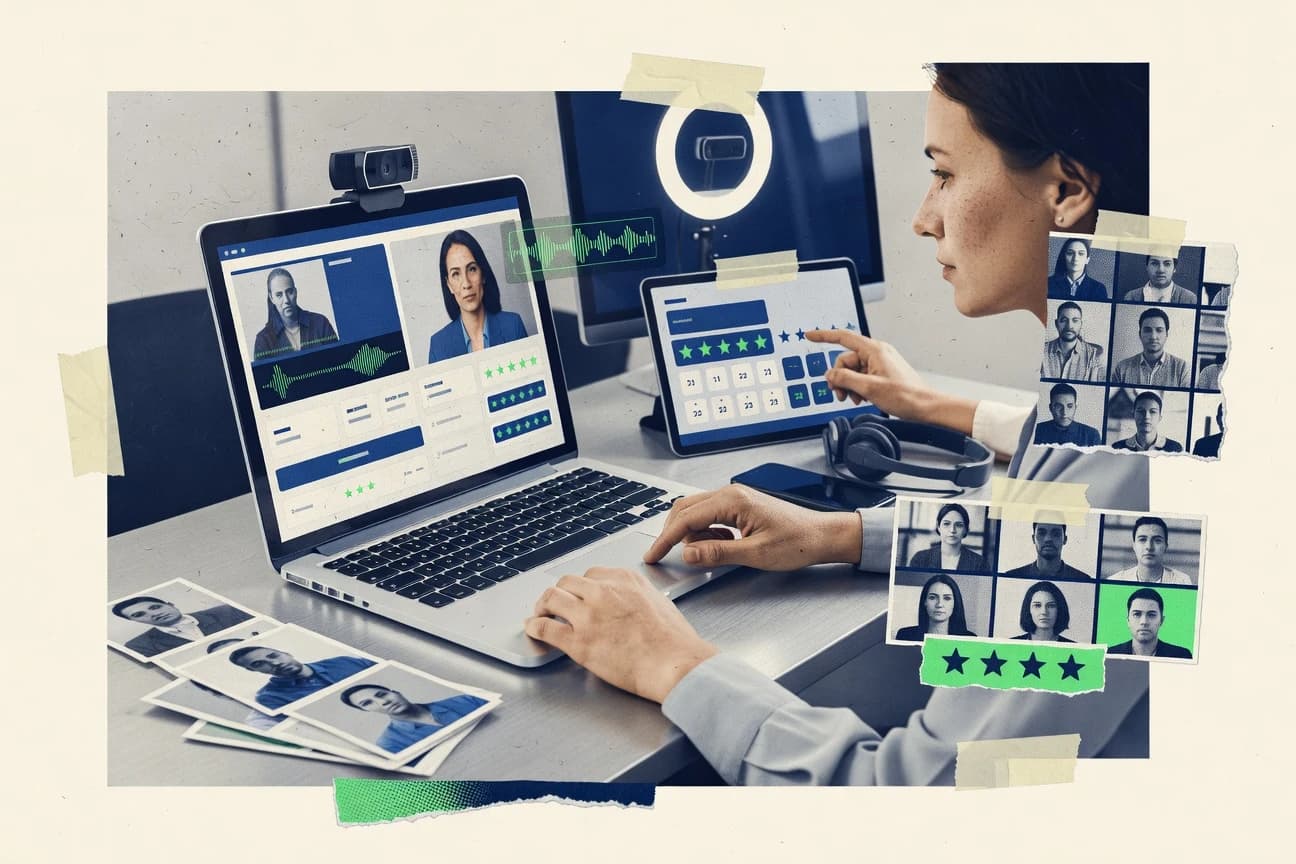
Digital interviewing software replaces paper scorecards and scheduling-heavy calls with structured interview workflows that capture candidate video and screen evidence. This guide covers Talview, HireVue, and VidCruiter first for rubric-led asynchronous scoring, then it includes Jobma, Interviewstream, and several interview-kit platforms that emphasize different workflow shapes.
Teams evaluating this category can map each tool’s structured scorecard design, evidence capture layout, and workflow automation approach to hiring operations needs. The selection also contrasts tools that focus on rubric consistency and timeline framing with tools that target technical screens and automated evaluation for coding assessments like HackerRank and rubric-first builders like Vervoe.
Digital interviewing software for structured, evidence-captured interviews and rubric scoring
Digital interviewing software runs structured interview workflows that combine candidate video capture with scorecard rubric evaluation so reviewers can score behavioral competencies from captured evidence. Talview and HireVue both center rubric-driven scoring workflows that pair interviewer notes with each candidate response so evidence and ratings stay aligned.
In practice, these platforms orchestrate the full interview session timeline with guided prompts, timed questions, and standardized reviewer scoring across roles. VidCruiter adds an assessor-led structured flow that ties rubric scoring to a session timeline, while Interviewstream emphasizes an API-driven approach to automate role-specific workflow construction around competency-aligned scorecards.
Evidence-linked structured workflows and rubric scoring consistency
Structured interview workflow design matters because tools like Talview and HireVue tie reviewer scoring and interviewer notes to the specific candidate response moment inside the interview flow. When score inputs map tightly to captured evidence, teams reduce review drift across interviewers and across roles.
Evidence capture layout matters because some platforms combine candidate video capture with screen recording capture in the same session while others anchor scoring to an interview session timeline. This difference changes how hiring teams audit what was observed, what was scored, and which competency rubric each score supported.
Rubric-managed guided interview flows with calibrated notes
Talview pairs rubric scoring with guided interview instructions and collects calibrated notes alongside each candidate response. HireVue uses rubric-driven scoring workflows with interviewer notes designed for consistent behavioral evaluation across interview kits.
Session timeline framing for consistent asynchronous context
VidCruiter ties rubric scoring to an assessor-led structured flow with a session timeline to keep interviewer context consistent. This timeline framing reduces variability when reviewers evaluate captured responses out of band.
Workflow orchestration across async and live session formats
Jobma links candidate video capture with rubric scoring inside structured workflows that support both asynchronous and live interview formats. This lets hiring teams reuse rubric setup across formats while keeping evidence and scorecards aligned.
API-driven workflow automation and role-specific building blocks
Interviewstream is built around a role-specific structured interview workflow and positions automation through API-driven workflow construction. Interviewstream maps prompts to role competencies so workflow automation can generate structured scorecards at scale.
Time-sequenced rubric review and answer-moment scoring
Hireflix segments review tied to rubric questions so interviewers score specific answer moments instead of whole videos. Time-sequenced playback helps reviewers anchor notes to the targeted portion of the candidate recording.
Rubric-tagged evidence capture from prompts during structured flow
EasyHire builds rubric-tagged scoring directly into the structured interview workflow so interview prompts produce rubric evidence during capture. This approach targets consistent review layouts for mixed video and screen evidence in one session.
Decide based on workflow shape, evidence-to-score mapping, and automation surface
Teams should choose the workflow shape that matches how interviews run today, because Talview and HireVue emphasize rubric-driven scoring workflows that pair evidence capture with interviewer notes at scale. Platforms with timeline framing like VidCruiter optimize review consistency for asynchronous sessions that reviewers evaluate later.
Automation and integration surface changes operational fit, because Interviewstream highlights API-driven workflow automation and HireVue and Jobma emphasize structured workflows that align with hiring operations. The decision should also account for governance workload, since complex workflows require admin design effort across tools like Jobma and Interviewstream.
Match rubric scoring to how interviewers give behavioral evidence
If interviewers need calibrated notes captured alongside each candidate response, Talview and HireVue both center rubric-driven scoring paired with interviewer notes. If the process depends on keeping reviewers anchored to an interview session timeline, VidCruiter ties rubric scoring to a timeline-aware structured flow.
Pick evidence capture layout based on what reviewers must validate
If combined candidate video capture and screen recording capture must land inside one session flow, HireVue and EasyHire both support mixed video and screen evidence capture. If the team can accept evidence recorded without proctor-first emphasis, Wheely focuses on recorded evidence retention via a structured asynchronous question flow.
Choose between structured orchestration and answer-moment review granularity
If the hiring process needs workflow orchestration that links video capture with rubric scoring across async and live sessions, Jobma supports shared rubric setup across formats. If the team needs segmented rubric scoring tied to specific answer moments, Hireflix provides time-sequenced playback and question-level review segmentation.
Select an automation philosophy for role construction at scale
If automation needs to drive role-specific workflow construction, Interviewstream is built around a structured interview builder that maps prompts to role competencies. If the organization primarily runs high-volume technical screens, HackerRank shifts evaluation to automated scoring for coding assessments tied to interview templates rather than complex behavioral rubric mapping.
Plan governance effort for multi-stage and multi-role routing
If interview kits require complex workflow design and careful role setup, Jobma and Interviewstream both note governance discipline as a scaling requirement. If the selection must reduce admin workload for structured interviews, Talview and HireVue still require upfront rubric and workflow design but keep scoring consistency as a core workflow principle.
Who benefits from rubric-first digital interviewing software
Hiring teams benefit most when they run structured interviews where evidence capture and scoring must stay aligned across interviewers and across roles. Talview and HireVue support this alignment through rubric-driven workflows that collect interviewer notes and maintain consistent behavioral evaluation.
Teams that optimize for technical screening throughput or lighter proctoring requirements also have distinct fit. HackerRank targets automated evaluation for coding assessments while Wheely and Vervoe emphasize asynchronous rubric-linked interviews without placing proctoring controls at the center.
Hiring operations teams running evidence-captured behavioral interviews at scale
Talview is built for rubric-managed guided interview flows that collect calibrated notes alongside each candidate response, which supports consistent evidence review at scale.
Large recruiting programs standardizing asynchronous scoring across interview kits
HireVue pairs rubric-driven scoring workflows with candidate video capture and screen recording capture in one session so reviewers score consistent evidence across standardized role kits.
Recruiting teams that need structured asynchronous interviews with rubric context anchored over time
VidCruiter ties rubric scoring to an assessor-led structured flow with a session timeline, which keeps interviewer context consistent when reviewing recorded sessions.
Organizations building role-specific interview automation and competency-aligned scorecards via workflow tooling
Interviewstream focuses on a role-specific structured interview workflow that binds prompts to competency-aligned scorecards and supports API-driven workflow automation.
Teams prioritizing standardized asynchronous coding screens over live proctoring controls
HackerRank centers automated evaluation for coding assessments tied to interview templates, and it is not positioned as the core focus for live proctoring or remote online proctoring controls.
Common failure modes when buying digital interviewing software
A common mistake is assuming rubric consistency happens automatically without upfront design work. Rubrics require upfront design to avoid noisy scoring in Talview, and advanced governance setup is necessary to scale workflow controls cleanly in tools like Jobma and Interviewstream.
Another mistake is choosing a tool without aligning evidence capture needs to the reviewer workflow. Platforms that emphasize timeline framing or answer-moment segmentation change how reviewers anchor notes, and tools that de-emphasize proctoring coverage can create gaps if candidate identity verification requirements are strict.
Buying for rubric scoring and then skipping rubric and workflow setup
Talview’s rubric-managed scoring can produce noisy results if rubrics are not designed upfront, so rubric design time must be planned before rollout.
Treating complex multi-stage interview routing as configuration-free
Jobma and Interviewstream both require workflow design upfront for complex multi-stage routing, so governance discipline must be resourced before expanding interview kits.
Assuming live session governance and proctoring depth match across vendors
Wheely and HackerRank do not center live proctoring and remote online proctoring controls, so identity verification and proctor-first coverage requirements need an explicit fit check.
Letting reviewers score entire videos when rubric moments must be isolated
Hireflix is built to segment review tied to rubric questions so interviewers score specific answer moments, which means a whole-video scoring workflow can undermine rubric evidence alignment.
How We Selected and Ranked These Tools
We evaluated Talview, HireVue, and VidCruiter first for rubric-managed structured workflows that keep scoring aligned to captured candidate evidence. Features carried 40% of the weighting because rubric scoring workflows, guided interview flows, and evidence capture layouts determine whether reviewers evaluate consistent material.
Ease and value each carried 30% to reflect how much admin time is required for template configuration, workflow setup, and governance-heavy rollouts. Talview ranked first because rubric-managed guided interview flows collect calibrated notes alongside each candidate response, which directly ties behavioral scoring consistency to captured evidence at scale.
Frequently Asked Questions About digital interviewing software
How do Talview and Jobma structure an interview workflow so prompts, scorecards, and session timelines stay aligned?
What breaks if an organization needs rubric scoring plus evidence from both webcam and screen recording in the same interview session?
Which tool supports SSO via SAML 2.0 and OAuth 2.0 for centralized access control?
How do HireVue and Interviewstream handle identity and consent capture in the candidate flow?
When is VidCruiter a better fit than Talview for consistent scoring across a panel workflow?
What integration approach is typically required for API-first workflow automation in tools like Interviewstream and Jobma?
How do HackerRank and Vervoe differ when the main requirement is standardized assessments with automation versus video interview standardization?
Where does Hireflix fall short compared with Talview when teams need workflow orchestration across both async and live formats?
How do admins configure interview templates and RBAC-style access controls in Interviewstream and Hireflix?
Tools reviewed
Primary sources checked during evaluation.
Referenced in the comparison table and product reviews above.
- HR In IndustryTop 10 Best Video Interviewing Software of 2026
- Technology Digital MediaTop 10 Best User Interview Software of 2026
- HR In IndustryTop 10 Best Digital Employee Onboarding Software of 2026
- HR In IndustryTop 10 Best Automated Interview Software of 2026
- Customer Experience In IndustryTop 10 Best Digital Engagement Software of 2026
Keep exploring
Comparing two specific tools?
Software Alternatives
See head-to-head software comparisons with feature breakdowns, pricing, and our recommendation for each use case.
Explore software alternatives→In this category
HR In Industry alternatives
See side-by-side comparisons of hr in industry tools and pick the right one for your stack.
Compare hr in industry tools→