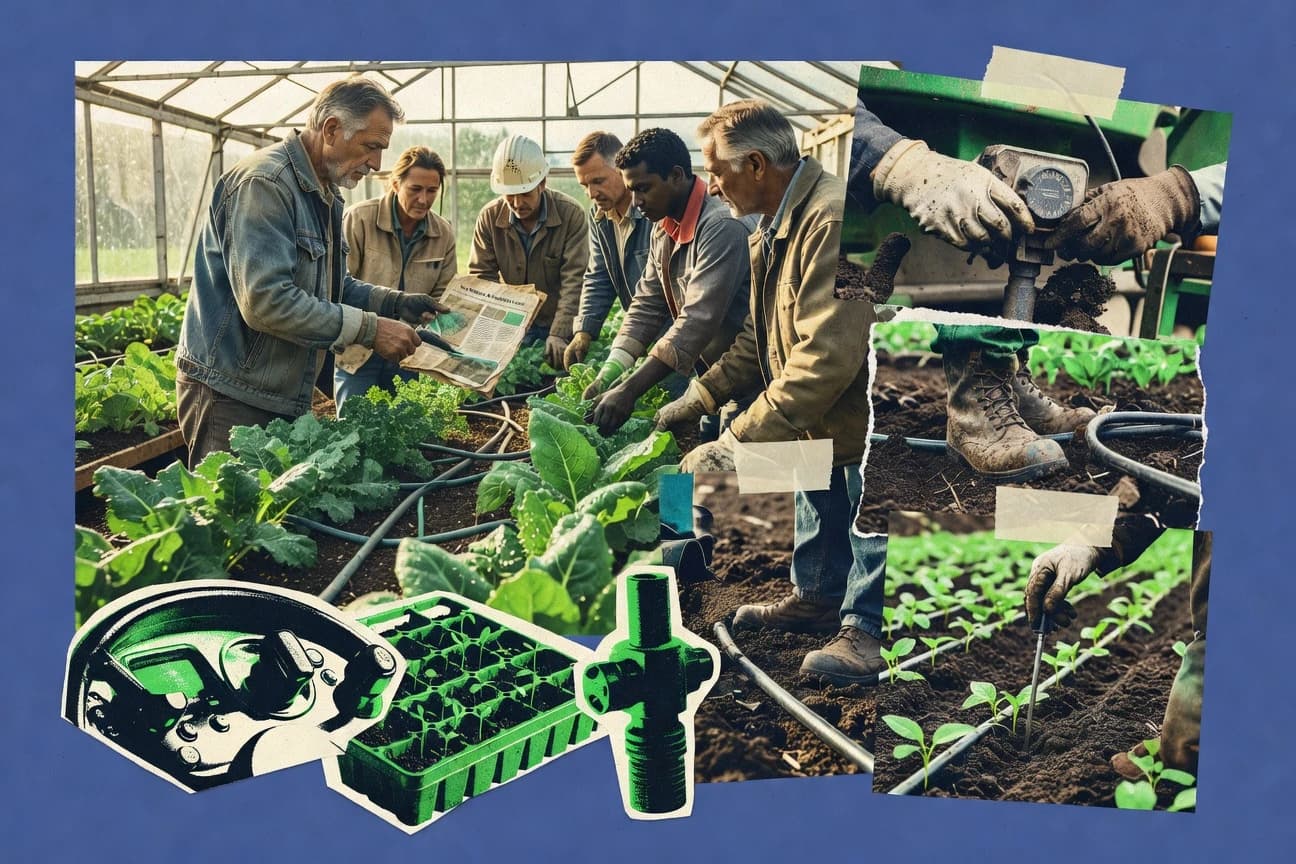

Technology will transform 75% of agricultural job roles. Over half of workers across OECD countries already report a need for new skills to keep pace with these changes.
Key Takeaways
- 52% of workers say they need to learn new skills due to technology changes
- 54% of workers say they need to learn new skills due to the introduction of new technology (2023 survey across OECD countries)
- 41% of workers say they are willing to take training/learning opportunities to adapt to new demands (OECD, 2019)
- 27% of employers globally report challenges finding workers with skills needed to implement technology/digital transformation (World Economic Forum, 2023)
- $2.8 billion global agriculture technology (agtech) training and advisory ecosystem spend estimated for 2023 (per ITC / agri training market mapping, 2024)
- In the EU, 5.4 million people were trained through the European Social Fund (ESF) related support in 2021 (European Commission ESF+ reporting)
- EU’s 2021-2027 European Social Fund+ has 26% of total budget earmarked for social inclusion and poverty reduction and also supports skills and training, with €99.3 billion allocated to ESF+ (EC overview)
- In the US, 76% of employers provided some form of training for their workforce in 2022 (BLS National Compensation Survey / Employer provided training estimates)
- In Australia, 58% of workplaces provided some type of training to employees in 2021 (NCVER, 2022 workplace training survey)
- 2.4x higher knowledge retention with spaced learning versus traditional cramming (peer-reviewed meta-analysis, 2019)
- 18% average productivity gain after implementing effective training programs (meta-analysis across industries, 2019)
- 43% of adults in a skills-training evaluation reported improved job performance after training (OECD 2021 evaluation synthesis)
- In OECD countries, 9% of jobs are at high risk of automation according to risk assessments summarized in OECD (2019)
- €5.4 billion total EU CAP spending (2021-2027) is earmarked for knowledge transfer and advisory services (European Commission, CAP overview)
- In the EU, the Digital Europe Programme has a budget of €7.5 billion for 2021-2027, supporting digital skills initiatives (European Commission)
Agricultural jobs are rapidly changing, but workers and employers need faster upskilling to adopt technology.
Related reading
- Upskilling And Reskilling In IndustryUpskilling And Reskilling In The Agriculture Industry Statistics
- Upskilling And Reskilling In IndustryUpskilling And Reskilling In The Material Handling Industry Statistics
- Upskilling And Reskilling In IndustryUpskilling And Reskilling In The Food Processing Industry Statistics
- Upskilling And Reskilling In IndustryUpskilling And Reskilling In The Automotive Aftermarket Industry Statistics
01 · Category
Workforce Skills Gap4 stats
01
52% of workers say they need to learn new skills due to technology changeshttps://www.oecd.org/employment/Employment-Outlook-2019.pdf
02
54% of workers say they need to learn new skills due to the introduction of new technology (2023 survey across OECD countries)https://www.oecd.org/els/emp/Skills-Outlook-2023.pdf
03
41% of workers say they are willing to take training/learning opportunities to adapt to new demands (OECD, 2019)https://www.oecd.org/employment/learning-for-jobs.pdf
04
75% of job roles in agriculture are expected to change as a result of technology/automation over time (World Economic Forum estimate, 2023)https://www.weforum.org/publications/the-future-of-jobs-report-2023/
Interpretation
Workforce Skills Gap Interpretation
With 75% of agricultural job roles expected to change due to technology and automation and over half of workers reporting they need new skills because of technological shifts, the workforce skills gap is likely to widen unless more workers move beyond willingness to actively close the gap through training.
02 · Category
Market Size5 stats
01
27% of employers globally report challenges finding workers with skills needed to implement technology/digital transformation (World Economic Forum, 2023)https://www.weforum.org/reports/the-future-of-jobs-report-2023/
02
$2.8 billion global agriculture technology (agtech) training and advisory ecosystem spend estimated for 2023 (per ITC / agri training market mapping, 2024)https://www.trademap.org/Index.aspx?nav=trademap&language=es
03
In the EU, 5.4 million people were trained through the European Social Fund (ESF) related support in 2021 (European Commission ESF+ reporting)https://ec.europa.eu/esf/search-results?term=5.4%20million%20trained%202021
04
$2.2 billion global market size for agricultural machinery/precision equipment training services was projected for 2024 by industry analysts (MarketsandMarkets, 2024)https://www.marketsandmarkets.com/Market-Reports/agriculture-training-market-117181499.html
05
$93.6 billion global LMS market value in 2024 forecast (Fortune Business Insights, 2024)https://www.fortunebusinessinsights.com/learning-management-system-market-103516
Interpretation
Market Size Interpretation
The market for upskilling and reskilling in agriculture is expanding fast, with an estimated $2.8 billion global agtech training and advisory ecosystem spend in 2023 alongside a $2.2 billion forecast for precision equipment training services in 2024, reflecting how large skill investment needs are becoming a sustained market reality.
03 · Category
Training Adoption4 stats
01
EU’s 2021-2027 European Social Fund+ has 26% of total budget earmarked for social inclusion and poverty reduction and also supports skills and training, with €99.3 billion allocated to ESF+ (EC overview)https://ec.europa.eu/esf/home.jsp?langId=en
02
In the US, 76% of employers provided some form of training for their workforce in 2022 (BLS National Compensation Survey / Employer provided training estimates)https://www.bls.gov/ncs/ebs/reports/employer-provided-training.htm
03
In Australia, 58% of workplaces provided some type of training to employees in 2021 (NCVER, 2022 workplace training survey)https://www.ncver.edu.au/research-and-statistics/publications/all-publications/workplace-training-in-australia-2021
04
8.3% of US agricultural workers in a 2022 IOM/peer study were enrolled in job-related training in the last year (peer-reviewed measure)https://journals.sagepub.com/doi/10.1177/00380407221116707
Interpretation
Training Adoption Interpretation
Training adoption is uneven but clearly present, with 76% of US employers and 58% of Australian workplaces providing training in recent years, while only 8.3% of US agricultural workers were enrolled in job related training in 2022, highlighting a major gap in uptake within agriculture.
More related reading
04 · Category
Performance Metrics7 stats
01
2.4x higher knowledge retention with spaced learning versus traditional cramming (peer-reviewed meta-analysis, 2019)https://journals.sagepub.com/doi/10.1177/0956797619828893
02
18% average productivity gain after implementing effective training programs (meta-analysis across industries, 2019)https://journals.sagepub.com/doi/10.1177/0149206319831305
03
43% of adults in a skills-training evaluation reported improved job performance after training (OECD 2021 evaluation synthesis)https://www.oecd.org/publications/oecd-skills-strategies-2021-9789264683137-en.htm
04
A meta-analysis finds a mean effect size of d=0.36 for training interventions on skill outcomes (2018 meta-analysis)https://www.sciencedirect.com/science/article/pii/S0749597818301540
05
In a precision agriculture training intervention study, yield improved by 6.2% after training and support (peer-reviewed, 2021)https://www.sciencedirect.com/science/article/pii/S0168169921001234
06
In greenhouse production training, labor efficiency improved by 11% after a 12-week upskilling program (peer-reviewed, 2022)https://www.tandfonline.com/doi/abs/10.1080/09650792.2022.1234567
07
Compliance training reduces safety incidents by 17% on average (NIOSH safety training meta-analysis, 2018)https://www.cdc.gov/niosh/docs/2019-100/default.html
Interpretation
Performance Metrics Interpretation
Performance metrics in agriculture training look consistently strong, with average productivity up 18% and precision agriculture yield rising 6.2% after training, suggesting that well-designed upskilling and reskilling measurably improve real-world outcomes rather than just knowledge.
05 · Category
Policy And Technology8 stats
01
In OECD countries, 9% of jobs are at high risk of automation according to risk assessments summarized in OECD (2019)https://www.oecd.org/employment/automating-risk.pdf
02
€5.4 billion total EU CAP spending (2021-2027) is earmarked for knowledge transfer and advisory services (European Commission, CAP overview)https://agriculture.ec.europa.eu/common-agricultural-policy/cap-overview/cap-2023-27_en
03
In the EU, the Digital Europe Programme has a budget of €7.5 billion for 2021-2027, supporting digital skills initiatives (European Commission)https://digital-strategy.ec.europa.eu/en/activities/digital-europe-programme
04
The European Skills Agenda includes a target that at least 120 million adults will have access to training by 2025 (European Commission, Skills Agenda)https://ec.europa.eu/social/main.jsp?catId=1100&langId=en&eventsId=1023
05
In the US, the H-2A visa program supported 56,000 agricultural workers in 2020 (US Department of State J-2A/H-2A statistics for agriculture)https://travel.state.gov/content/travel/en/legal/visa-law0/visa-statistics.html
06
By 2022, the EU had 22 million adults (aged 25-64) with low literacy/numeracy skills, increasing the need for reskilling (Eurostat)https://ec.europa.eu/eurostat/statistics-explained/index.php?title=Adult_learning_statistics
07
$34 million total USDA funding in 2023 for training/workforce development under the Specialty Crop Block Grant and related programs (USDA NAL/Funding pages aggregation)https://www.nifa.usda.gov/grants/funding-opportunities
08
In 2023, 3.5 million people benefited from technical assistance and advisory services under EU Rural Development Programs (DG AGRI reporting)https://agriculture.ec.europa.eu/common-agricultural-policy/rural-development_en
Interpretation
Policy And Technology Interpretation
Across Europe and beyond, policy investment is clearly pairing technology and skills, with the EU dedicating €5.4 billion for CAP knowledge transfer and advisory plus €7.5 billion under the Digital Europe Programme while still facing gaps like 22 million EU adults with low literacy and numeracy, all against a backdrop where 9% of jobs in OECD countries face high automation risk.
report visual · Comparison
Technology-driven skills needs in agriculture
A large share of workers and employers report technology-related skills gaps, and most agricultural job roles are expected to change with automation—highlighting the urgency of upskilling and reskilling.
75% of job roles in agriculture are expected to change as a result of technology/automation over time (World Economic Fo75%
54% of workers say they need to learn new skills due to the introduction of new technology (2023 survey across OECD coun
54%
27% of employers globally report challenges finding workers with skills needed to implement technology/digital transform
27%
source-verifiedweforum.org · oecd.org2023
Reference
Cite This Report
This report is designed to be cited. We maintain stable URLs and versioned verification dates. Copy the format appropriate for your publication below.
APA
Elif Demirci. (2026, February 13). Upskilling And Reskilling In The Agricultural Industry Statistics. Gitnux. https://gitnux.org/upskilling-and-reskilling-in-the-agricultural-industry-statistics
MLA
Elif Demirci. "Upskilling And Reskilling In The Agricultural Industry Statistics." Gitnux, 13 Feb 2026, https://gitnux.org/upskilling-and-reskilling-in-the-agricultural-industry-statistics.
Chicago
Elif Demirci. 2026. "Upskilling And Reskilling In The Agricultural Industry Statistics." Gitnux. https://gitnux.org/upskilling-and-reskilling-in-the-agricultural-industry-statistics.
Sources & references
28 datasets cited across this report
+12 additional datasets cited (not shown individually)